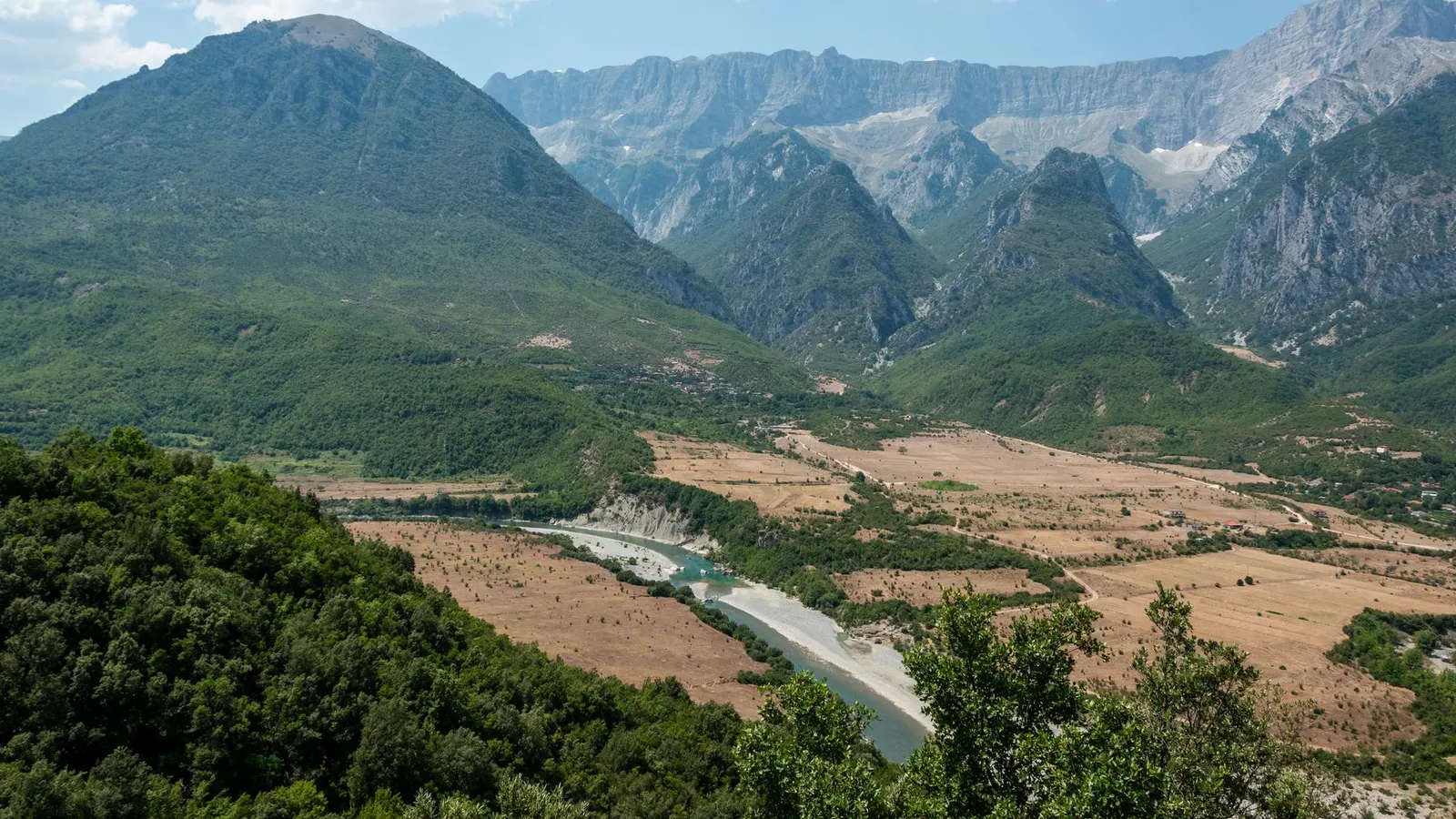
 Elona Agug · Pexels License
Country Guide № 002 / 194 · Europe
Albania
The Accursed Mountains, an Ionian coast and forty years of isolation still visible.
“The Accursed Mountains, an Ionian coast and forty years of isolation still visible.”
Albania spent forty years under one of the most isolated regimes in Europe, which ended in 1991 and left behind hundreds of thousands of concrete bunkers, a country with almost no tourism infrastructure, and - inadvertently - a coastline and mountain interior that escaped the development that reshaped its neighbours. That has been changing fast since about 2018.
The draws are specific and strong: the Accursed Mountains in the north with the Valbona to Theth walk and the Koman ferry that reaches them, the Ottoman stone towns of Berat and Gjirokastër, the Vjosa river - one of the last wild rivers in Europe, now a national park - and the Ionian coast from Himarë to Ksamil. Prices are the lowest in Europe and the food is better than anyone expects.
Chapter 01
Highlights
Valbona to Theth
A day's walk over a 1,800-metre pass between two valleys in the Accursed Mountains, with guesthouses at each end. Reached via the Koman ferry, which is itself one of the best boat journeys in Europe.
Berat and Gjirokastër
Two UNESCO-listed Ottoman towns - Berat the city of a thousand windows stacked up a hillside, Gjirokastër built of grey stone with fortified houses. Both worth a night.
The Albanian Riviera
The Ionian coast from Himarë south to Ksamil, with clear water, small beaches under the Llogara pass, and Butrint's Greek and Roman ruins at the far end.
The Vjosa
One of the last free-flowing wild rivers in Europe, declared a national park in 2023 after a long campaign against damming. Rafting, kayaking and a genuinely intact river ecosystem.
Chapter 02
Entry requirements for Albania
Checking your passport…
up to 360 days · free entry
360 days on arrival
Before you fly
The detail
- Maximum stay
- up to 360 days
- Fee
- free entry
- Passport validity
- Most destinations want validity beyond your stay, and some want six months. Check yours against the return date.
- Onward travel
- Airlines may ask for a return or onward ticket at check-in.
- Health
- No vaccinations required. Healthcare is limited outside Tirana and private clinics there are the practical option; insurance with evacuation cover matters more here than in neighbouring EU countries. Tap water is not reliably drinkable - use bottled. Sun and heat on the coast in summer are significant.
- Money
- Lek, cash-dominant. ATMs in towns; carry enough for the mountains, where there are none. Cards work in Tirana and larger hotels only. Prices are quoted in both old and new lek in some places - an old-lek figure is ten times the new one, and if a price sounds absurd that is usually why. Tipping is rounding up.
Albania asks nothing of a United States passport, and then asks nothing of it for an unusually long time: up to 360 days without a visa, effectively a year, which is one of the longest allowances any country grants an American visitor and four times what most of Europe gives. Albania is not in the Schengen area and keeps its own count. Days spent here do not come out of the Schengen allowance of 90 days in any rolling 180, and days already spent in the Schengen area do not come out of what you are allowed here. The Schengen window rolls, so time spent outside the area restores it day for day. It is why the western Balkans are where a long European itinerary buys itself room: a visitor who has nearly exhausted a rolling Schengen window can cross into Albania and let it recover while they travel. Treat the 360 as a year from the day you arrive rather than as a figure to test at the margin; staying beyond it is a residence matter handled by the police rather than an extension granted at a desk, and an overstay is charged as a fine on the way out. The passport should be valid three months beyond the day you intend to leave. The ten-year issue-date rule that catches British travellers at Schengen borders does not apply here - it is a Schengen Borders Code condition and Albania applies its own rules. Land crossings from Montenegro, Kosovo, North Macedonia and Greece are routine and take minutes outside the August peak; coming in from Greece you are leaving the Schengen area, which is the moment the Schengen count stops and this one starts. Albania has repeatedly extended visa-free access to further nationalities for a summer season, so a companion on a third passport is worth rechecking close to the date rather than from an older account.
Check another destination with this passport →
Entry details: Editorial synthesis - Albanian Ministry for Europe and Foreign Affairs visa policy, State Police border guidance (2025–2026) · compiled 18 Sept 2026
Who needs a visa for Albania
12 common passports| Passport | Requirement | Stay | Process |
|---|---|---|---|
| United States | Visa-free | up to 360 days | No process · €0 / $0 |
| United Kingdom | Visa-free | up to 90 days | No process · €0 / $0 |
| Germany | Visa-free | up to 90 days | No process · €0 / $0 |
| India | e-Visa | - | No Other passports record yet |
| China | Visa-free | up to 90 days | No Other passports record yet |
| Brazil | Visa-free | up to 90 days | No Other passports record yet |
| Nigeria | e-Visa | - | No Other passports record yet |
| Indonesia | Visa-free | - | No Other passports record yet |
| Philippines | e-Visa | - | No Other passports record yet |
| Vietnam | e-Visa | - | No Other passports record yet |
| Egypt | e-Visa | - | No Other passports record yet |
| Nepal | e-Visa | - | No Other passports record yet |
Holding a passport that is not listed? The picker above answers for any of them. See where your passport takes you. Source: Passport Index, updated 14 Aug 2026.
Chapter 03
When to go
BestMay–Jun, September. AvoidAugust, Nov–Feb.
Warm, green, and the coast opening - the best month.
The band above each month is our editorial verdict - it weighs crowds, prices and access as well as weather. The line is average daily temperature, the bars are monthly rainfall. Select a month for the figures. Climate figures: ERA5 reanalysis via Open-Meteo, 2005–2024 normals.
Chapter 04
What it costs
A day in Albania
Comfortable · sample day
≈ $54
Line items are real prices we track. The daily budget is an editorial estimate for this level, not their sum.
Where this sits among 244 countries we have costed
The Riviera doubles in July and August with domestic and Kosovar holiday demand and largely closes from November to April. The northern mountains have a June-to-September season and shut entirely outside it. Tirana is flat year-round. Albania remains the cheapest country in Europe, though the coast has been converging fast.
Updated Aug 2026 · Editorial synthesis - guesthouse and operator sampling, ferry tariffs, park entry prices (2025–2026) · confidence medium
Excludes international flights - they depend on where you fly from.
Chapter 05
Regions to know
5Tirana & the centre
The capital with its painted blocks and Bunk'Art museums, Kruja's castle and bazaar, and Durrës on the coast.
The northern Alps
The Accursed Mountains, the Koman ferry, and the Valbona to Theth crossing - the country's best walking.
The Ottoman towns
Berat and Gjirokastër, both UNESCO-listed, plus Apollonia's Greek ruins and the Osumi canyon.
The Riviera & the south
The Ionian coast from Llogara to Ksamil, Butrint's ruins, and the Blue Eye spring inland.
The east & the lakes
Lake Ohrid's Albanian shore at Pogradec, Korçë's bazaar and beer, and the Vjosa river valley.
Chapter 06
Practical guide
Getting there
Tirana (TIA) has grown fast and now takes low-cost flights from across Europe. Ferries run from Bari and Brindisi in Italy to Durrës and Vlorë, and from Corfu to Sarandë in about 30 minutes. Buses reach Kosovo, North Macedonia, Montenegro and Greece.
Getting around
Furgons - shared minibuses that leave when full from informal stands - are the backbone, plus larger intercity buses. There is essentially no useful passenger rail. A car gives far more freedom and the main roads are now good, though mountain roads are not. Coastal ferries link Himarë, Sarandë and Corfu. Timetables are informal; ask locally rather than trusting the internet.
Money & costs
Lek, cash-dominant. ATMs in towns; carry enough for the mountains, where there are none. Cards work in Tirana and larger hotels only. Prices are quoted in both old and new lek in some places - an old-lek figure is ten times the new one, and if a price sounds absurd that is usually why. Tipping is rounding up.
Safety
Low crime and strong hospitality traditions. The real risks are road conditions and driving standards, which are poor, and mountain terrain with limited rescue. Some remote areas still have unexploded ordnance and disused bunkers that should not be entered. Blood-feud traditions in the far north are a real historical phenomenon but do not involve visitors.
Health
No vaccinations required. Healthcare is limited outside Tirana and private clinics there are the practical option; insurance with evacuation cover matters more here than in neighbouring EU countries. Tap water is not reliably drinkable - use bottled. Sun and heat on the coast in summer are significant.
SIM & internet
Not in the EU, though the Western Balkans roaming zone and some EU operators now include it - check your plan. Local SIMs are very cheap. Coverage is good along the coast and in towns and patchy in the northern mountains. Wifi is standard in guesthouses.
Chapter 07
Driving
Driving standards are the country's main hazard - overtaking on blind bends is normal and rural roads carry livestock and unlit vehicles. Avoid driving at night outside the main corridors. A green card is needed for foreign vehicles and many EU rental agreements exclude Albania entirely.
Rules change - verify with an official source before you rent.
ExplWorld VerifiedNo verified partners here yet - all 6 country seats are open.
Become ExplWorld Verified →Chapter 08
Itineraries through this country
Chapter 09
From the Journal
Chapter 10
Before you go
AlbaniaChapter 11
Frequently asked questions
Is it safe?
Yes. The reputation for lawlessness dates from the 1990s and does not match the present. Crime against visitors is low, hospitality is a serious cultural obligation, and solo travel including for women is straightforward with normal precautions. The genuine hazards are the roads and, in remote mountains, thin rescue infrastructure.
How do I get to the northern mountains?
The classic route is a bus or furgon to Koman, the morning ferry up the reservoir to Fierzë - three hours through a gorge - then transport to Valbona, walk over to Theth, and out to Shkodër. It takes three or four days and needs booking in summer. The road to Theth is now paved, which has changed the valley considerably.
Do I need cash?
Yes, more than elsewhere. Cards work in Tirana and larger hotels and in very little else - mountain guesthouses, furgons, beach restaurants and small towns are cash. ATMs are available in towns and charge fees. Euros are accepted informally in tourist areas at a mediocre rate.