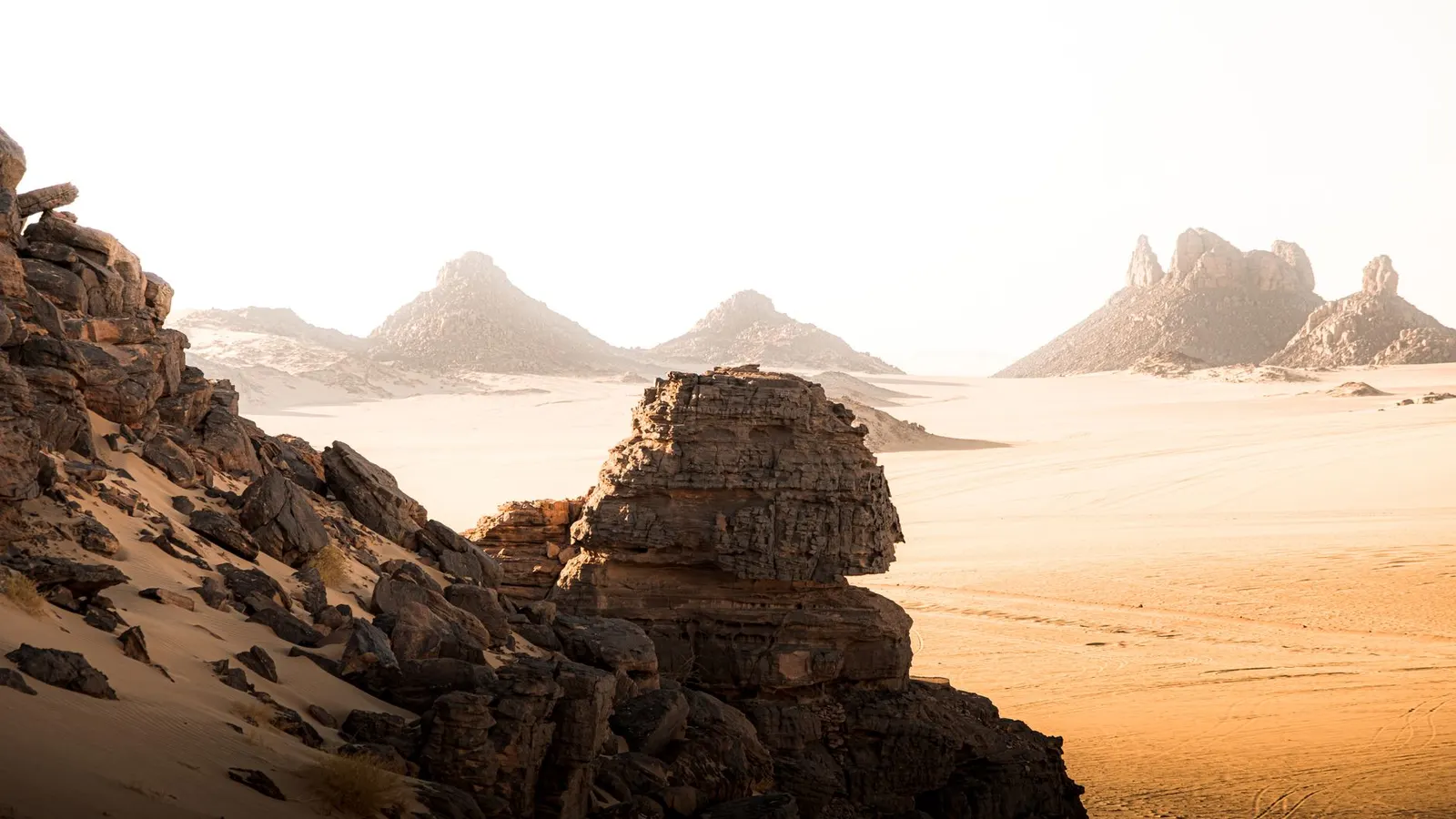
 raouf bedrani · Pexels License
Country Guide № 003 / 194 · Africa
Algeria
Africa's largest country - seven UNESCO sites, and almost nobody visiting them.
“Africa's largest country - seven UNESCO sites, and almost nobody visiting them.”
Algeria is the largest country in Africa and receives fewer visitors than almost any country of its size. Timgad and Djémila are Roman cities that survive more completely than most in Italy because nothing was built over them; the Casbah of Algiers drops down to the bay in a maze of Ottoman-era alleys; and 2,000 kilometres south, Tassili n'Ajjer holds thousands of rock paintings recording a Sahara that was once green savanna.
The country has been genuinely difficult to visit for decades - visas required a tour-operator invitation and were refused often. That has loosened: a visa on arrival scheme now exists for organised desert tours to the south, and the process for the north has become more predictable. It is still not independent travel in the usual sense. Come with an operator, allow time for paperwork, and expect a country almost untouched by tourism.
Chapter 01
Highlights
Timgad
A Roman colony founded by Trajan around AD 100 on a perfect grid, abandoned and buried by sand, and excavated almost complete - the arch, the forum, the library and 14 baths. There is nothing comparable still standing anywhere on the Mediterranean.
The Casbah of Algiers
The Ottoman citadel and old town tumbling down to the harbour, UNESCO-listed and partly crumbling. Go with a local guide: the alleys are genuinely disorienting and much of the interest is behind doors.
Tassili n'Ajjer
A sandstone plateau in the far southeast holding some 15,000 rock engravings and paintings spanning 12,000 years, recording elephants, giraffes and cattle herding in what is now hyper-arid desert. Multi-day trek with camels and guides.
Djémila and Tipaza
Two more Roman sites - Djémila in the mountains with mosaics still in place, and Tipaza on the coast where the ruins run down to the Mediterranean and Camus wrote about the light.
Chapter 02
Entry requirements for Algeria
Checking your passport…
up to 90 days · €85 / $92 · embassy application
90 days on arrival
Before you fly
The detail
- Maximum stay
- up to 90 days
- Process
- embassy application
- Fee
- €85 / $92
- Processing time
- Processing takes 10–40 days - apply with room to spare.
- Passport validity
- Most destinations want validity beyond your stay, and some want six months. Check yours against the return date.
- Onward travel
- Airlines may ask for a return or onward ticket at check-in.
- Health
- No malaria in the north; minimal risk in the far south. No vaccination requirements for arrivals from Europe. Health care in Algiers is adequate; in the desert you are far from everything, so evacuation insurance matters.
- Money
- Cash economy. Foreign cards do not work in practice. Bring euros; the gap between official and street rates is large enough to matter substantially to your budget. Keep receipts if you change officially.
A United States passport needs an Algerian visa arranged before travel, at an Algerian consulate, and there is no online route and nothing issued at Algiers airport - the northern half of the country has exactly one door and it is a consular one. The file wants a hotel booking for the whole stay or a letter of invitation from a host in Algeria, a detailed itinerary, proof of funds and a return ticket, and it is assessed rather than processed: refusals happen without an explanation and without the fee coming back, so build the application around a bookable-but-cancellable hotel rather than around flights you have already paid for. Ten working days is the optimistic figure and six weeks is the planning figure, longer over Ramadan and the summer. There is a second route and it is the one most visitors to the Sahara actually use: since 2023 a visa has been issued on arrival at Djanet and Tamanrasset to travellers on an organised desert tour, provided the licensed Algerian operator files the application in advance on your behalf - it is a scheme your operator opens for you, not a counter you can walk up to, and if nobody has filed anything you will not be admitted. A yellow fever certificate is asked of arrivals coming from a country where the disease is transmitted, rather than of everyone. The international rule counts a transit of more than twelve hours in such a country's airport as an arrival from it, so a long layover can bring the requirement to Algeria with it where a short connection does not - worth checking against your actual itinerary rather than against your departure country. Your passport should be valid six months. Two things about the trip itself belong in the same breath as the visa, because they shape it: the southern wilayas require an authorised guide and in places a police escort, and the frontier zones with Mali, Niger and Libya are closed to visitors. Algeria is also a cash economy in which foreign cards do not work in practice, so the money for the whole trip travels with you.
Check another destination with this passport →
Entry details: Editorial synthesis - Algerian Ministry of Foreign Affairs consular requirements, southern visa-on-arrival scheme for licensed operators (2025–2026) · compiled 18 Sept 2026
Who needs a visa for Algeria
12 common passports| Passport | Requirement | Stay | Process |
|---|---|---|---|
| United States | Visa required | - | Embassy visit · €85 / $92 · 10–40 d |
| United Kingdom | Visa required | - | Embassy visit · €85 / $92 · 10–40 d |
| Germany | Visa required | - | Embassy visit · €85 / $92 · 10–40 d |
| India | Visa required | - | Embassy visit · €85 / $92 · 10–40 d |
| China | Visa required | - | Embassy visit · €85 / $92 · 10–40 d |
| Brazil | Visa required | - | Embassy visit · €85 / $92 · 10–40 d |
| Nigeria | Visa required | - | Embassy visit · €85 / $92 · 10–40 d |
| Indonesia | Visa required | - | Embassy visit · €85 / $92 · 10–40 d |
| Philippines | Visa required | - | Embassy visit · €85 / $92 · 10–40 d |
| Vietnam | Visa required | - | Embassy visit · €85 / $92 · 10–40 d |
| Egypt | Visa required | - | Embassy visit · €85 / $92 · 10–40 d |
| Nepal | Visa required | - | Embassy visit · €85 / $92 · 10–40 d |
Holding a passport that is not listed? The picker above answers for any of them. See where your passport takes you. Source: Passport Index, updated 14 Aug 2026.
Chapter 03
When to go
BestMar–Apr, Oct–Nov. AvoidJun–Aug.
Spring in the north, comfortable in the desert.
The band above each month is our editorial verdict - it weighs crowds, prices and access as well as weather. The line is average daily temperature, the bars are monthly rainfall. Select a month for the figures. Climate figures: ERA5 reanalysis via Open-Meteo, 2005–2024 normals.
Chapter 04
What it costs
A day in Algeria
Comfortable · sample day
≈ $70
Line items are real prices we track. The daily budget is an editorial estimate for this level, not their sum.
Where this sits among 244 countries we have costed
Coastal hotels fill in July and August with domestic holidaymakers. Desert operators charge most from November to March, which is their only workable season.
Updated Aug 2026 · Editorial synthesis - operator tariffs and market sampling (2025–2026) · confidence low
Excludes international flights - they depend on where you fly from.
Chapter 05
Regions to know
5Algiers and the coast
The Casbah, the Bardo museum, Tipaza's seaside ruins and the beaches west towards Oran.
The eastern highlands
Constantine's gorge bridges, Timgad, Djémila and the Aurès mountains of the Chaouia Amazigh.
Kabylie
The Amazigh mountain heartland behind Algiers - Tizi Ouzou, Djurdjura national park and villages built along the ridgelines.
The M'Zab valley
Five fortified Ibadi towns around Ghardaïa, UNESCO-listed, whose architecture Le Corbusier studied. The gateway to the northern Sahara.
The deep Sahara
Tassili n'Ajjer's rock art from Djanet, the Hoggar volcanic peaks around Tamanrasset and the great sand seas between them.
Chapter 06
Practical guide
Getting there
Algiers Houari Boumediene is the main gateway, with Air Algérie, Air France, Turkish, Vueling and Iberia among others. Tunis is a common overland entry. Southern desert trips usually fly Algiers–Djanet or Algiers–Tamanrasset on Air Algérie or Tassili Airlines.
Getting around
SNTF trains link the northern cities along the coast and inland to Constantine. Long-distance buses are extensive and cheap. Domestic flights are the only sensible way to reach the Sahara. Vehicle and guide are arranged by operators in the south.
Money & costs
Cash economy. Foreign cards do not work in practice. Bring euros; the gap between official and street rates is large enough to matter substantially to your budget. Keep receipts if you change officially.
Safety
The north and the tourist south are calm. Border regions with Mali, Niger, Libya and parts of the Mauritanian frontier carry severe advisories and are off-limits. Police checkpoints are routine and frequent; carry your passport.
Health
No malaria in the north; minimal risk in the far south. No vaccination requirements for arrivals from Europe. Health care in Algiers is adequate; in the desert you are far from everything, so evacuation insurance matters.
SIM & internet
Djezzy, Mobilis and Ooredoo; tourist SIMs require passport registration. 4G in the north is good. The Sahara has coverage only in the towns.
Chapter 07
Driving
Self-drive in the north is possible but rental supply is thin. In the south it is not permitted without an authorised guide. Checkpoints are constant on inter-wilaya roads.
Rules change - verify with an official source before you rent.
ExplWorld VerifiedNo verified partners here yet - all 6 country seats are open.
Become ExplWorld Verified →Chapter 08
Itineraries through this country
Chapter 09
From the Journal
Chapter 10
Before you go
AlgeriaChapter 11
Frequently asked questions
How hard is the visa now?
Easier than it was, but not easy. Most nationalities still apply at an Algerian consulate with an invitation letter or a hotel booking, and processing can take weeks. Since 2023 a visa on arrival is available at the southern airports - Djanet and Tamanrasset - for travellers on an organised desert tour booked with a licensed Algerian operator. That route is now how most visitors see the Sahara.
Can I travel independently?
In the north, largely yes - trains and buses connect the coastal cities and the Roman sites, and hotels take walk-ins. In the south, no: the desert wilayas require a licensed guide and, in places, a police escort, and travel is organised through operators. The Sahel border zones with Mali, Niger and Libya are closed to visitors.
What about money?
Cash only, and there is a substantial parallel exchange rate - the unofficial rate has often been roughly double the bank rate, which changes the cost of the trip completely. International cards essentially do not work. Bring euros in cash and follow your operator's advice on changing them.