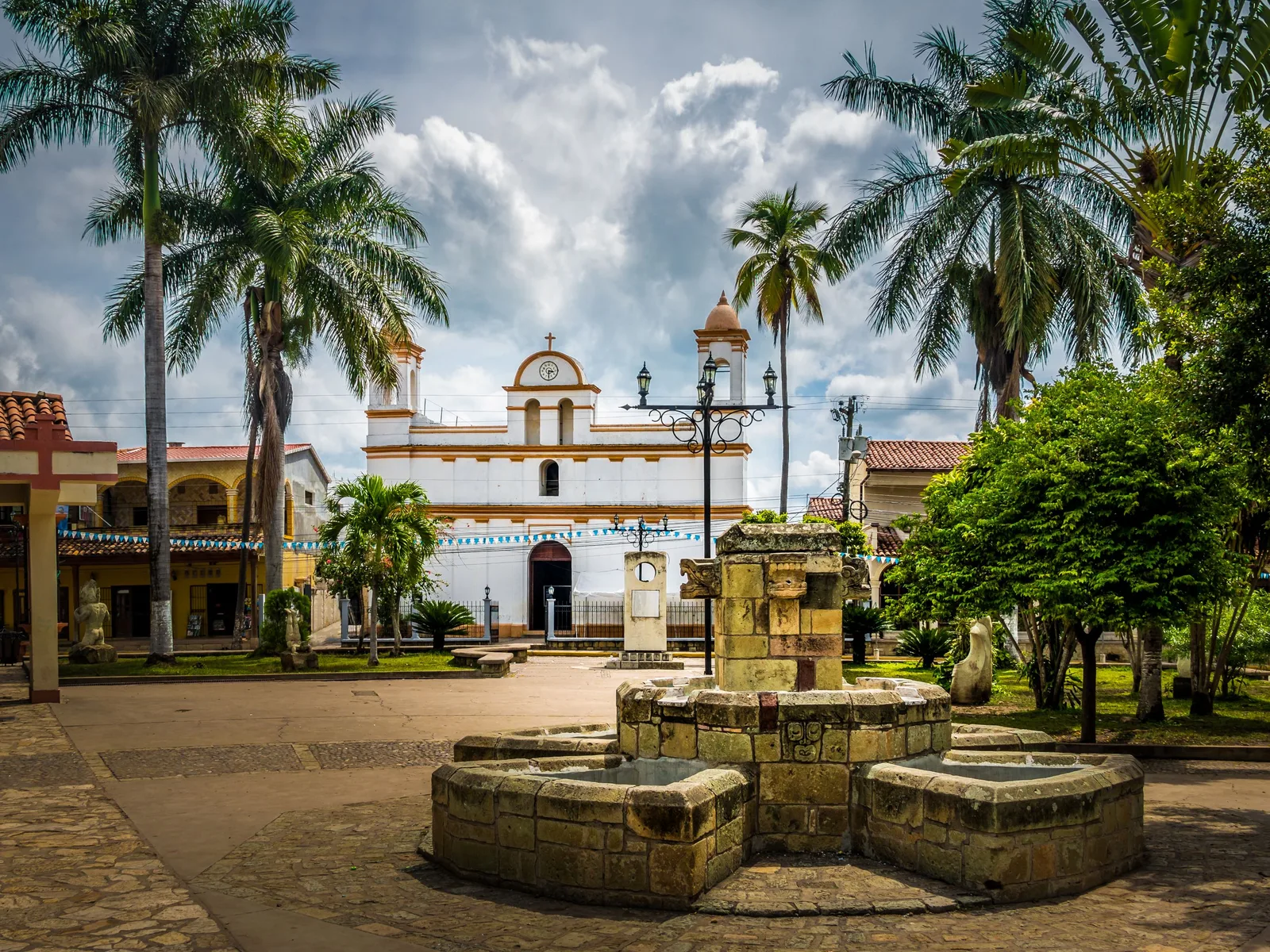
 diegograndi / stock.adobe.com
Country Guide № 073 / 194 · Central America
Honduras
The cheapest blue water in the world - dive the Bay Islands, then have Copán’s carvings to yourself.
“The cheapest blue water in the world - dive the Bay Islands, then have Copán’s carvings to yourself.”
Honduras suffers from the region’s worst press and hides some of its best assets: the Bay Islands sit on the Mesoamerican Reef with whale sharks cruising by, and Utila remains the cheapest respectable place on the planet to learn to dive. Inland, Copán’s sculpted stelae are the finest artistic achievement of the Maya world - visited by a fraction of Tikal’s numbers - and Lago de Yojoa’s coffee-and-birds micro-scene is the country’s best-kept secret.
The honest framing: mainland urban Honduras (San Pedro Sula, Tegucigalpa) has serious gang crime that deserves respect, and most travellers simply route around it - fly or coach straight to the coast, boat to the islands, shuttle to Copán. Do that, and the Honduras you actually experience is calm, cheap and disarmingly friendly. The gap between headline and itinerary is wider here than anywhere in the region.
Chapter 01
Highlights
Diving Utila
Open Water certifications for under €300 with dorm thrown in, whale sharks offshore in spring, and a backpacker dive culture like nowhere else.
Roatán’s reef
Wall dives minutes from shore on the Mesoamerican Reef, West Bay’s postcard beach, and direct international flights that skip the mainland entirely.
Copán ruins
The Paris of the Maya world - the Hieroglyphic Stairway carries the longest Maya text ever found, and scarlet macaws fly free over the plazas.
Lago de Yojoa
Honduras’s largest lake: 480+ bird species, the Pulhapanzak waterfall, and a microbrewery-guesthouse that anchors the whole scene.
Chapter 02
Entry requirements for Honduras
Checking your passport…
up to 90 days · free entry
90 days on arrival
Before you fly
The detail
- Maximum stay
- up to 90 days
- Fee
- free entry
- Passport validity
- Most destinations want validity beyond your stay, and some want six months. Check yours against the return date.
- Onward travel
- Airlines may ask for a return or onward ticket at check-in.
- Health
- No mandatory vaccinations; hepatitis A, typhoid and - for extended jungle or Mosquitia travel - malaria advice are the standards. Dengue is present in the lowlands. Water is bottled/filtered throughout. Utila and Roatán have hyperbaric chambers (the dive industry insists); mainland hospitals are basic outside San Pedro Sula - travel insurance with evacuation cover is not optional here.
- Money
- The lempira trades around 27 to the euro; the Bay Islands quote dive packages and much accommodation in US dollars - carry both and always confirm which currency a price is in. Cards work at dive shops and better hotels (3–5 % surcharge common); the mainland street economy is cash. ATMs are reliable in cities and on Roatán, scarcer on Utila - arrive with a cash buffer, and never count money in view.
No visa: a US passport is admitted for 90 days, and the most useful thing to know about that number is that it is not really Honduran. Honduras belongs to the CA-4 with Guatemala, El Salvador and Nicaragua, and the ninety days are ONE allowance shared across all four - crossing from Guatemala into Honduras does not restart the clock, the fortnight you spent in San Salvador counts against your Honduran stay, and an overstay is calculated on the bloc rather than on the country you happen to be standing in when somebody checks. Arriving at Roatán on an international flight is a CA-4 entry like any other, island or not. One extension of up to 90 days is applied for at the Instituto Nacional de Migración in Tegucigalpa; the only clean reset is leaving the four altogether - Belize, Mexico, Costa Rica or Panama - and officers generally expect about 72 hours outside the zone before you come back, so a few hours over the Guatemalan border and back does nothing at all. Land crossings collect a small entry charge of around US$3 in cash, so carry small notes and ask for the receipt. The onward ticket is checked at the airline desk rather than at the border, and six months of passport validity is what a check-in agent will want whatever the formal rule says.
Check another destination with this passport →
Entry details: Editorial synthesis - Instituto Nacional de Migración de Honduras, CA-4 Central America Border Control Agreement, Honduran Secretaría de Relaciones Exteriores (2025–2026) · compiled 18 Sept 2026
Who needs a visa for Honduras
12 common passports| Passport | Requirement | Stay | Process |
|---|---|---|---|
| United States | Visa-free | up to 90 days | No process · €0 / $0 |
| United Kingdom | Visa required | - | Not this passport's route |
| Germany | Visa-free | up to 90 days | No process · €0 / $0 |
| India | Visa required | - | No Other passports record yet |
| China | Visa required | - | No Other passports record yet |
| Brazil | Visa-free | up to 90 days | No Other passports record yet |
| Nigeria | Visa required | - | No Other passports record yet |
| Indonesia | Visa required | - | No Other passports record yet |
| Philippines | Visa required | - | No Other passports record yet |
| Vietnam | Visa required | - | No Other passports record yet |
| Egypt | Visa required | - | No Other passports record yet |
| Nepal | Visa required | - | No Other passports record yet |
Holding a passport that is not listed? The picker above answers for any of them. See where your passport takes you. Source: Passport Index, updated 14 Aug 2026.
Chapter 03
When to go
BestJan–May.
Interior dry and cool; islands still catching tail-end rains.
The band above each month is our editorial verdict - it weighs crowds, prices and access as well as weather. The line is average daily temperature, the bars are monthly rainfall. Select a month for the figures. Climate figures: ERA5 reanalysis via Open-Meteo, 2005–2024 normals.
Chapter 04
What it costs
A day in Honduras
Comfortable · sample day
≈ $54
Line items are real prices we track. The daily budget is an editorial estimate for this level, not their sum.
Where this sits among 244 countries we have costed
Island accommodation and dive packages barely move seasonally - Utila competes on price year-round; the visible bump is Semana Santa and Christmas–New Year (20–30 % on rooms, book ferries ahead). The mainland circuit (Copán, Yojoa) discounts modestly in the September–October rains. USD pricing on the islands adds a quiet premium over the lempira mainland.
Updated Aug 2026 · Editorial synthesis - Budget Your Trip, hostel and tour operator price lists, regional backpacker cost guides (2025–2026) · confidence medium
Excludes international flights - they depend on where you fly from.
Chapter 05
Regions to know
5The Bay Islands
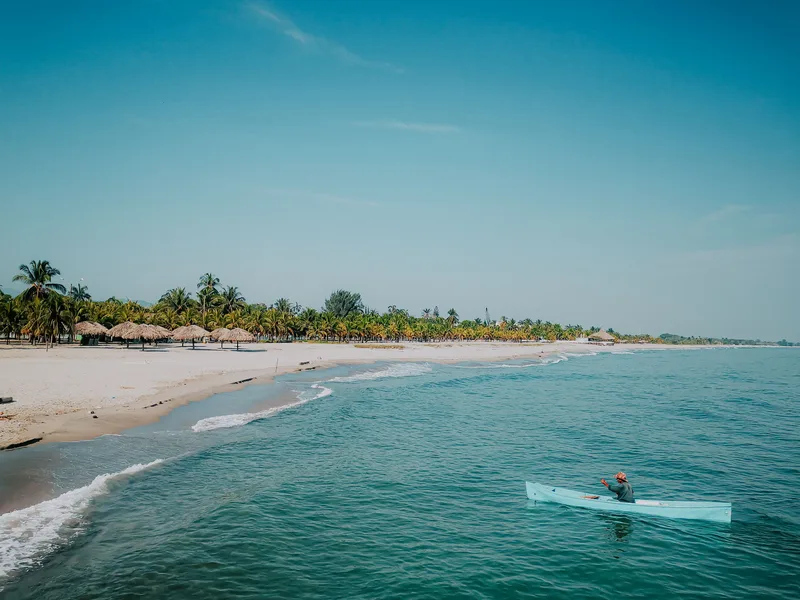
Utila for budget diving and backpacker nightlife, Roatán for reef walls and West Bay sand, Guanaja for near-total solitude.
Copán
The Maya world’s finest sculpture in a valley of coffee farms and macaws, with the relaxed town of Copán Ruinas a ten-minute walk away.
Lago de Yojoa & the centre
Birding, waterfalls, coffee tours and a legendary lakeside microbrewery - the slow-travel stop between Copán and the coast.
La Ceiba & the north coast
The ferry gateway to the islands, with Pico Bonito’s rainforest lodges and Cangrejal River rafting in its backyard.
The Mosquitia
One of Central America’s last great wildernesses - the Río Plátano biosphere, reachable by expedition only. For the seriously prepared.
Chapter 06
Practical guide
Getting there
From Europe, one stop via a US hub or Madrid to San Pedro Sula (SAP) or straight to Roatán (RTB), which has direct US links (Miami, Houston, Dallas, Atlanta) and lets you skip the mainland entirely. Palmerola (XPL) near Comayagua is the newer capital-region gateway. Overland, comfortable coaches run from Guatemala City and Antigua shuttles serve Copán directly - the classic circuit enters at Copán and exits via the islands.
Getting around
Hedman Alas and similar first-class coaches link the main cities with airport-style security - use them over chicken buses for long mainland hauls. To the islands: Galaxy Wave ferries from La Ceiba to Roatán (75 min) and the Utila Dream to Utila (1 h), or cheap CM Airlines/Aerolíneas Sosa hops. On the islands, water taxis, scooters and golf carts do the work. Book coaches a day ahead in Semana Santa.
Money & costs
The lempira trades around 27 to the euro; the Bay Islands quote dive packages and much accommodation in US dollars - carry both and always confirm which currency a price is in. Cards work at dive shops and better hotels (3–5 % surcharge common); the mainland street economy is cash. ATMs are reliable in cities and on Roatán, scarcer on Utila - arrive with a cash buffer, and never count money in view.
Safety
Route around, not through: fly or first-class coach between hubs, daylight travel on the mainland, airport taxis in the cities. On the circuit itself the atmosphere relaxes completely - Copán and the islands police themselves through tourism economics. Standard kit: no visible phones on mainland streets, small cash split across pockets, and scooters ridden sober with helmets (the islands’ real accident source).
Health
No mandatory vaccinations; hepatitis A, typhoid and - for extended jungle or Mosquitia travel - malaria advice are the standards. Dengue is present in the lowlands. Water is bottled/filtered throughout. Utila and Roatán have hyperbaric chambers (the dive industry insists); mainland hospitals are basic outside San Pedro Sula - travel insurance with evacuation cover is not optional here.
SIM & internet
Tigo has the best coverage, Claro the competition; prepaid SIMs with ~10 GB run €8–10 (passport to register). Coverage is solid in cities, on the islands and along the north coast, patchy in the interior mountains and absent in the Mosquitia. Dive-shop wifi on Utila is decent by island standards - good enough for logging dives, not for video calls at peak evening hours.
Chapter 07
Driving
Most visitors sensibly do not drive on the mainland - coaches and flights cover the circuit. If you do: daylight only between cities, watch for unmarked speed bumps and livestock, and treat checkpoint soldiers with unhurried politeness. On Roatán and Utila, scooters and golf carts are the fleet.
Rules change - verify with an official source before you rent.
ExplWorld VerifiedNo verified partners here yet - all 6 country seats are open.
Become ExplWorld Verified →Chapter 08
Itineraries through this country
Chapter 09
From the Journal
Chapter 10
Before you go
HondurasChapter 11
Frequently asked questions
Is Honduras safe for travellers?
Two different countries share the name. The tourist circuit - the Bay Islands, Copán, Lago de Yojoa - runs on tourism and is broadly calm; islanders will tell you, accurately, that Utila’s biggest danger is a rented scooter. The big mainland cities are another matter: San Pedro Sula and Tegucigalpa have real gang violence, so transit them in daylight by airport taxi or first-class coach and don’t linger. Night buses and roadside stops are the pattern to avoid.
When is the best time to visit Honduras?
February to May is the sweet spot: the islands dry out after the October–January rains, visibility peaks for diving, and whale sharks pass Utila in March–April. The interior (Copán, Yojoa) is driest November to April. September–October bring hurricane-season risk on the coast, and October–December are the islands’ wettest months.
How much does a day in Honduras cost?
Around €50 ($54) per day mid-range - €20–25 for your half of a double, €12 for food, the rest for transport and entries. Backpackers on Utila manage on €27 ($29) with dorms and baleadas. Diving is the anomaly: at €35 a fun dive and under €300 for Open Water, it is among the world’s cheapest - budget dive packages separately from daily spend.