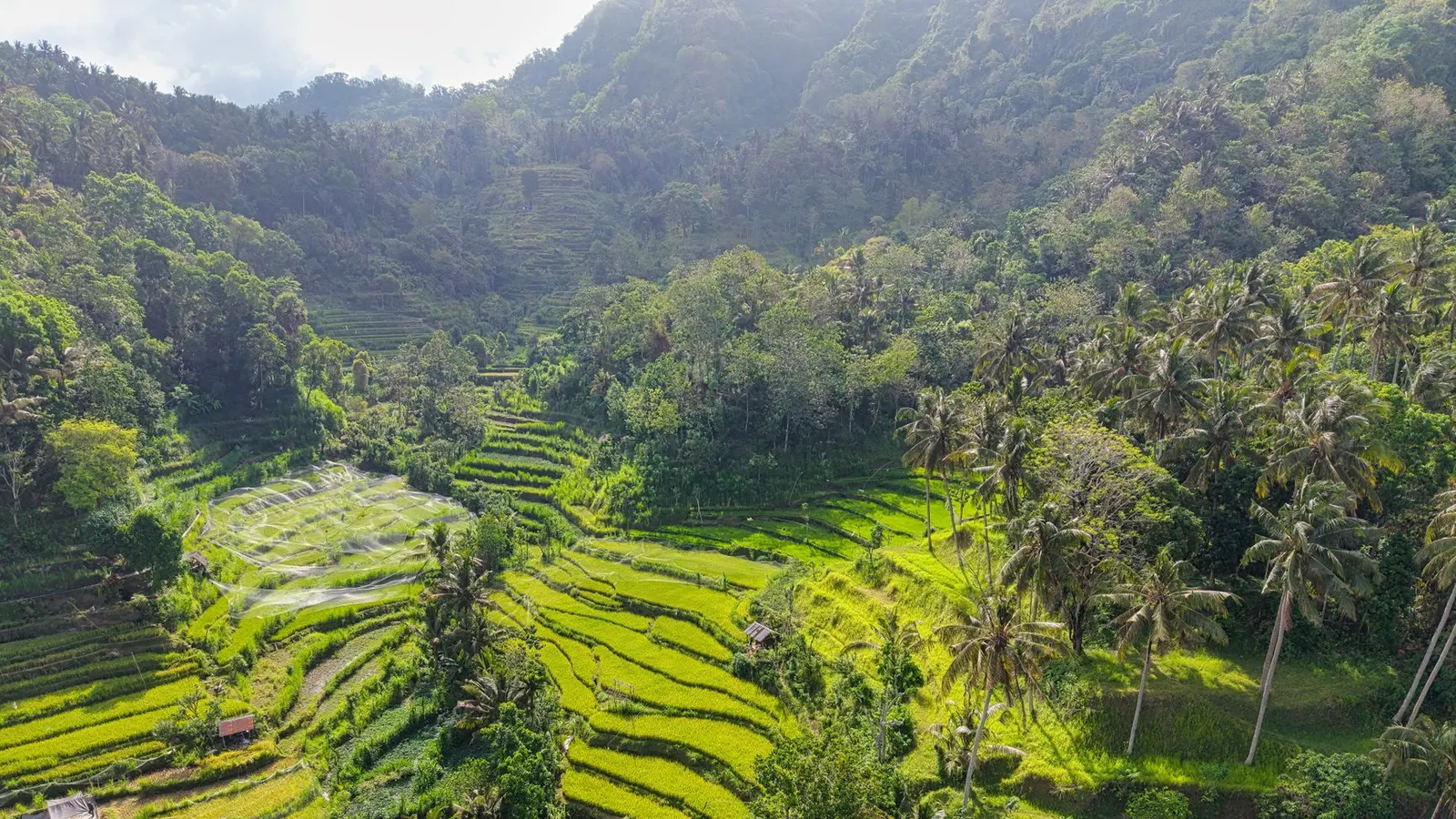
 Tom Fisk · Pexels License
Country Guide № 077 / 194 · Asia
Indonesia
Seventeen thousand islands, 700 languages, and one of them is Bali.
“Seventeen thousand islands, 700 languages, and one of them is Bali.”
Indonesia stretches 5,100 kilometres from Sumatra to Papua, further than London to Tehran, across seventeen thousand islands and three time zones. Treating it as one destination is the standard mistake. Bali is a Hindu island in a Muslim-majority country; Flores is Catholic; Papua is Melanesian. The food, the architecture and the pace change every time you get on a boat.
Bali earns its reputation and pays for it - the south is overdeveloped and the traffic is genuinely bad. Everything that made it famous still exists an hour north, and the islands beyond it are where the country opens up: Komodo's dragons and pink beaches, the Toraja highlands of Sulawesi, Sumatra's orangutans, and the volcanoes of Java, which is the most densely populated island on earth and still has empty craters at dawn.
Chapter 01
Highlights
Bromo and Ijen, East Java
A caldera of volcanic cones at sunrise and, further east, the blue sulphur flames and turquoise crater lake of Ijen. Both are pre-dawn starts and both are worth the alarm clock.
Komodo National Park
Dragons on Rinca and Komodo, manta rays at Manta Point and the pink beach at Padar. Best as a multi-day liveaboard from Labuan Bajo rather than a rushed day trip.
Tana Toraja, Sulawesi
Boat-shaped ancestral houses, cliff graves and elaborate multi-day funeral ceremonies that visitors may attend by invitation. Unlike anywhere else in Indonesia.
Raja Ampat
The richest reef biodiversity measured anywhere on earth, off the Papuan coast. Expensive and hard to reach, which is exactly why it is still in that condition.
Chapter 02
Entry requirements for Indonesia
Checking your passport…
up to 30 days · €30 / $32 · visa on arrival
30 days on arrival
Official portal only
Paid look-alike sites charge for a process that is free or cheap on the government portal. Use the link below and nothing else.
evisa.imigrasi.go.id →Before you fly
The detail
- Maximum stay
- up to 30 days
- Process
- visa on arrival
- Fee
- €30 / $32
- Passport validity
- Most destinations want validity beyond your stay, and some want six months. Check yours against the return date.
- Onward travel
- Airlines may ask for a return or onward ticket at check-in.
- Arrival form
- All-Indonesia electronic customs declaration must be filed within three days of arrival, plus the Bali tourist levy (Love Bali) for anyone landing on Bali.
- Health
- No vaccinations required. Hepatitis A, typhoid and tetanus are standard; rabies is a real concern on Bali, Flores and Sulawesi (dog and monkey bites - Bali is not rabies-free, whatever you are told locally); Japanese encephalitis for rural stays. Dengue is present nationwide and peaks in the wet season. Malaria risk in eastern Indonesia, Papua especially. Do not drink tap water. Decompression chambers are scarce outside Bali and Manado - a factor for divers.
- Money
- Rupiah runs to large numbers; a €30 room is 500,000 rupiah. ATMs are widespread with a €2–4 fee and low withdrawal caps. Cards work in hotels, malls and mid-range restaurants in cities and on Bali; warungs, markets and small islands are cash. Bring cash when heading to Flores, Sumba or Raja Ampat. Tipping is not obligatory but small amounts are appreciated.
United States passports are on the visa-on-arrival list: 500,000 rupiah, about €30, for 30 days, extendable once by a further 30. Nothing has to be arranged before you fly - the same permission is sold at a counter before immigration - but the e-VOA applied for beforehand at evisa.imigrasi.go.id is that identical permission with a far shorter queue at the airport, and is the route worth taking. Neither version has a lead time to plan around: the counter issues it while you wait and the electronic one is approved in minutes, so it is a purchase rather than an application; the extension is now done online rather than by two visits to an immigration office. Everyone must also file the electronic customs declaration before landing, and anyone flying into Bali owes the separate 150,000-rupiah tourist levy, which is collected online and checked at the terminal. Passport valid six months with a blank page, and airlines check onward or return tickets. Overstaying is charged at one million rupiah per day, enforced at departure, and the counter does not negotiate.
Check another destination with this passport →
Entry details: Editorial synthesis - Directorate General of Immigration e-visa portal, Love Bali tourist levy scheme (2025–2026) · compiled 15 Sept 2026
Who needs a visa for Indonesia
11 common passports| Passport | Requirement | Stay | Process |
|---|---|---|---|
| United States | Visa on arrival | - | Visa on arrival · €30 / $32 |
| United Kingdom | Visa on arrival | - | Visa on arrival · €30 / $32 |
| Germany | Visa on arrival | - | e-Visa · €30 / $32 · 1–3 d |
| India | Visa on arrival | - | No Other passports record yet |
| China | Visa on arrival | - | No Other passports record yet |
| Brazil | Visa-free | up to 30 days | No Other passports record yet |
| Nigeria | e-Visa | - | No Other passports record yet |
| Philippines | Visa-free | up to 30 days | No Other passports record yet |
| Vietnam | Visa-free | up to 30 days | No Other passports record yet |
| Egypt | Visa on arrival | - | No Other passports record yet |
| Nepal | e-Visa | - | No Other passports record yet |
Holding a passport that is not listed? The picker above answers for any of them. See where your passport takes you. Source: Passport Index, updated 14 Aug 2026.
Chapter 03
When to go
BestMay–Sep. AvoidDec–Feb.
Dry season begins on Java, Bali and Nusa Tenggara.
The band above each month is our editorial verdict - it weighs crowds, prices and access as well as weather. The line is average daily temperature, the bars are monthly rainfall. Select a month for the figures. Climate figures: ERA5 reanalysis via Open-Meteo, 2005–2024 normals.
Chapter 04
What it costs
A day in Indonesia
Comfortable · sample day
≈ $45
Line items are real prices we track. The daily budget is an editorial estimate for this level, not their sum.
Where this sits among 244 countries we have costed
Bali accommodation rises 40–60 % from July to August and spikes hardest over Christmas and New Year, when villas can double. Java, Sumatra and Sulawesi barely move. Domestic flights surge around Idul Fitri, when the whole country travels - that week is the single hardest time of year to move around Indonesia at any price.
Updated Aug 2026 · Editorial synthesis - Budget Your Trip, Indonesian Ministry of Tourism tariffs, airline and operator sampling (2025–2026) · confidence high
Excludes international flights - they depend on where you fly from.
Chapter 05
Regions to know
5Java
Volcanoes, Borobudur and Prambanan, the culture capital of Yogyakarta and the best train network in the country.
Bali & Lombok
Rice-terrace uplands, Hindu temple culture and surf - plus Lombok's Rinjani volcano and the quieter Gili islands.
Nusa Tenggara
The eastern chain to Komodo, Flores's coloured crater lakes and the tribal villages and horses of Sumba.
Sumatra
Orangutans at Bukit Lawang, the vast volcanic Lake Toba and jungle trekking in Gunung Leuser.
Sulawesi, Maluku & Papua
Toraja funeral culture, Bunaken's reefs, the spice islands and Raja Ampat - the far end of the archipelago.
Chapter 06
Practical guide
Getting there
Jakarta (CGK) and Bali Denpasar (DPS) are the main gateways, both with one-stop connections from Europe via the Gulf, Istanbul, Singapore or Kuala Lumpur; there are few direct European flights. Surabaya, Medan and Makassar are useful regional entry points. Arriving into Jakarta and leaving from Denpasar avoids doubling back across Java.
Entry formalities
All-Indonesia electronic customs declaration must be filed within three days of arrival, plus the Bali tourist levy (Love Bali) for anyone landing on Bali.
Getting around
Domestic flights carry the long hops cheaply. Java's trains are comfortable, punctual and scenic - the executive class between Jakarta, Yogyakarta and Surabaya is one of the best rail journeys in Asia. Grab and Gojek run in every city for cars, motorbikes and food, and remove all fare negotiation. Between smaller islands, fast boats and ferries; check the operator's safety record, as standards vary sharply. Scooters are the default on Bali and Lombok - helmet on, correct licence, and be honest with yourself about traffic.
Money & costs
Rupiah runs to large numbers; a €30 room is 500,000 rupiah. ATMs are widespread with a €2–4 fee and low withdrawal caps. Cards work in hotels, malls and mid-range restaurants in cities and on Bali; warungs, markets and small islands are cash. Bring cash when heading to Flores, Sumba or Raja Ampat. Tipping is not obligatory but small amounts are appreciated.
Safety
Ordinary crime risk is low; the specific ones are traffic, water and volcanoes. Scooter accidents are the leading cause of traveller injury - hospitals on Bali see them hourly. Rip currents on the south-facing beaches of Bali and Java are lethal and often unpatrolled. Indonesia has more active volcanoes than any country: check the Magma Indonesia app before climbing anything. Petty theft and ATM skimming occur in tourist areas. Drug offences carry extreme penalties including death.
Health
No vaccinations required. Hepatitis A, typhoid and tetanus are standard; rabies is a real concern on Bali, Flores and Sulawesi (dog and monkey bites - Bali is not rabies-free, whatever you are told locally); Japanese encephalitis for rural stays. Dengue is present nationwide and peaks in the wet season. Malaria risk in eastern Indonesia, Papua especially. Do not drink tap water. Decompression chambers are scarce outside Bali and Manado - a factor for divers.
SIM & internet
Telkomsel has the best coverage by a wide margin, and tourist SIMs run €8–15; eSIM works well. 4G is strong on Java, Bali and in provincial capitals, thin on remote islands and absent in much of Papua. Wifi is standard in accommodation. WhatsApp is universal for business.
Chapter 07
Driving
Hiring a car with a driver on Bali or Java costs €35–45 a day and is what most visitors should do. Traffic in south Bali is severe - a 20 km transfer can take ninety minutes.
Rules change - verify with an official source before you rent.
ExplWorld VerifiedNo verified partners here yet - all 6 country seats are open.
Become ExplWorld Verified →Chapter 08
Itineraries through this country
Chapter 09
From the Journal
Chapter 10
Before you go
IndonesiaChapter 11
Frequently asked questions
How do I get around such a big country?
Fly for anything between islands - Garuda, Lion Air, Citilink and Batik connect everything, and Jakarta to Bali costs €50–70. Java has a genuinely good train network worth using end to end. Ferries link the Nusa Tenggara chain but run to island time. As a rule, budget one travel day for every island hop and do not plan more than four islands in three weeks.
Do I have to pay the Bali tourist levy?
Yes. Since February 2024 foreign visitors to Bali pay a one-off levy of 150,000 rupiah (about €9), payable online via the official Love Bali portal before arrival or at the airport. It is separate from your visa and is checked at some attractions. Pay through the official site only.
When is the dry season?
Broadly May to September for Java, Bali and Nusa Tenggara, which is what most itineraries follow. But the archipelago spans the equator: northern Sumatra and parts of Maluku and Papua run different, sometimes opposite, patterns. Check the specific island rather than the country.