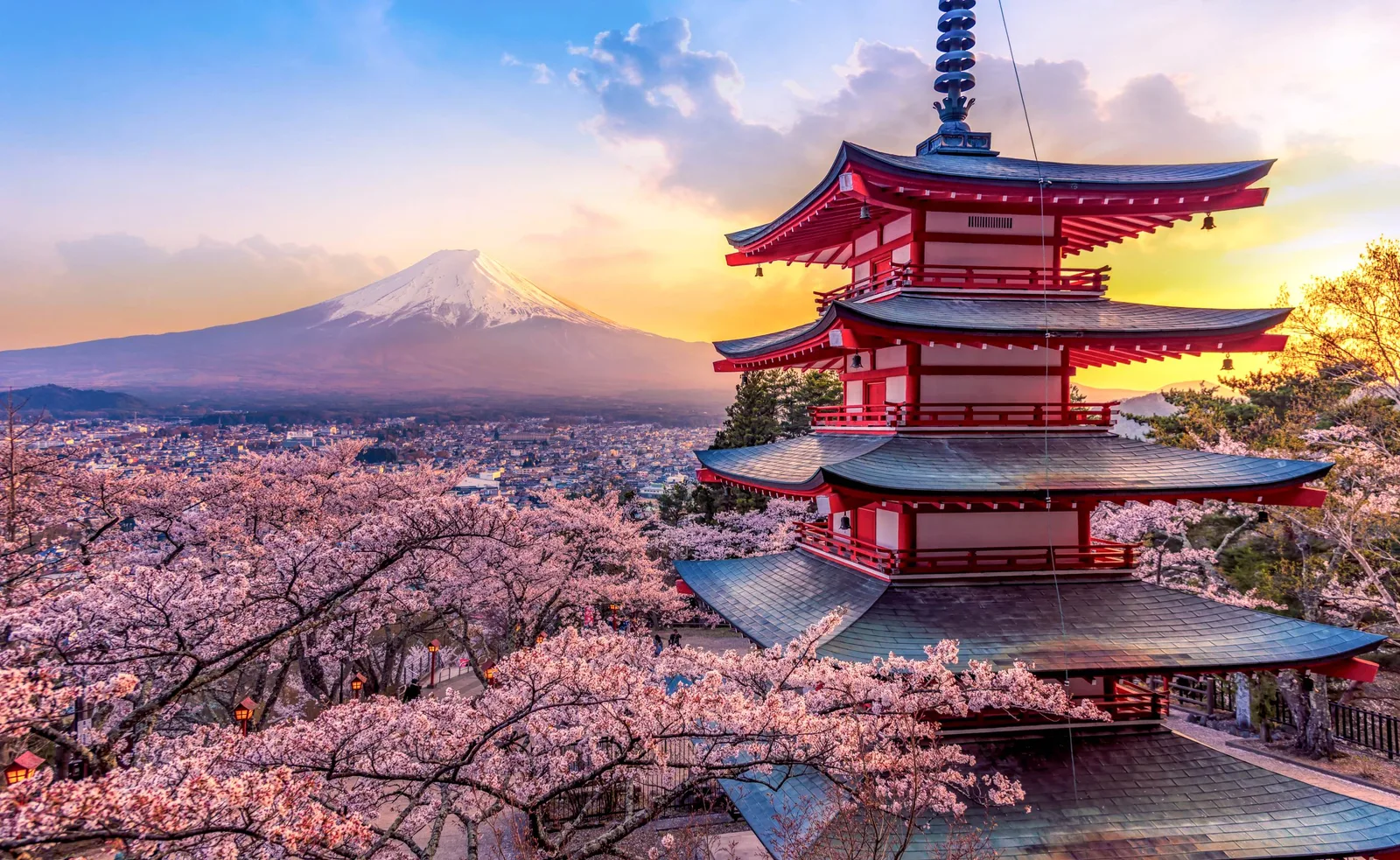
 Travel mania / stock.adobe.com
Country Guide № 084 / 194 · Asia
Japan
A country that runs on time and still leaves room for the plum blossom.
“A country that runs on time and still leaves room for the plum blossom.”
Japan is the rare destination where the infrastructure is part of the attraction. Trains leave to the second, convenience stores sell food worth eating, and a city of 37 million people is quieter than most European towns. That order is not sterility - it is what makes the disorder underneath legible: the standing bars under the tracks in Shinjuku, the moss temples of Kyoto in November rain, the fish market at five in the morning.
The mistake first-timers make is treating it as a two-city trip. Tokyo and Kyoto are essential and both are crowded; the country that lingers is the one between and beyond - the Nakasendō post towns, the Seto Inland Sea islands, a snowbound onsen in Tōhoku. Plan the trains carefully, then leave a week unplanned.
Chapter 01
Highlights
Kyoto in the shoulder season
Fushimi Inari before dawn, the Philosopher's Path under maples, and temple gardens designed to be looked at rather than walked through. Go in late November or early April and accept that you will share it.
Tokyo after dark
Six-seat yakitori counters in Ebisu, jazz kissa in Shibuya, the neon canyon of Shinjuku's Golden Gai. The city is a collection of villages - pick two neighbourhoods a night, not six.
The Nakasendō post road
An eight-kilometre walk between Magome and Tsumago on the restored Edo highway, past waterwheels and bear bells. Day-hikeable from Nagoya and the easiest way to see rural Japan without a car.
Onsen towns in winter
Ginzan, Nozawa or Kinosaki: wooden ryokan, snow-banked streets and outdoor baths at 42 °C while it snows on your head. This is the reason to visit in February.
Chapter 02
Entry requirements for Japan
Checking your passport…
up to 90 days · free entry
90 days on arrival
Official portal only
Paid look-alike sites charge for a process that is free or cheap on the government portal. Use the link below and nothing else.
www.vjw.digital.go.jp →Before you fly
The detail
- Maximum stay
- up to 90 days
- Fee
- free entry
- Passport validity
- Most destinations want validity beyond your stay, and some want six months. Check yours against the return date.
- Onward travel
- Airlines may ask for a return or onward ticket at check-in.
- Arrival form
- Visit Japan Web - register your immigration and customs details online before departure and show the QR codes on arrival. Not legally mandatory, but the paper-form queue is significantly slower.
- Health
- No vaccinations required. Medical care is excellent but not free - insurance is essential and clinics often expect payment at the point of care. Pharmacies stock a smaller range of familiar drugs; bring what you rely on. Note that some common Western medications containing pseudoephedrine or codeine are prohibited imports, and ADHD stimulants are effectively banned - check before you pack. Tap water is safe everywhere.
- Money
- Contactless works in cities, chains and all rail, but Japan is still more cash-based than Europe - small restaurants, shrines, rural buses and markets want yen. Withdraw from 7-Eleven or Japan Post ATMs, which reliably take foreign cards; bank ATMs often do not. Tipping does not exist and attempting it causes confusion. Tax-free shopping over ¥5,000 requires your passport at the till.
United States passports enter visa-free for 90 days as temporary visitors, with no fee and no form to lodge before departure. The stay is not extendable in the ordinary case, and flying to Seoul for a weekend to reset it is treated as abuse - officers do refuse re-entry, and the refusal happens at the airport with your onward plans already booked. Register on Visit Japan Web before you fly: it is free, it is not a visa, and it puts you in the fast immigration and customs lanes instead of the long ones. The passport must be valid for the whole stay and airlines routinely check onward or return tickets at check-in even where immigration does not ask. Japan has announced a JESTA pre-travel authorisation for later this decade; it is not in force, so any site charging you for one today is selling nothing.
Check another destination with this passport →
Entry details: Editorial synthesis - Japan Ministry of Foreign Affairs visa-exemption list, Immigration Services Agency, Visit Japan Web (2025–2026) · compiled 15 Sept 2026
Who needs a visa for Japan
12 common passports| Passport | Requirement | Stay | Process |
|---|---|---|---|
| United States | Visa-free | up to 90 days | No process · €0 / $0 |
| United Kingdom | Visa-free | up to 90 days | No process · €0 / $0 |
| Germany | Visa-free | up to 90 days | No process · €0 / $0 |
| India | e-Visa | - | No Other passports record yet |
| China | e-Visa | - | No Other passports record yet |
| Brazil | Visa-free | up to 90 days | No Other passports record yet |
| Nigeria | Visa required | - | No Other passports record yet |
| Indonesia | eTA | - | No Other passports record yet |
| Philippines | Visa required | - | No Other passports record yet |
| Vietnam | e-Visa | - | No Other passports record yet |
| Egypt | Visa required | - | No Other passports record yet |
| Nepal | Visa required | - | No Other passports record yet |
Holding a passport that is not listed? The picker above answers for any of them. See where your passport takes you. Source: Passport Index, updated 14 Aug 2026.
Chapter 03
When to go
BestMar–May, Oct–Nov. AvoidJun–Aug.
Cherry blossom starts in the south late in the month; prices climb with it.
The band above each month is our editorial verdict - it weighs crowds, prices and access as well as weather. The line is average daily temperature, the bars are monthly rainfall. Select a month for the figures. Climate figures: ERA5 reanalysis via Open-Meteo, 2005–2024 normals.
Chapter 04
What it costs
A day in Japan
Comfortable · sample day
≈ $113
Line items are real prices we track. The daily budget is an editorial estimate for this level, not their sum.
Where this sits among 244 countries we have costed
Accommodation is what swings, and it swings hard: cherry-blossom fortnight (late March–mid April), Golden Week, Obon in mid-August and the New Year week can double Tokyo and Kyoto room rates and sell out ryokan months ahead. February and early December are the cheapest weeks of the year. Food and transport prices are effectively flat year-round.
Updated Aug 2026 · Editorial synthesis - JR fare tables, Japan National Tourism Organization, hotel-rate sampling and Budget Your Trip (2025–2026) · confidence high
Excludes international flights - they depend on where you fly from.
Chapter 05
Regions to know
5Tokyo & Kantō
The capital and its hinterland - Nikkō's lacquered shrines, Kamakura's great Buddha and Hakone's baths under Fuji, all inside two hours.
Kansai
Kyoto's temples, Nara's deer and Osaka's eating culture within a 45-minute triangle. The densest history in Japan.
The Japan Alps & Chūbu
Takayama's old town, the thatched farmhouses of Shirakawa-gō, Kanazawa's gardens and the Nakasendō post road.
Kyūshū & the Inland Sea
Volcanic Kyūshū with the country's best onsen at Beppu, plus the art islands of Naoshima and Teshima across the Seto Inland Sea.
Hokkaidō & Tōhoku
The cold north - powder snow, lavender fields, Sapporo's food and the empty coastlines that most itineraries never reach.
Chapter 06
Practical guide
Getting there
Haneda (HND) is closer to central Tokyo than Narita (NRT) and worth paying for; Kansai (KIX) serves Kyoto and Osaka directly. Direct flights run from London, Paris, Frankfurt, Munich, Helsinki and Istanbul in 11–14 hours; from smaller European airports expect one stop. Arriving into Kansai and leaving from Haneda (or the reverse) saves a backtrack - most airlines price the open jaw the same as a return.
Entry formalities
Visit Japan Web - register your immigration and customs details online before departure and show the QR codes on arrival. Not legally mandatory, but the paper-form queue is significantly slower.
Getting around
The rail network is the reason to come. Load a Suica or ICOCA card (or the Apple/Google Wallet version) for every metro, bus and local train nationwide; buy shinkansen tickets separately at machines or via SmartEX. Highway buses undercut the trains by half on overnight routes. Rural Japan is where a rental car earns its keep - Hokkaidō, the Noto peninsula, southern Kyūshū. Luggage forwarding (takkyūbin, ~€15 a bag) between hotels is the local trick that makes train travel painless.
Money & costs
Contactless works in cities, chains and all rail, but Japan is still more cash-based than Europe - small restaurants, shrines, rural buses and markets want yen. Withdraw from 7-Eleven or Japan Post ATMs, which reliably take foreign cards; bank ATMs often do not. Tipping does not exist and attempting it causes confusion. Tax-free shopping over ¥5,000 requires your passport at the till.
Safety
Among the safest countries in the world - lost wallets are handed in, and solo night walking is normal. The real hazards are natural: earthquakes (learn the drop-cover-hold drill, hotels stock instructions), typhoons from August to October, and summer heat that regularly kills. Download the NHK World or Safety Tips app for push alerts in English. Crowd crush at festivals and Halloween in Shibuya is a genuine risk, not a theoretical one.
Health
No vaccinations required. Medical care is excellent but not free - insurance is essential and clinics often expect payment at the point of care. Pharmacies stock a smaller range of familiar drugs; bring what you rely on. Note that some common Western medications containing pseudoephedrine or codeine are prohibited imports, and ADHD stimulants are effectively banned - check before you pack. Tap water is safe everywhere.
SIM & internet
An eSIM bought before departure is the simplest route; physical tourist SIMs and pocket wifi are sold at every airport. Coverage is near-total including on the shinkansen and in mountain valleys. Free wifi is common but often requires a clumsy sign-up - a data plan is worth the €15. Line, not WhatsApp, is the messaging app everyone actually uses.
Chapter 07
Driving
City driving is not worth it; the trains beat the car everywhere between Tokyo and Fukuoka. Rent for Hokkaidō, Tōhoku, Shikoku and the Noto peninsula, where buses run twice a day.
Rules change - verify with an official source before you rent.
ExplWorld VerifiedNo verified partners here yet - all 6 country seats are open.
Become ExplWorld Verified →Chapter 08
Itineraries through this country
Chapter 09
From the Journal
Chapter 10
Before you go
JapanChapter 11
Frequently asked questions
Is the Japan Rail Pass still worth buying?
Much less often than it used to be. The October 2023 price rise put the 7-day pass around ¥50,000, so it only pays off if you do a genuine long haul - Tokyo–Kyoto–Hiroshima–Tokyo or better. For a Tokyo-and-Kyoto trip, buy individual shinkansen tickets and load an IC card for local transit. Run the numbers on your actual route before committing.
Do I need to speak Japanese?
No. Signage in cities and on the rail network is bilingual, ticket machines have English modes, and translation apps handle menus. Outside the big three cities, spoken English thins out fast - download offline translation, learn sumimasen and arigatō, and point politely. Nobody will be rude about it.
How expensive is Japan really?
Less than its reputation, more than Southeast Asia. Eating is the bargain - a superb bowl of ramen is €7, a convenience-store breakfast €3. Accommodation and long-distance rail are what hurt: business hotels run €60–90, and Tokyo–Kyoto by shinkansen is about €90 one way. Budget €105 a day mid-range, €55 with hostels and local trains.