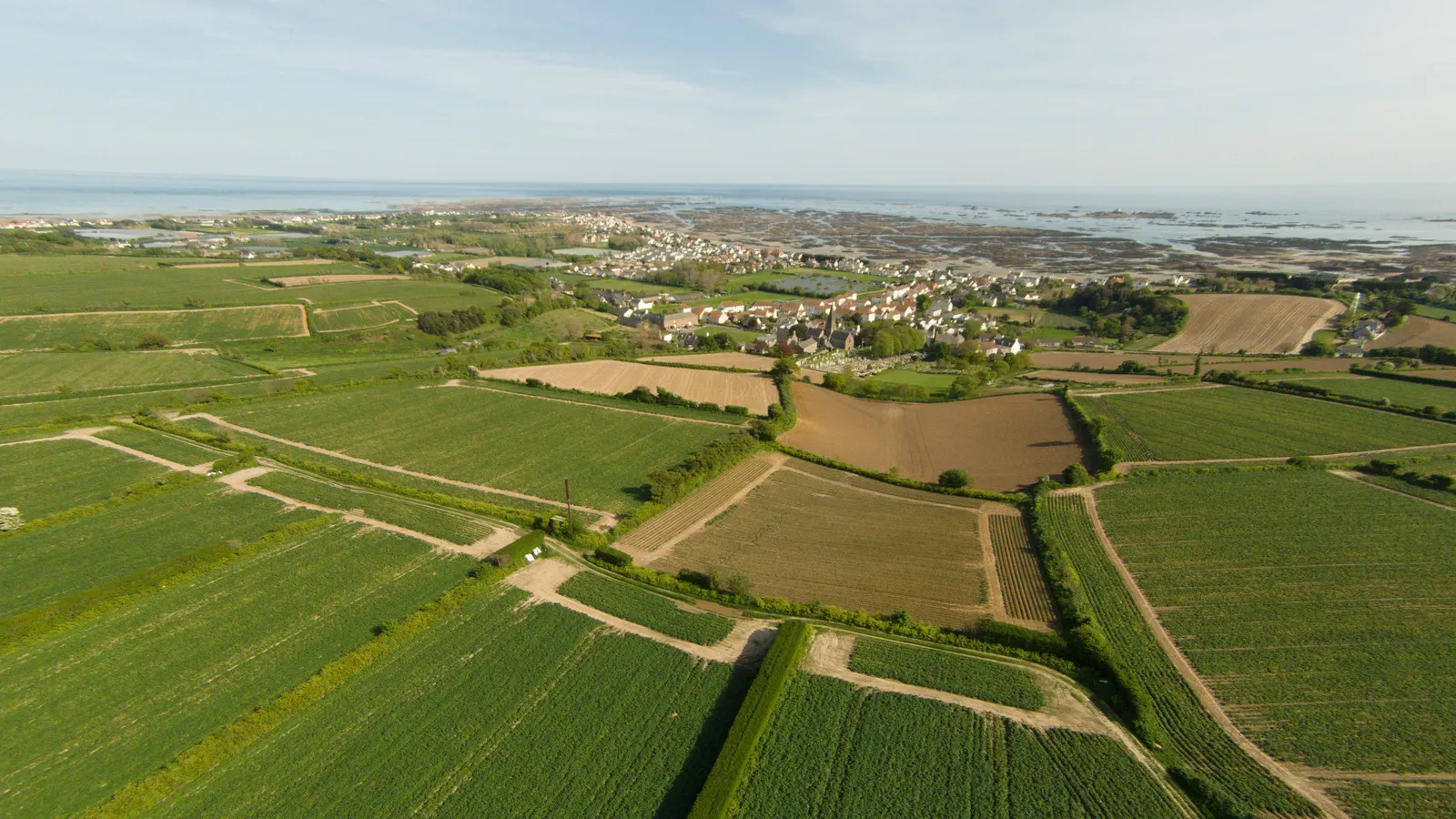
 Danrok · CC BY-SA 4.0
Jersey
The largest Channel Island - a tidal range that doubles its size twice a day.
“The largest Channel Island - a tidal range that doubles its size twice a day.”
Jersey is the largest of the Channel Islands and a British Crown Dependency with its own parliament, laws, currency issue and tax system - closer to France than to England and never part of the EU. Its tidal range is among the largest anywhere on earth, roughly twelve metres at springs, and at low water the island effectively grows by about half again as reefs, sandflats and causeways emerge.
That tide is what makes Elizabeth Castle walkable across the seabed from St Helier, and what exposes Seymour Tower's two kilometres of reef where guided moonwalks cross the flats. The German occupation from 1940 to 1945 left the Jersey War Tunnels, dug by forced labour into a hillside. Beyond that there are Neolithic passage graves, a coastline of cliff path in the north and long sand in the south, and a food culture built on shellfish, Jersey Royals and the island's own breed of cattle.
Chapter 01
Highlights
Elizabeth Castle
A fortress on a tidal islet off St Helier, reached on foot across the seabed at low water or by amphibious ferry when the tide is in. Walter Raleigh was governor here and Charles II sheltered in it.
The Jersey War Tunnels
An underground complex dug by forced labourers during the German occupation, now a museum that deals seriously with collaboration, resistance and the position of an occupied civilian population.
Seymour Tower and the low-tide reef
Guided walks two kilometres out across the exposed seabed to an eighteenth-century tower, sometimes by moonlight, on a reef that vanishes entirely a few hours later. Only with a licensed guide.
La Hougue Bie
A 6,000-year-old Neolithic passage grave under a mound with a medieval chapel built on top, one of the best-preserved in Europe, alongside an occupation-era bunker in the same grounds.
Chapter 02
Entry requirements for Jersey
Checking your passport…
We don't hold entry details for this passport group yet.
Before you fly
The detail
- Passport validity
- Most destinations want validity beyond your stay, and some want six months. Check yours against the return date.
- Onward travel
- Airlines may ask for a return or onward ticket at check-in.
- Health
- Good healthcare with a reciprocal agreement covering UK residents for emergency treatment; travel insurance is still advised for others. No particular hazards.
- Money
- Jersey pound, pegged to and interchangeable with sterling here; Guernsey notes also circulate. Jersey notes are not legal tender in the UK, so change them before leaving. Cards work everywhere. No VAT, but a 5% goods and services tax applies.
Who needs a visa for Jersey
12 common passports| Passport | Requirement | Stay | Process |
|---|---|---|---|
| United States | eTA | - | No United States record yet |
| United Kingdom | Visa-free | - | No United Kingdom record yet |
| Germany | eTA | - | No process · €0 / $0 |
| India | Visa required | - | No Other passports record yet |
| China | Visa required | - | No Other passports record yet |
| Brazil | eTA | - | No Other passports record yet |
| Nigeria | Visa required | - | No Other passports record yet |
| Indonesia | Visa required | - | No Other passports record yet |
| Philippines | Visa required | - | No Other passports record yet |
| Vietnam | Visa required | - | No Other passports record yet |
| Egypt | Visa required | - | No Other passports record yet |
| Nepal | Visa required | - | No Other passports record yet |
Holding a passport that is not listed? The picker above answers for any of them. See where your passport takes you. Source: Passport Index, updated 14 Sept 2026.
Chapter 03
When to go
BestApr–Sep. AvoidNov–Feb.
Jersey Royals in the fields, mild and uncrowded.
The band above each month is our editorial verdict - it weighs crowds, prices and access as well as weather. The line is average daily temperature, the bars are monthly rainfall. Select a month for the figures. Climate figures: ERA5 reanalysis via Open-Meteo, 2005–2024 normals.
Chapter 04
What it costs
A day in Jersey
Comfortable · sample day
≈ $162
Line items are real prices we track. The daily budget is an editorial estimate for this level, not their sum.
Where this sits among 244 countries we have costed
July and August rates are roughly double the winter equivalent, and the fast ferries to France run mainly between April and October.
Updated Aug 2026 · Editorial synthesis - Visit Jersey tariffs and accommodation sampling (2025–2026) · confidence high
Excludes international flights - they depend on where you fly from.
Chapter 05
Regions to know
5St Helier
The capital, the market, Elizabeth Castle across the causeway and the Maritime Museum.
The south coast
St Aubin's harbour, St Brelade's Bay, the Fisherman's Chapel and Corbière lighthouse at the tip.
The north coast
The cliff path from Grosnez to Rozel, Devil's Hole, Plémont's beach and the deep wooded valleys.
The east
Mont Orgueil castle at Gorey, the Royal Bay of Grouville and the oyster beds on the flats.
The interior
La Hougue Bie, the Green Lanes, Jersey Zoo and the potato fields of the côtils.
Chapter 06
Practical guide
Getting there
Jersey Airport has British Airways, easyJet, Blue Islands and Jet2 from London, Manchester, Birmingham, Southampton and elsewhere. Condor Ferries runs from Poole and Portsmouth, plus fast ferries to Guernsey, St Malo and Granville.
Getting around
The LibertyBus network covers the island cheaply and well. Hire cars are widely available; the island is 14 kilometres across so distances are short. Cycling is good, with the Green Lane network giving priority to walkers, cyclists and horses.
Money & costs
Jersey pound, pegged to and interchangeable with sterling here; Guernsey notes also circulate. Jersey notes are not legal tender in the UK, so change them before leaving. Cards work everywhere. No VAT, but a 5% goods and services tax applies.
Safety
Very safe. The tide is the genuine hazard, along with cliff paths in wind. Rip currents on the west coast beaches - swim where lifeguards are posted.
Health
Good healthcare with a reciprocal agreement covering UK residents for emergency treatment; travel insurance is still advised for others. No particular hazards.
SIM & internet
Sure, JT and Airtel-Vodafone. Jersey is outside both EU and UK roaming bundles for most operators - check before arriving or expect a bill.
Chapter 07
Driving
Left-hand traffic with a 40 mph island maximum and 15 mph on the Green Lanes, where walkers, cyclists and horses have priority. "Filter in turn" at yellow-box junctions is a local convention: cars alternate, and everyone expects you to know it.
Rules change - verify with an official source before you rent.
ExplWorld VerifiedNo verified partners here yet - all 6 country seats are open.
Become ExplWorld Verified →Chapter 08
Before you go
JerseyChapter 09
Frequently asked questions
Is Jersey in the UK or the EU?
Neither. It is a Crown Dependency - self-governing, not part of the United Kingdom, and never an EU member. It is in the Common Travel Area with the UK and Ireland, so no routine immigration control on arrival from there, but customs allowances are third-country and there is no VAT.
How careful do I need to be about tides?
Very. The range is around twelve metres at springs and the water comes in across flat sand faster than you can walk. People are cut off every year. Never go out onto the reefs without a licensed guide, check the tide table for any beach walk, and treat causeways as timed.
Can I get to France from here?
Yes - fast ferries run to St Malo and Granville in about an hour and a half, which makes a day trip to Normandy or Brittany easy in summer. You leave the Common Travel Area and enter Schengen, so bring your passport and check your visa position.