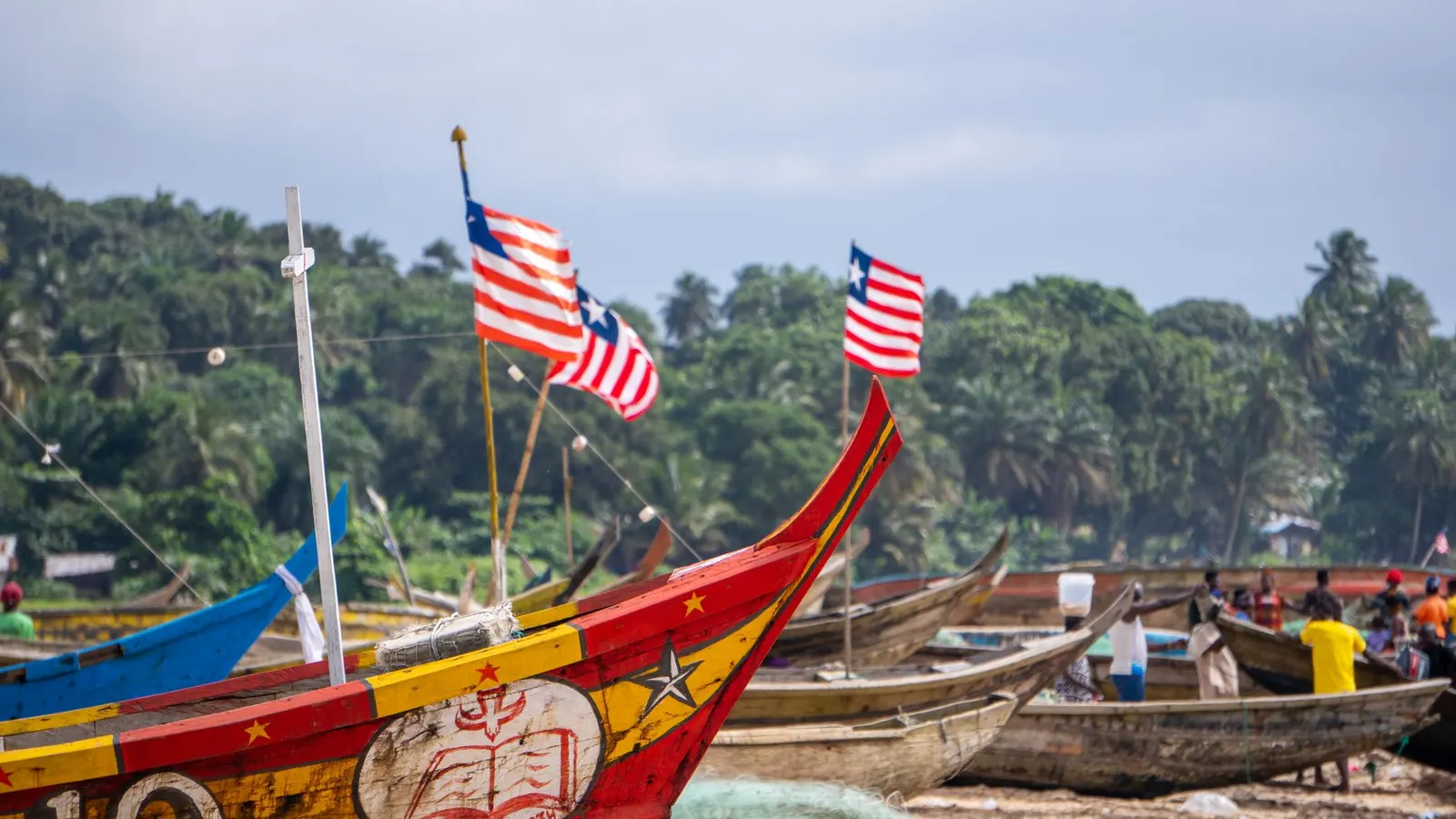
 Isiaka D. Massalay · Pexels License
Country Guide № 095 / 194 · Africa
Liberia
Founded by freed American slaves, and holding the last big block of Upper Guinean rainforest.
“Founded by freed American slaves, and holding the last big block of Upper Guinean rainforest.”
Liberia was founded in 1822 as a settlement for freed African-Americans, declared independence in 1847 and was never colonised, which makes it constitutionally and culturally distinct from everywhere around it - the flag is a single-star version of the Stars and Stripes, the capital is named after a US president, and the legal system is American in origin. The tension between Americo-Liberian settlers and indigenous peoples shaped a century of politics and eventually two civil wars.
Those wars ended in 2003 and Ebola in 2016. What survives is remarkable: Sapo National Park protects the largest remaining block of primary Upper Guinean rainforest, with forest elephants, chimpanzees and pygmy hippos, and Robertsport has consistent Atlantic point breaks that a small surf community has built around. Infrastructure is thin, the rainy season is among the wettest in Africa, and independent travel takes patience.
Chapter 01
Highlights
Sapo National Park
The largest protected block of primary rainforest in West Africa - forest elephants, chimpanzees, pygmy hippos and zebra duiker. Visits require permits and a guide, and getting there is a multi-day undertaking.
Robertsport
Right-hand point breaks at Cottons and Fisherman's that work best from April to October, with a small local surf community, palm-backed sand and a fishing town behind.
Monrovia
The National Museum, the ruined Ducor hotel above the city, Waterside market and the long beaches at ELWA and Thinkers Village on the eastern edge.
Providence Island and the settler history
The landing site of the first settlers in 1822, in the Mesurado river beside Monrovia - the physical starting point of a country founded by people returning across the Atlantic.
Chapter 02
Entry requirements for Liberia
Checking your passport…
up to 90 days · €120 / $130 · embassy application
90 days on arrival
Before you fly
The detail
- Maximum stay
- up to 90 days
- Process
- embassy application
- Fee
- €120 / $130
- Processing time
- Processing takes 7–30 days - apply with room to spare.
- Passport validity
- Most destinations want validity beyond your stay, and some want six months. Check yours against the return date.
- Onward travel
- Airlines may ask for a return or onward ticket at check-in.
- Health
- Yellow fever certificate compulsory for entry. Malaria year-round nationwide. Medical facilities are very limited; evacuation insurance is essential. Bottled or treated water only.
- Money
- US dollars and Liberian dollars circulate together. Cash dominates; card acceptance is limited to a few Monrovia hotels. Bring US dollars in small notes.
Liberia wants the visa arranged before you travel, and for a United States passport the route is the Liberian embassy in Washington rather than a form on a phone. The pattern is worth understanding because it explains the whole page: Liberia has been opening an electronic route for nationalities whose countries it keeps no mission in, while the nationalities it CAN serve from a mission are still expected to use one. That is why the table above shows a visa required of an American, a British, a Belgian, a German, a French and an Italian passport while the other twenty-three European Union passports beside them are offered the electronic route - the difference appears to be not the strength of the passport but whether there is a Liberian mission accredited to you. Allow three to four weeks. The mission will want the yellow fever certificate, a return ticket, proof of where you are staying and frequently a letter of invitation from a host or a company, and will sometimes ask for a bank statement. The fee is not a single published figure: it varies by nationality, by number of entries and by mission, running from roughly US$70 for a single entry upward, and the €120 shown here is indicative rather than a schedule - ask the mission for its own current list before you budget. If the immigration service’s own portal offers you an electronic application for this passport, that is the faster door and it is worth checking before you book an appointment; do not, however, plan the trip on the assumption that it will, and do not pay one of the commercial sites that advertise a "Liberian e-visa" for a nationality the government’s own site does not serve. Roberts International sits over an hour from Monrovia on a road that is slow after dark, so build the transfer into the arrival rather than the next morning. Citizens of the Economic Community of West African States move freely into Liberia and need neither a visa nor an authorisation. That is a right of movement under the ECOWAS protocol rather than a concession granted to visitors, which is why a West African travelling companion may be waved through the same counter that asks you to pay. A yellow fever certificate is a condition of entry to Liberia for every arrival, not only for travellers coming from an affected country, and it is checked before immigration rather than after - a missing certificate is dealt with at the airport, at your expense and occasionally by vaccination on the spot. The injection has to be given at least ten days before you travel for the certificate to be valid, which is the part that catches a late booking; the certificate itself then lasts a lifetime. It is also what the next country will want if you spend MORE than twelve hours in an airport here on the way to it.
Check another destination with this passport →
Entry details: Editorial synthesis - Liberia Immigration Service visa requirements and mission practice (2025–2026) · compiled 18 Sept 2026
Who needs a visa for Liberia
12 common passports| Passport | Requirement | Stay | Process |
|---|---|---|---|
| United States | Visa required | - | Embassy visit · €120 / $130 · 7–30 d |
| United Kingdom | Visa required | - | Embassy visit · €120 / $130 · 7–30 d |
| Germany | Visa required | - | e-Visa · €120 / $130 · 7–30 d |
| India | e-Visa | - | e-Visa · €120 / $130 · 7–30 d |
| China | Visa required | - | e-Visa · €120 / $130 · 7–30 d |
| Brazil | e-Visa | - | e-Visa · €120 / $130 · 7–30 d |
| Nigeria | Visa-free | - | e-Visa · €120 / $130 · 7–30 d |
| Indonesia | e-Visa | - | e-Visa · €120 / $130 · 7–30 d |
| Philippines | e-Visa | - | e-Visa · €120 / $130 · 7–30 d |
| Vietnam | e-Visa | - | e-Visa · €120 / $130 · 7–30 d |
| Egypt | Visa required | - | e-Visa · €120 / $130 · 7–30 d |
| Nepal | e-Visa | - | e-Visa · €120 / $130 · 7–30 d |
Holding a passport that is not listed? The picker above answers for any of them. See where your passport takes you. Source: Passport Index, updated 15 Aug 2026.
Chapter 03
When to go
BestNov–Feb. AvoidMay–Sep.
Dry season; the best month for the interior.
The band above each month is our editorial verdict - it weighs crowds, prices and access as well as weather. The line is average daily temperature, the bars are monthly rainfall. Select a month for the figures. Climate figures: ERA5 reanalysis via Open-Meteo, 2005–2024 normals.
Chapter 04
What it costs
A day in Liberia
Comfortable · sample day
≈ $86
Line items are real prices we track. The daily budget is an editorial estimate for this level, not their sum.
Where this sits among 244 countries we have costed
Monrovia rates are business-driven and steady. Robertsport guesthouses fill during the April–October surf season, which is also the rainy season.
Updated Aug 2026 · Editorial synthesis - market sampling and operator quotes (2025–2026) · confidence low
Excludes international flights - they depend on where you fly from.
Chapter 05
Regions to know
5Monrovia
The capital, Providence Island, the ruined Ducor and the city beaches to the east.
The northwest coast
Robertsport's point breaks, Lake Piso's lagoon and the Sierra Leonean border beyond.
The southeast
Sapo National Park, Greenville and the long, difficult road towards Harper on the Ivorian border.
The interior
Gbarnga, the Nimba range on the Guinean border and the iron-ore country around Yekepa.
Harper and Maryland
The far southeast corner, with decaying Americo-Liberian mansions from the settler era and beaches almost nobody reaches.
Chapter 06
Practical guide
Getting there
Roberts International, about 50 km from Monrovia, is served by Brussels Airlines, Royal Air Maroc, Kenya Airways, Air Côte d'Ivoire and ASKY. The road in from the airport takes over an hour. Overland from Sierra Leone, Guinea and Côte d'Ivoire is possible in the dry season.
Getting around
Shared taxis and minibuses on the paved corridors; motorbike taxis everywhere else. A 4x4 with driver is the realistic option outside Monrovia. There is no meaningful domestic air network for visitors.
Money & costs
US dollars and Liberian dollars circulate together. Cash dominates; card acceptance is limited to a few Monrovia hotels. Bring US dollars in small notes.
Safety
Petty crime and occasional armed robbery in Monrovia, worst after dark. Beaches have strong rip currents and drownings are common. Political demonstrations occur. Road safety is poor. The security situation is otherwise calm.
Health
Yellow fever certificate compulsory for entry. Malaria year-round nationwide. Medical facilities are very limited; evacuation insurance is essential. Bottled or treated water only.
SIM & internet
Orange and Lonestar Cell MTN; SIM registration requires a passport. 4G in Monrovia and the main towns; nothing in the forest. Power is largely generator-based outside the capital.
Chapter 07
Driving
Right-hand traffic with a largely imported right-hand-drive vehicle fleet, which makes overtaking genuinely dangerous. Roads outside Monrovia are poor and often impassable in the rains. Hire a driver.
Rules change - verify with an official source before you rent.
ExplWorld VerifiedNo verified partners here yet - all 6 country seats are open.
Become ExplWorld Verified →Chapter 08
Itineraries through this country
Chapter 09
From the Journal
Chapter 10
Before you go
LiberiaChapter 11
Frequently asked questions
Which dollar do I use?
Both. The US dollar circulates alongside the Liberian dollar and is legal tender - larger payments are usually in US dollars and small change in Liberian. Bring US dollars in cash in small denominations. ATMs in Monrovia dispense both but are unreliable for foreign cards.
How bad are the roads?
The paved network is limited to Monrovia and a few corridors. Beyond them, laterite roads become extremely difficult in the May–October rains and some routes to the southeast are effectively closed for months. Domestic flights are minimal. Plan for the dry season if you want to leave the coast.
Is the visa hard?
It needs advance planning. Most nationalities apply at a Liberian mission or, where available, through the e-visa system, with a yellow fever certificate, proof of accommodation and a return ticket. The yellow fever certificate is separately compulsory at the border and is checked.