 Asad Photo Maldives · Pexels License
Country Guide № 103 / 194 · Asia
Maldives
Twelve hundred islands, eighty centimetres above the sea.
“Twelve hundred islands, eighty centimetres above the sea.”
The Maldives sells one image so effectively that most people do not know there is another option. Twenty-six atolls, twelve hundred islands, about two hundred inhabited - and since a 2009 law change, local islands may host guesthouses. That created a second country inside the first: €60-a-night rooms on inhabited islands, public ferries between them, and the same reef a hundred metres offshore.
The two versions come with different rules. Resort islands are private and sell alcohol; local islands are conservative Muslim communities where alcohol is prohibited and modest dress is expected on the village beach, with a designated bikini beach for visitors. The diving and snorkelling - manta cleaning stations, whale sharks in South Ari, reef sharks everywhere - is the same water either way.
Chapter 01
Highlights
Manta rays at Hanifaru Bay
A UNESCO biosphere reserve in Baa Atoll where dozens of manta rays and sometimes whale sharks gather to feed between May and November. Snorkel only, with a permit and a licensed guide.
Whale sharks in South Ari
One of the few places on earth with a resident year-round whale shark population. Go with operators that follow the code of conduct - no touching, no blocking the animal's path.
Local island life
Guesthouse islands like Dhigurah, Thulusdhoo and Fulidhoo - ferries, fish markets, surf breaks and reef a short swim out, at a fraction of resort prices.
Malé
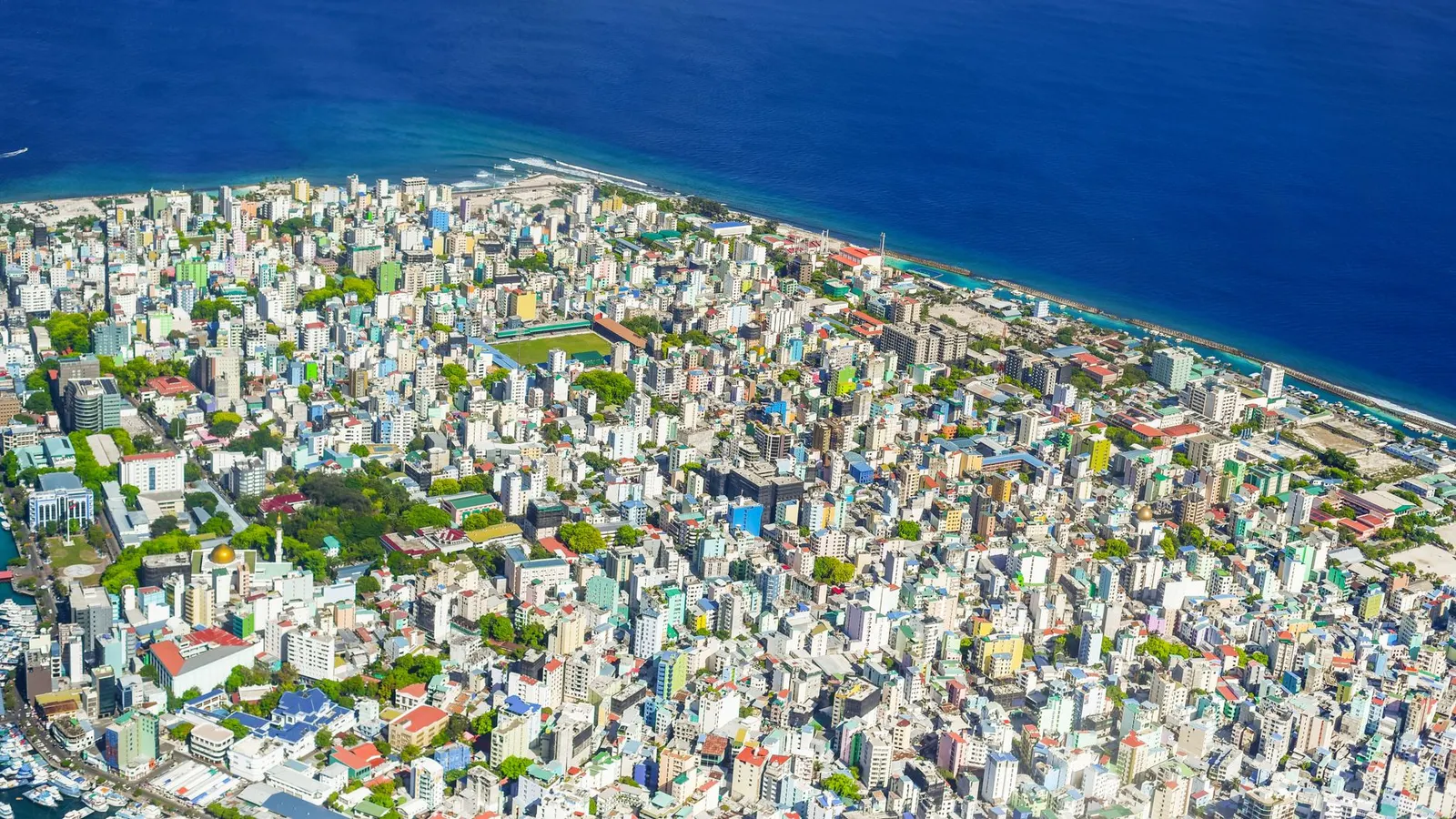
One of the densest cities on earth on two square kilometres, with the coral-stone Old Friday Mosque and a fish market that is the opposite of a resort brochure. Worth a half day.
Chapter 02
Entry requirements for Maldives
Checking your passport…
up to 30 days · free entry
30 days on arrival
Official portal only
Paid look-alike sites charge for a process that is free or cheap on the government portal. Use the link below and nothing else.
imuga.immigration.gov.mv →Before you fly
The detail
- Maximum stay
- up to 30 days
- Fee
- free entry
- Passport validity
- Most destinations want validity beyond your stay, and some want six months. Check yours against the return date.
- Onward travel
- Airlines may ask for a return or onward ticket at check-in.
- Arrival form
- IMUGA Traveller Declaration must be submitted online within 96 hours before arrival and again before departure.
- Health
- No vaccinations required; hepatitis A and typhoid are standard advice. Dengue occurs. Tap water on resorts is desalinated and safe; on local islands drink bottled or filtered. Medical facilities are limited outside Malé, and there are only a handful of decompression chambers in the country - a serious consideration for divers, and one reason dive insurance is worth having.
- Money
- US dollars are accepted everywhere and are what resorts price in; rufiyaa is used on local islands for small purchases. Cards work at resorts, in Malé and at larger guesthouses; carry cash for ferries, small shops and island cafés. ATMs exist in Malé and on larger local islands. A 16 % goods and services tax plus a green tax per night applies and is often quoted separately - check whether a rate includes them.
Nothing is applied for and nothing is paid to enter the Maldives: a free 30-day permit is issued on arrival to a United States passport, as it is to almost every nationality on earth. What is checked is the rest of it - a passport with six months of validity, a confirmed booking at a registered resort, hotel, guesthouse or safari vessel, an onward ticket and evidence of funds - and the accommodation booking genuinely is inspected, which is why an unbooked island-hopping plan is the usual reason somebody is turned back at Velana. Every traveller must also file the free IMUGA Traveller Declaration in the 96 hours before arrival and again before departure; it costs nothing, and the sites charging for it are selling a government form. Two charges arrive separately and neither is an entry fee: a green tax, US$12 per person per night at resorts and hotels and US$6 at guesthouses on inhabited islands at the time of writing, billed by the property, and a departure tax, around US$50 in economy for foreign travellers at the time of writing, collected inside the airfare. Alcohol, pork, and religious material for proselytising may not be imported - duty-free bottles bought en route are held at the airport and returned to you on the way out.
Check another destination with this passport →
Entry details: Editorial synthesis - Maldives Immigration free 30-day permit, IMUGA Traveller Declaration, Maldives Inland Revenue Authority green tax, airport taxes and charges (2025–2026) · compiled 17 Sept 2026
Who needs a visa for Maldives
12 common passports| Passport | Requirement | Stay | Process |
|---|---|---|---|
| United States | Visa on arrival | - | No process · €0 / $0 |
| United Kingdom | Visa on arrival | - | No process · €0 / $0 |
| Germany | Visa on arrival | - | No process · €0 / $0 |
| India | Visa-free | up to 90 days | No process · €0 / $0 |
| China | Visa-free | up to 30 days | No process · €0 / $0 |
| Brazil | Visa on arrival | - | No process · €0 / $0 |
| Nigeria | Visa on arrival | - | No process · €0 / $0 |
| Indonesia | Visa on arrival | - | No process · €0 / $0 |
| Philippines | Visa on arrival | - | No process · €0 / $0 |
| Vietnam | Visa on arrival | - | No process · €0 / $0 |
| Egypt | Visa on arrival | - | No process · €0 / $0 |
| Nepal | Visa on arrival | - | No process · €0 / $0 |
Holding a passport that is not listed? The picker above answers for any of them. See where your passport takes you. Source: Passport Index, updated 14 Aug 2026.
Chapter 03
When to go
BestNov–Apr.
Dry season, calm seas, best visibility - and peak prices.
The band above each month is our editorial verdict - it weighs crowds, prices and access as well as weather. The line is average daily temperature, the bars are monthly rainfall. Select a month for the figures. Climate figures: ERA5 reanalysis via Open-Meteo, 2005–2024 normals.
Chapter 04
What it costs
A day in Maldives
Comfortable · sample day
≈ $140
Line items are real prices we track. The daily budget is an editorial estimate for this level, not their sum.
Where this sits among 244 countries we have costed
Resort rates swing enormously - the same overwater villa can be €400 in September and €1,200 over Christmas and New Year. Guesthouse islands move far less, perhaps 20–30 %. Transfers are fixed and are the line most people underestimate: a seaplane can cost more than four nights of a guesthouse. The 16 % GST and the per-night green tax are added on top of most quoted rates.
Updated Aug 2026 · Editorial synthesis - Maldives Inland Revenue Authority tax rates, guesthouse and resort rate sampling, published transfer tariffs (2025–2026) · confidence high
Excludes international flights - they depend on where you fly from.
Chapter 05
Regions to know
5North and South Malé Atolls
Closest to the airport, so the cheapest transfers - surf breaks, day-trip resorts and the guesthouse islands of Maafushi and Thulusdhoo.
Ari Atoll
Whale sharks in the south year-round, plus manta cleaning stations and some of the best-known dive sites.
Baa Atoll
A UNESCO biosphere reserve, with the seasonal manta and whale-shark feeding aggregation at Hanifaru Bay.
Malé & Hulhumalé
The capital island and its reclaimed neighbour - the fish market, the old coral mosque and the airport link.
The far atolls
Addu in the deep south and the northern atolls: domestic flights, fewer resorts and reefs that see very few divers.
Chapter 06
Practical guide
Getting there
Velana International (MLE) beside Malé takes direct flights from several European cities in winter plus frequent connections via the Gulf, Istanbul, Colombo and Delhi. Everything else is a transfer from there - seaplane, domestic flight or boat. Seaplanes fly in daylight only, which constrains which flights work with which resorts; check before booking a late arrival.
Entry formalities
IMUGA Traveller Declaration must be submitted online within 96 hours before arrival and again before departure.
Getting around
Public ferries link inhabited islands cheaply on published but sparse schedules - often a few days a week and rarely on Fridays. Speedboat transfers are faster and cost real money. Domestic flights reach the far atolls. Within islands, everything is walkable; most local islands are under two kilometres long.
Money & costs
US dollars are accepted everywhere and are what resorts price in; rufiyaa is used on local islands for small purchases. Cards work at resorts, in Malé and at larger guesthouses; carry cash for ferries, small shops and island cafés. ATMs exist in Malé and on larger local islands. A 16 % goods and services tax plus a green tax per night applies and is often quoted separately - check whether a rate includes them.
Safety
Very low crime. The real hazards are marine: strong currents between islands, boat transfers in rough weather, and the fact that many local islands have no lifeguard and no decompression chamber nearby. Sunburn and dehydration do more damage than anything else. Malé has occasional petty crime and drug-related issues. Alcohol outside resorts and licensed hotels is illegal, as is bringing it in - it is confiscated at the airport.
Health
No vaccinations required; hepatitis A and typhoid are standard advice. Dengue occurs. Tap water on resorts is desalinated and safe; on local islands drink bottled or filtered. Medical facilities are limited outside Malé, and there are only a handful of decompression chambers in the country - a serious consideration for divers, and one reason dive insurance is worth having.
SIM & internet
Dhiraagu and Ooredoo tourist SIMs are sold at the airport for €10–20; eSIM works. 4G coverage is good across inhabited atolls. Resort wifi is generally free and adequate. Note that VoIP calling has historically been restricted on local networks.
Chapter 07
Driving
Transport here is boats and seaplanes. The only vehicles most visitors see are the airport shuttle and the occasional island buggy.
Rules change - verify with an official source before you rent.
ExplWorld VerifiedNo verified partners here yet - all 6 country seats are open.
Become ExplWorld Verified →Chapter 08
Itineraries through this country
Chapter 09
From the Journal
Chapter 10
Before you go
MaldivesChapter 11
Frequently asked questions
Can I visit without booking a resort?
Yes. Guesthouses on inhabited islands have been legal since 2009 and there are hundreds. You reach them by public ferry (very cheap, slow, and not running on Fridays on many routes) or speedboat transfer. Expect €50–90 a night rather than €400, and expect local rules: no alcohol, modest dress in the village, swimwear only on the designated bikini beach.
How much do transfers cost?
More than people budget for, and they are unavoidable. A seaplane transfer to a distant resort runs US$400–700 return per person; a speedboat to a nearer island US$100–250; a domestic flight plus boat somewhere between. Public ferries cost a few euros but run on a limited schedule. Always check the transfer cost before comparing room rates - it can exceed several nights of the room.
When is the best time to go?
The northeast monsoon from November to April is the dry season with calm seas and the best visibility - and the highest prices. May to October is wetter and windier with more rain, lower prices, and better manta and whale-shark aggregations in some atolls. Neither half is a washout; the rain comes in bursts.