Country Guide № 128 / 194 · Europe
Norway
Fjords, a coastline longer than the equator, and a right to camp on almost any of it.
“Fjords, a coastline longer than the equator, and a right to camp on almost any of it.”
Norway's coastline, counting every fjord and island, runs to over 100,000 kilometres - more than twice the circumference of the earth. That geography is the country: deep glacial inlets with vertical walls, a rail line that climbs from sea level to the Hardangervidda plateau in two hours, and Arctic islands where the sun does not set for two months and then does not rise for two more.
It is also one of the most expensive countries on earth, with a caveat that changes the arithmetic. Allemannsretten - the right to roam - lets anyone walk, camp and pick berries on uncultivated land, including private land, as long as you stay 150 metres from a house and move on after two nights. That single law makes a wild-camping trip here dramatically cheaper than a hotel one, and it is why Norwegians spend so much time outdoors.
Chapter 01
Highlights
The western fjords
Nærøyfjord and Geirangerfjord are both UNESCO-listed; the Flåm railway and the Bergen line together make one of the great rail journeys in Europe. Preikestolen and Trolltunga are the famous hikes and both are long days.
Lofoten
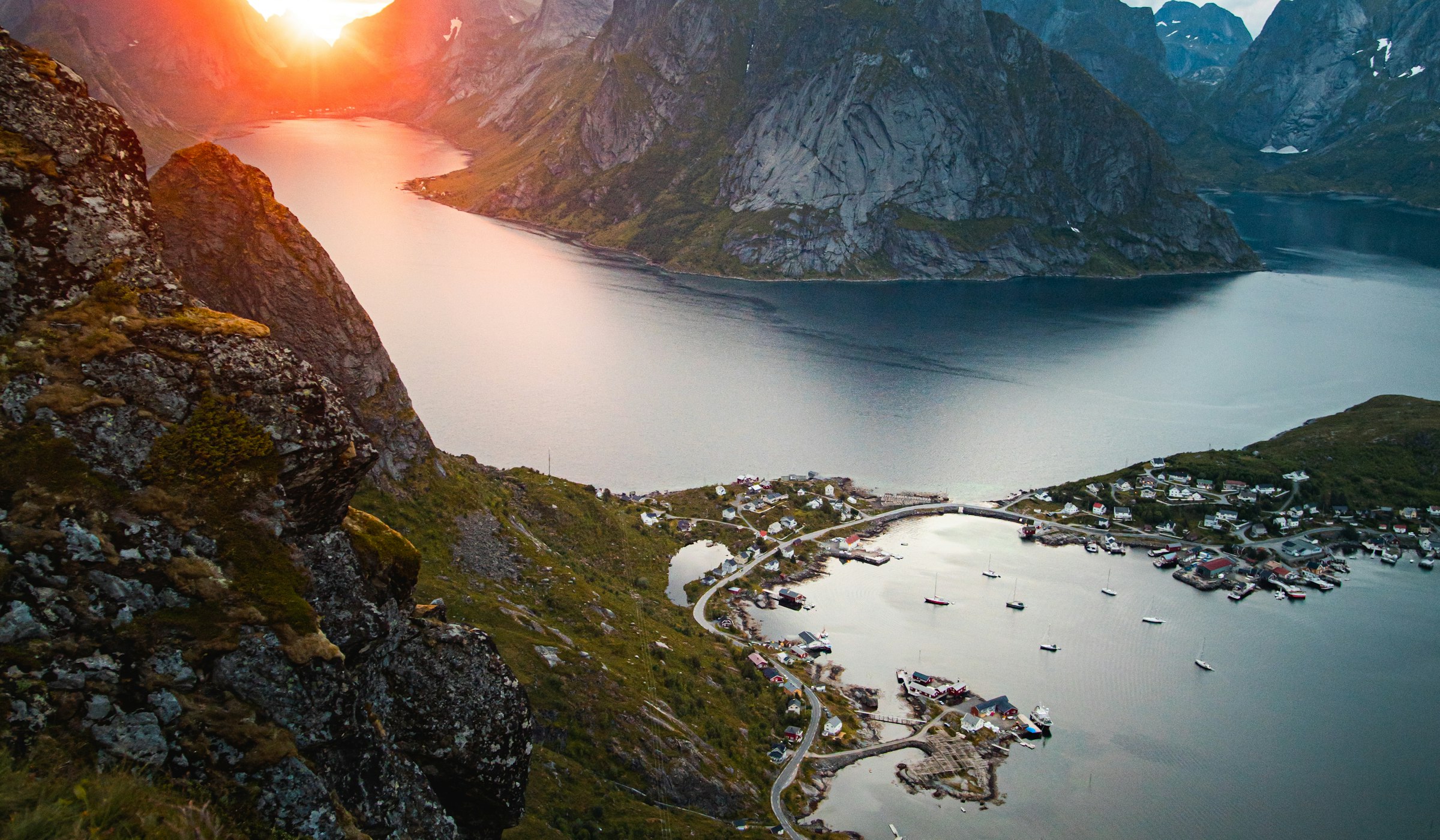
Granite peaks rising straight from the sea above red fishing cabins, above the Arctic Circle. Midnight sun in June, northern lights from September, and a road that runs the whole chain.
The Hurtigruten coastal route
The working coastal ferry from Bergen to Kirkenes, calling at thirty-four ports over six days. Not a cruise - a service that carries freight and locals, which is why it stops where it does.
Svalbard
A high-Arctic archipelago at 78 degrees north with polar bears outnumbering people. Visa-free under a 1920 treaty, reached by flight from Oslo or Tromsø, and requiring a guide with a rifle outside the settlements.
Chapter 02
Entry requirements for Norway
Checking your passport…
up to 90 days · free entry
90 days on arrival
Before you fly
The detail
- Maximum stay
- up to 90 days
- Fee
- free entry
- Passport validity
- Most destinations want validity beyond your stay, and some want six months. Check yours against the return date.
- Onward travel
- Airlines may ask for a return or onward ticket at check-in.
- Health
- No vaccinations required. Healthcare is excellent; EHIC/GHIC covers EU and UK visitors for state care. Remote areas mean long evacuation times and mountain rescue, while competent, is not instant. Tap water is superb. Tick-borne encephalitis exists along the southern coast. Hypothermia is a real risk in any season at altitude.
- Money
- Effectively cashless - cards work everywhere including on buses and in mountain huts, and many places refuse cash entirely. Norwegian kroner, not euros. Tipping is not expected. Alcohol above 4.7 % is sold only in state Vinmonopolet shops with limited hours, which closes early on Saturdays and not at all on Sundays.
Norway is in Schengen without being in the European Union, so a US passport enters with no visa for 90 days in any rolling 180 and those days come out of the same allowance as Spain or Greece - there is no separate Nordic ration. Arrivals from within the area involve no check; arrivals from outside it meet the Entry/Exit System, which has taken a photograph and fingerprints in place of a stamp since April 2026 and keeps the 90-day count automatically, with overstays produced by the database rather than by an officer’s memory. Passports need to have been issued within the last ten years and to stay valid three months beyond your departure from the area. ETIAS has been announced for visa-exempt travellers but was not required at the time of writing, so check the position rather than assuming. Two Norwegian specifics: the country is outside the EU customs union and its alcohol and tobacco allowances are small, strictly enforced and worth reading before you pack, given what the same bottle costs in a Norwegian shop. And Svalbard is genuinely unusual - under the 1920 treaty it is open to every nationality with no visa at all, but it sits outside Schengen, so flying to Longyearbyen leaves the area and coming back through Tromsø or Oslo is a fresh entry that you must be admissible for in your own right.
Check another destination with this passport →
Entry details: Editorial synthesis - Schengen Borders Code, Norwegian Directorate of Immigration, Svalbard Treaty provisions, Norwegian Customs, EU Entry/Exit System rollout (2025–2026) · compiled 16 Sept 2026
Who needs a visa for Norway
12 common passports| Passport | Requirement | Stay | Process |
|---|---|---|---|
| United States | Visa-free | up to 90 days | No process · €0 / $0 |
| United Kingdom | Visa-free | up to 90 days | No process · €0 / $0 |
| Germany | Visa-free | - | No process · €0 / $0 |
| India | Visa required | - | No Other passports record yet |
| China | Visa required | - | No Other passports record yet |
| Brazil | Visa-free | up to 90 days | No Other passports record yet |
| Nigeria | Visa required | - | No Other passports record yet |
| Indonesia | Visa required | - | No Other passports record yet |
| Philippines | Visa required | - | No Other passports record yet |
| Vietnam | Visa required | - | No Other passports record yet |
| Egypt | Visa required | - | No Other passports record yet |
| Nepal | Visa required | - | No Other passports record yet |
Holding a passport that is not listed? The picker above answers for any of them. See where your passport takes you. Source: Passport Index, updated 14 Aug 2026.
Chapter 03
When to go
BestJun–Sep. AvoidApril, November.
Midnight sun north of the Arctic Circle; everything opening.
The band above each month is our editorial verdict - it weighs crowds, prices and access as well as weather. The line is average daily temperature, the bars are monthly rainfall. Select a month for the figures. Climate figures: ERA5 reanalysis via Open-Meteo, 2005–2024 normals.
Chapter 04
What it costs
A day in Norway
Comfortable · sample day
≈ $178
Line items are real prices we track. The daily budget is an editorial estimate for this level, not their sum.
Where this sits among 244 countries we have costed
Summer is the peak in the fjords and Lofoten, roughly doubling accommodation from June to August; the far north has a second peak from January to March for aurora. Mountain huts and many fjord hotels close entirely from October to May. Alcohol prices do not move because they are set by tax rather than market.
Updated Aug 2026 · Editorial synthesis - Vy published fares, DNT hut tariffs, Statistics Norway price data (2025–2026) · confidence high
Excludes international flights - they depend on where you fly from.
Chapter 05
Regions to know
5Oslo & the southeast
The capital with its Munch and Viking ship museums, plus the forests and lakes of the Oslomarka around it.
The western fjords
Bergen, Sognefjord and Geirangerfjord, the Flåm railway, and the Preikestolen and Trolltunga hikes.
The central mountains
Jotunheimen with Norway's highest peaks, the Hardangervidda plateau and the DNT hut network across both.
Trøndelag & Helgeland
Trondheim's cathedral, the Atlantic Road, and the Arctic Circle crossing on the coastal route north.
The Arctic north & Svalbard
Lofoten and Vesterålen, Tromsø, the North Cape, and the high-Arctic archipelago at 78 degrees north.
Chapter 06
Practical guide
Getting there
Oslo (OSL) is the main hub, with Bergen, Stavanger, Trondheim and Tromsø taking direct European flights. Trains link Oslo to Stockholm and Copenhagen; ferries run from Denmark, Germany and Sweden. Given the length of the country, an open-jaw ticket - in to Bergen, out from Tromsø - saves days.
Getting around
The rail network covers the south and reaches Bodø; the Bergen and Rauma lines are attractions in themselves. Buses and express boats fill the fjord country, and ferries are part of the road network rather than an extra. Domestic flights are the practical way north and are competitively priced. A car is genuinely useful in the fjords and Lofoten, with ferry crossings that mostly bill automatically to the plate.
Money & costs
Effectively cashless - cards work everywhere including on buses and in mountain huts, and many places refuse cash entirely. Norwegian kroner, not euros. Tipping is not expected. Alcohol above 4.7 % is sold only in state Vinmonopolet shops with limited hours, which closes early on Saturdays and not at all on Sundays.
Safety
Extremely safe from crime. The hazards are environmental: fast-changing mountain weather, avalanche risk in winter, and hikers underestimating the famous routes - Trolltunga is a 27-kilometre round trip that people attempt in trainers. Roads in the fjords are narrow with tunnels and hairpins. In Svalbard, polar bears are a genuine and legislated risk outside the settlements.
Health
No vaccinations required. Healthcare is excellent; EHIC/GHIC covers EU and UK visitors for state care. Remote areas mean long evacuation times and mountain rescue, while competent, is not instant. Tap water is superb. Tick-borne encephalitis exists along the southern coast. Hypothermia is a real risk in any season at altitude.
SIM & internet
Norway is in the EEA and EU roaming applies. Coverage is remarkably good given the terrain, including in most fjord villages and along main roads, with gaps in the mountains and the far interior. Wifi is standard everywhere including DNT huts near roads.
Chapter 07
Driving
Speeding fines are among the highest in the world and enforcement is heavy - 10 km/h over can cost several hundred euros. Winter tyres are required in winter conditions. Fjord roads mean long single-lane tunnels and frequent ferries; build ferry timetables into the day rather than assuming a road distance.
Rules change - verify with an official source before you rent.
ExplWorld VerifiedNo verified partners here yet - all 6 country seats are open.
Become ExplWorld Verified →Chapter 08
Itineraries through this country
Chapter 09
From the Journal
Chapter 10
Before you go
NorwayChapter 11
Frequently asked questions
How does the right to roam actually work?
Allemannsretten lets you walk and camp on uncultivated land - forest, mountain, shoreline - including privately owned land, for up to two nights in one spot before moving on. Stay at least 150 metres from any inhabited house or cabin, leave no trace, and respect fire bans, which run from mid-April to mid-September in forests. It applies to foreigners exactly as it does to Norwegians.
How do I see the northern lights?
Go north of the Arctic Circle - Tromsø, Lofoten, Alta - between late September and late March, and stay at least four or five nights, because the variable is cloud rather than solar activity. There is no version of this that is guaranteed. Winter also means very short days and cold, so pair it with something else you want to do.
Is it really that expensive?
Yes. A restaurant main is €35–45, a beer €11, a hotel room €180. The counters are camping under the right to roam, self-catering from Rema 1000 or Kiwi, and the excellent DNT mountain hut network, which costs around €35 a night for members. Alcohol is state-monopoly and taxed hard - the Vinmonopolet is the only place to buy anything above 4.7 %.