 Tiago Alvar · Pexels License
Country Guide № 131 / 194 · Oceania
Palau
The Rock Islands, Jellyfish Lake and the world's first shark sanctuary.
“The Rock Islands, Jellyfish Lake and the world's first shark sanctuary.”
Palau made a shark sanctuary of its entire exclusive economic zone in 2009, the first country to do so, and now protects 80% of its waters from all extractive activity. Every arriving visitor signs the Palau Pledge - a commitment to act responsibly, stamped into your passport and written by the country's children. Reef-toxic sunscreens are banned outright.
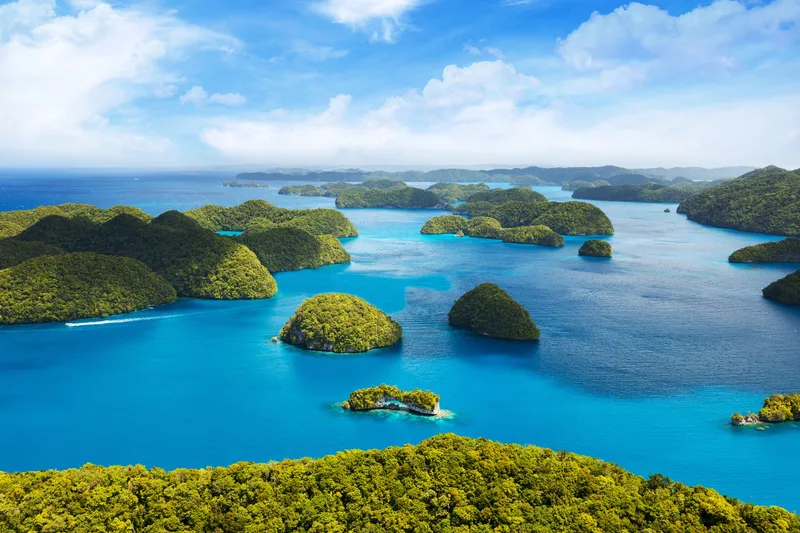
The Rock Islands are hundreds of mushroom-shaped limestone knobs in a turquoise lagoon, UNESCO-listed, with Jellyfish Lake among them - a marine lake holding golden jellyfish that lost their sting after millennia isolated from predators. The diving at Blue Corner and German Channel is consistently rated among the best in the world for pelagic action. It is expensive, small, and the strictest place in the Pacific about how visitors behave.
Chapter 01
Highlights
Blue Corner
A reef plateau where currents bring sharks, jacks, barracuda and napoleon wrasse in numbers - divers hook onto the reef edge and watch. Routinely ranked among the best dive sites in the world.
Jellyfish Lake
A marine lake in the Rock Islands where golden jellyfish, isolated for millennia without predators, have lost their sting and migrate across the lake daily. Snorkelling only - diving is prohibited.
The Rock Islands
Hundreds of undercut limestone islands in a UNESCO-listed lagoon, with hidden marine lakes, arches, Second World War relics and beaches only reachable by boat.
Peleliu
The site of one of the bloodiest battles of the Pacific war in 1944, with wrecked tanks, bunkers and aircraft left in the jungle and on the reef.
Chapter 02
Entry requirements for Palau
Checking your passport…
up to 360 days · free entry
360 days on arrival
Before you fly
The detail
- Maximum stay
- up to 360 days
- Fee
- free entry
- Passport validity
- Most destinations want validity beyond your stay, and some want six months. Check yours against the return date.
- Onward travel
- Airlines may ask for a return or onward ticket at check-in.
- Health
- No malaria. Dengue outbreaks occur. Belau National Hospital handles routine care; there is a recompression chamber, which matters here. Serious cases are evacuated to Guam or Manila.
- Money
- US dollar. Cards work at hotels and dive shops; carry cash for markets and small businesses. ATMs in Koror.
Palau admits a United States passport for a full year, which is the longest allowance in this wave and one of the longest anywhere - and it is worth understanding that it is not the same instrument as the arrangements in the Marshall Islands and Micronesia. Those two Compacts give an American citizen entry, residence and work as a right with no clock on it; Palau's admits you for one year, which is an enormous allowance and still an allowance. Nothing is applied for beforehand and nothing is paid at the border. Carry the onward ticket and the first accommodation booking in a form you can show on a phone. Across the Pacific these are asked for far more consistently than in most of the world, and they are asked for by the AIRLINE at check-in rather than by Palau at the door - a carrier that lands somebody in a country they have no way out of owns the cost of taking them home, so the refusal comes from a check-in agent hours before anyone official has looked at your passport. Every arriving visitor signs the Palau Pledge, which is written by Palauan children, stamped into the passport and taken seriously. Sunscreens containing oxybenzone, octinoxate and eight other reef-toxic compounds are banned outright and are confiscated at the airport - bring a mineral sunscreen or buy one in Koror rather than arguing about it at the counter. Two charges that are not visa fees but will appear anyway: the Pristine Paradise Environmental Fee of US$100 is collected in the price of the airline ticket, and the Rock Islands and Jellyfish Lake permit is US$100 for ten days, bought separately from any dive or boat charge, so budget for it rather than being surprised by it on the first morning. Flights are thin - Taipei, Seoul, Guam and Manila, on schedules that change - and a cancellation reshapes an itinerary rather than delaying it. If you route through Guam you are entering the United States, which for a US passport is simply a domestic-feeling hop.
Check another destination with this passport →
Entry details: Editorial synthesis - Palau Immigration entry rules, the Compact of Free Association, the Palau Pledge and Koror State permit rules (2025–2026) · compiled 18 Sept 2026
Who needs a visa for Palau
12 common passports| Passport | Requirement | Stay | Process |
|---|---|---|---|
| United States | Visa-free | up to 360 days | No process · €0 / $0 |
| United Kingdom | Visa on arrival | - | No process · €0 / $0 |
| Germany | Visa-free | up to 90 days | No process · €0 / $0 |
| India | Visa on arrival | - | No process · €0 / $0 |
| China | Visa on arrival | - | No process · €0 / $0 |
| Brazil | Visa on arrival | - | No process · €0 / $0 |
| Nigeria | Visa on arrival | - | No process · €0 / $0 |
| Indonesia | Visa on arrival | - | No process · €0 / $0 |
| Philippines | Visa on arrival | - | No process · €0 / $0 |
| Vietnam | Visa on arrival | - | No process · €0 / $0 |
| Egypt | Visa on arrival | - | No process · €0 / $0 |
| Nepal | Visa on arrival | - | No process · €0 / $0 |
Holding a passport that is not listed? The picker above answers for any of them. See where your passport takes you. Source: Passport Index, updated 14 Aug 2026.
Chapter 03
When to go
BestNov–Apr.
Dry season; the best visibility and calmest seas.
The band above each month is our editorial verdict - it weighs crowds, prices and access as well as weather. The line is average daily temperature, the bars are monthly rainfall. Select a month for the figures. Climate figures: ERA5 reanalysis via Open-Meteo, 2005–2024 normals.
Chapter 04
What it costs
A day in Palau
Comfortable · sample day
≈ $221
Line items are real prices we track. The daily budget is an editorial estimate for this level, not their sum.
Where this sits among 244 countries we have costed
The November–April dry season is peak. Palau's visitor numbers swing sharply with the availability of flights from Asia rather than with any local season.
Updated Aug 2026 · Editorial synthesis - Koror State permit tariffs and operator sampling (2025–2026) · confidence high
Excludes international flights - they depend on where you fly from.
Chapter 05
Regions to know
5Koror
The main town, the Belau National Museum, the Etpison Museum and the departure point for every boat.
The Rock Islands
The UNESCO lagoon, Jellyfish Lake, the arches, Milky Way's white mud and hundreds of limestone knobs.
The reef and outer walls
Blue Corner, Blue Holes, German Channel and Ulong - the dive sites the country is known for.
Babeldaob
The large northern island with the Compact Road, the Ngardmau waterfall, ancient stone monoliths and the capital at Ngerulmud.
Peleliu and Angaur
The southern islands, the 1944 battlefields, wrecked armour in the jungle and quiet beaches.
Chapter 06
Practical guide
Getting there
Roman Tmetuchl International at Koror is served by China Airlines, Korean Air, United and Philippine carriers from Taipei, Seoul, Guam and Manila. Schedules are thin and cancellations reshape itineraries.
Getting around
Boats do everything - the Rock Islands, the dive sites and Peleliu are all boat access. Koror and Babeldaob are linked by a bridge and have a road network; hire cars are available. There is no meaningful public transport.
Money & costs
US dollar. Cards work at hotels and dive shops; carry cash for markets and small businesses. ATMs in Koror.
Safety
Very safe. The hazards are marine - strong currents at the dive sites, which is why they are good, plus saltwater crocodiles in mangrove areas. Unexploded ordnance remains on Peleliu; stay on marked paths.
Health
No malaria. Dengue outbreaks occur. Belau National Hospital handles routine care; there is a recompression chamber, which matters here. Serious cases are evacuated to Guam or Manila.
SIM & internet
PNCC and PalauTel; SIMs available in Koror. 4G in Koror and parts of Babeldaob; nothing in the Rock Islands. Data is expensive.
Chapter 07
Driving
Right-hand traffic with very low speed limits, strictly enforced by a small police force. The Compact Road circles Babeldaob and is a pleasant drive; everything else worth seeing needs a boat.
Rules change - verify with an official source before you rent.
ExplWorld VerifiedNo verified partners here yet - all 6 country seats are open.
Become ExplWorld Verified →Chapter 08
Itineraries through this country
Chapter 09
From the Journal
Chapter 10
Before you go
PalauChapter 11
Frequently asked questions
What is the Palau Pledge and are the sunscreen rules real?
Every visitor signs the Pledge on arrival, stamped into the passport - a commitment to tread lightly, written by Palauan children. And yes, sunscreens containing oxybenzone, octinoxate and eight other reef-toxic ingredients are banned; they are confiscated at the airport and sold at fines to retailers. Bring mineral sunscreen or buy locally.
What does it cost to dive here?
A Rock Islands and Jellyfish Lake permit is US$100 for ten days on top of dive charter costs, and boat days run US$150–200. It is one of the most expensive dive destinations in the world, and the money funds the conservation regime that keeps it worth diving.
How do I get there?
Koror is served from Taipei, Manila, Seoul and Guam, with connections onwards. There is no route from Europe under about 24 hours and most involve two stops. United's island-hopper from Guam through Micronesia is the interesting way in if you have time.