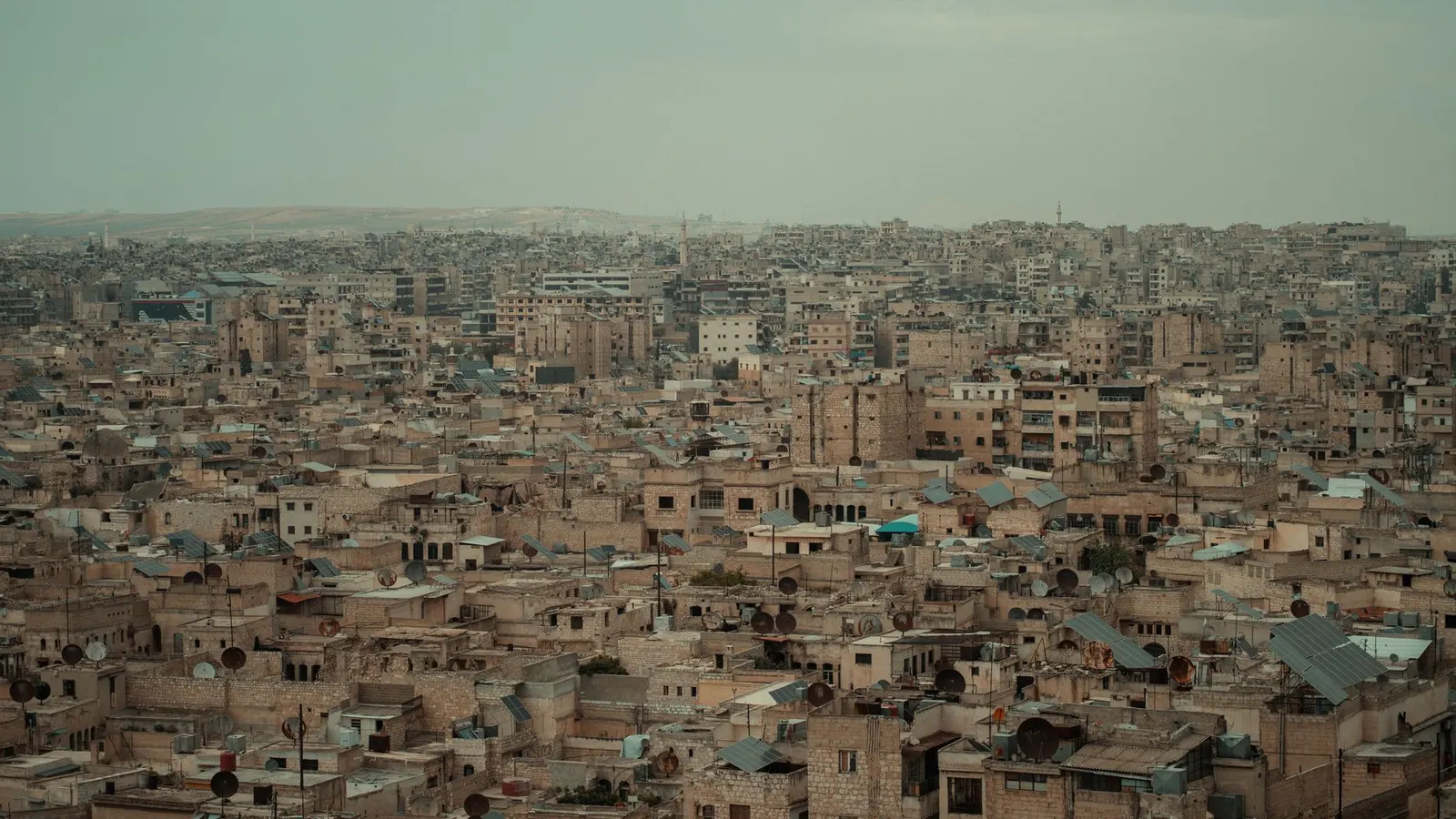
 khaled damlakhi · Pexels License
Country Guide № 169 / 194 · Middle East
Syria
Palmyra, Aleppo and Damascus - a guide written after fourteen years of war.
Advisory - travel not recommended · checked 26 Sept 2026
Foreign ministries advise against all travel to Syria. Fourteen years of war have left unexploded ordnance and mine contamination across much of the country, the security situation after the 2024 change of government remains unsettled, and consular assistance is minimal to nonexistent. Standard scores are suspended while this alert is active.
Official advisory →Every advisory in force →“Palmyra, Aleppo and Damascus - a guide written after fourteen years of war.”
Syria holds Damascus, which claims to be the oldest continuously inhabited capital on earth, Aleppo's covered souq and citadel, Palmyra's desert colonnades, and the Crac des Chevaliers, the finest crusader castle anywhere. Before 2011 it was one of the most rewarding countries in the region to travel in and one of the most hospitable.
Fourteen years of war changed all of it. Aleppo's old city was devastated and is being rebuilt; Palmyra was damaged by Islamic State and by the fighting around it; several million people were displaced. The government changed in December 2024 and the situation since has been unsettled rather than resolved. Every foreign ministry advises against all travel. Unexploded ordnance and mine contamination are among the worst in the world. This page exists to inform, not to invite.
Chapter 01
Highlights
Damascus old city
The Umayyad Mosque, the covered souq al-Hamidiyya, the Christian quarter and Straight Street - a walled city inhabited continuously for millennia and comparatively less damaged than Aleppo.
Aleppo
The citadel on its mound and the medieval souq beneath it, UNESCO-listed and severely damaged in the battle for the city. Reconstruction has been under way for several years.
Palmyra
A desert caravan city of colonnades, temples and tower tombs, damaged by Islamic State occupation and the fighting to retake it. Access depends entirely on the current situation.
Crac des Chevaliers
The best-preserved crusader castle in the world, held by the Knights Hospitaller, damaged during the war and partly restored. UNESCO-listed and, by most accounts, still extraordinary.
Chapter 02
Entry requirements for Syria
Advisory - travel not recommended · checked 26 Sept 2026
Foreign ministries advise against all travel to Syria. Fourteen years of war have left unexploded ordnance and mine contamination across much of the country, the security situation after the 2024 change of government remains unsettled, and consular assistance is minimal to nonexistent. Standard scores are suspended while this alert is active.
Official advisory →Every advisory in force →Checking your passport…
up to 15 days · €130 / $140 · embassy application
15 days on arrival
Before you fly
The detail
- Maximum stay
- up to 15 days
- Process
- embassy application
- Fee
- €130 / $140
- Processing time
- Processing takes 14–60 days - apply with room to spare.
- Passport validity
- Most destinations want validity beyond your stay, and some want six months. Check yours against the return date.
- Onward travel
- Airlines may ask for a return or onward ticket at check-in.
- Arrival form
- Visa arranged in advance or at the border through an approved operator, plus security clearance in practice.
- Health
- Hepatitis A and B, typhoid, tetanus, polio and rabies are all standard advice. The healthcare system was devastated by the war - hospitals were destroyed, medical staff left in large numbers, and drug supply is unreliable. There is no dependable evacuation route. Water and sanitation infrastructure is damaged in many areas. Bring a comprehensive medical kit.
- Money
- Cash only, in US dollars, brought in. The pound has collapsed and the banking system is severed from the international one by sanctions - no foreign card works anywhere. Multiple exchange rates operate. This is a country where you carry the entire budget and where getting it wrong strands you.
Syria requires a visa of a United States passport, and the honest description of how one is obtained is that it has changed more than once since the change of government in December 2024 and should be established close to the date rather than from any account of it, this one included. The route that has worked throughout is a visa arranged in advance - either through a Syrian mission or, more commonly for this passport, by a licensed Syrian operator who obtains the security clearance, files for the visa and meets the traveller at the border. That is not a tour in the ordinary sense; it is the mechanism by which a clearance exists at all. An electronic application route has been reported since the change of government and could not be confirmed against a government source at the time of writing, which is why no portal address is stored here: an invented or stale link on a page about entering Syria would be worse than none. The Syrian embassy in Washington has not operated since 2014, so applications are lodged at a Syrian embassy in a third country - Beirut and Amman are the usual ones - or handled entirely by the operator. The figure shown here is an approximation of the order rather than a published schedule, and the security clearance and the operator’s charge sit outside it. Visas have typically been issued for around fifteen days with extensions arranged in country. Entry is overland from Lebanon or Jordan for most visitors; commercial flights to Damascus have resumed in stages and remain thin and subject to change. There is no American diplomatic presence in Syria and there has not been since 2012: the Czech Republic acts as protecting power and what it can do is limited. No foreign card works, so the entire budget is carried in United States dollars in cash and changed there; sanctions relief since 2025 has begun to alter the banking picture, but not in a way any visitor should plan around yet. Mine and unexploded-ordnance contamination is extensive and is not confined to former front lines. An Israeli passport is not admitted to Syria, and evidence of a visit to Israel in any other passport - an Israeli stamp, an entry or exit card, or a stamp from the Jordanian or Egyptian side of a land crossing that serves only Israel - has been treated as grounds for refusal. Israel stopped stamping passports at Ben Gurion years ago, which removes the commonest form of that evidence and none of the others. And one thing that is not a visa rule and matters more than one of them. An advisory is not the border’s answer and the border’s answer is not permission: whatever Syria asks for at the counter, it is your own ministry’s current advice that decides what your insurer will cover and what a consulate could do for you, and that advice is revised far more often than any account of visa procedure. Read it in the days before you travel rather than the months before, and read the regional detail rather than the headline.
Check another destination with this passport →
Entry details: Editorial synthesis - Syrian mission guidance, licensed operator practice, foreign-ministry advisories (2025–2026) · compiled 18 Sept 2026
Who needs a visa for Syria
12 common passports| Passport | Requirement | Stay | Process |
|---|---|---|---|
| United States | e-Visa | - | Embassy visit · €130 / $140 · 14–60 d |
| United Kingdom | e-Visa | - | Embassy visit · €130 / $140 · 14–60 d |
| Germany | e-Visa | - | Embassy visit · €130 / $140 · 14–60 d |
| India | e-Visa | - | No Other passports record yet |
| China | e-Visa | - | No Other passports record yet |
| Brazil | e-Visa | - | No Other passports record yet |
| Nigeria | e-Visa | - | No Other passports record yet |
| Indonesia | e-Visa | - | No Other passports record yet |
| Philippines | e-Visa | - | No Other passports record yet |
| Vietnam | e-Visa | - | No Other passports record yet |
| Egypt | e-Visa | - | No Other passports record yet |
| Nepal | e-Visa | - | No Other passports record yet |
Holding a passport that is not listed? The picker above answers for any of them. See where your passport takes you. Source: Passport Index, updated 14 Aug 2026.
Chapter 03
When to go
BestApr–May, Sep–Oct. AvoidJun–Aug, Dec–Feb.
Warm, green and flowering - climatically the best month.
The band above each month is our editorial verdict - it weighs crowds, prices and access as well as weather. The line is average daily temperature, the bars are monthly rainfall. Select a month for the figures. Climate figures: ERA5 reanalysis via Open-Meteo, 2005–2024 normals.
Chapter 04
What it costs
A day in Syria
Comfortable · sample day
≈ $65
Line items are real prices we track. The daily budget is an editorial estimate for this level, not their sum.
Where this sits among 244 countries we have costed
There is no seasonal market to describe. A collapsed currency with multiple rates, a cash-only dollarised visitor economy and a handful of operators mean prices are set by circumstance rather than demand. What changes month to month is access, not cost.
Updated Aug 2026 · Editorial synthesis - operator quotations, traveller reports (2025–2026) · confidence low
Excludes international flights - they depend on where you fly from.
Chapter 05
Regions to know
5Damascus & the south
The old city and Umayyad Mosque, Maaloula's Aramaic-speaking villages, and Bosra's Roman theatre.
Aleppo & the north
The citadel and souq under reconstruction, the Dead Cities of the limestone massif, and St Simeon's basilica.
The coast & the mountains
Latakia and Tartus on the Mediterranean, Crac des Chevaliers, and the Alawite mountains behind them.
The Orontes valley
Hama's wooden norias on the river, Apamea's colonnade and the agricultural plain around Homs.
The desert & the east
Palmyra, the Euphrates valley and the northeast - the last under separate administration and largely inaccessible.
Chapter 06
Practical guide
Getting there
Damascus (DAM) has limited flights from a small number of regional carriers, with schedules that change without notice. Most arrivals are overland from Lebanon at the Masnaa crossing or from Jordan at Nasib. The Turkish border crossings serve the northwest under different administration. Sanctions complicate every aspect of booking and payment.
Entry formalities
Visa arranged in advance or at the border through an approved operator, plus security clearance in practice.
Getting around
Road travel between the main cities functions, with numerous checkpoints operated by different authorities. There are no useful domestic flights or rail services for visitors. Movement is normally arranged through a local operator with a driver who knows which routes are usable that week. Some regions, including parts of the northeast and the south, are under separate control and are not accessible from Damascus.
Money & costs
Cash only, in US dollars, brought in. The pound has collapsed and the banking system is severed from the international one by sanctions - no foreign card works anywhere. Multiple exchange rates operate. This is a country where you carry the entire budget and where getting it wrong strands you.
Safety
The dominant consideration. Sporadic violence continues, the security situation after December 2024 remains unsettled, unexploded ordnance is widespread, and arbitrary detention is a documented risk. Several regions are under separate armed control. There is minimal to no consular assistance for most nationalities. Photography of anything official is dangerous. Conditions can change within days.
Health
Hepatitis A and B, typhoid, tetanus, polio and rabies are all standard advice. The healthcare system was devastated by the war - hospitals were destroyed, medical staff left in large numbers, and drug supply is unreliable. There is no dependable evacuation route. Water and sanitation infrastructure is damaged in many areas. Bring a comprehensive medical kit.
SIM & internet
Mobile networks function in the main cities. Internet is filtered and monitored, and shutdowns have been used. Assume no privacy in any communication and that device inspection at the border is possible.
Chapter 07
Driving
Checkpoints operated by different authorities govern every journey and a local driver is what makes them navigable. Roadside ordnance contamination means never leaving the paved surface. Fuel supply has been unreliable for years.
Rules change - verify with an official source before you rent.
ExplWorld VerifiedNo verified partners here yet - all 6 country seats are open.
Become ExplWorld Verified →Chapter 08
Itineraries through this country
Chapter 09
From the Journal
Chapter 10
Before you go
SyriaChapter 11
Frequently asked questions
Can anyone actually go?
Visas are being issued and a small number of tour operators run trips, generally with a government-approved guide. Administratively it is possible. Every foreign ministry advises against all travel, consular capacity is minimal to nonexistent for most nationalities, and the situation after the December 2024 change of government remains unsettled with sporadic violence. Anyone considering it should speak to their own ministry first.
What about the ordnance?
Syria is one of the most contaminated countries in the world after fourteen years of war, with mines, cluster munition remnants and unexploded shells across large areas including in and around towns. Civilian casualties continue every month. The rule is absolute: stay on hard surfaces, never enter rubble, damaged buildings or agricultural land, and follow local guidance without exception.
Will my insurance cover me?
No standard policy will, and specialist war-risk cover for Syria is difficult to obtain at any price. Medical facilities have been devastated by the war and evacuation options are extremely limited. Anyone entering is effectively self-insuring against everything.