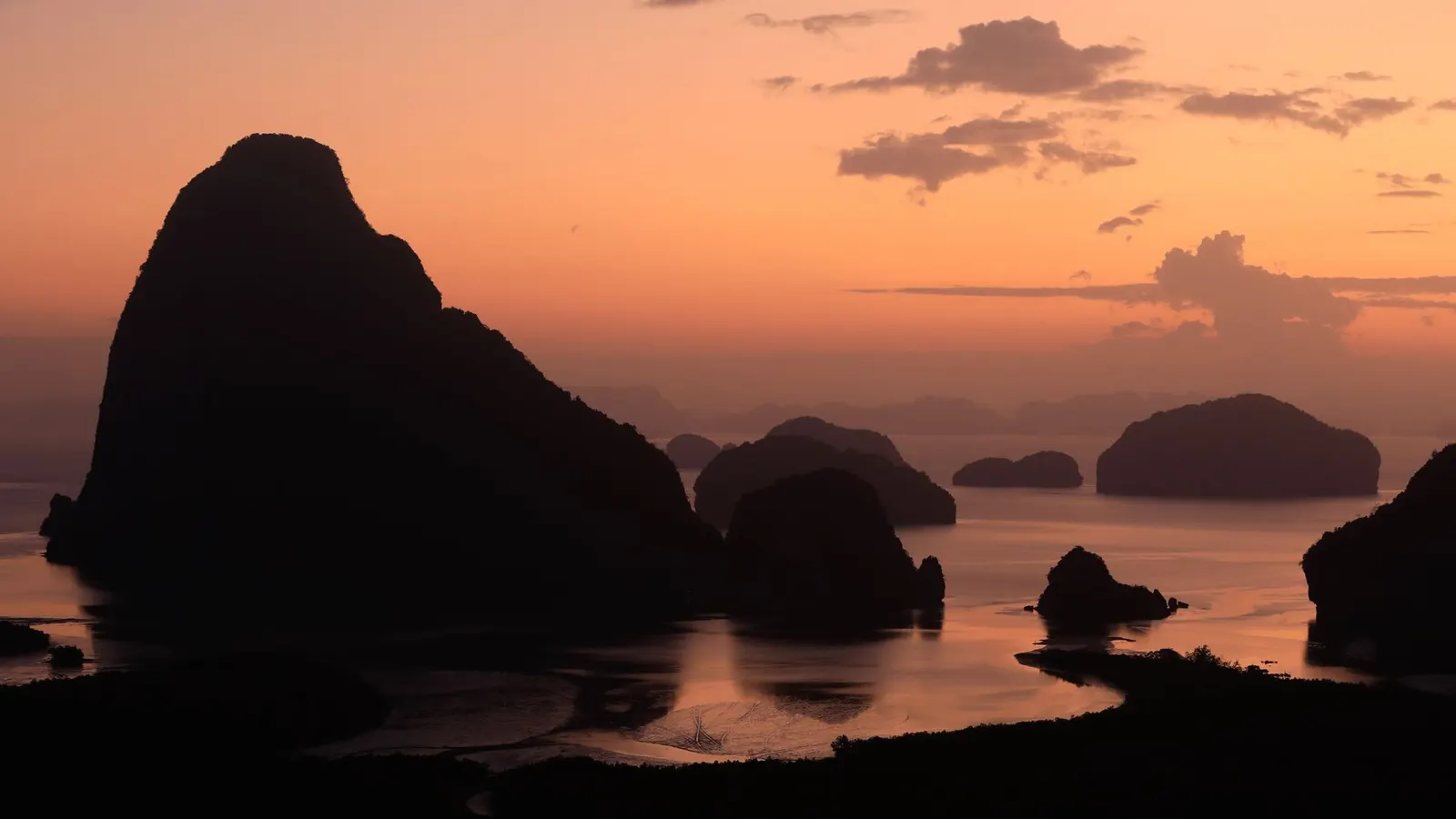
 Vladyslav Dushenkovsky · Pexels License
Country Guide № 172 / 194 · Asia
Thailand
The one everybody starts with, and the one that keeps rewarding a second look.
“The one everybody starts with, and the one that keeps rewarding a second look.”
Thailand has been absorbing travellers for fifty years and has never lost its footing. The reason is depth: for every Khao San Road there is a northern valley where nobody speaks English, for every full-moon beach a national park with hornbills and no phone signal. It is the easiest country in Asia to travel and one of the hardest to exhaust.
Treat the well-known bits as the on-ramp rather than the destination. Bangkok deserves three days minimum and rewards more; the north - Chiang Mai, Pai, the Mae Hong Son loop - is a different country in climate and culture; and the two coasts have opposite weather, so there is a good beach somewhere in Thailand in any month of the year.
Chapter 01
Highlights
Bangkok street food
Chinatown after dark on Yaowarat Road, boat noodles in Victory Monument, and the grilled-pork stalls that appear at dawn outside every BTS station. Eat where the queue is Thai.
The Mae Hong Son loop
Six hundred kilometres of switchbacks through northern hill country by motorbike or car - Pai, Mae Hong Son, Mae Sariang, hot springs and Shan villages, four days minimum.
Ayutthaya and Sukhothai
The two great ruined capitals. Sukhothai is the more beautiful and far quieter; both are best rented-bicycle at seven in the morning before the heat.
The Andaman limestone
Railay's cliffs, the Trang islands and Khao Sok's flooded jungle karst. November to April on this coast; skip Maya Bay unless you want the photograph more than the swim.
Chapter 02
Entry requirements for Thailand
Checking your passport…
up to 60 days · free entry
60 days on arrival
Before you fly
The detail
- Maximum stay
- up to 60 days
- Fee
- free entry
- Passport validity
- Most destinations want validity beyond your stay, and some want six months. Check yours against the return date.
- Onward travel
- Airlines may ask for a return or onward ticket at check-in.
- Health
- No vaccinations required; hepatitis A, typhoid and tetanus are standard advice, rabies worth considering for long or rural trips, and Japanese encephalitis for extended rural stays. Dengue is present year-round and peaks in the wet season - repellent matters more than any vaccine. Malaria risk is limited to remote border zones. Tap water is not for drinking; refill stations are widespread. Private hospitals in Bangkok, Chiang Mai and Phuket are excellent and used to insurers.
- Money
- ATMs are everywhere and all charge a fixed 220-baht foreign-card fee, so withdraw large amounts rarely. Cards work in malls, hotels and chains; markets, street food and small guesthouses are cash. Thailand has adopted QR payment nationally but the systems mostly need a Thai bank account. Tipping is not expected, though rounding up is normal.
United States passports enter visa-exempt for 60 days, the period Thailand raised from 30 in July 2024, extendable once by a further 30 days at any immigration office for 1,900 baht. Every arrival must file the Thailand Digital Arrival Card online in the days before travel - it replaced the paper TM6 form in May 2025, it is free, and the sites charging for it are selling nothing. Passport valid six months; airlines routinely demand proof of onward travel and immigration may ask for an address and funds. Entering overland is the part that catches people, because visa-exempt land crossings have been capped at two per calendar year and consecutive border runs invite refusal. Thailand has revised this period three times since 2022 and a reversion to 30 days has been floated more than once, so confirm it before booking rather than after.
Check another destination with this passport →
Entry details: Editorial synthesis - Thai Ministry of Foreign Affairs, Thai Immigration Bureau, Thailand Digital Arrival Card scheme (2025–2026) · compiled 15 Sept 2026
Who needs a visa for Thailand
12 common passports| Passport | Requirement | Stay | Process |
|---|---|---|---|
| United States | Visa-free | up to 60 days | No process · €0 / $0 |
| United Kingdom | Visa-free | up to 60 days | No process · €0 / $0 |
| Germany | Visa-free | up to 60 days | No process · €0 / $0 |
| India | Visa-free | up to 60 days | No Other passports record yet |
| China | Visa-free | up to 60 days | No Other passports record yet |
| Brazil | Visa-free | up to 90 days | No Other passports record yet |
| Nigeria | e-Visa | - | No Other passports record yet |
| Indonesia | Visa-free | up to 60 days | No Other passports record yet |
| Philippines | Visa-free | up to 60 days | No Other passports record yet |
| Vietnam | Visa-free | up to 60 days | No Other passports record yet |
| Egypt | e-Visa | - | No Other passports record yet |
| Nepal | e-Visa | - | No Other passports record yet |
Holding a passport that is not listed? The picker above answers for any of them. See where your passport takes you. Source: Passport Index, updated 15 Aug 2026.
Chapter 03
When to go
BestNov–Feb. AvoidApril, September.
Cool dry season everywhere - the best month, and priced accordingly.
The band above each month is our editorial verdict - it weighs crowds, prices and access as well as weather. The line is average daily temperature, the bars are monthly rainfall. Select a month for the figures. Climate figures: ERA5 reanalysis via Open-Meteo, 2005–2024 normals.
Chapter 04
What it costs
A day in Thailand
Comfortable · sample day
≈ $49
Line items are real prices we track. The daily budget is an editorial estimate for this level, not their sum.
Where this sits among 244 countries we have costed
Island and beach accommodation doubles between the November–February high season and the wet months, and triples over Christmas and New Year on Phuket, Koh Samui and Koh Lanta. Bangkok and the north barely move. Food, transport and scooter rental are flat all year.
Updated Aug 2026 · Editorial synthesis - Budget Your Trip, Tourism Authority of Thailand, published rail and ferry fares (2025–2026) · confidence high
Excludes international flights - they depend on where you fly from.
Chapter 05
Regions to know
5Bangkok & the central plains
The capital plus Ayutthaya's ruins and the floating-market canals - the entry point and, given three days, a destination.
The north
Chiang Mai, Pai and the Mae Hong Son loop: cooler air, Lanna temples, hill villages and the country's best trekking.
Isaan (the northeast)
The least-visited third of Thailand - Khmer temple ruins, the Mekong border road and the spiciest food in the country.
The Andaman coast
Limestone cliffs and clear water from Phuket down to Trang, plus the flooded jungle lake at Khao Sok. November to April.
The Gulf islands
Koh Samui, Koh Phangan and the diving school capital Koh Tao - driest when the Andaman is wet.
Chapter 06
Practical guide
Getting there
Bangkok Suvarnabhumi (BKK) is the regional hub, with direct flights from London, Paris, Frankfurt, Munich, Zurich, Vienna, Istanbul and the Gulf; Don Mueang (DMK) handles budget carriers and is a separate airport - leave three hours between them. Chiang Mai and Phuket take direct regional flights from across Asia. Overland entry is straightforward from Malaysia and Laos, more complicated from Cambodia (scam-prone land borders) and closed in practice from Myanmar.
Getting around
Domestic flights are cheap enough to change the shape of a trip - Bangkok to Chiang Mai or Phuket runs €30–60. Overnight sleeper trains to Chiang Mai and the south are comfortable and worth doing once. Long-distance VIP buses are fast; minivans are faster and less safe. In Bangkok, use the BTS and MRT plus Grab; on the islands, songthaews and rented scooters. Rent a scooter only with the right licence and a helmet - this is the single most common way travellers get hurt here.
Money & costs
ATMs are everywhere and all charge a fixed 220-baht foreign-card fee, so withdraw large amounts rarely. Cards work in malls, hotels and chains; markets, street food and small guesthouses are cash. Thailand has adopted QR payment nationally but the systems mostly need a Thai bank account. Tipping is not expected, though rounding up is normal.
Safety
Thailand is safe in the ordinary sense - violent crime against visitors is rare. The dangers are traffic (one of the world's worst road-death rates, mostly motorbikes), drowning on unlifeguarded beaches with rip currents, and drink spiking in party areas. Scams are commercial rather than violent: the closed-temple tuk-tuk gem run, jet-ski damage claims, rigged taxi meters. The far south (Yala, Pattani, Narathiwat) carries a live insurgency and standing advisories.
Health
No vaccinations required; hepatitis A, typhoid and tetanus are standard advice, rabies worth considering for long or rural trips, and Japanese encephalitis for extended rural stays. Dengue is present year-round and peaks in the wet season - repellent matters more than any vaccine. Malaria risk is limited to remote border zones. Tap water is not for drinking; refill stations are widespread. Private hospitals in Bangkok, Chiang Mai and Phuket are excellent and used to insurers.
SIM & internet
Tourist SIMs (AIS, TrueMove, dtac) cost €8–15 at any airport for a month of generous data; eSIM works equally well. Coverage is total apart from deep national park interiors. Wifi is universal in accommodation and cafés. Line is the dominant messaging app for businesses; WhatsApp is used with foreigners.
Chapter 07
Driving
Traffic discipline is loose and overtaking on blind curves is normal upcountry. The Mae Hong Son loop is a genuinely great drive; Bangkok is not worth driving in at all.
Rules change - verify with an official source before you rent.
ExplWorld VerifiedNo verified partners here yet - all 6 country seats are open.
Become ExplWorld Verified →Chapter 08
Itineraries through this country
Chapter 09
From the Journal
Chapter 10
Before you go
ThailandChapter 11
Frequently asked questions
How long can I stay without a visa?
Since mid-2024 most Western passports get 60 days visa-exempt on arrival, extendable once by 30 days at an immigration office for 1,900 baht (about €48). The rule has changed repeatedly in recent years - confirm the current period with the Thai embassy or your airline before you fly, because it is the airline that will stop you at check-in.
Which coast should I go to, and when?
The Andaman side (Phuket, Krabi, Koh Lanta) is at its best November to April. The Gulf side (Koh Samui, Koh Phangan, Koh Tao) is drier May to September and takes its heaviest rain in November. That inversion means the beach season never really closes - it just moves.
Is Thailand still cheap?
Yes by European standards, no by its own history. Mid-range travel runs about €45 a day; a backpacker on street food, fan rooms and buses manages €25. What has risen fastest is island accommodation and anything on Phuket - inland and northern Thailand cost roughly what they did five years ago.