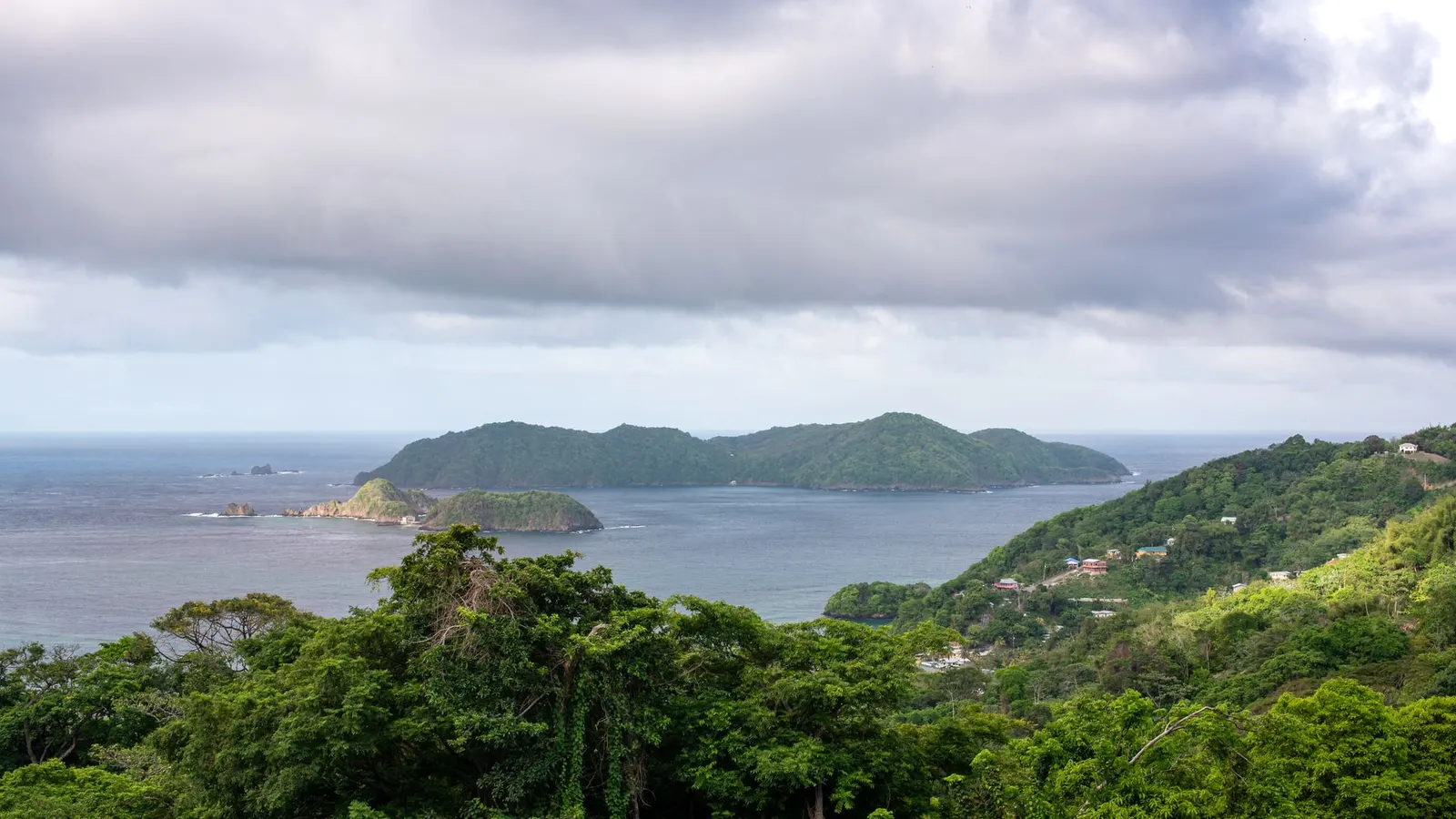
 Dominik Gryzbon · Pexels License
Country Guide № 176 / 194 · Caribbean
Trinidad and Tobago
Carnival’s birthplace - doubles at dawn, scarlet ibis at dusk, and Tobago’s slow blue weekends.
“Carnival’s birthplace - doubles at dawn, scarlet ibis at dusk, and Tobago’s slow blue weekends.”
Trinidad and Tobago doesn’t do the standard Caribbean pitch. Trinidad is a working country - oil, gas, and the most compelling cultural mix in the region, where Indian and African heritages fused into calypso, soca, steelpan and a street-food canon (doubles, roti, bake and shark) that embarrasses islands twice as touristed. Its Carnival, climaxing the two days before Ash Wednesday, is the hemisphere’s greatest street festival and the axis the national year turns on.
Twenty-five minutes’ flight away, Tobago is the holiday: reef-fringed bays, one of the western hemisphere’s oldest protected rainforests, goat races at Easter and Sunday School - the open-air party in Buccoo, not a church service. Nature ties the two together: leatherback turtles nest on both islands’ beaches, and the Caroni Swamp’s evening blizzard of scarlet ibis is one of the great bird spectacles anywhere. Bonus: the country sits south of the main hurricane belt.
Chapter 01
Highlights
Carnival
Two days of mas bands, soca and steelpan through Port of Spain, fed by weeks of fetes and Panorama rehearsals - play mas in a band and you’re a participant, not a spectator.
Caroni Swamp at dusk
Flat-bottomed boats glide the mangrove channels as thousands of scarlet ibis flame home to roost - one of the world’s great bird spectacles, minutes from the capital.
Leatherbacks at Grande Riviere
From March to June, hundreds of half-tonne leatherback turtles haul up nightly onto one village beach on Trinidad’s north coast - among the densest nesting sites on earth.
Tobago’s Buccoo Reef & Nylon Pool
Glass-bottom boats cross the reef to a waist-deep sandbar pool in open sea; stay for Sunday School, Buccoo’s weekly street party of steelpan and soca.
Chapter 02
Entry requirements for Trinidad and Tobago
Checking your passport…
up to 90 days · free entry
90 days on arrival
Official portal only
Paid look-alike sites charge for a process that is free or cheap on the government portal. Use the link below and nothing else.
travel.gov.tt →Before you fly
The detail
- Maximum stay
- up to 90 days
- Fee
- free entry
- Passport validity
- Most destinations want validity beyond your stay, and some want six months. Check yours against the return date.
- Onward travel
- Airlines may ask for a return or onward ticket at check-in.
- Health
- No special vaccinations required; hepatitis A and typhoid are standard, and a yellow fever certificate is needed only if arriving from an affected country. Dengue circulates - repellent, especially in the wet season. Tap water is officially treated; most visitors drink bottled. Sandflies on Tobago’s beaches at dusk are the most reliable irritant. Good private clinics exist in Port of Spain; carry insurance regardless.
- Money
- The TT dollar trades around 7.3 to the euro (managed near 6.8 to the US dollar). Cards are fine in malls, supermarkets and restaurants; street food, maxi-taxis, beach bars and markets run on cash. ATMs are everywhere in towns - less so on Trinidad’s north-east coast, so cash up before Grande Riviere. Prices are quoted in TTD; US dollars are not the parallel currency they are elsewhere in the Caribbean.
A United States passport needs no visa for Trinidad and Tobago and is admitted for up to three months. Two things separate this border from the rest of the region. The first is the paperwork: since 17 March 2026 the paper card is gone and the arrival AND departure declarations are both made online on the government's travel portal, up to 72 hours before each journey, each answered with a QR code to show at the counter - the only country in this group that also asks for a form on the way out. The second is the questioning. Immigration here is stricter than its neighbours: expect to be asked the purpose of the visit, to give the address you are staying at and to show the onward ticket, and expect the officer to write a shorter date than the maximum. Immigration here asks for more than a passport: an onward or return ticket, an address for every night you are booked, and, where the officer is not satisfied, some evidence that you can pay for the stay. Those questions come at the desk rather than at the gate, and the answer that gets people turned round is that they will work it out when they arrive. It is free on the government address given here and on no other: the sites that outrank it in search charge twenty to a hundred dollars to type your answers into the same boxes. The period recorded here is the maximum the law allows rather than the one you will be given: the officer writes a date in the passport, usually the date of your return flight, and it is that written date you must not overstay. The Port of Spain–Scarborough air bridge and ferry are domestic - Tobago needs no second clearance. CARICOM is not a Schengen. It moves goods, capital and its own skilled nationals, and it creates no common visa, no common stamp and no common arrival form for visitors, so an island-hopping trip clears immigration from scratch every time it lands. The departure and security taxes these islands levy sit inside the air fare and are not an entry fee, but keep a little local cash back anyway for ferry departures and small-island counters, where they are still sometimes collected at a desk.
Check another destination with this passport →
Entry details: Editorial synthesis - Trinidad and Tobago Ministry of Homeland Security online arrival and departure card platform, immigration division arrival guidance (2026) · compiled 18 Sept 2026
Who needs a visa for Trinidad and Tobago
12 common passports| Passport | Requirement | Stay | Process |
|---|---|---|---|
| United States | Visa-free | up to 90 days | No process · €0 / $0 |
| United Kingdom | Visa-free | - | No process · €0 / $0 |
| Germany | Visa-free | up to 90 days | No process · €0 / $0 |
| India | Visa-free | up to 90 days | No Other passports record yet |
| China | Visa required | - | No Other passports record yet |
| Brazil | Visa-free | up to 90 days | No Other passports record yet |
| Nigeria | Visa required | - | No Other passports record yet |
| Indonesia | Visa required | - | No Other passports record yet |
| Philippines | Visa on arrival | - | No Other passports record yet |
| Vietnam | Visa required | - | No Other passports record yet |
| Egypt | Visa required | - | No Other passports record yet |
| Nepal | Visa required | - | No Other passports record yet |
Holding a passport that is not listed? The picker above answers for any of them. See where your passport takes you. Source: Passport Index, updated 14 Aug 2026.
Chapter 03
When to go
BestJan–May.
Dry season; Carnival fetes and Panorama build all month.
The band above each month is our editorial verdict - it weighs crowds, prices and access as well as weather. The line is average daily temperature, the bars are monthly rainfall. Select a month for the figures. Climate figures: ERA5 reanalysis via Open-Meteo, 2005–2024 normals.
Chapter 04
What it costs
A day in Trinidad and Tobago
Comfortable · sample day
≈ $108
Line items are real prices we track. The daily budget is an editorial estimate for this level, not their sum.
Where this sits among 244 countries we have costed
Outside Carnival, prices barely move with the seasons - this is a working economy, not a resort one. Carnival week is the exception that swallows the rule: Port of Spain accommodation triples or worse, mas-band costumes run €400+, and fete tickets stack up fast; book months ahead. Tobago adds a modest premium over Christmas–New Year and Easter.
Updated Aug 2026 · Editorial synthesis - Budget Your Trip, Numbeo Port of Spain, Caribbean cost guides (2025–2026) · confidence medium
Excludes international flights - they depend on where you fly from.
Chapter 05
Regions to know
5Port of Spain & the west
The capital’s Queen’s Park Savannah, panyards and street-food strips, with the Caroni Swamp’s scarlet ibis and the Chaguaramas peninsula on its doorstep.
The Northern Range & north coast
Rainforest peaks, the Asa Wright bird lodge, and the hairpin road over to Maracas Bay - bake and shark on the sand - continuing to wild Blanchisseuse.
The east & Grande Riviere
Coconut-lined Atlantic beaches down the Manzanilla road, and the leatherback nesting beach at Grande Riviere - hundreds of turtles a night in season.
San Fernando & the south
Trinidad’s industrial second city, Indo-Trinidadian heartland towns, and the surreal asphalt expanse of Pitch Lake at La Brea - the world’s largest natural bitumen deposit.
Tobago
Reef bays from Pigeon Point to Englishman’s Bay, the protected Main Ridge rainforest, diving at Speyside and Buccoo’s Sunday School party - the slow half of the country.
Chapter 06
Practical guide
Getting there
Piarco (POS) outside Port of Spain is the hub: Caribbean Airlines and US carriers link Miami, New York, Orlando and Houston, with London reachable via British Airways’ Caribbean network or a US one-stop; from Central Europe count on two legs. Tobago’s ANR Robinson airport (TAB) has seasonal European leisure flights plus the constant domestic air bridge. Book Carnival-week flights and rooms months ahead.
Getting around
On Trinidad, colour-coded maxi-taxis (minibuses) and shared route taxis run fixed corridors cheaply; ride apps and hotel drivers cover the gaps. A rental car suits the north coast and the east - drive on the left. Between islands, the Caribbean Airlines air bridge takes about 25 minutes for roughly €20 one way, or the Port of Spain–Scarborough fast ferry crosses in about four hours. On Tobago, rental cars and route taxis cover the single coastal loop easily.
Money & costs
The TT dollar trades around 7.3 to the euro (managed near 6.8 to the US dollar). Cards are fine in malls, supermarkets and restaurants; street food, maxi-taxis, beach bars and markets run on cash. ATMs are everywhere in towns - less so on Trinidad’s north-east coast, so cash up before Grande Riviere. Prices are quoted in TTD; US dollars are not the parallel currency they are elsewhere in the Caribbean.
Safety
Treat the two islands separately. Tobago: standard beach-holiday sense. Trinidad: avoid Laventille, Beetham and Sea Lots entirely, use registered taxis or apps after dark in Port of Spain, and keep phones out of sight downtown. Crime spikes drove a state of emergency in late 2024; conditions change, so check current advisories. During Carnival stick with your band and use the official transport laid on after night events.
Health
No special vaccinations required; hepatitis A and typhoid are standard, and a yellow fever certificate is needed only if arriving from an affected country. Dengue circulates - repellent, especially in the wet season. Tap water is officially treated; most visitors drink bottled. Sandflies on Tobago’s beaches at dusk are the most reliable irritant. Good private clinics exist in Port of Spain; carry insurance regardless.
SIM & internet
Digicel and bmobile both run strong LTE across the populated coasts of both islands; the Northern Range interior and the far north-east drop out. A visitor SIM or eSIM with 10–15 GB costs €10–15 with a passport. Wifi is standard in guesthouses and cafés; Port of Spain has a genuine remote-work café scene around Woodbrook and St Clair.
Chapter 07
Driving
Drive on the left. Trinidad’s highways are good but Port of Spain rush hour is genuinely heavy; the north-coast and Toco roads are slow, winding and worth it. Tobago is easy, slow driving on one coastal loop. Watch for flash flooding in the wet season.
Rules change - verify with an official source before you rent.
ExplWorld VerifiedNo verified partners here yet - all 6 country seats are open.
Become ExplWorld Verified →Chapter 08
Itineraries through this country
Chapter 09
From the Journal
Chapter 10
Before you go
Trinidad and TobagoChapter 11
Frequently asked questions
Is Trinidad and Tobago safe?
Tobago is relaxed and low-risk. Trinidad demands more judgement: violent crime is concentrated in specific Port of Spain districts (Laventille, Beetham, Sea Lots) that visitors have no reason to enter, and a crime-driven state of emergency was declared as recently as late 2024. Use registered taxis or ride apps at night, don’t flash valuables downtown, and take local advice on which fetes and beaches to reach with a driver. Carnival itself is heavily policed and overwhelmingly friendly.
When is the best time to visit?
January to May is the dry season - and February usually means Carnival, the peak of the national year (book rooms months ahead at triple rates). The wet season, June to December, brings afternoon downpours rather than washouts, plus a mini dry spell (the petit carême) around September. T&T sits south of the main hurricane belt, so the Sep–Oct storm anxiety of the northern islands barely applies.
How much does a day cost?
Around €100 (≈ $108) a day mid-range - decent guesthouse, restaurant dinners, a rental car share or taxis. Street food keeps budgets honest: doubles cost under €1, a roti €4. Backpackers manage on €50 (≈ $54). Carnival is the exception - accommodation triples or worse for the week, and a costume in a mas band runs €400+.