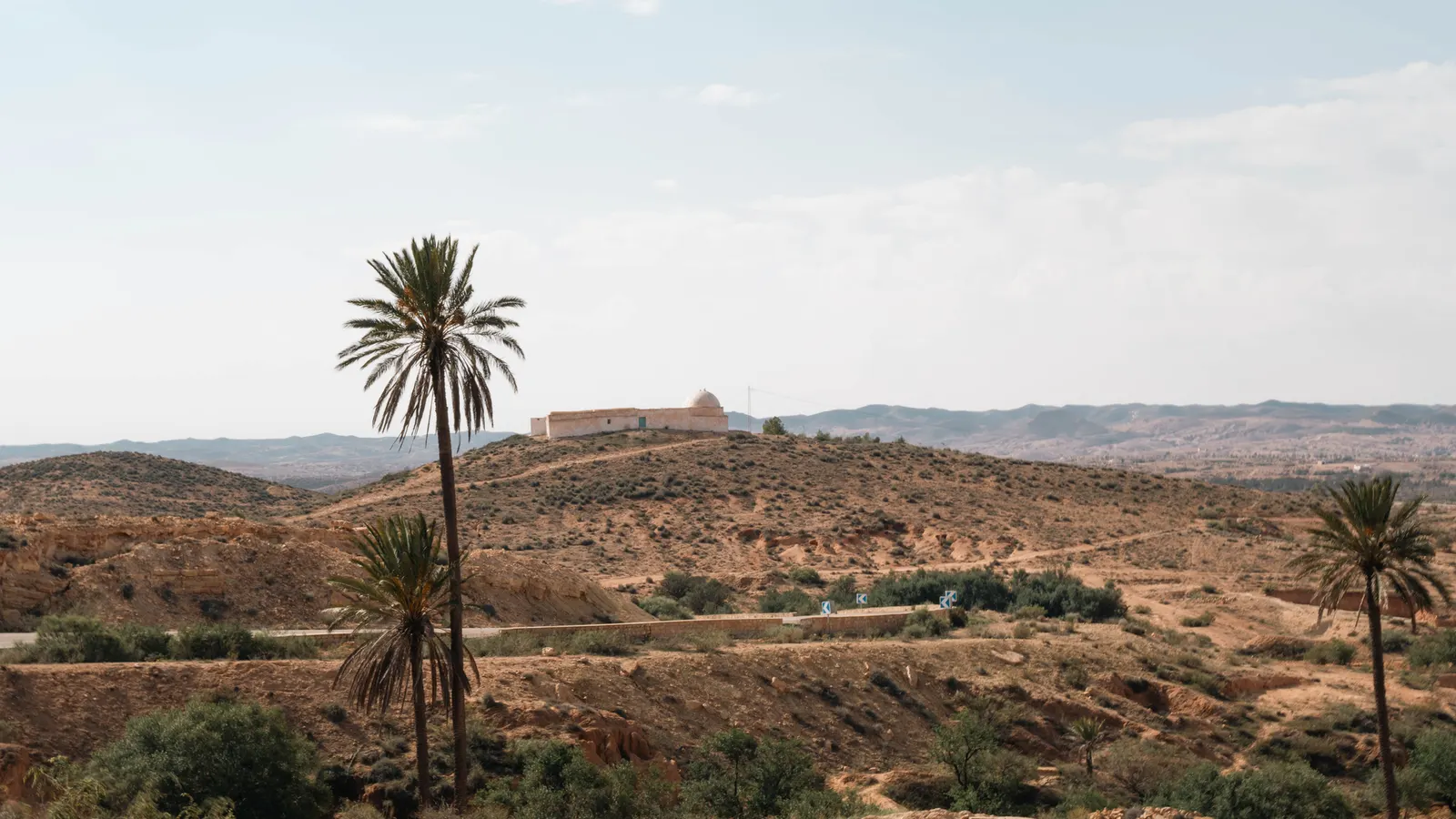
 Eleanore Stohner · Pexels License
Country Guide № 177 / 194 · Africa
Tunisia
Roman amphitheatres, Mediterranean beaches and the northern edge of the Sahara.
“Roman amphitheatres, Mediterranean beaches and the northern edge of the Sahara.”
Tunisia packs an unreasonable amount into a country the size of Greece. Carthage sits on the Gulf of Tunis where Rome eventually flattened it; El Djem holds the third-largest Roman amphitheatre anywhere, standing almost intact in a small inland town; Kairouan is one of the oldest mosque cities in the Islamic world. Between them are salt flats, Berber granaries in the south and 1,300 kilometres of Mediterranean coast.
It is also the cheapest Mediterranean country by a wide margin, which is why the coastal resorts around Hammamet and Djerba fill with European package tourists in summer. Skip them and the country is quiet. Distances are modest - Tunis to Tozeur is a day's drive - and a week covers the classic loop of Roman sites, holy city and desert edge without rushing.
Chapter 01
Highlights
El Djem amphitheatre
A 35,000-seat Roman amphitheatre in an otherwise unremarkable inland town, better preserved than the Colosseum in places and usually near-empty. You can walk the underground corridors where animals and fighters were held.
Carthage and Sidi Bou Said
The Punic and Roman ruins spread across a wealthy Tunis suburb, best combined with the blue-and-white clifftop village of Sidi Bou Said next door. The Bardo Museum in the city holds the mosaics lifted from these sites.
Kairouan
The fourth holiest city in Sunni Islam, built around the Great Mosque of Uqba with its forest of reused Roman columns. The old medina is still a working carpet town rather than a curated one.
The southern oases and Chott el Jerid
Tozeur, Nefta and the mountain oases of Chebika and Tamerza sit on the edge of the Sahara, reached across the Chott el Jerid salt pan. Star Wars sets at Ong Jemel and Matmata's underground Berber houses are nearby.
Chapter 02
Entry requirements for Tunisia
Checking your passport…
up to 90 days · free entry
90 days on arrival
Before you fly
The detail
- Maximum stay
- up to 90 days
- Fee
- free entry
- Passport validity
- Most destinations want validity beyond your stay, and some want six months. Check yours against the return date.
- Onward travel
- Airlines may ask for a return or onward ticket at check-in.
- Health
- Tap water is chlorinated and generally safe in cities but most visitors drink bottled. Private clinics in Tunis and Sousse are good; state hospitals are stretched. No vaccinations are required for entry from Europe or North America.
- Money
- Cash economy outside hotels and the larger supermarkets. ATMs are everywhere in the north and on the coast, thinner in the south. Cards are accepted in hotels and mid-range restaurants but not in medinas, louages or most cafés.
What changed
A United States passport enters Tunisia visa-free for up to 90 days with nothing arranged in advance and no arrival form to file. Airlines apply a three-month passport validity rule even though the legal requirement is validity for the stay, and they may ask for a return ticket and an address; arrivals on a package charter with a confirmed hotel booking have historically had the lightest process of all at Djerba and Enfidha. Two practical things catch American visitors more often than immigration does. The dinar is a closed currency that may not legally be taken out of the country: change what you need, keep the exchange receipts, and convert the rest back before you reach the airport, because the receipts are what let you. And drones are effectively banned for visitors - bringing one in requires prior authorisation and they are routinely seized at customs, with the paperwork to recover them taking longer than most holidays. Overstaying is billed at departure as a fine, payable in dinars before you are allowed to leave. The southern border zones with Algeria and Libya are subject to their own restrictions and to a standing military exclusion area, so read the current advisory before planning anything in the desert.
Check another destination with this passport →
Entry details: Editorial synthesis - Tunisian Ministry of Foreign Affairs entry rules, Tunisian customs and currency regulations (2025–2026) · compiled 17 Sept 2026
Who needs a visa for Tunisia
12 common passports| Passport | Requirement | Stay | Process |
|---|---|---|---|
| United States | Visa-free | up to 90 days | No process · €0 / $0 |
| United Kingdom | Visa-free | up to 90 days | No process · €0 / $0 |
| Germany | Visa-free | up to 120 days | No process · €0 / $0 |
| India | Visa required | - | No Other passports record yet |
| China | Visa-free | up to 90 days | No Other passports record yet |
| Brazil | Visa-free | up to 90 days | No Other passports record yet |
| Nigeria | Visa required | - | No Other passports record yet |
| Indonesia | Visa-free | up to 90 days | No Other passports record yet |
| Philippines | Visa required | - | No Other passports record yet |
| Vietnam | Visa required | - | No Other passports record yet |
| Egypt | Visa required | - | No Other passports record yet |
| Nepal | Visa required | - | No Other passports record yet |
Holding a passport that is not listed? The picker above answers for any of them. See where your passport takes you. Source: Passport Index, updated 14 Aug 2026.
Chapter 03
When to go
BestApr–May, Sep–Oct. AvoidJul–Aug.
The best month - warm, green, uncrowded.
The band above each month is our editorial verdict - it weighs crowds, prices and access as well as weather. The line is average daily temperature, the bars are monthly rainfall. Select a month for the figures. Climate figures: ERA5 reanalysis via Open-Meteo, 2005–2024 normals.
Chapter 04
What it costs
A day in Tunisia
Comfortable · sample day
≈ $63
Line items are real prices we track. The daily budget is an editorial estimate for this level, not their sum.
Where this sits among 244 countries we have costed
Coastal hotel rates roughly double in July and August and collapse from November to March. Inland and desert prices barely move.
Updated Aug 2026 · Editorial synthesis - on-the-ground price sampling and published tariffs (2025–2026) · confidence medium
Excludes international flights - they depend on where you fly from.
Chapter 05
Regions to know
5Tunis and the north
The capital, Carthage, Sidi Bou Said and the cork forests and Roman sites of the Tell. Greenest and wettest part of the country.
The Sahel coast
Sousse, Monastir, Mahdia and El Djem - beaches, ribats and the great amphitheatre, linked by the coastal railway.
Kairouan and the centre
The holy city, the carpet trade and the dry steppe that separates coast from desert.
The south and the oases
Tozeur, Nefta, Douz, the Chott el Jerid salt pan, Matmata's pit dwellings and the Ksour granaries near Tataouine.
Djerba
A flat, low-key island with one of the oldest Jewish communities in North Africa, whitewashed menzel farmsteads and package resorts along the east shore.
Chapter 06
Practical guide
Getting there
Tunis–Carthage is the main gateway with wide European coverage; Enfidha and Djerba take mostly charter and low-cost seasonal traffic. Ferries run from Marseille, Genoa, Civitavecchia and Palermo to Tunis, and taking a car across is straightforward.
Getting around
SNCFT trains run the coastal spine north–south and are cheap but slow. Louages - shared inter-city minibuses leaving when full from dedicated stations - are the workhorse of Tunisian travel and reach almost every town. Metro and TGM light rail cover greater Tunis.
Money & costs
Cash economy outside hotels and the larger supermarkets. ATMs are everywhere in the north and on the coast, thinner in the south. Cards are accepted in hotels and mid-range restaurants but not in medinas, louages or most cafés.
Safety
Petty theft in the Tunis medina and around the main resorts is the realistic risk. The persistent hassle in tourist areas is commercial rather than dangerous. Avoid the Algerian and Libyan border zones flagged in your government's advisory.
Health
Tap water is chlorinated and generally safe in cities but most visitors drink bottled. Private clinics in Tunis and Sousse are good; state hospitals are stretched. No vaccinations are required for entry from Europe or North America.
SIM & internet
Ooredoo, Orange and Tunisie Telecom all sell tourist SIMs at the airport and in town; you need your passport. 4G covers the whole populated country; coverage thins in the deep south.
Chapter 07
Driving
Police checkpoints are frequent and routine - slow down, stop if waved, have licence and rental papers to hand. Driving after dark outside cities is best avoided: unlit vehicles, animals and unmarked roadworks are common.
Rules change - verify with an official source before you rent.
ExplWorld VerifiedNo verified partners here yet - all 6 country seats are open.
Become ExplWorld Verified →Chapter 08
Itineraries through this country
Chapter 09
From the Journal
Chapter 10
Before you go
TunisiaChapter 11
Frequently asked questions
Is Tunisia safe for tourists?
The coastal and northern tourist regions are calm and have been for years. Most governments advise against travel to the Chaambi Mountains on the Algerian border and to the militarised zones near the Libyan frontier in the far south - neither is anywhere near the standard itinerary. Check your own government's current advisory before booking, as the restricted zones are redrawn periodically.
Can I bring dinars in or out?
No. The Tunisian dinar is a closed currency: it cannot legally be taken across the border in either direction and is not sold abroad. Change on arrival, keep your exchange receipts, and convert leftovers back at the airport before security - you need the receipts to do it, and there is a cap on how much you can convert back.
Do I need to hire a car?
Not for the coast - trains link Tunis, Sousse, Sfax and Gabès, and louage shared minibuses cover everything else cheaply. For the southern desert loop a car makes a real difference, and a 4x4 is worth it only if you plan to leave the tarmac around Ksar Ghilane.