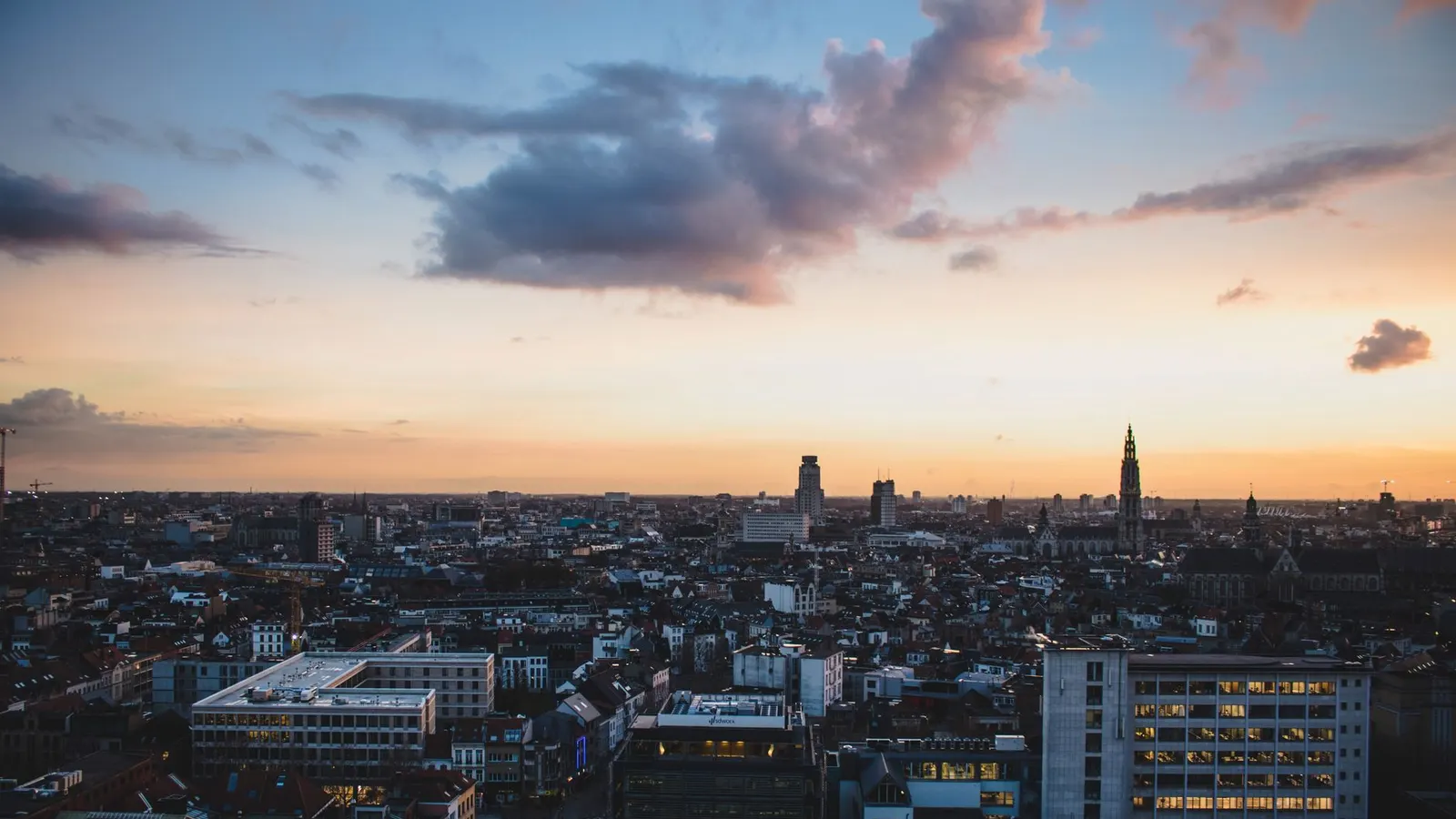
 Ayşe7 · Pexels License
Itinerary · Europe · 14 days · Easy
Three Languages, West to East
Ostend→Ieper→Tyne Cot Cemetery, Passendale→Bruges→Ghent→Antwerp+8 stops
The whole country on the trains that cross it - the North Sea and the Westhoek battlefields, Bruges, Ghent and Antwerp, two days in Brussels, the coalfields and hydraulic boat lifts of Wallonia, the Ardennes, and the nine German-speaking communes at the far end that Belgium was handed in 1920.
Ostend and the coast tram
Belgium's working seaside town rather than its pretty one: a fishing harbour, Leopold II's 400-metre colonnade along the front, and the Mu.ZEE collection, which hangs James Ensor - born here in 1860 and painter of the town as a carnival - alongside Spilliaert and the rest of the Belgian moderns. Check the address before you go: the museum's own building on the Romestraat closed in January 2025 for a renovation running to 2028 and is showing in the Venetian Galleries on the seafront in the meantime, while Ensor's house on the Vlaanderenstraat, reopened in 2024, is a separate ticket and the better hour. The largest Ensor holding anywhere is not in Ostend at all but in Antwerp, later on this route. In the afternoon take the Kusttram, which runs the length of the coast from De Panne on the French border to Knokke on the Dutch one and is the longest tram line in the world. A day ticket rides all of it; the western end drops you at the biggest dune system in the country.
Ieper
The town was shelled to powder between 1914 and 1918 and then rebuilt to its own medieval drawings; the Cloth Hall was not finished until 1967 and now holds the In Flanders Fields Museum. The Menin Gate carries close to 55,000 names of Commonwealth dead with no known grave. At eight the roads shut and buglers of the local fire brigade sound the Last Post, as they have every evening since 1928 - the sequence broke only for the German occupation and resumed on the evening the town was freed in September 1944, with fighting still going on nearby.
The salient
Hire bikes at the station - the ground is flat and the whole salient fits into a day. Tyne Cot at Passendale is the largest Commonwealth cemetery anywhere, close to twelve thousand graves with roughly seven in ten unnamed, and a memorial wall behind it carrying nearly 35,000 more names that would not fit on the Menin Gate. South at Wijtschate and Mesen the mines fired at ten past three on the morning of 7 June 1917 left craters that are now ponds; the one at Spanbroekmolen is owned by a British trust and called the Pool of Peace.
Brugge
Bruges stalled when the Zwin silted up and Antwerp took its trade, and that failure is the reason it still looks like this - there was never money to knock it down and build again. The Groeningemuseum has Van Eyck's Madonna with Canon van der Paele of 1436; the Church of Our Lady has a Michelangelo Madonna bought by Bruges merchants in 1504, the only sculpture of his that left Italy in his lifetime.
Gent
Bigger, younger and less finished than Bruges, with a university that keeps it awake. The Ghent Altarpiece of 1432 sits in its own glass room in Saint Bavo's; a restoration begun in 2012 took 1550s overpaint off the lamb and gave it back a face that made news round the world when the panel went back into the cathedral in January 2020. One panel, the Just Judges, was stolen in April 1934 and has never been recovered - the replacement painted in its place is a signed copy.
Antwerpen
The port that ended Bruges and is now the second largest in Europe by tonnage. The Red Star Line sheds on the Rijnkaai are a museum to the roughly two million people who left Europe through them for North America between 1873 and 1934, built into the buildings where the medical inspection was actually done. The diamond quarter behind Centraal Station still clears a large share of the world's rough stones, though a smaller one every year as Dubai and Surat take the trade.
Brussels
The Grand-Place, and then out of it quickly. The Royal Museums of Fine Arts for the Bruegels, the Old England building for the instrument collection, and an afternoon in Matongé or the Marolles for the city people actually live in. Brussels is the country's only officially bilingual region, which is why every street sign here carries both names; elsewhere signs are single-language, bar the couple of dozen communes along the language borders that have facilities for the other side.
Horta, and what was pulled down
Victor Horta built the Hôtel Tassel in a side street in 1893 and more or less began Art Nouveau with it; four of his town houses were listed by UNESCO in 2000, and his own house and studio in Saint-Gilles is the one to book ahead. Then walk to the corner where his Maison du Peuple stood until 1965, when it was demolished for an office tower - the argument that followed gave the world the word Brusselisation, and the Palais de Justice up the hill has been under scaffolding so long that parts of the scaffolding have had to be replaced.
Mons and the Borinage
The British Expeditionary Force met the German army here on 23 August 1914, and the cemetery at Saint-Symphorien holds the first British soldier killed in the war and one of the last, a few metres apart. West of the city, Grand-Hornu is a neoclassical colliery laid out between 1810 and 1830 with 450 workers' houses around it: closed in 1954, close to demolition, bought in 1971 by an architect who refused to let it go, and listed by UNESCO in 2012. Van Gogh spent 1879 and 1880 down the road at Cuesmes and decided there to become a painter.
The lifts on the Canal du Centre
Four hydraulic boat lifts to an English design still work the old canal - the first at Houdeng-Goegnies from 1888, lifting 15.4 metres, and three more from 1917 lifting 16.93 metres each, so the water climbs 66 metres in about seven kilometres. They are the only complete set of their kind left running anywhere; UNESCO listed them in 1998. Commercial traffic left them in 2002 for the machine standing beside them that made them obsolete - Strépy-Thieu, which takes the whole climb in one movement of seventy-three metres, so what rides the old lifts now is trip boats. Bois-du-Luc, a mining village begun in the 1830s, is ten minutes away and is the most complete company town in Wallonia.
Marcinelle
On 8 August 1956 a fire started in the shaft at Bois du Cazier and killed 262 of the 275 men underground. A hundred and thirty-six of them were Italians, brought to Belgium under a 1946 protocol that sent workers north in exchange for coal at a preferential price. Italy suspended the arrangement within days, and 8 August is now its national day of remembrance for Italians killed at work abroad. The pit is a museum, listed by UNESCO alongside Grand-Hornu, and it is not a comfortable one.
Namur and Dinant
Namur sits where the Sambre runs into the Meuse, under a citadel that was besieged so often the Dutch, the French and the Austrians all rebuilt it. Half an hour upriver, Dinant has a bulbous church tower under a cliff, a citadel reached by 408 steps, and the birthplace of Adolphe Sax, born here in 1814 and patenting the saxophone in Paris thirty-two years later. On 23 August 1914 German troops shot 674 civilians in this town in a single day, which is the other thing it is known for; 116 of them were killed against one wall, the Mur Tschoffen, which is the memorial now.
Bastogne
The town lost its passenger railway in the 1990s, so this is a train to Libramont and a bus over the plateau. The 101st Airborne was surrounded here from 20 to 26 December 1944 and its acting commander answered a German surrender demand with a single word; the Mardasson memorial above the town, dedicated in 1950, is a star carrying the names of the American states as they stood then. The Bastogne War Museum below it is the rare battlefield museum that gives as much room to the civilians as to the armies.
The Fagnes and Eupen
North-east across the plateau into the high bogs. The Signal de Botrange is the highest ground in Belgium at 694 metres, and in 1923 the Royal High Commissioner then governing this territory had a six-metre stone stair built on top of it so that somebody could stand at exactly 700 - his name was Baltia and the mound still carries it. Boardwalks run out over the peat. Then down to Eupen, capital of the German-speaking Community, where the parliament of 25 members sits in a converted sanatorium on the Kaperberg. The hourly intercity out of Eupen ends at Ostend, where this began.
Good to know
Trains are the spine and the language law is the trap: signage and announcements follow the region, so Mons is Bergen on a Flemish departure board, Liège is Luik, Ieper is Ypres in French and Ghent is Gent or Gand depending on where you are standing - read the train number rather than the town. SNCB's ten-journey Standard Multi, the old Rail Pass, can be shared between people travelling together and comes out well under the walk-up fare on the longer hops; a Weekend Ticket does the same for returns begun after seven on Friday evening, and under-26s should ask for the Youth Multi instead. The Last Post at the Menin Gate is at eight every evening, free and unticketed, with the roads closing about fifteen minutes before; a two-year restoration pushed the ceremony onto a bridge nearby from April 2023 until May 2024, so check with the Last Post Association before building an evening around it. Never pick anything metal out of a Westhoek field - the army's disposal unit still lifts unexploded 1914–18 ordnance by the tonne every year, farmers stack it at field edges for collection, and it is collected because it still works. Bastogne has no passenger railway, so the approach is a train to Libramont and a TEC bus, and the Fagnes beyond it are effectively car country: doing Bastogne to Eupen on buses takes most of a day and several changes. A car picked up in Bastogne and left in Eupen is a one-way hire and carries a drop charge, which is most of what that line in the budget is. The Hautes Fagnes reserve runs a colour-coded access regime under which whole zones shut in dry weather, in high fire risk and after heavy snow, published daily by the Walloon forestry service - look it up before driving out to Botrange. Most Belgian museums close on Mondays, the mining sites included, and boat trips through the four historic lifts on the Canal du Centre run only from roughly April to October, although the towpath beside them is open all year.
Shorter or longer?
Hire a bike at Eupen and ride the Vennbahn, about 125 kilometres of railway embankment turned cycle path running from Aachen down to Troisvierges in Luxembourg. The embankment itself is Belgian and the land either side is German, which leaves five German exclaves stranded on the wrong side of it - three or four extra days and the strangest border in western Europe.
Brussels, Ghent, Bruges and Ieper with a day on the salient, and nothing else. Keeps the cities and the battlefields, cuts every mining site, the Meuse and the whole of the Ardennes, and needs no car at all.
Practical guide
Visa check for this route
Budget
Mid-range · per person · sharing a double room. Excludes international flights - they depend on where you fly from.
Editorial estimates · checked August 2026
Country guides
Trip essentials
The connectivity placement is our own eSIM store. No affiliate link on this list. How we choose these →