Itinerary · Europe · 14 days · Moderate
Four Ranges and a Narrow Gauge
Sofia→Boyana Church→Rila Monastery→Melnik→Bansko→Vihren+8 stops
Bulgaria is built in ridges running east to west with the plains and most of the history strung between them. This is Rila, Pirin, the Rhodopes and the Stara Planina in fourteen days - a monastery you can sleep inside, a 760-millimetre railway to the highest station in the Balkans, a river that goes into a cave and does not come out the way it went in, and a concrete saucer on the ridge where Bulgarian socialism met in secret in 1891.
Sofia
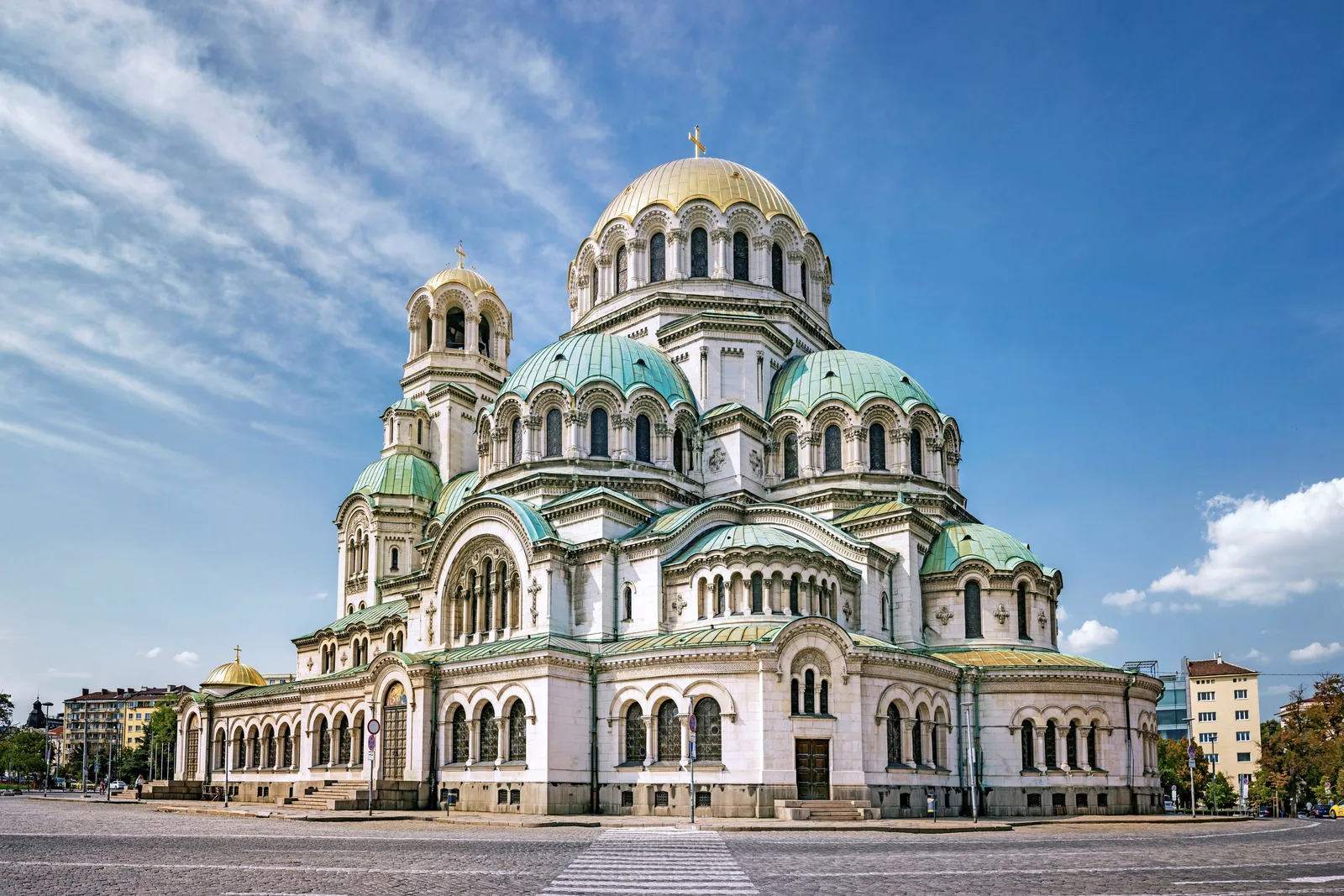
Arrive and walk the four hundred metres that hold a mosque of 1566, a synagogue of 1909 that is the largest Sephardic building in south-eastern Europe, an Orthodox cathedral and a Catholic one. Under the pavement, the Roman streets of Serdica sit open in the metro underpass; above it the Largo, thrown up through the 1950s around the Party House, is the most complete piece of socialist planning in any Balkan capital.
Boyana and Vitosha
The church at the foot of Vitosha is small, dark and rationed: humidity control means groups of a few people for about ten minutes, and you should book. The 1259 layer of frescoes was painted by a workshop nobody can name and is the reason UNESCO listed the building in 1979. Afterwards the National History Museum is a kilometre up the road, in the residence Todor Zhivkov built for himself. The mountain behind both has stone rivers on it - fields of boulders pouring down the slope, the biggest at Zlatnite Mostove - but reach them by road: the lifts up Vitosha have spent years at a time shut over concession and land disputes, so check one is running before you plan around it.
Rila Monastery
Hrelyu's tower, built in the 1330s, is the only thing that survived the fire of 1833; everything striped and arcaded around it was put up between 1834 and 1862, and Zahari Zograf painted the porch. Sleep in a cell. The gate is locked at night, the rooms are unheated, and the monastery empties of coaches at about five o'clock, which is when the place starts making sense.
Melnik and Rozhen
The smallest town in Bulgaria, under two hundred people, in a bowl of eroded sandstone pyramids that are still moving. Kordopulov House of 1754 is the largest Revival house in the country and has a cellar cut into the hill. Rozhen Monastery is six kilometres up; Yane Sandanski, the guerrilla leader shot near here in 1915, is buried beside it, and Bulgaria and North Macedonia both claim him - an argument over history that has repeatedly stalled North Macedonia's EU accession talks and shows no sign of being settled by either side.
Bansko
Over the shoulder of the Pirin by way of Gotse Delchev. Bansko produced Paisiy Hilendarski, who wrote the 1762 history that started the National Revival, and Nikola Vaptsarov, who was shot in Sofia in July 1942. The Holy Trinity church of 1835 is enormous for a church built under Ottoman rule, which was the point. The old quarter of stone houses is now the smaller half of Bansko; the apartment blocks that went up after the resort was rebuilt in the early 2000s are the rest.
Vihren
A rough road climbs to Vihren hut, where the jeep-taxis stop, and the marble peak above it reaches 2,914 metres - the highest thing in the Pirin and the second highest in Bulgaria after Musala. The straightforward ascent is a long scree slog rather than a climb; the alternative is the circuit of the tarns below it. Baikushev's pine, a Bosnian pine reckoned to be over thirteen hundred years old, stands near the road up.
The narrow gauge
Six kilometres to Dobrinishte and onto the last narrow-gauge line in Bulgaria: 760 millimetres between the rails, 125 kilometres to Septemvri, five hours, and a fare in single figures. It crosses from the Pirin into the Rhodopes and tops out at Avramovo, at 1,267 metres the highest railway station in the Balkans. Change at Septemvri for a regional train down to Plovdiv.
Plovdiv
Six hills of syenite, and a seventh that was quarried away for cobblestones. The Roman theatre came out of a landslide in 1972 and now holds concerts; the stadium runs under the main shopping street with one curved end visible in a pit below Dzhumaya Square. In March 1943 the Jews of this city were assembled for deportation and the Metropolitan of Plovdiv intervened, part of the pressure that stopped the trains inside Bulgaria - while 11,343 Jews from the territories Bulgaria was administering - Greek Thrace, Yugoslav Macedonia and Pirot - were handed over and killed. Both halves are in the museums here, and the town argues about the proportions.
Bachkovo and Asen's Fortress
Half an hour south into the Chepelare valley. The monastery was founded in 1083 by Gregory Pakourianos, a Byzantine commander whom historians make Georgian or Armenian depending on which of them you read, and the ossuary a few minutes' walk up the hill is the only eleventh-century building left standing, with frescoes to match. Stop at Asen's Fortress on the way back, five kilometres north towards Asenovgrad, where a thirteenth-century church stands whole on its crag and the rest of the fortress is footings and broken wall. The Smolyan buses pass below it - ask for the stop, then give the climb from the road a quarter of an hour.
Into the Rhodopes
Pick up a car in Plovdiv - from here the buses stop being a plan. Shiroka Laka is a village of white Revival houses and a school of folk music founded in 1971 that teaches the kaba gaida, the low Rhodope bagpipe. It was a Rhodope song, sung by Valya Balkanska, that NASA put on the Voyager record in 1977. Smolyan, half an hour on, is strung ten kilometres along its valley and claims to be the longest town in the country.
Trigrad and Yagodina
West on a single-track road that threads a crack in the limestone barely wider than a car. The Trigradska river runs into the Devil's Throat, falls about forty metres inside the hill and comes out half a kilometre downstream; you walk in at river level and out up a tunnel of three hundred steps cut in the 1960s. The Orpheus descent has been attached to this cave for a long time and nobody can say when. Yagodina is six kilometres away over the ridge and about twenty-five by road - back down the Trigrad gorge to Teshel and up the Buynovo one - and it is the longest cave system in the Rhodopes, showing about a kilometre of its ten.
North to Kazanlak
The long transfer of the trip: back over the Rhodopes, across the Thracian plain, then north to Karlovo and east along the whole length of the Valley of the Roses. The Thracian tomb here was found in April 1944 by soldiers digging a shelter, dates to the late fourth century BC and has been sealed ever since - you see a full-size replica beside it, which is the correct trade. Golyama Kosmatka, twelve kilometres north below Shipka village, was dug out in 2004 and is the one from this royal cemetery you can walk into: a stone corridor, a round chamber, and the bronze head of Seuthes III that came out of it, which went to the National Archaeological Museum in Sofia and is worth having seen on day one.
Shipka and Buzludzha
Up to the pass held through the winter of 1877 and its monument of 1934, just under nine hundred steps above the car park. Twelve kilometres east along the ridge stands the Buzludzha monument: the Bulgarian Communist Party opened it in 1981 on the summit where Dimitar Blagoev and a few dozen socialists had met in secret in 1891 to found the party the communists counted as their ancestor. It abandoned the building within a decade, and a mosaic-lined concrete disc has sat on the mountain ever since. Conservation work began after a Getty grant in 2019; the interior is closed and going in is neither legal nor sensible. Down through Gabrovo afterwards.
Veliko Tarnovo and Arbanasi
Capital of the Second Bulgarian Empire from 1185 until the Ottomans took it in 1393, stacked in tiers above a loop of the Yantra. Baldwin of Flanders, briefly Latin emperor in Constantinople, was taken at Adrianople in 1205 and died a prisoner here; the tower that carries his name was rebuilt in the 1930s and the link to him is tradition rather than evidence. The constitution of the new Bulgarian state was adopted in this town in 1879. Four kilometres up the hill, Arbanasi looks like a village of blank stone barns until you go into the Nativity church and find every surface painted - the exteriors were kept plain because Ottoman rules said so.
Good to know
Bulgaria has been a full Schengen member since 1 January 2025, when the land borders opened - the air and sea borders had gone two years earlier - so arriving overland from Greece or Romania no longer means a passport queue, and Schengen days spent here count against the 90-in-180 allowance like anywhere else. Bulgaria joined the euro on 1 January 2026 and the conversion was fixed at 1.95583 lev, the rate the currency had been pegged to since 1999 - so nothing has changed about what things cost, but dual pricing in both currencies runs through the changeover year and small shops in the mountains may still quote in lev out of habit. Do not accept lev as change; commercial banks swapped notes free of charge only for a limited window, while the central bank goes on exchanging them at its own counters. The narrow-gauge line runs four or five times a day and the timetable changes in mid-December - buy at the station on the day, and treat the English pages of bdz.bg as unreliable. Rila takes cell bookings by telephone rather than through any booking site. Boyana Church should be reserved ahead in summer, because the ten-minute slots fill. From Smolyan onwards a car is not a luxury: rural bus services in the Rhodopes are built around school terms and thin out sharply in July and August and at weekends, which is exactly when visitors arrive. Winter tyres are compulsory from 15 November to 1 March, hire cars need a valid electronic vignette that you should confirm rather than assume, and the Trigrad, Rozhen and Shipka roads close in snow without much warning. The Buzludzha access road is not cleared in winter at all. If the roses are the reason for the trip the window is narrow - the harvest runs from late May to about mid-June and the picking is done before the sun is up. One social quirk that catches people out at ticket windows: the Bulgarian head shake means yes and the nod means no, and helpful people sometimes reverse it for foreigners, which makes it worse rather than better.
Shorter or longer?
Five more days east from Veliko Tarnovo: the Madara rider cut into a cliff around the eighth century, the Varna gold that is the oldest worked gold anywhere, Nessebar on its isthmus, and the Strandzha villages down towards the Turkish border.
Sofia, Rila, Bansko, the narrow gauge, Plovdiv and Veliko Tarnovo on buses and trains. Keeps the monastery and the railway - which crosses the Rhodopes anyway - but cuts the Rhodope villages, the caves and the Stara Planina entirely.
Practical guide
Visa check for this route
Budget
Mid-range · per person · sharing a double room. Excludes international flights - they depend on where you fly from.
Editorial estimates · checked August 2026
Country guides
Trip essentials
The connectivity placement is our own eSIM store. No affiliate link on this list. How we choose these →