Itinerary · Africa · 9 days · Moderate
Karthala to the Turtle Beach
Moroni, Grande Comore→Karthala, Grande Comore→Iconi, Grande Comore→Mitsamiouli, Grande Comore→Nioumachoua, Mohéli→Mohéli Marine Park+3 stops
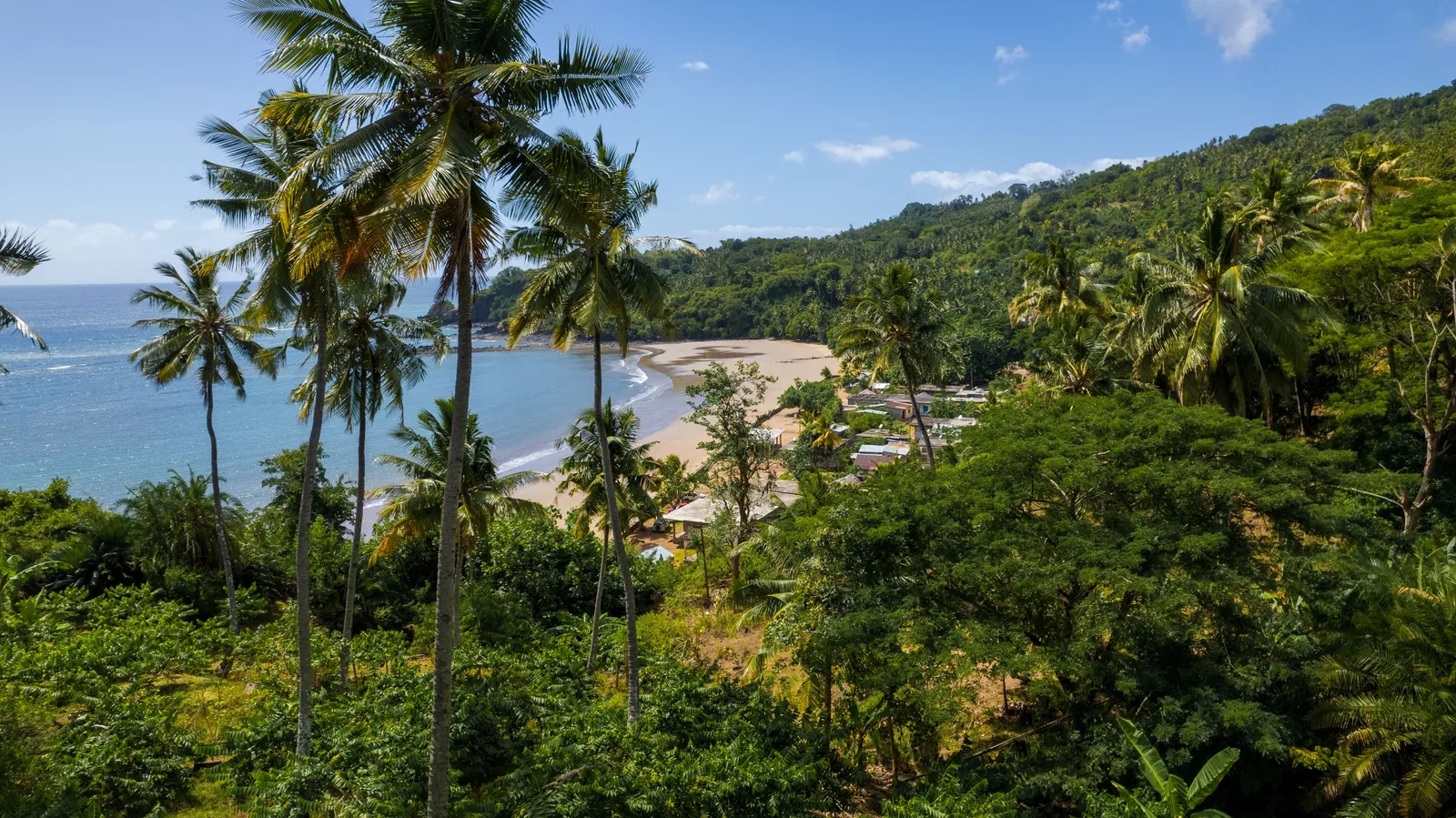
Three islands in nine days - the caldera above Moroni, the marine park on Mohéli where green turtles come ashore most nights of the year, and the citadel and distilleries of Anjouan. Every hop is a twenty-minute flight on a small aircraft that may not go, so the order is built to lose the least when one is cancelled.
Moroni
A capital of about a hundred thousand people, walkable end to end in a morning. The Ancienne mosquée du vendredi sits on the sea wall by the old port, begun in 1427, its minaret a later addition; behind it the medina is coral rag and lime, lanes barely wide enough for two people, carved doors, and no signage of any kind. The CNDRS museum a few streets up holds a preserved coelacanth - the fish that Comorian fishermen had been catching on deep handlines for generations before science noticed. Volo-Volo market for the fruit and the price of everything. Change euros, buy a SIM, and go in person to the AB Aviation and Int'Air Îles offices to buy the inter-island tickets, because neither sells them reliably any other way.
Up Karthala
The trail starts above Boboni, twenty minutes inland from the capital, and climbs through farmland into cloud forest and then out onto black lava and ash. Five to seven hours to the rim depending on how much of the route is under cloud, which is most days. There is no water anywhere on the mountain - you carry every litre - and no shelter, so the night is spent in a tent on the ash near the crater edge. A guide is not a formality here: the upper mountain is featureless in mist and people have got lost on it.
The crater, then down to Iconi
Karthala is one of the largest active craters on earth and it is at its clearest before the cloud builds, which means walking the rim at first light. The caldera is roughly three by four kilometres; the small lake that used to sit in it was destroyed by the eruptions of April and November 2005, and the volcano erupted again in January 2007. Four or five hours back down. In the afternoon, Iconi south of Moroni - the seat of the Bambao sultanate, with a ruined palace and a cliff above the sea that local tradition says women threw themselves from rather than be taken in the Malagasy slave raids of the early nineteenth century.
The north and the east coast
A car and driver for the day, because the shared taxis on this circuit involve a great deal of standing at junctions. North through Mitsamiouli to Lac Salé, a brackish green crater lake in the dunes at Bangoi-Kouni with the sea on the other side of a ridge, and the Trou du Prophète, the bay on the north coast that carries the legend of the Prophet's landing. Then down the east side, which is younger lava and mostly empty: Chomoni and Bouni are white sand between black flows, with no development on either and no lifeguard, and the currents on this coast are serious.
Across to Mohéli
Twenty-five minutes in a small aircraft to Bandar Es Salam, the airstrip outside Fomboni. Mohéli is the smallest island, around fifty thousand people, and has almost no tarmac, no bank worth the name and the best of the country's wildlife. Cross the spine of the island to Nioumachoua on the south coast, where the marine park was created in 2001 - the first protected area the Comoros ever declared. The afternoon goes on the village and the ridge behind it. Livingstone's fruit bat, a black flying fox with a wingspan up to about 1.4 metres, lives on this island and Anjouan and nowhere else, and it roosts inland in the steep wet forest of the spine - not on the coast and not on the islets, so seeing one means walking up with someone who knows a roost, and it is a maybe rather than a fixture.
The marine park by boat
A full day on the water off the south coast. Humpbacks come into this channel to calve between July and October and are close enough inshore that the boats do not have to go far; outside those months the trip is reef, turtles in the water rather than on the sand, and the chain of islets offshore, which carry the seabird colonies. Dugongs are here and are very rarely seen - the population is small enough that a sighting is reportable. The park is co-managed with the villages that used to fish it, which is why the boatman is also, in most cases, the person enforcing the rules.
Itsamia
East along the coast, past Dziani Boundouni - a crater lake in the south-east of the island, a Ramsar wetland since 1995, and about as far from anything as the Comoros gets. Itsamia at the eastern end is the reason to come: green turtles haul out on the beaches here most nights of the year, in the hundreds over a good month, and the nesting has been counted and protected since 1991 by ADSEI, an association of the village itself rather than a government body. You walk the beach after dark with one of them, no torches on the sand, and you keep back. It is the single most reliable wildlife encounter in the country and it exists because a few hundred people decided to stop eating the turtles. There is no hotel and no walk-up arrangement: the beds and the night walk are the association's, and you send word ahead through them or through a Fomboni guesthouse before you set out.
On to Anjouan
Back to Fomboni for the morning flight, and in most weeks that means routing through Moroni to reach Ouani on Anjouan - the direct Mohéli–Anjouan sector appears on the schedule and disappears from it. Anjouan is the steep one: ridges straight out of the sea, terraced to the top, and the greenest ground in the archipelago. Mutsamudu is the old trading town, a Swahili medina of tall coral houses on lanes a metre wide, with a citadel above it, built by the sultan of Anjouan around 1860. In the afternoon, the ylang-ylang. The distilleries around Bambao Mtsanga are sheds with a copper still and a wood fire, and the country is the world's main producer of the oil - you smell the valley long before you reach one, and you visit by walking in and asking.
Domoni, and back to Moroni
Down the east coast to Domoni, the oldest town on Anjouan and the seat of its sultans, with a stone quarter, tombs of the ruling families and a working port of small boats. On 20 December 1952 a fisherman landed a coelacanth here; it was the second ever recorded and the first anyone had a chance to examine fresh, and the South African ichthyologist J. L. B. Smith was flown up in a military aircraft to collect it. Comorian fishermen already had a name for the fish and no particular interest in it. Afternoon flight back to Moroni - take the earliest one you can get, and sleep near the capital rather than gambling on a same-day international connection.
Good to know
Most nationalities get a visa on arrival at Moroni - a form, a fee of roughly €30–50 payable in euro cash, and an address to write down; there is no online system to pre-arrange it, and the officials will want to see a booking for the first night. The Comorian franc is pegged to the euro at a fixed 491.9678 to one, which makes the arithmetic easy, and euros are accepted directly almost everywhere. Cards are not: assume nothing you carry works, that the handful of ATMs in Moroni are out of service or out of cash as often as not, and that there is no bank on Mohéli you would want to depend on. Bring the whole trip in euro notes, in small denominations. Inter-island flying is the fragile part of any Comoros itinerary. AB Aviation and Int'Air Îles run small turboprops between Moroni, Ouani on Anjouan and Bandar Es Salam on Mohéli; sectors are twenty-five to thirty minutes and cost €60–100 each way; delays of half a day are routine, outright cancellation is common, and schedules are rearranged without notice. Buy tickets in person at the airline offices in Moroni, reconfirm the day before, and keep spare time between the last domestic flight and any international departure. This route's ninth day gets you back to Moroni with one night in hand, which is the bare minimum; if you cannot absorb a lost day, book the flight home for the day after that. The cargo-passenger boats between the islands are the fallback and they are slow, overnight and genuinely rough in the trade-wind months. May to October is the dry season and the one to travel in; December to April is the cyclone window, the wettest months are January and February, and the roads on Anjouan and eastern Mohéli fail in heavy rain. Whales are off Mohéli July to October; turtles nest at Itsamia year-round. Malaria is present on all three islands and prophylaxis is the sensible default; a yellow fever certificate is demanded if you are arriving from a country with transmission risk. Airport transit is normally exempt, but Nairobi and Addis Ababa are the two hubs almost everyone routes through and the exemption is applied by whoever is on the desk - carry the certificate rather than argue the rule. Medical care is basic and serious cases are evacuated to Réunion or Mayotte, which is a slow and expensive process - travel insurance that explicitly covers evacuation is not optional here. The country is almost entirely Sunni Muslim: cover shoulders and knees, women should carry a scarf for villages and mosques, alcohol is served in a small number of hotels and nowhere else, and everything shuts for Friday midday prayers. During Ramadan daytime food outside hotels is hard to find. July and August are grand mariage season, when the diaspora returns from France for the anda ceremonies - guesthouses fill, offices empty, and villages hold days of drumming and feasting that you will be invited into. Mayotte is seventy kilometres from Anjouan and visible from the ridges on a clear day; it is French territory, it requires a Schengen visa, and there is no legal ferry a visitor can simply take. Do not treat it as part of the trip.
Shorter or longer?
Stay on Anjouan and walk it. Lac Dzialandzé sits in a crater in the interior, Mount Ntringui at 1,595 metres is the high point of the island, and the remaining forest above Moya holds the other population of Livingstone's fruit bat. Guides come from the villages, the paths are steep and slippery, and the deforestation on the lower slopes is the most visible environmental problem in the country - which is part of what you have come to look at.
Drop the Anjouan leg and the two sectors it adds: Moroni, the two days on Karthala, the island circuit, then four days on Mohéli for the marine park, Itsamia and the ridge. It removes the connection most likely to strand you and gives Mohéli the time it deserves, at the cost of the medina, the citadel and the distilleries.
Practical guide
Visa check for this route
Budget
Mid-range · per person · sharing a double room. Excludes international flights - they depend on where you fly from.
Editorial estimates · checked August 2026
Country guides
Trip essentials
The connectivity placement is our own eSIM store. No affiliate link on this list. How we choose these →