Itinerary · Africa · 10 days · Moderate
Highveld to Lowveld, Mostly on Foot
Ngwenya→Malolotja Falls→Nsangwini Rock Art Shelter→Bulembu→Mantenga Nature Reserve→Mlilwane Wildlife Sanctuary+3 stops
Ten days across a country two hours wide, taken slowly and walked wherever walking is possible - the oldest known mine on earth, a full day down to Malolotja Falls and back, an asbestos company town that emptied in 2001 and was bought and restarted five years later, San paintings above the Komati, the craft workshops of the Ezulwini and Malkerns valleys, and then east into the lowveld for lions at Hlane, a community camp on the Lubombo escarpment, and black and white rhino approached on foot at Mkhaya.
Over at Ngwenya
Cross from South Africa at Ngwenya/Oshoek, the busiest of the borders and normally twenty minutes if you have the vehicle paperwork in order. Ngwenya Glass is five minutes past the post: a glassworks started in 1979 as a Swedish aid project, closed, and bought and restarted in 1987 working only in recycled glass, which is why the bottles have a green cast and a bubble in them. Then into Malolotja to walk up to Lion Cavern with a reserve guide. Charcoal from the workings put them at roughly 41,000 years after Adrian Boshier and Peter Beaumont excavated here in the 1960s, and later re-dating has pushed the earliest cutting further back still; what was being taken out of the hill was haematite, ground for pigment, not metal. It is a hole in a hillside with a view over the Ngwenya valley and it is the oldest mine anyone has found.
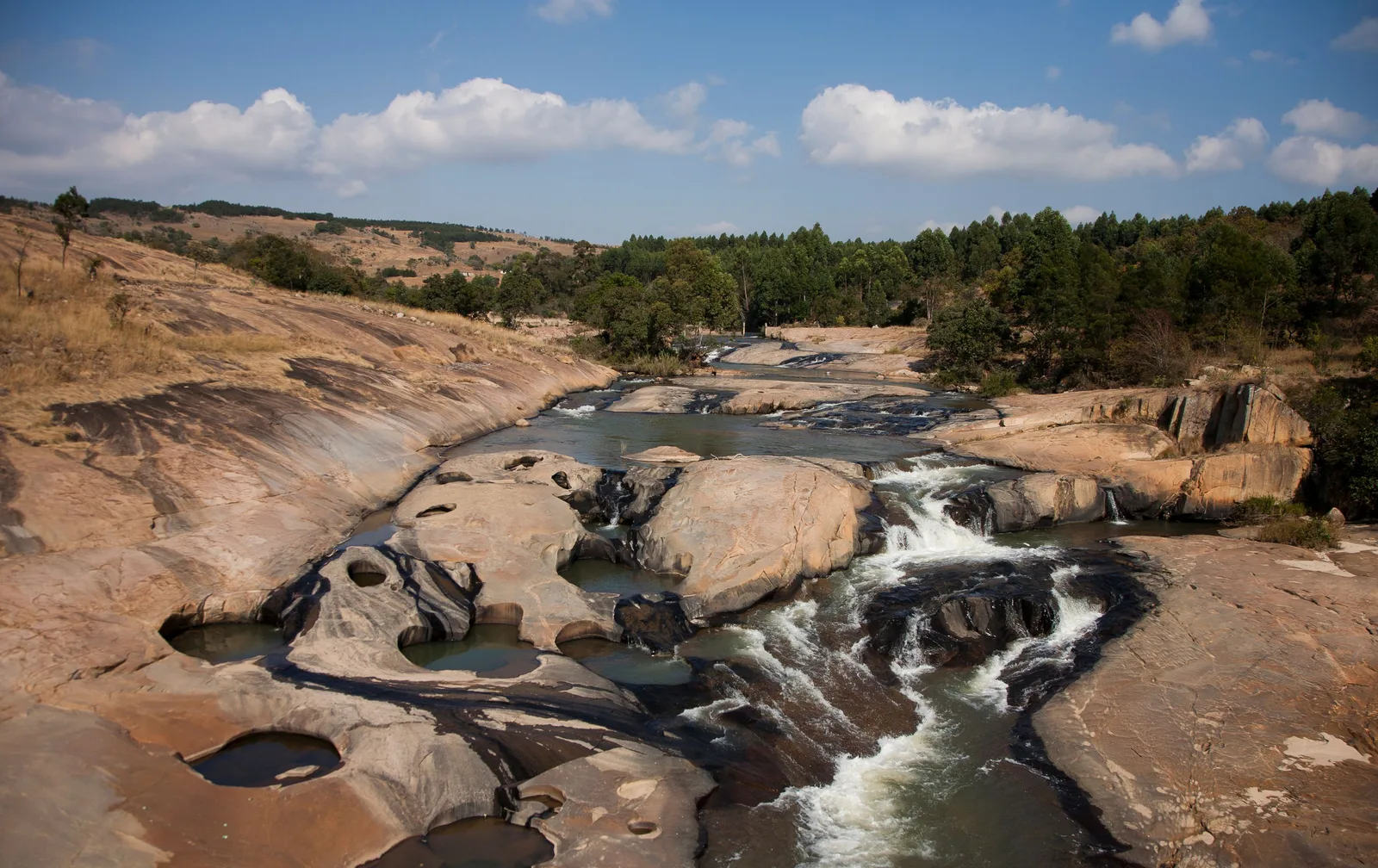
Malolotja Falls
The reserve is about 18,000 hectares of high montane grassland cut by gorges, with no dangerous game to speak of, which means you may walk anywhere in it unaccompanied. The route down to Malolotja Falls - a single drop of around 95 metres, the highest in the country - is a full day: a long descent on grass and rock into the Malolotja river gorge and the same climb back out, seven to eight hours if you do not dawdle at the bottom. There is no water on the top half of the route and no shade at all. Register at the office before you go and sign back in when you return, because nobody will come looking otherwise.
The canopy, the dam and the rock shelter
The zip-line course strung across the Majolomba gorge takes a morning and is run out of the reserve. Then north on the MR1: Maguga Dam, a 115-metre wall across the Komati completed in 2002 and built jointly with South Africa under the two countries' 1992 treaty on the river, with a viewpoint and a café above it. Beyond the dam a signed track turns off to Nsangwini, where a community trust keeps a rock shelter above the Komati and walks you down to it in fifteen minutes. The paintings are San, and include winged human figures that have no close parallel elsewhere in southern Africa; there is later work on the same rock attributed to Nguni painters. Carry on to Phophonyane for the night.
Bulembu
Twenty kilometres of gravel west of Piggs Peak, in the highest corner of the country under Emlembe, is a town built for one purpose. The Havelock mine worked chrysotile asbestos from 1939 and sent it out on a twenty-kilometre aerial ropeway across the border to Barberton - the longest cableway in the world when it was strung. The mine closed in 2001 and the town emptied: a thousand houses, a hospital, a school, a golf course, all of it standing and none of it wanted. In 2006 it was bought entire by a Swazi charitable venture that has been repopulating it ever since around a children's home, running the dairy, bakery, honey and timber businesses that pay for it. Walk the streets, look at the ropeway pylons on the ridge, and then drive south - Piggs Peak, Mbabane, and down into the Ezulwini valley.
Sibebe at first light, then the craft valley
Sibebe is a bare granite dome north-east of Mbabane rising a few hundred metres straight out of the Mbuluzi valley, and the walk up it is a scramble on friction rather than a path. Go at six, with a guide from the community that manages access, and be down before the rock heats. The rest of the day belongs to the valley floor: Mantenga Nature Reserve for the falls and the cultural village, where the sibhaca dancing runs to a fixed timetable twice a day, then Malkerns for the workshops - Swazi Candles, Baobab Batik, Gone Rural's grass weaving, House on Fire's theatre. None of them is large next to the sugar estates or the textile factories at Matsapha, which is where formal wages in this country are actually earned. What they are is one of the few routes to a cash income for rural women who are not on an estate payroll - Gone Rural's grass is woven at homesteads scattered across the country and brought in - which is worth knowing while you are buying a candle.
Mlilwane
Ted Reilly turned his family's farm into a wildlife sanctuary and got it proclaimed in 1964, the first protected area in the country. There are no lions and no elephants in it, which is the point: you go round Mlilwane on foot, on a mountain bike or on a horse, among zebra, blesbok, nyala, warthog and hippo, and the only animals that will bother you are the warthogs at the rest camp, which have no fear of anyone and will take food off a plate. Walk up Nyonyane - Execution Rock - for the whole Ezulwini valley laid out below, and stay in one of the beehive huts if they are free.
Manzini market, then the lowveld
Manzini is the commercial town rather than the capital and its main market is where the country actually trades - busiest from Thursday to Saturday morning, when rural producers come in and the upstairs handicraft section fills before the coaches arrive. Then east on the MR3 and down off the middleveld: the road gives up four hundred metres in an hour and the temperature does the opposite. Hlane is royal land, the king's hunting ground before it was a national park, and it holds the country's lions, elephants and the larger share of its white rhino. Ndlovu Camp has no electricity - paraffin lamps, and a waterhole in front of the tents.
Mlawula and the Lubombo
Mlawula sits where the lowveld runs into the Lubombo range on the Mozambican border, and it is walking country again - trails along the Mlawula and Mbuluzi rivers, cycads on the ridges, and a bird list that is the best in the country because the escarpment catches species from both sides of it. In the afternoon climb the gravel road onto the plateau to Shewula, a community-owned camp opened in 2000 by the Shewula chiefdom and run by a trust that puts the takings back into the villages below. Rondavels on the edge, dinner cooked by whoever is on the roster, and the lights of the sugar estates on the flats a long way down.
Mkhaya Game Reserve
Day 9–10 · 2 daysSouth to Mkhaya
Down off the plateau and south through Simunye and the cane, then west across the Usuthu at Siphofaneni to the pickup point at Phuzumoya. You cannot drive into Mkhaya. You leave the car at the gate and are collected at ten in the morning or four in the afternoon, and if you are not there the vehicle does not wait. The reserve was set up in 1979, originally to keep the indigenous Nguni cattle breed from disappearing, and takes its name from the knobthorn. Stone Camp is open-sided stone and thatch with no doors, no windows and no fourth wall, and the evening drive goes out as soon as you have put your bag down.
Rhino on foot
Out at first light on foot with a ranger, which is what Mkhaya is for. Black and white rhino are approached upwind and on the ground at distances that will feel wrong for the first ten minutes, and the man walking in front of you is armed because the same statute that makes him a guide makes him a peace officer under the Game Act. Sable, roan, tsessebe and elephant are here too, and the Nguni cattle the reserve was founded for are still in it. You are collected back to Phuzumoya by ten. From there it is an hour to Manzini, about the same to King Mswati III International at Sikhuphe, or ninety minutes south to the Lavumisa border for KwaZulu-Natal.
Good to know
EU, UK, US, Canadian, Australian and SADC passports enter visa-free for 30 days, extendable at the immigration office in Mbabane, with six months' validity on the passport. Nationalities that do need a visa should arrange it at a mission or through the immigration department before travelling rather than counting on getting one at the border, and the small land posts are not the place to test it. A yellow fever certificate is demanded only of arrivals from a country with risk of transmission, not of everyone. Malaria is a real question on the second half of this route and not on the first: the eastern lowveld - Hlane, Mlawula, Shewula, Mkhaya and everything below the escarpment - carries risk from about November to May, while Mbabane, Malolotja, Bulembu and the Ezulwini valley sit high enough to be free of it, so a clinic will usually prescribe for the lowveld days and the tail either side. The lilangeni is pegged one for one to the South African rand and rand is legal tender here, so most people simply carry rand throughout; lilangeni are not accepted in South Africa, so spend or change them before you leave. Cards work in Ezulwini, Mbabane, Manzini and the estates, and nowhere reliable beyond them - carry cash for reserve gates, Nsangwini, Shewula and fuel in the north. Almost everyone hires a car in Johannesburg or Nelspruit, and the piece people forget is the cross-border authorisation: rental companies charge a fee and need several working days' notice to issue the letter of authority and a certified copy of the registration document, and without both the border will turn you round. Foreign-registered vehicles also pay a small road toll on entry, in cash. Driving is on the left and an English-language licence is accepted; an International Driving Permit is useful if yours is not in English. Tar on the MR1 and MR3 is good, but livestock on the carriageway is constant and is the leading cause of crashes, so do not drive after dark anywhere outside the Ezulwini valley. Gravel to Nsangwini and Bulembu is fine in a 2WD in the dry and turns slick and rutted after the afternoon storms of November to March; a high-clearance vehicle removes the question. Ngwenya/Oshoek keeps long hours; the Bulembu/Josefsdal post on the far side of the mine town is small, opens for a short working day and sits at the end of a rough mountain road, so admire it rather than planning a connection through it. Bookings split three ways and all of them matter: Mlilwane, Hlane and Mkhaya are Big Game Parks and go through one central reservations office, and Mkhaya in particular cannot be walked into - no self-drive, no day visitors without prior arrangement, and the Phuzumoya pickups at 10:00 and 16:00 leave on time. Malolotja, Mantenga and Mlawula are the Eswatini National Trust Commission and are booked separately. Shewula is booked direct with the camp. If you are travelling in late August or around the December solstice, check the ceremonial calendar before you book anything in the valleys: Umhlanga at Ludzidzini and Incwala are royal ceremonies whose dates are set and announced by the royal household at short notice, accommodation between Mbabane and Manzini fills completely, and the photography restrictions around the King and the Queen Mother are enforced rather than suggested. Political demonstrations turned violent in 2021 and unrest recurs periodically with road closures and occasional curfews - check your government's advice the week you travel, and stay away from protests entirely. Medical facilities are limited and anything serious is evacuated to South Africa, which is an argument for having the cover in writing before you cross.
Shorter or longer?
Add three or four days: cross at Lomahasha/Namaacha in the north-east, about eighty kilometres of good road down to Maputo, and finish with the Portuguese colonial grid, the fish market on the Marginal, and the drive south to the Ponta beaches - tar the whole way since the Katembe bridge and the road behind it opened in 2018, where it used to be a ferry and a day of deep sand. There is no passenger train down that coast; it is the road or nothing. Check the rental company's letter covers Mozambique as well - it usually does not by default, and the border sells the third-party insurance, reflective vests and warning triangles you are required to be carrying.
Ezulwini and Mantenga, Mlilwane, Hlane and Mkhaya, entering at Ngwenya and leaving at Lavumisa. Keeps the craft valley and all the wildlife, cuts the entire north - Malolotja, Bulembu, Nsangwini - and with it the gravel, the hiking and roughly half the driving.
Practical guide
Visa check for this route
Budget
Mid-range · per person · sharing a double room. Excludes international flights - they depend on where you fly from.
Editorial estimates · checked August 2026
Country guides
Trip essentials
The connectivity placement is our own eSIM store. No affiliate link on this list. How we choose these →