Itinerary · Africa · 14 days · Challenging
Rail, Forest and Coast
Libreville→Pointe Denis, Pongara National Park→Owendo station, Libreville→Lopé→Lopé National Park→Mikongo, Lopé National Park+7 stops
East out of Libreville on the manganese railway to the savanna islands of Lopé, on foot into the Ivindo forest to a clearing that can only be reached by walking, then back west and down the coast to Loango, one of the few places left where forest elephants come out of the trees onto an Atlantic beach.
Libreville
Arrive, change money and confirm every onward booking in person, because almost nothing in this country is confirmable from abroad. Mont-Bouët market for the scale of the city, then the Musée National des Arts et Traditions on the Boulevard Triomphal, which is small, well-lit and the best half-hour you will spend on Gabon's masks and Fang reliquary figures. The Atlantic is at the end of every street and nobody swims off the city beaches.
Across the estuary to Pongara
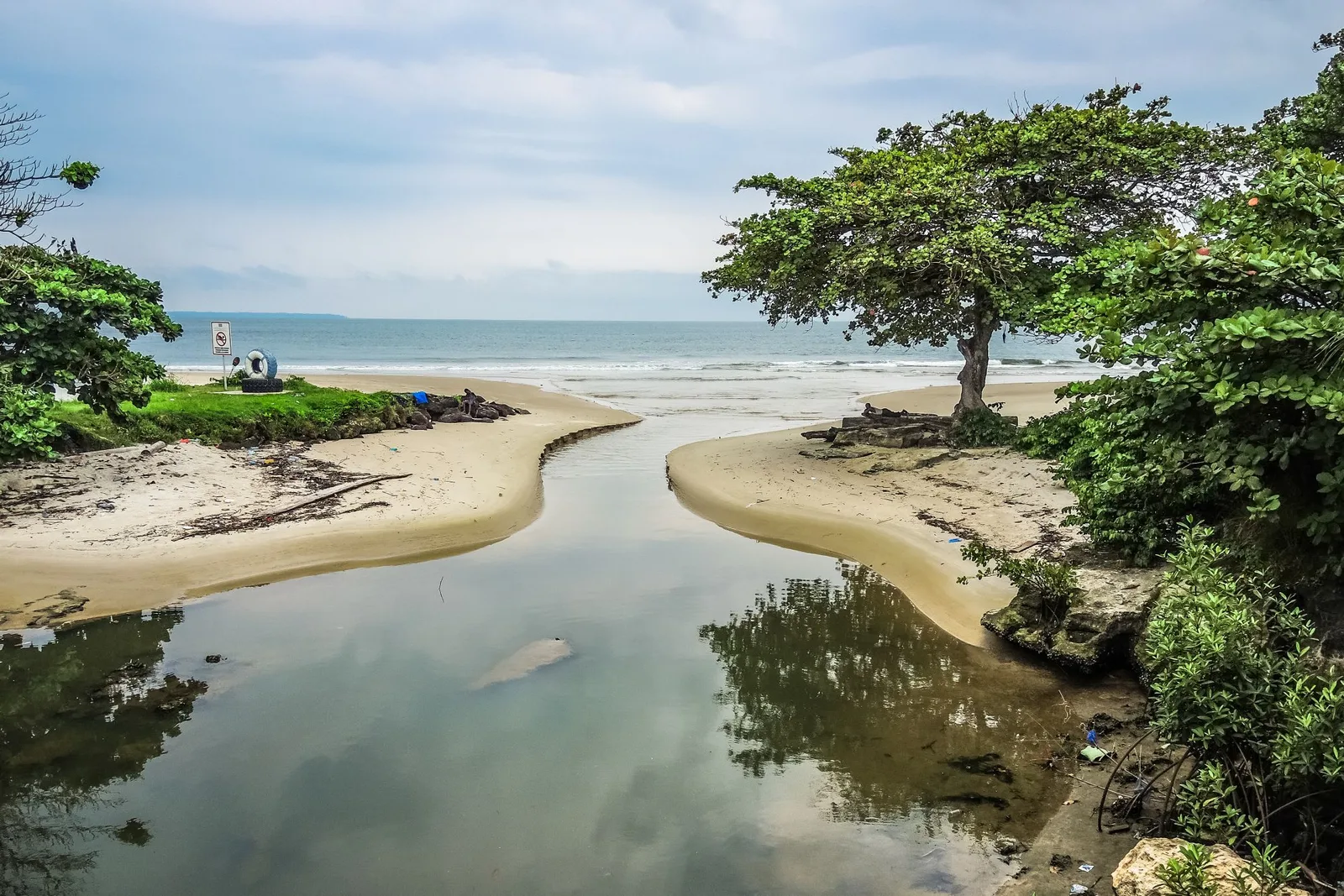
Boats cross the mouth of the Komo from the Port Môle pier in about forty-five minutes and land you on a sandspit facing the city you just left. Pongara is one of the thirteen parks created in 2002 and the easiest of them to reach: mangrove behind the beach, forest behind that, and a shoreline that leatherback turtles come up between October and April, peaking around Christmas. Gabon's coast holds the largest leatherback nesting population in the world and Pongara is one of its densest stretches - the counting is done by patrols who walk the beach at night, and you can go out with them. Outside that window it is a long empty beach with buffalo tracks on it.
Back to the city, then the night train
Morning boat back. Spend the afternoon on the road east, out through Owendo and on another twenty minutes to the Nkok industrial zone - the fenced estate of veneer mills and drying kilns that Gabon built after it made exporting a raw log illegal in 2010, and the reason the log rafts that used to fill this estuary are gone. Back to Owendo station to board the Trans-Ogooué in the evening. Take a couchette if one is going; the seats are survivable and the train is not fast.
Lopé
The train reaches Lopé in the small hours or around first light depending on how the freight ran, and the hotel sends a vehicle. Sleep, then go out in the afternoon. What you are looking at is the strangest landscape in Central Africa: open grassland in the middle of the equatorial forest belt, a relic of the drier climate of the last glacial period that has never closed over. The savanna is burned each year, which is the only reason it is still there.
Mandrills and the Ogooué
Out early with an ANPN guide. Lopé holds the largest mandrill hordes ever recorded anywhere - researchers here filmed and counted one at more than 1,300 animals, the biggest aggregation of non-human primates on record. Understand what that does and does not promise you. The hordes move fast over a very large range and most visitors never see one; the counts that produced those numbers came off radio-collared animals followed for years. Guides read fresh signs and go where they lead, and a crossing is a piece of luck rather than a fixture of the morning. Forest elephant and buffalo on the grassland edges at dawn and dusk are the reliable part. In the afternoon take a pirogue on the Ogooué to the engraved rocks at Kongo Boumba: geometric pecked figures, part of the Lopé-Okanda inscription UNESCO made in 2007, on a river the iron-working people who cut them were living beside two and a half thousand years ago.
Into the forest, and the 3 a.m. platform
A walking day in closed canopy rather than a driving one - the Mikongo side of the park, where the trails are cut for research rather than for vehicles and the point is what is on the ground and overhead rather than what runs across a clearing. Then sleep for a few hours, because the eastbound train passes Lopé somewhere around three in the morning and the station has no waiting room worth the name. The hotel will wake you and drive you down.
Langoué Bai, Ivindo National Park
Day 7–8 · 2 daysIvindo station to Langoué Bai
The longest day of the route and the one that justifies it. Off the train at Ivindo at dawn, into a 4×4 for two to three hours on a logging road, and then the road stops. From there it is about three hours on foot through forest to the camp the Wildlife Conservation Society put in when the research here started, a few kilometres short of the clearing. Tents on wooden platforms, bucket showers, no vehicles and no phone signal. Carry as little as you can and let the porters carry the rest - they are from the villages along the railway and the portering is one of the few paid jobs the park has produced locally.
The bai
A bai is a clearing in the forest where the ground water and soil carry minerals animals cannot get from leaves, so they walk to it. This one runs to something under a kilometre long with a stream through it. You sit on a raised platform at the edge and wait. Forest elephant, sitatunga and forest buffalo are the regulars; western lowland gorillas come out to feed on the sedges, which is the reason people walk in. Mike Fay reached this clearing on foot in 2000 during the Megatransect, and the practical case for Gabon's national parks was built partly on what he found in it - Ivindo went on the UNESCO World Heritage list in 2021. Dawn and late afternoon are the hours; the middle of the day is for reading.
Walk out, and the train west
Out the way you came in - three hours on foot, then the logging road, then the wait at Ivindo station, which will be long. The westbound service comes up from Franceville in the evening and passes through late. Eat before you get on the train.
Libreville and the flight to Port-Gentil
Into Owendo in the morning, a shower somewhere, and the afternoon flight to Port-Gentil - forty-five minutes over the Ogooué delta, and the only sensible way to make this connection since there is no road from Libreville to Port-Gentil at all. The town is Gabon's oil capital, built on an island, expensive and not designed for visitors, but the seafood is the best in the country and the point of the day is to be in position.
South to Omboué and into Loango
The transfer everyone underestimates. The boat down the coast and through the Fernan Vaz lagoon to Omboué takes about five hours; the new Port-Gentil–Omboué road cuts it to roughly two where it is finished and open, so ask which you are getting before you pack. From Omboué it is around fifty kilometres of laterite and bush track by 4×4, an hour and a half, and then a boat across the Iguéla lagoon to the lodge. Arrive with the light if you can.
The beach at Loango
Loango is the reason Gabon is worth the logistics. A strip of coastal forest and savanna runs to the Atlantic with nothing between them, so forest elephant, buffalo and red river hog walk out of the trees onto open sand - the image every article about this country uses. It is real and it is not staged, but it is also not a scheduled event: drive the Louri beach track at first light, twice if you can, and treat a blank morning as normal. Humpback whales are offshore from roughly July to September and calve within sight of the surf. Worth knowing while you watch: Gabon holds the largest surviving population of African forest elephants, on the order of ninety-five thousand, and in the villages either side of the park the same animals are a crop problem that people have been asking the state to do something about for years. The elephant on the beach and the elephant in the manioc are the same elephant.
Akaka and the flooded forest
Inland by boat instead. Akaka is seasonally flooded forest on the Rembo Ngové where the water lets you move quietly through trees you would otherwise have to hack into - elephant standing in it, forest buffalo, dwarf crocodile, and hornbills going over. If you have a permit for the habituated gorilla group that researchers here have worked with since the 2000s, this is the day it happens; numbers are capped, it is expensive, and it is arranged months out or not at all.
Out the way you came
A last drive along the beach before breakfast, then the whole transfer chain in reverse - lagoon boat, 4×4 to Omboué, the run north to Port-Gentil, and the evening flight to Libreville. Build in the spare day if your international flight is the same evening. It is a long chain and any link in it can slip.
Good to know
Most nationalities need a visa arranged before travel and the mechanism is the e-visa at evisa.dgdi.ga - around US$76, roughly 72 hours to process, and it is only valid for arrival by air at Léon-Mba in Libreville, so an overland entry from Cameroon or Congo needs a paper visa from an embassy instead. Passports must have at least six months left. A yellow fever certificate is not conditional here: it is demanded of essentially every arrival, the vaccine has to have been given at least ten days before you fly, and since 2016 the certificate is valid for life. Malaria is year-round, falciparum and countrywide, including in Libreville - prophylaxis is not a judgement call on this route and you will be walking into forest at dawn. Buy insurance that names medical evacuation in writing and read what it says about remoteness: Langoué camp has no road, no phone signal and no clinic, the nearest hospital is a 4×4 ride and a train away, and the realistic worst case is a stretcher walked out over three hours followed by a long wait. The currency is the Central African CFA franc, pegged to the euro, and outside a handful of Libreville and Port-Gentil hotels this is a cash country; ATMs exist in the two cities and effectively nowhere else on the itinerary, so draw what you need before the train. French is the working language and English gets you very little. Self-drive is not realistic and this route does not assume it: there is no road at all between Libreville and Port-Gentil, the tarmac heading east runs out long before the parks and what follows is laterite in whatever state the last rain left it, the Transgabonaise rebuild means diversions and long roadworks stretches, hire vehicles are scarce, and nobody is coming to recover you. The rains run roughly October to mid-December and mid-February to May, and laterite that is a road in August is mud in April - the Ivindo and Omboué transfers are the ones that fail. Park entry, guides and camps are administered through ANPN and in practice through a registered operator; permits for Langoué Bai and for the habituated gorillas at Loango are capped and go months ahead, and turning up hoping to arrange either locally does not work. The Trans-Gabon is run by Setrag: two passenger services, the faster Trans-Ogooué Express and the all-stations omnibus, running on a timetable that changes every few months and gives way to manganese freight, so treat any printed departure as an intention and confirm at the station. Politically the country is in its post-coup settlement - the army took power in August 2023 and Brice Oligui Nguema was elected president in April 2025 - and foreign advice is broadly to take normal or increased care rather than to stay away, but demonstrations happen, police checkpoints are frequent and routine, and photographing anything military, governmental or port-related is a genuinely bad idea. Carry a passport copy and the original separately.
Shorter or longer?
Add four or five days: ride the railway to its terminus instead of turning round at Ivindo, for the Poubara falls and liana bridge, the semi-free mandrill groups at the Lékédi park near Bakoumba, and the Batéké Plateaux - grassland rather than forest, on the Congolese border, where orphaned western lowland gorillas have been released back into the wild since the late 1990s and where a lone male lion turned up in 2015, the first recorded in Gabon in decades.
Libreville, Pongara, three nights at Lopé off the night train, the westbound train from Lopé instead of Ivindo, then Port-Gentil and three nights at Loango. Keeps the savanna, the rock engravings and the beach; cuts the Ivindo leg, which is the hardest walking, the least certain transport and a large share of the cost.
Practical guide
Visa check for this route
Budget
Mid-range · per person · sharing a double room. Excludes international flights - they depend on where you fly from.
Editorial estimates · checked August 2026
Country guides
Trip essentials
The connectivity placement is our own eSIM store. No affiliate link on this list. How we choose these →