Itinerary · Europe · 14 days · Easy
Budapest to Tokaj, the Long Way
Budapest→Városliget, Budapest→Visegrád→Balatonfüred→Badacsonytomaj→Keszthely+7 stops
Fourteen days across a small country on a railway that only really goes to Budapest - the capital and the water under it, the extinct volcanoes above Lake Balaton, Ottoman Pécs, the grid Szeged laid out after it drowned, the puszta, and Tokaj at the far end.
Budapest, the flat side
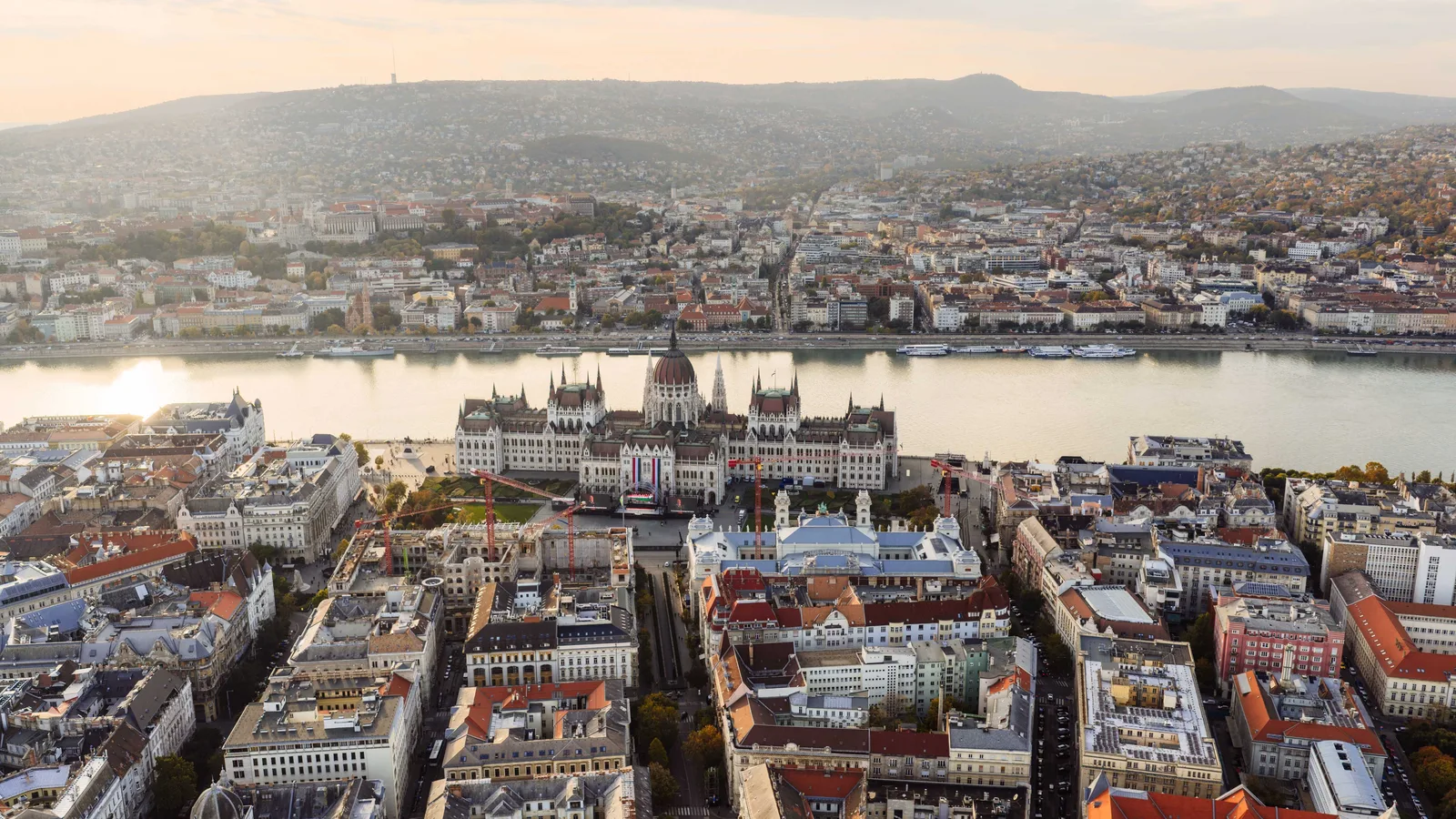
Arrive and stay in Pest. The Nagykörút and Andrássy út were laid out in the 1870s and 1880s as one act of city-making, and the underground beneath Andrássy was dug in about twenty months to open for the millennium celebrations of 1896 - the first electric underground on the European mainland. It still runs at the size it was built, which is why the carriages feel like toys and why the stations are two flights of stairs and no more.
Budapest, the water
Buda is the hill and what is under it. Rudas has an octagonal pool beneath a dome carried on eight pillars, built in the 1560s when this was an Ottoman province, and it is still a working bath rather than a monument. Széchenyi, out in the Városliget, is fed by a well that Vilmos Zsigmondy drilled between 1868 and 1878 to 970 metres - the deepest artesian bore in the world when it was finished, and the reason a public bath sits in a city park at all.
The Danube Bend
Suburban railway to Szentendre, which filled with Serbian refugees after 1690 and kept its Orthodox churches, then upstream to Visegrád. The citadel looks down on the ruins of the Angevin palace where three kings met in 1335 to agree a trade route that avoided Vienna; when Hungary, Poland and Czechoslovakia formed a bloc in 1991 they met here and took the name.
To Balatonfüred and Tihany
Train to the north shore. Balatonfüred has sold its mineral water since the eighteenth century and its promenade is named after Rabindranath Tagore, who planted a tree here in 1926 after a cure. Cross to the Tihany peninsula in the afternoon: the abbey was founded in 1055, and its Latin founding charter carries the oldest surviving fragments of written Hungarian.
Badacsony and Szigliget
West along the shore. Badacsony is a truncated volcano with vines on its lower slopes and columnar basalt standing above them, one of a line of witness hills whose basalt caps held while the softer ground of the Tapolca basin around them wore away. Szigliget castle, ten kilometres on, was built in the 1260s after the Mongol invasion, which is why it is on a rock and not in the village.
Keszthely and Hévíz
The Festetics palace at Keszthely was begun in 1745 and its library survived every subsequent regime intact; the family also founded the Georgikon here in 1797, the first agricultural college in Europe. Then six kilometres to Hévíz, a thermal lake of about four hectares whose water turns over roughly every three days, which is why you can swim in it in February.
Pécs
Day 7–8 · 2 daysAcross country to Pécs
The slow leg, and the one that explains Hungarian railways. It is 190 kilometres, a car does it in two and a half hours, and the train needs two changes and most of a day because almost every line was built to reach Budapest rather than the next county. Arrive in the evening; Pécs is worth being awake for.
Pécs
Three layers on one square kilometre. The Sopianae burial chambers under the cathedral square are fourth-century and painted, and went on the UNESCO list in 2000. The mosque of Pasha Qasim on Széchenyi tér, built in the 1570s, is the largest Ottoman building left in Hungary and has been a Catholic church since the Turks left. The Zsolnay quarter is the factory that made pyrogranite, the frost-proof ceramic on the roofs of the Matthias Church, the Museum of Applied Arts and the Parliament.
Villány and Siklós
South to the warmest corner of the country. The Villány–Siklós route was designated in 1994 as Hungary's first wine road, and the cellars cut into the loess at Villánykövesd are the ones to walk. Siklós castle at the other end is one of the few Hungarian castles lived in without a break since the thirteenth century - Suleiman took it in 1543 and the Ottomans held it for the next 143 years, but it was never left to fall down.
East to Szeged
Coach across the southern plain via Baja, because on this axis there is no useful train. Szeged is the sunniest city in Hungary and the flattest, and it is entirely a nineteenth-century object: the Tisza took it on 12 March 1879 and left a few hundred houses standing out of thousands.
Szeged and Ópusztaszer
Walk the boulevards first and read the street signs: the outer ring is divided into sections named for Brussels, London, Paris, Rome, Vienna, Berlin and Moscow, after the cities that sent reconstruction money in 1879. The Great Synagogue of 1903 is Lipót Baumhorn's best building. Then out to Ópusztaszer for the Feszty panorama, 120 metres of canvas painted for the millennium and restored after the war left it in pieces.
North-east to Debrecen
A transfer day up the spine of the plain. Debrecen was the Calvinist capital and called itself the Calvinist Rome; the Great Church, built between 1805 and 1824, is where independence from the Habsburgs was declared in April 1849, and the Reformed College behind it is where a provisional national assembly met in December 1944, with the Red Army closing on Budapest and the government of the country running out of a school.
Hortobágy
Forty minutes west into the puszta. It looks primeval and it is not: this grassland is largely what happened after the Tisza was straightened in the nineteenth century, the floodplain drained and the soil went alkaline. The Nine-Arch Bridge was finished in 1833 and is 167 metres long. Grey cattle, racka sheep with corkscrew horns, and in October the largest gathering of migrating cranes in Europe.
Tokaj
North to the confluence of the Bodrog and the Tisza. Tokaj was closed off as a wine district by royal decree in 1737; Chianti had been drawn in 1716 and the Douro would follow in 1756, and all three claim to be first depending on what counts. Aszú is made from berries shrivelled by noble rot and picked one at a time, which is the whole cost of it. Direct trains run back to Budapest in about two and a half hours.
Good to know
MÁV's network radiates from Budapest and barely connects anything else, so the two cross-country legs here - Keszthely to Pécs, Pécs to Szeged - are the slow ones, and on both the coach is worth checking against the train. menetrendek.hu covers rail and Volánbusz together and is the only planner that does; on the Pécs–Szeged corridor departures are few, so fix that day the evening before. Domestic tickets are cheap and can be bought on the day, and a compulsory seat reservation applies only to a minority of long-distance trains and is flagged when you buy. The Balaton north shore is a summer economy: ferries, cellars and much of the accommodation at Badacsony and Szigliget run roughly May to September and shut outside it. Those are also the weeks when Budapest is fullest - the Grand Prix at Mogyoród in late July or early August and Sziget in mid-August each move hotel prices for a week. Villány and Tokaj cellars are mostly family operations and expect a call a day ahead. In the baths, bring flip-flops, expect a cap to be required in some pools, and buy timed tickets online for Széchenyi and Gellért, which undercut the door. Everything prices in forint: decline the card machine's offer to charge you in euro, and avoid the Euronet ATMs in the central streets.
Shorter or longer?
Three days between Hortobágy and Tokaj for Eger - the castle that held out against the Ottomans in 1552, the northernmost Ottoman minaret still standing, and the cellars in the Szépasszony valley - with the Baradla cave at Aggtelek on the Slovak border if you want a fourth. Eger is two hours from Tokaj by train via Füzesabony and two from Budapest at the end.
Budapest, the Danube Bend, Debrecen, Hortobágy and Tokaj. Cuts the Balaton and the whole southern loop, and with them both slow cross-country legs - what is left runs on fast, direct trains apart from the last few kilometres up to Visegrád.
Practical guide
Visa check for this route
Budget
Mid-range · per person · sharing a double room. Excludes international flights - they depend on where you fly from.
Editorial estimates · checked August 2026
Country guides
Trip essentials
The connectivity placement is our own eSIM store. No affiliate link on this list. How we choose these →