 Boris K. · Pexels License
Itinerary · Europe · 14 days · Easy
Up the Daugava and Round the Coast
Riga→Riga Central Market→Koknese→Pļaviņas HPP, Aizkraukle→Daugavpils Fortress→Slutišķi, Daugavas loki Nature Park+8 stops
Latvia has one river that matters and one coast that matters, and this route does both. Upstream first - past the killing grounds outside Riga, the dams that drowned the valley the folk songs are about, and the loops upriver of Daugavpils that a fourth dam would have covered - then back west through the Gauja forests to Kurzeme, ending on the sandspit where the Gulf of Riga meets the open Baltic.
Riga
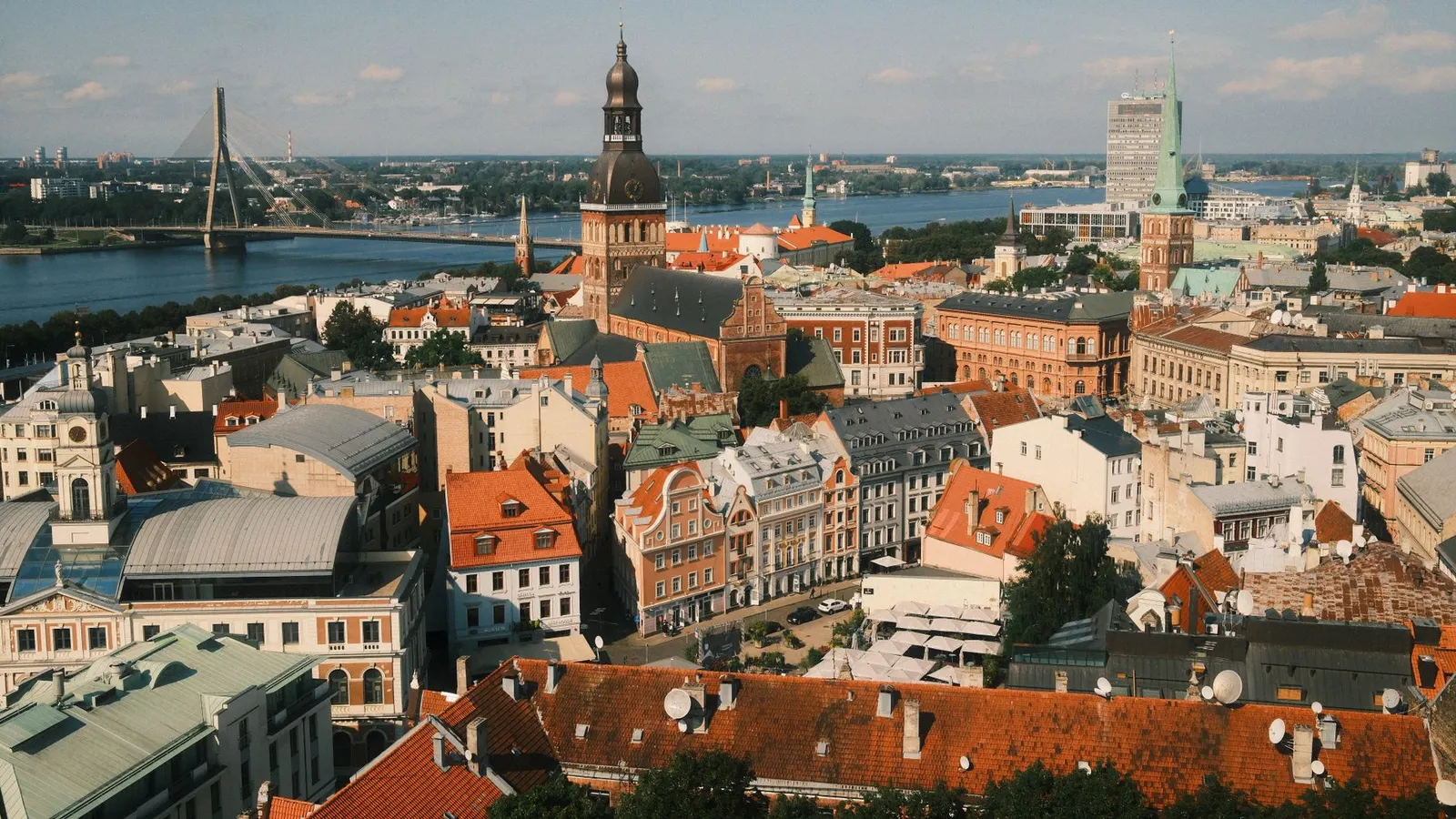
The old town was listed by UNESCO in 1997 and is smaller than its reputation; you can walk it in a morning. Spend the afternoon north of the canal in the Art Nouveau quarter instead, where roughly a third of central Riga's buildings are Jugendstil and Alberta iela has six by Mikhail Eisenstein, whose son Sergei went on to make films.
Riga, market and ministry
The Central Market opened in 1930 and its pavilions are built on the steel skeletons of two German airship hangars hauled from Vaiņode after the First World War - the vaults are visible from inside, and the fish hall is still where the city buys fish. Then the Academy of Sciences tower, raised through the 1950s in the full Stalinist manner, with a viewing gallery near the top that gives you the whole river.
Out of Riga, upriver
The road and the railway east both follow the Daugava. Rumbula forest, where about twenty-five thousand people from the Riga ghetto and one transport from Germany were shot over two days in late 1941, is fifteen minutes from the centre, set back behind the railway and easy to drive past. Salaspils camp memorial, a few kilometres on, is a set of enormous concrete figures in a clearing with a metronome beating under the ground; Soviet texts claimed a hundred thousand dead here, and Latvian and German historians now put it in the low thousands, which is an argument about numbers and not about what the place was. Sleep at Koknese, where the castle the Saxons blew up in 1701 stands at the waterline because the reservoir rose to it.
Pļaviņas and what is under the water
The dam at Aizkraukle was built between 1961 and 1966 and is the largest hydroelectric plant in the Baltic states - spillway and powerhouse in a single block, because the dolomite underneath would not take anything else. Behind it went the rapids, the Pērse waterfall at Koknese, and Staburags, a tufa cliff some eighteen metres high that appears in more Latvian folk songs than any other piece of rock. There is a memorial stone in the park at Vīgante above where it stood. Latvenergo runs guided tours inside the plant, by prior arrangement and with a passport.
Daugavpils
Latvia's second city, majority Russian-speaking, and built around a fortress raised between 1810 and 1878 that survived the twentieth century almost unaltered because the Soviet army kept using it. The arsenal inside now holds the Mark Rothko Art Centre - he was born Markus Rothkowitz in this town in 1903 and left at ten - with a small number of originals lent by his family and rotated every few months.
The Daugava loops
Upstream the river stops behaving like a lowland river and starts turning back on itself - eight deep meanders between Naujene and Krāslava, in a valley cut forty-odd metres into the plateau. The tower at Vasargelišķi looks down the best of them. Slutišķi below it is an Old Believer village of squared timber houses, settled by people who left Russia after the schism of the 1660s and kept the old rite. This is the stretch the Daugavpils dam would have put under water.
Aglona and Lake Rāzna
North into Latgale, which is Catholic where the rest of the country is Lutheran. The basilica at Aglona was finished in 1780 and is the national pilgrimage church; on 15 August the village of a few hundred people takes tens of thousands. Then Rāzna, the largest lake in Latvia by volume and second by area, with a national park around it since 2007 and almost nobody on the shore outside July.
Rēzekne, then west
Latgale was inside the Vitebsk governorate when the Russian empire banned Latin-script printing there from 1865 to 1904, and the region came out of those forty years with a written language of its own; Latgalian is still spoken here and still argued about in Riga. See the Green Synagogue, wooden and the only one of the town's synagogues left standing, restored as a museum; and the Māra monument, which was pulled down by the Soviets in 1940, rebuilt under the German occupation, destroyed again in 1950 and put back for good in 1992. Afternoon train to Riga.
Sigulda and Turaida
An hour up the line into the Gauja valley, which became Latvia's first national park in 1973. Turaida's brick castle was begun in 1214 for the Bishop of Riga; Gūtmanis cave below it is the largest in the Baltics by volume and is carved over with graffiti going back to the seventeenth century. The cable car across the valley has run since 1969. The bobsleigh track above the town is one of a handful in the world that sells rides to the public.
Līgatne and Cēsis
Līgatne is a paper-mill village of 1815 with cellars cut into the sandstone behind the houses and a cable ferry that crosses the Gauja on the current alone. Two kilometres away, nine metres under a rehabilitation centre at Skaļupes, is the bunker built in 1982 to hold the Soviet Latvian leadership through a nuclear war; it was declassified in 2003 and the tour goes through it with the telephones and the map boards in place. On to Cēsis, whose castle garrison blew itself up in 1577 rather than surrender to Ivan the Terrible, and which you tour after dark by hand lantern.
Across to Kuldīga
The one real transfer day: back down to Riga by train and out west by bus. Kuldīga was listed by UNESCO in 2023 for a wooden old town that never burned or got rebuilt. The Venta rapid below it is 249 metres across, which makes it the widest waterfall in Europe and about two metres the least impressive; in spring fish jump it, and the dukes of Courland used to have baskets set to catch them in mid-air. The brick road bridge of 1874 alongside is one of the longest of its kind left.
Liepāja and Karosta
Karosta was built as a naval port for the Tsar between 1890 and 1906 and takes up roughly a third of the city. The Orthodox naval cathedral was consecrated in 1903 with Nicholas II present; the northern forts were demolished with explosives and are falling into the sea in pieces you can walk among; the military prison ran until 1997 and now sells overnight stays in the cells, which is a stranger business than it sounds. In town, note that Helsinki-86, the first openly anti-Soviet group in the country, was founded here in July 1986.
Ventspils
Up the coast to the port. Ventspils spent the Soviet decades shipping Russian crude and was closed to foreigners for it; the pipeline was shut off from the Russian end at the start of 2003 and never turned back on, and the town has been rebuilding itself around containers, a technology park and an unembarrassed number of painted cow sculptures ever since. The narrow-gauge train in the seaside open-air museum is a survivor of a network that once covered Kurzeme.
The Livonian coast and Cape Kolka
The last stretch runs through the twelve villages of Līvõd rānda, the coast of the Livonians, a Finnic people whose last native speaker died in Canada in 2013. The People's House at Mazirbe was paid for by Finland, Estonia and Hungary and opened in 1939, a year before everything stopped; the coast then became a Soviet border zone, which is why the villages emptied. Slītere's lighthouse of 1849 stands on an old shoreline cliff behind them. At Kolka a sandbank runs several kilometres out under the sea, the Gulf of Riga meets the open Baltic, and on a windy day you can watch the two sets of waves collide.
Good to know
Trains are run by Vivi, the rebranded national operator, and buses are aggregated on 1188.lv; the two do not appear on each other's timetables. Rail runs in three useful directions out of Riga and no more - Daugavpils, Rēzekne, and the Gauja line through Sigulda and Cēsis towards the Estonian border. West of Tukums there is no passenger train at all, so Kuldīga, Liepāja, Ventspils and Kolka are buses whether you like it or not. Latgale and the Livonian coast are the two places where public transport genuinely fails - rural services often carry a note meaning they run on school days only, so they vanish in July and August and at weekends, exactly when visitors turn up. Hire a car for those two legs and use trains for the rest. Tours inside Pļaviņas hydroelectric plant and the Līgatne bunker both have to be booked in advance and neither takes walk-ins; the plant is a working Latvenergo site and wants names and a document number when you book. The Belarusian border runs close to Krāslava and the Daugava loops, and the border strip is a permit zone administered by the State Border Guard - the marked viewpoints are all outside it, but do not improvise a walk east of the nature park. Midsummer, 23 and 24 June, shuts the country: shops close, timetables thin out and everybody is at a bonfire, so either plan around it or join in. Latvia has one of the highest rates of tick-borne encephalitis in Europe and Latvians vaccinate against it; the standard course runs over months and even the accelerated one wants a few weeks, so ask a doctor before you book rather than after. Shop alcohol sales are restricted to fixed hours, and those hours have been cut more than once in recent years - read the sign on the door instead of assuming an evening bottle. Rumbula and Salaspils are open at all hours, free, and have no facilities of any kind.
Shorter or longer?
Four more days from Riga: the boardwalk across the Great Ķemeri Bog at dawn, a night in Jūrmala's wooden villas, then north along the Vidzeme coast to the sandstone cliffs at Veczemji and the old harbour town of Ainaži on the Estonian border.
Riga, the dams at Ķegums and Aizkraukle, Daugavpils and the loops, Aglona and out by train from Rēzekne. Keeps the whole argument the route is built around and drops Kurzeme, the Gauja and the coast entirely.
Practical guide
Visa check for this route
Budget
Mid-range · per person · sharing a double room. Excludes international flights - they depend on where you fly from.
Editorial estimates · checked August 2026
Country guides
Trip essentials
The connectivity placement is our own eSIM store. No affiliate link on this list. How we choose these →