Itinerary · Europe · 8 days · Easy
Eight Days on a Free Network
Luxembourg City→Luxembourg American Cemetery, Hamm→Belval, Esch-sur-Alzette→Musée National des Mines, Rumelange→Schengen→Echternach+2 stops
The whole country on buses, trains and a tram that stopped charging fares in February 2020 - the fortress city and its casemates, the iron-ore towns of the Minett with a dead blast furnace standing over a university, the Moselle vineyards and the village where five states signed Schengen on a boat, then the sandstone gorges of the Mullerthal and north into the Ardennes for a castle, a pumped-storage plant inside a hill and Steichen's photographs.
Luxembourg City, above and below
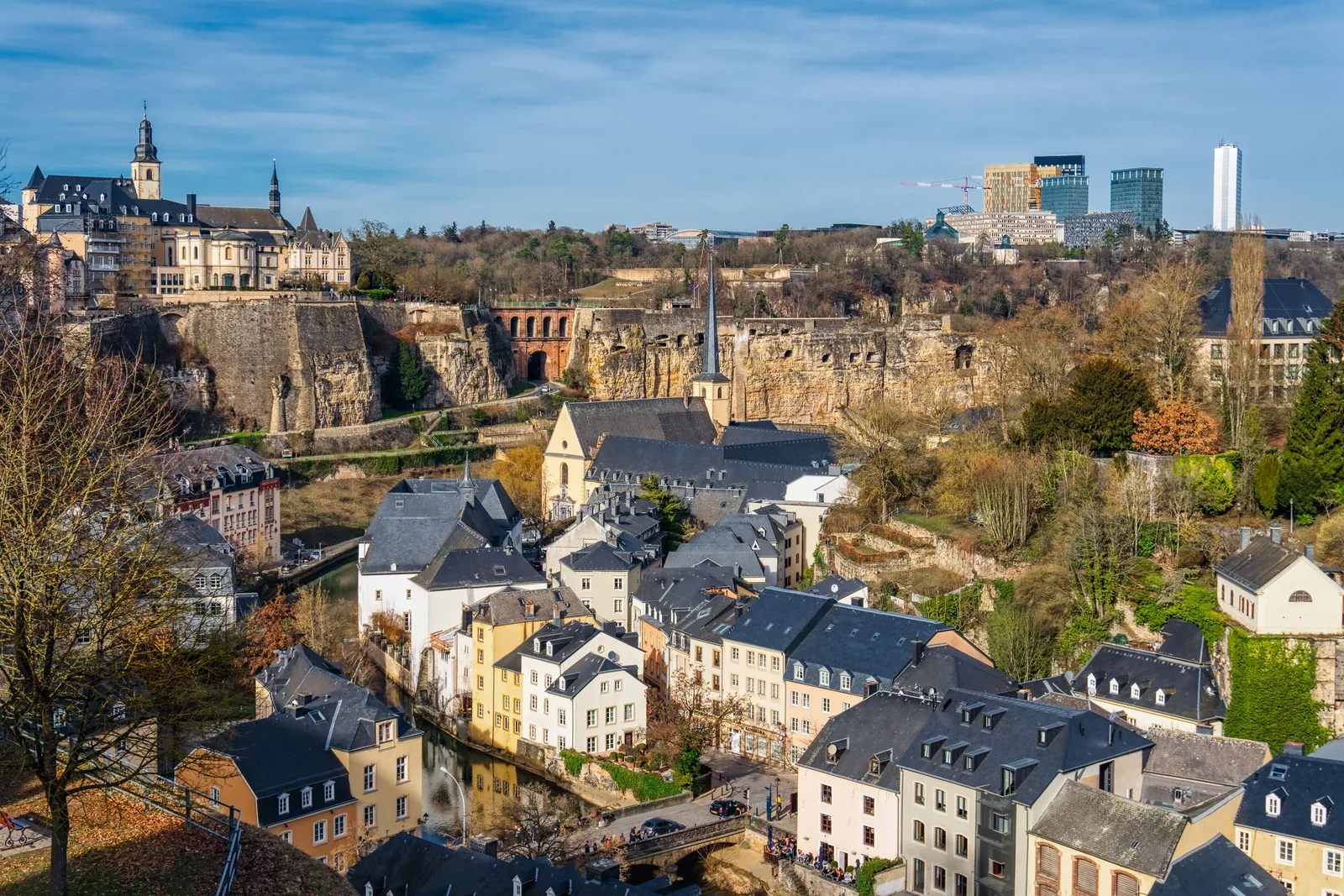
The old quarters and the fortifications went onto the UNESCO list in 1994, and the point of them is vertical. The Bock casemates were cut into the sandstone from 1644 under the Spanish and extended by Vauban after 1684; when the Treaty of London in 1867 required the fortress to be demolished, the tunnels were too entangled with the rock to remove and were sealed instead. Walk the Chemin de la Corniche along the top, drop into the Grund on foot, and come back up on the Pfaffenthal panoramic lift - seventy-odd metres, glass floor, free, like everything else here.
Kirchberg, Hamm and Sandweiler
The tram runs out along the Kirchberg plateau past the institutions that pay for a good deal of this country: the Court of Justice of the European Union, the European Investment Bank, the secretariat of the European Parliament. Then bus east to Hamm, where just over five thousand American war dead are buried and George Patton lies at the head of them, and on to Sandweiler, where close to eleven thousand German soldiers from the same months are buried in a fraction of the space. The two cemeteries are a couple of kilometres apart, most of their dead were killed in the same campaign, and one is laid out as a memorial park while the other is not.
Into the Minett - Esch-sur-Alzette and Belval
Twenty-five minutes by train to Belval-Université, and the platform comes out under two blast furnaces. Furnace A ran until 1997, when the last iron in Luxembourg was tapped; instead of clearing the site the state built the University of Luxembourg between the legs of it, and you can climb the walkway to the top platform. The rest of the day is Esch itself - European Capital of Culture in 2022, and the centre of a region UNESCO designated a biosphere reserve in 2020 on the strength of what grew back over the abandoned ore workings.
Underground at Rumelange, and the Fond-de-Gras
The National Mine Museum at Rumelange puts you on a train into a real gallery of the Walert mine, driven horizontally into the hillside because the ore here lay in beds rather than shafts - which is why the Minett produced open adits and not pit villages. Afterwards, if it is summer and a Sunday, the Fond-de-Gras at the other end of the basin runs a steam train and a narrow-gauge mine railway through to Lasauvage. Check both before you set out: these are volunteer operations with short seasons, not a daily service.
The Moselle and Schengen
East to the river, which is the German border and the country's entire wine industry - Riesling, Auxerrois, Elbling and Pinot Gris on steep left-bank slopes, plus the Crémant appellation created in 1991. Schengen is a village of a few hundred people a couple of kilometres from the point where Luxembourg, France and Germany meet, which is exactly why it was chosen: on 14 June 1985 five governments signed the agreement aboard a boat moored on the river rather than in anyone's capital. The European Museum on the bank explains the choice better than the monument outside it does.
North to Echternach and the Mullerthal
Downstream through Grevenmacher and Wasserbillig - the Moselle runs north-east here, so this is with the current, not against it - then inland. Echternach grew around the abbey Willibrord founded in 698 and still holds his tomb in the crypt; the hopping procession that goes through the streets on Whit Tuesday was put on UNESCO's intangible heritage list in 2010. Behind the town the sandstone breaks into the gorges people insist on calling Little Switzerland - the Schiessentümpel falls, the clefts at Berdorf, and 112 kilometres of waymarked Mullerthal Trail if you want more than an afternoon of it.
Diekirch and Vianden
West to Diekirch for the National Museum of Military History, which is about the Ardennes offensive of December 1944 and is far better than the size of the town suggests, then north to Vianden. The castle above the Our was sold off and stripped in the 1820s and stayed a ruin for a century and a half, until the Grand Duke handed it to the state in 1977 and restoration began. The more interesting structure is invisible: inside the hill opposite sits one of Europe's largest pumped-storage plants, running since the early 1960s and expanded again in 2014, which pumps water uphill on cheap German electricity and sells it back when the German grid is short.
Clervaux, and the train back
Deeper into the Oesling to Clervaux, where the castle holds The Family of Man permanently. Edward Steichen was born in Luxembourg in 1879, ran photography at the Museum of Modern Art in New York, and assembled 503 photographs from 68 countries for a 1955 exhibition that then toured the world for eight years; he left it to his birth country, it has been installed here since 1994, and UNESCO added it to the Memory of the World register in 2003. An hour on line 10 back to Luxembourg afterwards, still without buying a ticket.
Good to know
Luxembourg is in the Schengen area, so entry rules are the standard ones - 90 days in any 180 visa-free for most Western passports, a Schengen visa applied for in advance otherwise, and the Entry/Exit System now taking biometrics at the external border on first arrival. ETIAS is signposted to follow; check the current position when you book rather than assuming, because the date has moved repeatedly. In practice Luxembourg has no external border on the ground: arriving by train or road from France, Belgium or Germany involves no check at all, and the only place you meet one is Findel airport on a flight from outside the area - so most people on this route are stamped in somewhere else entirely. Since 29 February 2020 all scheduled public transport inside the country is free in second class - buses, trains and the city tram, for residents and visitors alike, with no ticket, card or registration involved. Three things are still charged for: first class on trains, the Nightrider door-to-door night service, and the portion of any cross-border journey that lies outside Luxembourg, so a train to Trier or Thionville costs only the foreign kilometres. The catch is not price but frequency. The city and the Minett run at urban intervals; the Oesling and the Mullerthal do not, and in the smaller villages the last bus can leave in the early evening and Sunday service can drop to a handful of departures. Plan those legs on mobiliteit.lu the night before, not on the day. Three languages are in daily use - Luxembourgish is the national language, French is the working default in shops, restaurants and on menus, German dominates the press - and English is understood almost everywhere on this route. Accommodation is the real expense and it behaves oddly: city hotels are priced for the EU institutions and the fund industry, so they are dear from Monday to Thursday and can halve at weekends, which is worth building the trip around. Driving is possible and unnecessary; around 230,000 people commute in across the French, Belgian and German borders every working day, a large share of them by car, and the morning queues into the city are genuinely bad. Seasonally, the mine railways at the Fond-de-Gras and the Vianden chairlift run roughly Easter to autumn only, the Mullerthal rock passages are slippery and often muddy after rain, and Echternach's hopping procession fills every bed for miles on Whit Tuesday. Card payment is universal and cash is barely needed.
Shorter or longer?
Add three or four days by using the same network to get to its edges: Trier is half an hour from Wasserbillig and has the best-preserved Roman gate north of the Alps, Metz is an hour south, and Bastogne in the Belgian Ardennes completes the winter of 1944 that Diekirch only half tells.
City, Belval, Rumelange and the Mullerthal, sleeping in Luxembourg throughout and treating everything as a day trip. Cuts the Moselle and the whole of the north, which is where the timetables get thin anyway.
Practical guide
Visa check for this route
Budget
Mid-range · per person · sharing a double room. Excludes international flights - they depend on where you fly from.
Editorial estimates · checked August 2026
Country guides
Trip essentials
The connectivity placement is our own eSIM store. No affiliate link on this list. How we choose these →