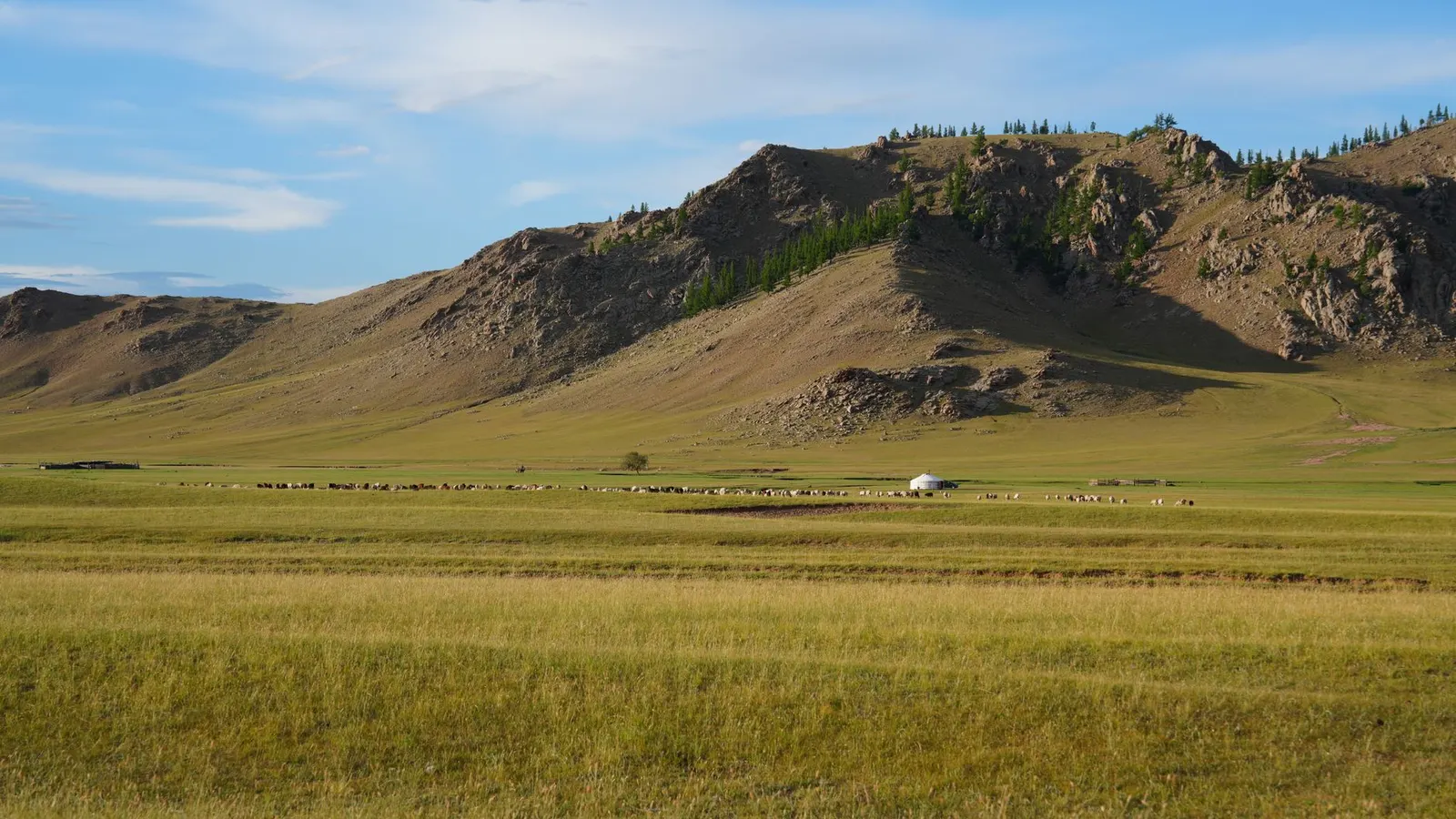
 Dal Tamiraa · Pexels License
Itinerary · Asia · 14 days · Moderate
The Gobi and the Orkhon
Ulaanbaatar→Bogd Khan Winter Palace, Ulaanbaatar→Yolyn Am, Gurvan Saikhan National Park→Yolyn Am→Khongoryn Els→Khongoryn Els, north face+8 stops
Fly south into the desert and drive the whole way back - a gorge that holds ice into the summer, three hundred metres of singing sand, the cliffs where the first dinosaur eggs came out of the ground in 1923, then up onto the Khangai grassland for the Mongol capital, a hermitage at 2,300 metres, and the horse that went extinct in the wild and was put back.
Ulaanbaatar
Roughly half the country lives here and none of the rest of the country looks like it. Gandantegchinlen is the working monastery - its 26-metre Migjid Janraisig is a 1996 replacement, the original having been carted off in 1938 - and the Choijin Lama Temple, two kilometres south-east of it, was closed the same year and reopened as a museum of religion in 1942, on the reasoning that the thing being abolished ought also to be exhibited.
Ulaanbaatar, and the arrangements
The National Museum for the long version, then the Bogd Khan Winter Palace, the only one of the eighth Bogd Gegeen's residences that was not pulled down. Keep the afternoon for logistics: meet the driver, look at the vehicle before you agree to it, settle in writing what is inside the price, and buy the water, jerrycans and food the next twelve days run on.
South to the desert
Chinggis Khaan International sits fifty kilometres out of the city, so leave early. The flight crosses in eighty minutes the ground you will spend eleven days driving back over. Dalanzadgad is a provincial capital of about twenty thousand people and holds the last cash machine for several days; an hour west of it the Gurvan Saikhan ridge starts.
Yolyn Am
A gorge named for the lammergeier, narrowing to a few metres across under walls of several hundred. Walk in from the car park - an hour to where the ice sits, longer if you walk the gorge through to where it opens out - and find ice on the floor of it in a desert, fed by shade and a stream rather than altitude. It used to last all summer and now rarely survives July. Ibex work the skyline, which is the argument for carrying binoculars.
West to the dunes
Five hours along the southern flank of the Gurvan Saikhan on gravel and tyre track. Khongoryn Els is a hundred kilometres of sand piled against the Sevrei range, rising in places to three hundred metres, with the Khongoryn Gol running green along the northern foot of it and camel-herding families on the river.
Khongoryn Els
Climb the high crest in the last hour of light - sand gives back half of every step and it takes an hour - and come down the face fast enough to set it humming, which is where duut mankhan, the singing dunes, comes from. A camel is the honest way to cover the ground between the river and the sand, and the two-humped Bactrian here is the local animal rather than a prop.
Bayanzag
North-east to the cliffs Roy Chapman Andrews named the Flaming Cliffs on the American Museum of Natural History's Central Asiatic Expeditions. The 1923 season took the first dinosaur eggs anyone recognised as such out of this sandstone, along with the Velociraptor described the year after. What comes out now largely leaves illegally: Mongolia spent 2012 and 2013 in a New York court recovering a Tarbosaurus bataar skeleton auctioned there for over a million dollars, and it is on display in Ulaanbaatar.
Ongi
North to the Ongi river and two monastery complexes facing each other across it - the northern one founded in 1660, the southern not until 1810 - both destroyed in the purge of 1937 to 1939, which pulled down something like seven hundred monasteries across the country and killed monks in their thousands. A small temple was rebuilt in the 2000s and a handful of monks are back. Everything else is foundations, and the extent of the foundations is what there is to see.
Up to Kharkhorin
The long driving day: gravel and tyre track as far as Arvaikheer, then tarmac for most of what is left, out of the Gobi and onto the Khangai grassland. The change in the country outside the window happens over about two hours and is impossible to miss - bare stone and saxaul give way to grass, then to grass with rivers in it.
Erdene Zuu and Karakorum
Ögedei made Karakorum the capital in 1235 and Kublai left it for Beijing within thirty years; almost nothing of it stands above ground. Erdene Zuu, begun in 1585, was built beside it partly out of its stone, and its wall carries 108 stupas. A few of its temples came through the purge and the site reopened as a state museum in 1947, which is the only reason anything here survives. UNESCO listed the Orkhon valley in 2004 for the whole sequence of capitals - Turkic, Uighur, Mongol - rather than for any single ruin.
Tövkhön and the falls
A rough track up into the Khangai forest and then the last hour on foot. Zanabazar founded Tövkhön in 1648, at fourteen, and cast and carved here on and off until Galdan's Dzungars burned it in 1688; it was rebuilt, levelled again in the purge, and rebuilt a second time from the 1990s. The hermitage sits at about 2,300 metres in the trees, and the hour on foot is why most groups leave it out. Afterwards south-west to Ulaan Tsutgalan, where the Orkhon drops twenty metres over the lip of an old lava flow.
Tsenkher
North-west across the Khangai to the hot springs, which surface at about 85°C and are piped into concrete pools at every camp in the valley. This is the one wash of the trip that is not a bowl of heated water carried to you, and it is worth building the route around.
Elsen Tasarkhai
North off the springs track to the Tsetserleg–Kharkhorin road, then east on tarmac, back past Kharkhorin to the sand belt that crosses the road at Bayangobi - eighty kilometres of dune with a river and pine woods along one side of it, which corrects the assumption that Mongolian sand is a southern phenomenon. Horses are hired here by the hour from the families camped at the edge of it.
Hustai, and in
The Przewalski's horse was last seen in the wild in 1969 and spent a generation existing only in zoos. Sixteen were released here in 1992 out of the European breeding stock; there are several hundred now, and the IUCN took the species off the Extinct in the Wild list in 2008. Go out at dusk with a park ranger, which is when the harems come down to water. Ulaanbaatar is ninety minutes on from the gate.
Good to know
Nobody does this route on public transport, and the reason is not adventure - outside the trunk roads there is no scheduled service, no signage and frequently no road, only a spread of tyre tracks a driver reads off landmarks. What you hire in Ulaanbaatar is a Russian UAZ van or a Land Cruiser with its driver, quoted as a rate per kilometre plus a daily fee, with the driver's food and bed on you; agree in writing whether fuel, park entries and a cook sit inside or outside that number, because all three are commonly outside it. The driver is a driver: assume no English, no commentary and no help at a family ger, and hire a guide-interpreter separately at roughly €30 a day for the whole vehicle if you want twelve days of the country rather than twelve days of the window. Entry is the loosest part of the trip and the least stable. US passports have held a ninety-day exemption since 1991, but most European ones enter visa-free under a government resolution that has been renewed in one- and two-year blocks rather than made permanent, so confirm the resolution currently in force before you book flights, not at the desk. Anyone staying past thirty days must register with the Immigration Agency in Ulaanbaatar within the first week. Nothing on this route needs a border-zone permit - Khongoryn Els is still the better part of a hundred kilometres short of the Chinese frontier - but the Great Gobi strictly protected areas and the Altai border sums do, and the permit is arranged in Ulaanbaatar, never at the gate. The season is short. Most ger camps open around the middle of May and close in late September, and outside that window this is a winter expedition rather than a holiday. Naadam falls on 11–13 July, with the public holiday running to the 15th, and empties the countryside into the capital: beds in Ulaanbaatar double in price and book out months ahead, and the aimag Naadams in the surrounding weeks are the better ones to watch in any case. Cash machines exist in Dalanzadgad, Arvaikheer and Tsetserleg and essentially nowhere in between, so draw tögrög before you leave. The flight south is on a small aircraft with a checked allowance around 15 kg and a habit of consolidating half-empty departures, so do not book it against a same-day international connection. At a family ger, stop outside and call nokhoi khor - hold the dog - rather than walking up to the door; the dogs are working animals and they are not tied. And the Gobi is cold after dark even in July, because the figure people quote for it is a midday figure.
Shorter or longer?
Carry on from Tsenkher to the Great White Lake and the Khorgo crater, then over to Mörön and up to Khatgal on Khövsgöl, flying back to Ulaanbaatar from Mörön. Six more days, and the road between Tariat and Mörön is the worst driving on any version of this trip.
Fly both ways to Dalanzadgad and keep Yolyn Am, Khongoryn Els and Bayanzag. Loses Karakorum and the entire Khangai, halves the driving, and is the honest shape of the trip if you have a week.
Practical guide
Visa check for this route
Budget
Mid-range · per person · sharing a double room. Excludes international flights - they depend on where you fly from.
Editorial estimates · checked August 2026
Country guides
Trip essentials
The connectivity placement is our own eSIM store. No affiliate link on this list. How we choose these →