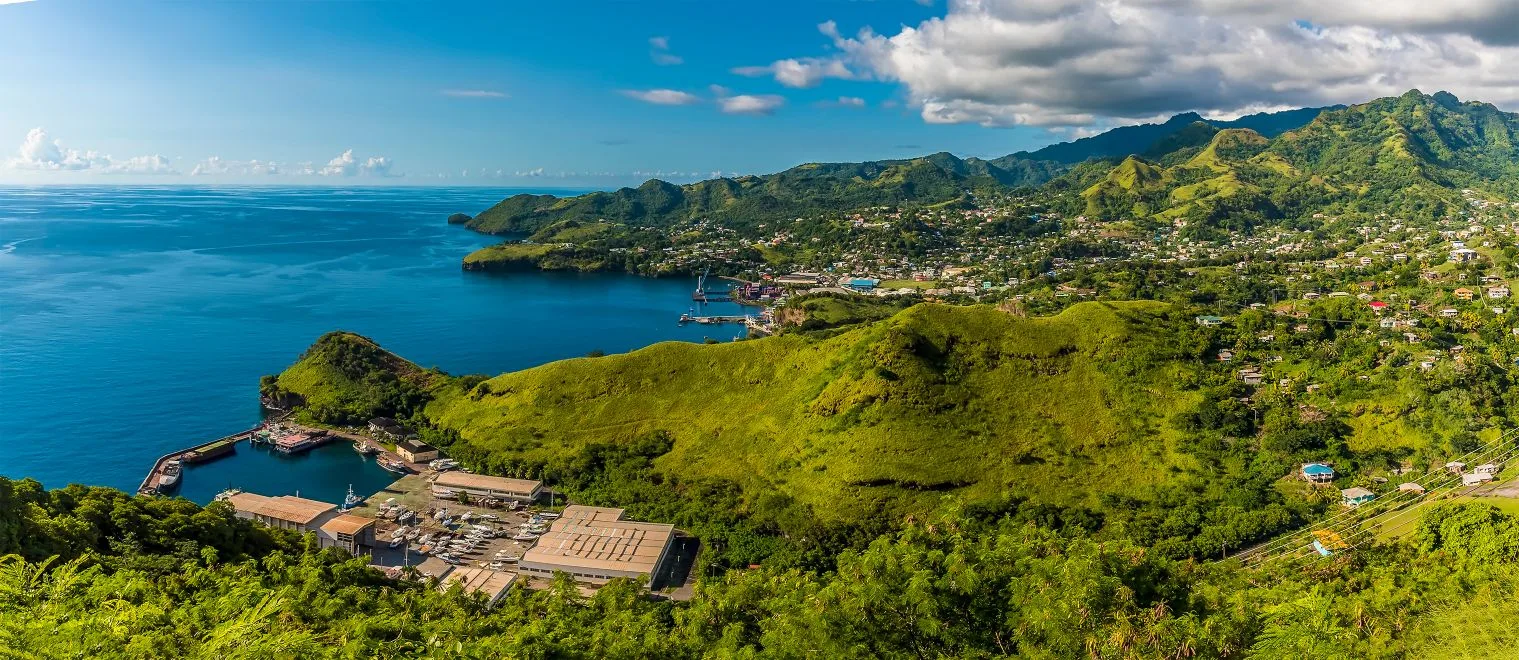
Itinerary · Caribbean · 7 days · Moderate
Mail Boat to the Cays
Kingstown→La Soufrière→Owia Salt Pond→Vermont Nature Trail→Port Elizabeth, Bequia→Clifton, Union Island+1 stops
Seven days on the volcanic main island and the Grenadines you can reach on public boats - a fort whose guns point inland, a crater that exploded for two weeks in 2021 without killing anyone, and the cargo boat that runs south to Union Island twice a week. There is no charter yacht in it. The chain is usually written up from a deck; this is the version done on the boats the islands actually run.
Kingstown
A working port capital of arched stone arcades, and a market that is finished by early afternoon. The Botanic Gardens above the town were founded in 1765 and are generally cited as the oldest in the western hemisphere; they were laid out to trial economically useful plants for the plantations, and the breadfruit here descends from the stock William Bligh finally landed in 1793 - the second attempt, the first having ended with the mutiny on the Bounty. The enslaved population it was imported to feed refused to eat it for years. There is a breeding aviary for the Saint Vincent parrot in the same grounds. Above everything, Fort Charlotte was completed in 1806 on the ridge some 190 metres over the harbour, and the thing to notice is which way the guns face: most of them point inland, because after two wars against the Garifuna the British expected the next attack to come down the valleys rather than in off the sea.
La Soufrière
The volcano is 1,234 metres at the northern end of the island and it has erupted explosively three times in living memory or close to it - 1902, which killed over a thousand people the day before Mont Pelée destroyed Saint-Pierre across the channel in Martinique; 1979, which emptied the north; and April 2021, which went on for two weeks, put ash into the stratosphere and killed nobody at all. The windward route starts beyond the Rabacca dry river and climbs through rainforest, then bamboo, then bare volcanic ground where nothing has come back yet. Six to eight hours return, no water on the mountain, and the summit is not the shape it was before 2021 - the dome that grew through late 2020 was blown out of the crater. Go with a guide and start at first light, because the cloud comes in by late morning and the dry river floods after rain.
The windward coast north
The road up the Atlantic side runs through the ground the 2021 ashfall landed on, and four years of rain has not moved all of it. At Byera the Black Point Tunnel was cut through the headland in 1815 by enslaved Africans and Caribs so that sugar from the Grand Sable estate could be moved by boat instead of over the ridge - roughly a hundred metres of it, hand-cut through volcanic rock, and you can still walk through to the beach on the far side. Further north, Sandy Bay and Owia are Garifuna villages, descended from the people who were not deported in 1797 or who came back. The Owia Salt Pond is a set of natural rock pools protected from the Atlantic by a wall of lava, and the road ends shortly afterwards at Fancy.
The parrot valley and the leeward road
Start before six at the Vermont Nature Trail in the Buccament valley: a loop of a little under three kilometres with a parrot lookout partway round, and the birds are audible long before they are visible. Amazona guildingii lives on this island and nowhere else, was down to a few hundred birds in the 1980s, and has roughly doubled since under a long programme run out of the Botanic Gardens aviary. Afterwards, north up the leeward coast, which is a sequence of hairpins between the sea and the mountain. Wallilabou Bay still has the remains of the set built for the first Pirates of the Caribbean film, shot here in 2002, knocked about by storms since. Dark View Falls near Richmond is reached over a bamboo bridge across the river, and the tarmac gives out not far beyond it - the north-west of the island has no road at all.
Bequia
An hour on the Bequia Express from Kingstown, and the pace changes at the jetty. Port Elizabeth is a boat-building town with a working harbour; the Belmont walkway runs south along the rocks to Princess Margaret Beach and Lower Bay. At Park Beach, the Old Hegg turtle sanctuary was set up in 1995 by Orton King, a retired fisherman, to raise hawksbills past the stage at which almost all of them are eaten, and to release them at three or four years old. At the other end of the island, Paget Farm is where the whaling happens: Saint Vincent and the Grenadines holds an aboriginal subsistence quota under the International Whaling Commission for a very small number of humpbacks a year, and Bequia is the only place in the country it is exercised - taken from open sailing boats with hand harpoons, and both sides of that argument are conducted in the harbour bars. Moonhole, at the western tip, is a house built into a natural rock arch from 1961 and abandoned after the arch dropped stone into it; visits are by arrangement only.
South on the Gem Star
This is the day the route is built around and it cannot be moved: the MV Gem Star sails south twice a week and not daily - Mondays and Thursdays on the timetable that has held most recently, though it is worth confirming at the wharf rather than trusting that - so you take the first Bequia Express back at dawn and wait for it. The boat is the supply line for four islands - cement, gas bottles, crates of chicken, mattresses, schoolchildren going back after the weekend - and passengers sit on deck among it for about five hours, calling at Canouan and Mayreau. Union Island at the end is the southern hub of the chain: Clifton harbour, and Fort Hill above it, half an hour up for a view over the whole reef system. West of the airstrip is Ashton Lagoon, where a foreign developer began a marina in 1994, abandoned it in 1995, and left a causeway that cut the water flow and killed the largest mangrove system in the Grenadines; since 2016 a restoration led by Sustainable Grenadines has reopened the channels and put boardwalks across it, and the birds are back. Hurricane Beryl took the roofs off most of this island on 1 July 2024, so what you are looking at is a rebuild in progress, and it is worth being straightforward about that rather than photographing around it.
The Tobago Cays and Mayreau
Thirty to forty minutes by open boat from Clifton to five uninhabited islands lying inside Horseshoe Reef, protected as a marine park with a fee of EC$10 a head a day. Green turtles graze the seagrass beds off Baradal in water shallow enough to stand in; the rangers enforce a distance and they are right to. Lunch on Mayreau, which has one village, a few hundred people and a road that goes up and comes down, and the climb to the church at the top of the village gives you the entire Cays laid out below. Salt Whistle Bay is on the other side of the ridge. Getting out is the awkward part, and it works the same way whichever sailing you came down on: the northbound Gem Star leaves the morning after the boat arrives, which is before a Cays day boat is back on the dock. Taking the boat north means giving up the Cays, so the last day ends instead with the twenty-five-minute flight from Union Island to Argyle.
Good to know
Most nationalities need no visa and are stamped in for a month at Argyle International, but an onward ticket is asked for and occasionally checked. The currency is the East Caribbean dollar, pegged at EC$2.70 to the US dollar since 1976, so the rate never moves and US dollars are accepted almost everywhere at a worse one. Cards work in Kingstown, on Bequia and on Canouan and mostly nowhere else - there are ATMs in Kingstown, Port Elizabeth, Canouan and Clifton, and the guesthouses, boat crews and minibuses south of Bequia want cash, so draw it before the mail boat rather than after. The single hardest planning fact is Hurricane Beryl, which came through the southern Grenadines as a Category 4 on 1 July 2024 and damaged or destroyed the overwhelming majority of buildings on Union Island, with Mayreau and Canouan badly hit as well; rebuilding is well under way but the bed stock on Union and Mayreau is a fraction of what the guidebooks list, so confirm your room directly with the owner by phone before you commit to a boat you cannot easily leave. Hurricane season runs 1 June to 30 November and the dangerous weeks are August to October. The MV Gem Star sails Kingstown to Union Island twice a week and not daily - southbound Mondays and Thursdays and back the following mornings on the timetable most recently in force - for a fare of well under twenty euros. Treat those weekdays as this year's arrangement rather than a fixture: the timetable is not reliably published anywhere online, has moved before, changes with cargo and weather, and should be confirmed at the Grenadines wharf in Kingstown the day before. If it does not fit your week, SVG Air and the Grenadine air alliance fly Argyle to Bequia, Canouan, Mustique and Union Island on small aircraft, daylight only, with luggage allowances around 20 kg and a hard cut-off enforced at check-in. Mustique is not a day trip: the island is run by the Mustique Company on behalf of its homeowners and casual visitors are neither ferried nor encouraged. On Saint Vincent itself, minibuses run from the Little Tokyo terminal in Kingstown, cost very little, stop by early evening and effectively do not run on Sundays, when the whole country closes; if you drive, it is on the left and you must buy a temporary local permit, which the rental company will arrange. Take a guide up La Soufrière - the route is not always obvious on the upper slopes, the crater rim has no barrier, and the 2021 deposits are unstable in places. Dengue circulates and there is no malaria; the mosquitoes here bite in daylight, so repellent belongs in the day bag. Reef-safe sunscreen is the decent minimum in the Tobago Cays, where the reef is already carrying storm damage.
Shorter or longer?
Add three days by taking the Gem Star only as far as Canouan, staying a night, and using local boats down through Mayreau and Union - plus a second night on Bequia at the start, which is the one island where a single day genuinely is not enough. It roughly doubles the boat admin and is the version to choose if you have flexible dates rather than a fixed flight home.
Kingstown, La Soufrière, the windward coast and Bequia. Drops the mail boat, the Tobago Cays and everything south of Bequia - which is most of what people come for, but it removes the twice-weekly sailing from the plan and with it the main way this route goes wrong.
Practical guide
Visa check for this route
Budget
Mid-range · per person · sharing a double room. Excludes international flights - they depend on where you fly from.
Editorial estimates · checked August 2026
Country guides
Trip essentials
The connectivity placement is our own eSIM store. No affiliate link on this list. How we choose these →