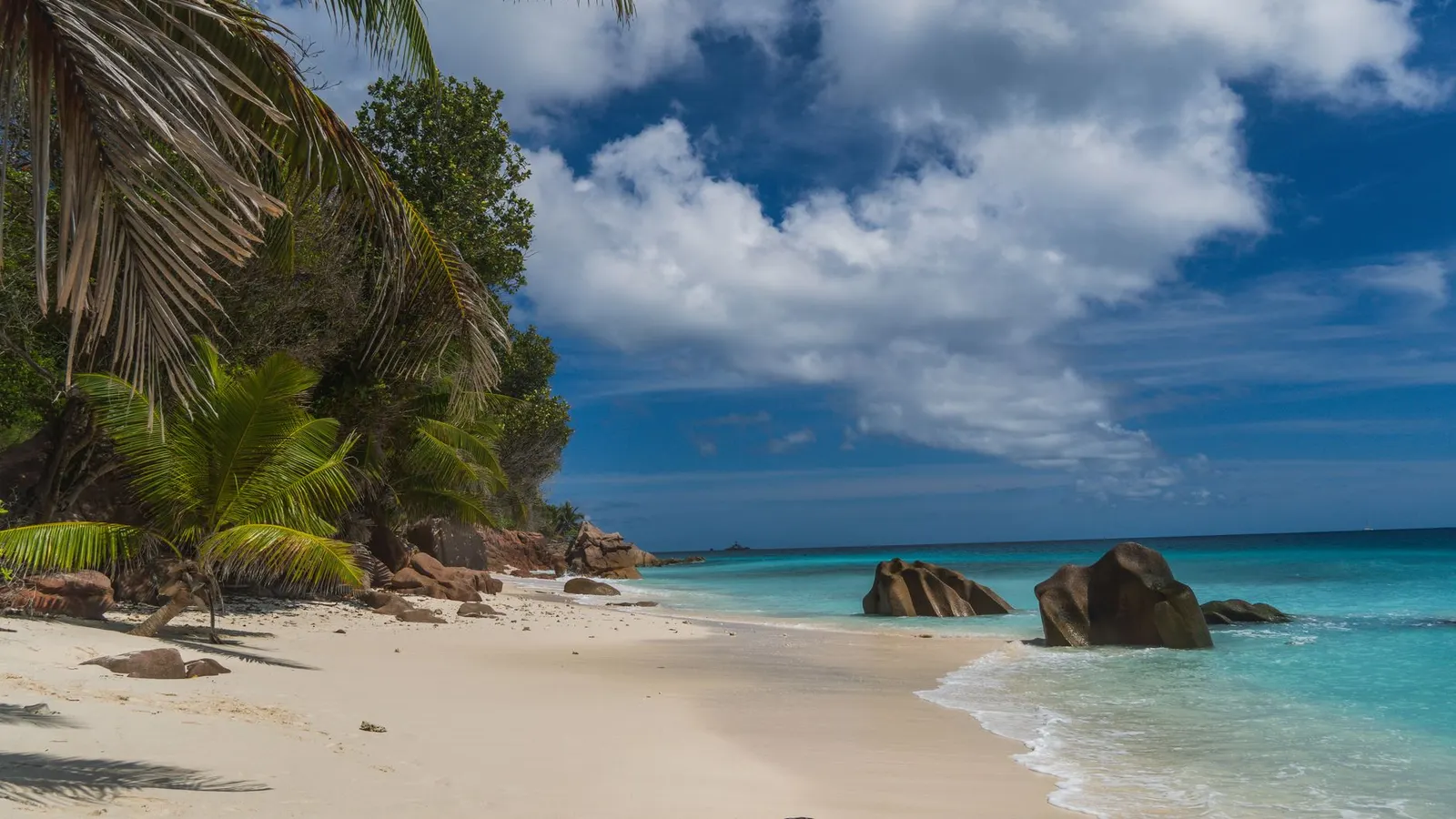
 Adrien Daurenjou · Pexels License
Itinerary · Africa · 13 days · Easy
The Granite Islands
Victoria, Mahé→Mission Lodge, Sans Souci→Anse Major, Mahé→Anse Intendance, Mahé→Vallée de Mai, Praslin→Cousin Island Special Reserve+7 stops
Three inhabited islands and ten protected areas, entirely on public ferries and reserve boats, with no resort island anywhere in it - the mountain forest above Victoria, the palm valley on Praslin that pays for an atoll eleven hundred kilometres away, seabird islands you may only land on behind a warden and only on certain days, and a fourth island where the transport is a bicycle.
Victoria
One of the smallest capital cities in the world and walkable in a morning. The Selwyn-Clarke market is the cheapest food in the country and empties by early afternoon; the clock tower on the junction outside it went up in 1903 to mark Seychelles being made a colony in its own right rather than an appendage of Mauritius, and is a copy of the one outside Victoria Station in London. The botanical garden dates from 1901 and has coco de mer palms and a tortoise pen. Buy a SIM, buy ferry tickets, and work out which reserves are open on which days before anything else.
Up the Sans Souci road
The Morne Seychellois National Park covers roughly a fifth of Mahé and starts fifteen minutes above the capital. Copolia is the short climb - an hour up to a bare granite slab with endemic pitcher plants growing out of the cracks and the whole east coast underneath. Mission Lodge, further along the ridge, is the ruin of Venn's Town, a school opened in 1876 by the Church Missionary Society - the name is Henry Venn, its secretary in London - for children taken off slave ships intercepted by the Royal Navy and landed here; it closed in 1889 and is on the country's UNESCO tentative list.
The north-west coast
Bus to Beau Vallon and on to Danzil, where the tarmac stops and the Anse Major track runs a little over an hour along the cliffs to a beach with no road to it. Come back the same way and take an afternoon boat into Baie Ternay, a marine national park since 1979 and the best snorkelling reachable from Mahé without a full charter. The bus stops running by early evening, so plan the return.
South Mahé
A hire car for one day, or the bus over the Les Cannelles pass and a lot of waiting. Anse Intendance takes the full swell of the south-east trades and has no reef in front of it, which is why nobody built a hotel on it for decades; Anse Takamaka around the headland is calmer. Inland above Anse Royale, the Jardin du Roi sits on the site of a spice garden the French planted in 1772 to break the Dutch monopoly on nutmeg and cinnamon - the original was burned by its own administrator in 1780 to keep it out of British hands.
Across to Praslin
The Cat Cocos catamaran does the crossing in about seventy-five minutes and it is not always a comfortable one between May and September. On the other side, the Vallée de Mai - nineteen hectares of palm forest, World Heritage since 1983, and the least disturbed of the coco de mer stands left on the two islands where the palm grows wild. The nut is the largest seed of any plant on earth. The black parrot in the canopy is the national bird and lives on this island and its neighbour and nowhere else.
Cousin
Twenty-five minutes off the west coast to an island that BirdLife International - then the International Council for Bird Preservation - bought outright in 1968 because the Seychelles warbler was down to twenty-six birds on it and nowhere else. The coconut plantation was pulled out, the native scrub came back, and the warbler now numbers in the thousands across several islands. Nature Seychelles, the BirdLife partner in the country, has run the reserve since 1998. You transfer to the reserve's own boat outside the reef and land through the surf, and you walk the island behind a warden. Mornings only, weekdays only.
Curieuse and St Pierre
The island was a leper colony from the 1830s and the last patients did not leave until 1965; the doctor's house at Anse St José was built in 1873 and is a small museum now. A boardwalk crosses the mangroves at Baie Laraie to the ranger station, and several hundred Aldabra giant tortoises range free on the way. St Pierre, the granite stack off Côte d'Or, is the snorkel stop on the way back and it is over-visited by mid-morning.
Aride
The northernmost granitic island and the one with the seabirds - ten breeding species, one of the largest lesser noddy colonies anywhere, and Wright's gardenia, which grows wild on this hillside and on no other piece of land in the world. There is no jetty. The reserve boat runs you in through the break, which is why landings only happen roughly October to May and are cancelled outright on swell. Keep a spare day for it and treat the trip as conditional until the morning.
Anse Lazio and the other palm forest
Anse Lazio is at the top of the island and is the beach every photograph of Praslin is taken on; go before nine or after four. Fond Ferdinand, at the opposite corner above Anse Marie-Louise, is the quieter half of the same forest - guided only, steep, a hundred and twenty-odd hectares of coco de mer running up a ridge, and a view down the whole south coast from the top.
La Digue
Fifteen minutes on the inter-island ferry and the traffic stops. Hire a bicycle at the jetty - there are a handful of taxis on the island and no car hire at all. L'Union Estate is a working copra and vanilla plantation with an ox-driven mill, and the path to Anse Source d'Argent runs through it, which is why the beach has an entrance fee. The Veuve reserve inland protects the Seychelles paradise flycatcher: a few hundred birds in total, and until a translocation to Denis Island in 2008 every one of them lived here.
The east coast on foot
Cycle to Grand Anse, leave the bike, and walk the path over the headlands to Petite Anse and Anse Cocos. Grand Anse takes the trade wind head-on and the rip there is genuine and has killed people - Anse Cocos has a pool at the north end that is safe on most days. In the afternoon, the climb to Nid d'Aigle at 333 metres, which is the whole island in one view and takes about an hour from the village.
Coco, Félicité and the Sisters
A half-day boat north-east to three small islands, of which Coco is a marine national park - a fee, and small enough that everyone off the boats from La Digue and Praslin is standing on it between ten and two, so take the first departure or skip it. Félicité was a copra estate and, for a while, a place of exile: after the killing of J. W. W. Birch, the first British Resident of Perak, in November 1875, Sultan Abdullah of Perak and two of his chiefs were deported to Seychelles in 1877, and Abdullah spent part of his exile on this island. Grande Soeur has the lunch stop and a beach on each side.
Back across, and Sainte Anne
The morning Cat Cocos sailing runs La Digue to Mahé via Praslin in a little over two hours. If the afternoon is free, take a boat out to Sainte Anne, which was declared in 1973 and was the first marine national park in the Indian Ocean - a decision made three years before independence and forty-seven years before the country protected thirty per cent of its ocean. Moyenne inside it has about a hundred tortoises and the graves of two men who are supposed to be pirates and probably are not.
Good to know
Seychelles requires no visa from anybody, which is unusual, but every visitor must hold a Travel Authorisation applied for online before departure - around €10 for standard processing, applied for at seychelles.govtas.com and nowhere else, because the copycat sites charging four times that are numerous and rank well. Proof of accommodation and an onward ticket are part of the application. A yellow fever certificate is only demanded if you are arriving from a country with transmission risk or have spent more than twelve hours in transit in one, which catches a good many people routing through Nairobi or Addis Ababa - Kenya and Ethiopia are both on the risk list, as is most of West and Central Africa. Tanzania, Mauritius, the Gulf hubs and everywhere in Europe are not, so a connection through Dubai, Doha or Mauritius raises the question at no point. There is no malaria in Seychelles and no prophylaxis to take, but Aedes mosquitoes are established and dengue and chikungunya both circulate - they bite in daylight, so repellent belongs in the day bag rather than beside the bed. The south-east trades blow from about May to September: cooler, windier, seaweed piled on the south and east beaches, rough ferry crossings, and Aride closed. The north-west monsoon from November to March is hot and wet with calm sea and better landings; April and October are the two transitions and the flattest water of the year. Reserve access is the thing that breaks itineraries - Cousin lands weekday mornings only and is shut at weekends, Aride runs roughly October to May on a few days a week, and both put you into a small boat through surf, so build a spare day rather than one chance. The Vallée de Mai charges SCR 450 and half of every ticket goes to running Aldabra. Coco de mer nuts may only leave the country with a government export permit and every legal nut is numbered; one bought loose from a beach vendor will be taken off you at the airport. Book Cat Cocos in advance and take something for the crossing between May and September; Air Seychelles flies Mahé–Praslin in fifteen minutes for roughly double the ferry fare and is the sensible fallback when the sea is up. Buses on Mahé and Praslin are a flat fare of a few rupees, exact change, and stop by early evening; La Digue has bicycles and almost nothing else. Driving is on the left and the mountain roads on Mahé are narrow, steep and unforgiving of wide cars. An environmental sustainability levy has been charged per room per night since 2023 - small, scaled to the size of the establishment, and usually collected in cash at checkout rather than shown on the booking, so budget for it separately. Almost everything on the shelves is imported and priced accordingly - self-catering, the Victoria market and the takeaway counters are the difference between an expensive trip and an impossible one.
Shorter or longer?
Add three days on the third-largest granitic island, a national park since 2010, forty-five minutes by boat from Bel Ombre - Mont Dauban at 740 metres, one of the last populations of the Seychelles sheath-tailed bat, and a village of about a hundred and fifty people. Beds are limited to one resort and a very small number of rooms in La Passe, so fix accommodation before you fix the boat.
Ferry straight through to Praslin on arrival and split the week with La Digue. Keeps the Vallée de Mai, Cousin, Curieuse and the walking, cuts all four Mahé days, the mountain forest and the south coast.
Practical guide
Visa check for this route
Budget
Mid-range · per person · sharing a double room. Excludes international flights - they depend on where you fly from.
Editorial estimates · checked August 2026
Country guides
Trip essentials
The connectivity placement is our own eSIM store. No affiliate link on this list. How we choose these →