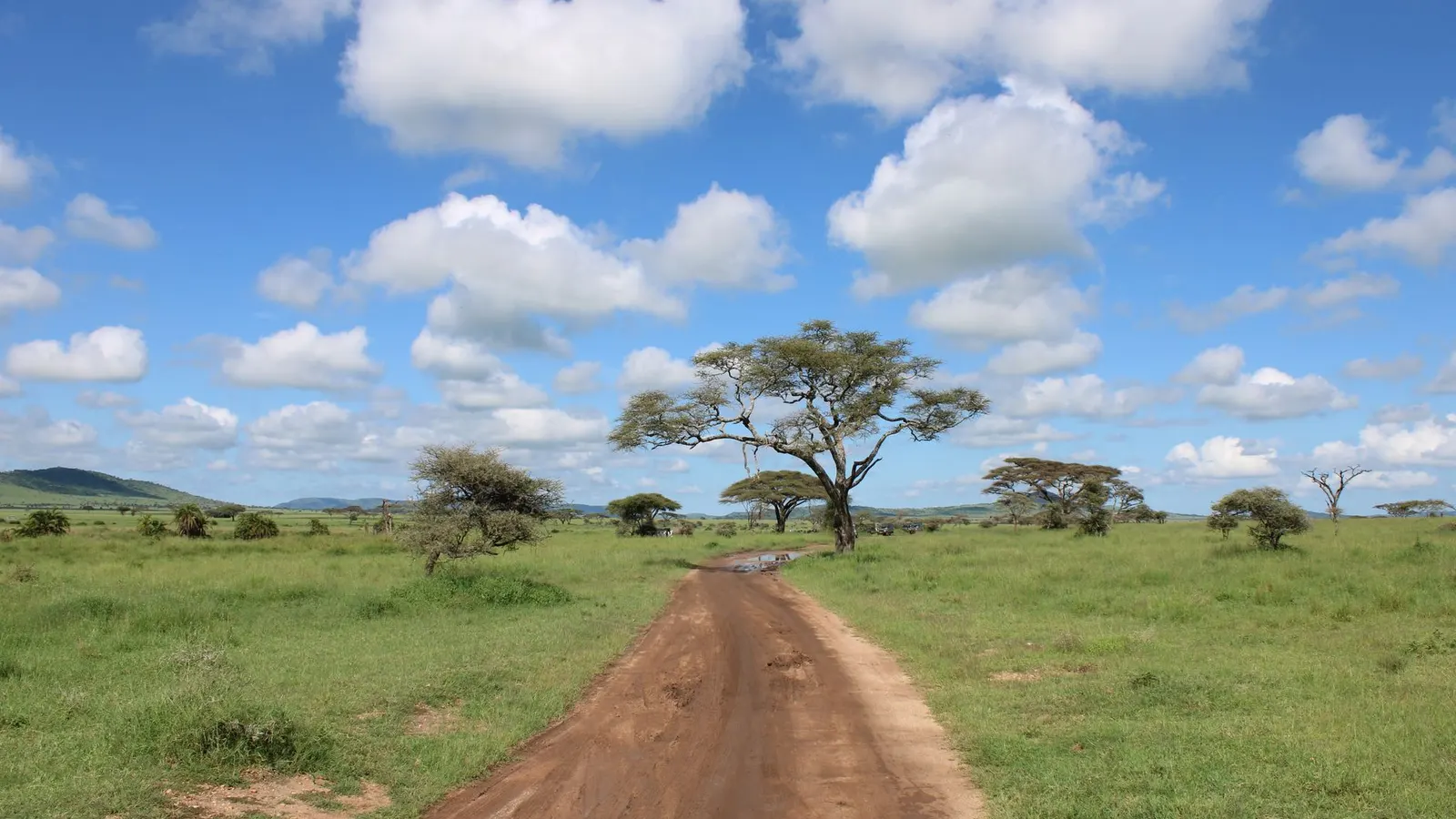
 Ana Kenk · Pexels License
Itinerary · Africa · 14 days · Moderate
The Southern Line
Dar es Salaam→Bagamoyo→TAZARA terminus, Dar es Salaam→Mbeya→Matamba→Kitulo Plateau+8 stops
Tanzania without the northern circuit: the TAZARA train out of Dar es Salaam and up the Mlimba escarpment, then the Southern Highlands - a plateau national park gazetted for its flowers, the north shore of Lake Nyasa under the Livingstone Mountains, the Hehe capital at Kalenga, and Ruaha at the end of a gravel road.
Dar es Salaam
Arrive and walk the waterfront while the fish market at Kivukoni is still working. The Old Boma on Sokoine Drive dates from 1867 and is the oldest surviving building in the city; the National Museum a few streets inland holds the Olduvai material - including the Paranthropus boisei skull Mary Leakey dug out of Bed I in 1959 - and casts of the Laetoli trail, three hominins walking across wet ash about 3.6 million years ago.
Bagamoyo
Seventy kilometres up the coast, and the reason Dar es Salaam is the city and this is not: Bagamoyo has no harbour, only an open beach where dhows stood offshore and cargo came in by lighter. It was the mainland end of the caravan routes from Lake Tanganyika - ivory and slaves out to Zanzibar, cloth and guns back - and the capital of German East Africa until 1891, when the administration moved south to deep water. The Catholic mission of 1868, the caravanserai and the ruined German boma are all within a short walk of each other.
Onto the TAZARA
The terminus is out where Nyerere Road meets Nelson Mandela Road, several kilometres from the central line station and incompatible with it. Board in the early afternoon, find your berth, and watch the coastal plain give way to the miombo. The line clips the northern edge of Nyerere National Park after dark - you will not see much, but the halts are named for it and the guards will tell you when.
The escarpment, and Mbeya
The section worth being awake for runs between Mlimba and Makambako: 157 kilometres, eighteen of the line's twenty-two tunnels, and something like 1,500 metres of climb - Mlimba sits around 300 metres on the Kilombero floodplain, Makambako above 1,800 on the plateau. Chinese and Tanzanian crews cut it between 1970 and 1975 and it has not been substantially rebuilt since. Mbeya sits at 1,700 metres and is noticeably cold after the coast.
Up the Chimala hairpins
East along the highway to Chimala, then off it and up. The escarpment road to Matamba is unsurfaced and climbs through more than fifty switchbacks, and local drivers count them the way other people count kilometres. Matamba is the Kitulo park headquarters - a village with a gate, an office and a couple of guesthouses.
Kitulo Plateau
Grassland at about 2,600 metres that was gazetted in 2005 primarily to protect what grows on it - some forty-five terrestrial orchids among the three hundred-odd plant species, several of them found nowhere else. Tanzanians call it Bustani ya Mungu. It was cattle grazing and potato ground before it was a park, and gazettement pushed the herds off the top; the villages on the rim farm the slopes and supply the guides, and whether that trade was worth making is not a settled question up here. Wildlife is thin and the walking is the point; from the plateau edge the ground falls away towards Lake Nyasa. Back down the hairpins in the afternoon.
South to Lake Nyasa
Down through Tukuyu and the banana country of Rungwe to the lake. Matema sits on the northern shore with the Livingstone Mountains rising behind it out of the water - no coastal shelf, no road along the eastern side, which is why the villages down there are reached by boat and not otherwise.
Down the shore to Ikombe
Hire a boat and run south along the mountain wall. Ikombe makes clay cooking pots and has done for a very long time; they go north to Matema and Kyela by boat because there is no road. It is a working morning, not a beach excursion, and the return depends entirely on the wind - the lake gets up in the afternoon.
Ngozi and the way back up
North to Tukuyu, then the walk up to Ngozi crater lake - a caldera in the Poroto range with green water at the bottom of it and about an hour of forest between the road and the rim. Daraja la Mungu on the Kiwira river is a natural lava bridge and takes twenty minutes off the same road. On to Mbeya.
North-east to Iringa
A bus day on the Tanzam Highway, which is the tarmac spine of southern Tanzania and carries most of the freight that TAZARA does not. Iringa is on a ridge at 1,600 metres with a market that has not been rearranged for anybody, and it is the base for everything in the next three days.
Kalenga and Isimila
Kalenga was Mkwawa's capital, and the Hehe destroyed a German column at Lugalo in August 1891 before the Germans stormed the town three years later, in October 1894. Mkwawa fought on from the bush for another four years and shot himself rather than be taken in July 1898; his skull went to Germany, Article 246 of the Treaty of Versailles required its return, and it came back in 1954. It is in the museum here. Isimila, twenty kilometres south-west of Iringa on the Mbeya road, is an Acheulean site - hand axes in situ, and a gully of eroded sandstone pillars behind it.
West to Ruaha
Tarmac to Ipogolo, then gravel for most of the remaining hundred kilometres to the Msembe gate on the Great Ruaha River. Pay at the gate, note the time on the receipt, and use the last of the afternoon on the river circuit. The Ruaha–Rungwa landscape holds one of the largest lion populations left anywhere - the figure usually quoted is around a tenth of the world's wild lions - and an elephant population that the poaching years to 2015 cut down hard and that has been climbing back since. It takes a fraction of the vehicles the northern parks do.
The Great Ruaha
A full day between the river and the sand rivers running into it. In the dry season the Great Ruaha stops flowing in its lower reaches - the water is taken upstream in the Usangu wetlands for rice irrigation, and how much of the drying is abstraction and how much is climate has been argued over since the river first failed in 1993. Either way the animals concentrate on what pools are left, which is why the game viewing here is what it is.
Msembe to Dar es Salaam
The scheduled light aircraft off the Msembe strip does the return in a couple of hours with a stop or two, against a full day by road to Iringa and another to the coast. It is the one leg worth flying, and it is the standard way people leave this park.
Good to know
TAZARA runs two long-distance passenger trains a week in each direction, not a daily service, and departures from Dar es Salaam have long been Tuesday and Friday afternoons - confirm at the station rather than online, buy the first-class sleeper a few days ahead, and treat the arrival time as an estimate rather than a promise. First-class compartments hold four berths and are sold by gender unless you take the whole compartment. Carry water and food; the restaurant car is real but not reliable. The line is under a rehabilitation concession, so engineering possessions and altered timetables are likely for the next several years. Park fees are the dominant cost and they work on a clock: TANAPA charges non-residents per person per twenty-four hours, plus a separate vehicle fee, plus 18 per cent VAT, and entering Ruaha at four in the afternoon starts a day you will pay for again the next afternoon. Most gates now take cards and some no longer take cash at all, so bring a working Visa or Mastercard and a backup. Where US dollars are used they must be notes issued in 2009 or later, and this is enforced. Self-driving Ruaha is legal but rarely sensible - high-clearance 4WD, two spares and recovery gear are the floor, there is no fuel inside the park and the nearest is Iringa; hiring a vehicle with a driver-guide from Iringa costs little more and solves the navigation. Malaria prophylaxis is standard for the whole route: Mbeya and the Kitulo plateau are high and low-risk, but the Kyela lowland at Matema and the Ruaha valley are not. Ruaha is tsetse country: the flies bite through thin cloth, they are drawn to dark blue and black, and long sleeves in dull colours are most of the defence. A yellow fever certificate is required only if you are arriving from, or have transited for more than twelve hours in, a country with a risk of transmission - a direct flight from Europe does not trigger it, a connection through Nairobi or Addis can. Most nationalities need a visa; the e-visa through the immigration portal runs around US$50 for an ordinary single entry, US$100 for United States passports, and visa on arrival at Julius Nyerere still works but adds a queue at the end of a long flight. The bush flight out of Msembe takes a soft bag against a hard weight limit, typically 15 kg including hand luggage - a wheeled suitcase is refused at the strip rather than negotiated, so leave the hard case in Dar es Salaam or do not bring one. The seasons here run against the rest of the country: Kitulo flowers from roughly December to April, which is precisely when the Chimala escarpment road is at its worst and when Ruaha camps close for the long rains. June to October is dry, hard, and Kitulo is brown.
Shorter or longer?
Do not get off at Mbeya. The line runs on through Tunduma and Nakonde to New Kapiri Mposhi, which is another day on board and about 46 hours end to end from the coast, and puts you within a couple of hours of Lusaka - or of Mpulungu on Lake Tanganyika if you get off earlier at Kasama instead. Add four or five days.
Dar es Salaam, the train, Kitulo, Matema and Tukuyu, then fly out of Songwe airport at Mbeya. Drops Iringa and Ruaha, which removes every park fee except Kitulo and most of the transport cost with them.
Practical guide
Visa check for this route
Budget
Mid-range · per person · sharing a double room. Excludes international flights - they depend on where you fly from.
Editorial estimates · checked August 2026
Country guides
Trip essentials
The connectivity placement is our own eSIM store. No affiliate link on this list. How we choose these →