Itinerary · Europe · 11 days · Challenging
Overland to Kyiv
Lviv→Rynok Square, Lviv→Lychakiv Cemetery, Lviv→Kyiv→Saint Sophia Cathedral, Kyiv→Maidan Nezalezhnosti, Kyiv+4 stops
Advisory - travel not recommended · checked 26 Sept 2026
Ukraine
Ukraine is at war. Foreign ministries advise against all travel to the country, and against all travel to the eastern and southern oblasts and any area near the front line or the Russian and Belarusian borders. Missile and drone strikes reach cities far from the front, including Kyiv and Lviv, and air-raid alerts are a daily feature of life. Standard scores are suspended while this alert is active.
Official advisory →Every advisory in force →Read the advisory first: Ukraine is at war, foreign ministries advise against all travel to the country, and this route is published for the day that changes rather than as an invitation for today. It stays in the west and in Kyiv and goes nowhere near the eastern or southern oblasts, the front line or the Russian and Belarusian borders - and it goes the only way anyone goes, in by train from Poland and out by road to Romania, because the airspace has been closed to civil aviation since February 2022.
In by rail from Przemyśl
Ukrainian Railways runs through carriages onto a broad-gauge platform at Przemyśl Główny, which is why this is the crossing almost everyone uses: you sit still while the border happens around you, instead of standing in a road queue for six hours. Spend the afternoon on the two things that decide the rest of the trip. Install the official air-alert app and turn the sound on. Then find out where the shelter is in the building you are sleeping in, and walk to it once in daylight so you are not learning the route at three in the morning.
The historic centre
Lviv came through the twentieth century with its fabric largely intact - Rynok square, the Latin cathedral, the Armenian cathedral and the Boim chapel inside a few hundred metres - and UNESCO listed the ensemble in 1998. In the spring of 2022 the city took the stained glass out of the cathedral windows and boxed in the carved stone outside; some of it has come back and some of it has not, and the plywood is worth looking at rather than looking past. The Lychakiv side of town is for tomorrow. Today is the centre on foot, and the coffee houses, which stay open until the curfew closes them and not a minute past.
Lychakiv and the Field of Mars
Lychakiv cemetery was laid out in 1786 and holds the writers, singers and engineers of Austrian Galicia under some very good funerary sculpture. The reason to come now is the ground beside it. The Field of Mars is the military ground next door, it has been extended repeatedly since 2022, and there are burials most weeks; go quietly, do not photograph mourners, and understand that this is a working cemetery rather than a memorial. Afterwards the Territory of Terror museum, built on the site of the wartime ghetto transit point and the Soviet prison that followed it, which is the shortest available explanation of why this city argues about its own history the way it does.
East to Kyiv
Intercity+ from Lviv, and the trains keep time to a degree that visitors find hard to credit - Ukrainian Railways has run through four winters of strikes on its power supply and publishes its punctuality anyway. Kyiv is about 600 km (370 mi) of track east and the country flattens out as you go. Arrive in the afternoon, get oriented before dark, and note the curfew hour for the oblast you are now in, because it is enforced and it is not the same everywhere.
Saint Sophia and the Lavra
The two halves of a single UNESCO inscription made in 1990, and both were added to the List of World Heritage in Danger in January 2023, at an extraordinary session called for the purpose. Sophia was begun in the 1030s and still holds eleventh-century mosaic and fresco under a baroque exterior; the Lavra was founded in 1051 and its caves are a monastic burial system you walk through with a candle. The Lavra is also the site of a live legal fight over which church holds it, after the state ended the Moscow-linked jurisdiction's tenancy in 2023. Parts of it may be closed. Ask on the day rather than planning around it.
Maidan and Mykhailivska
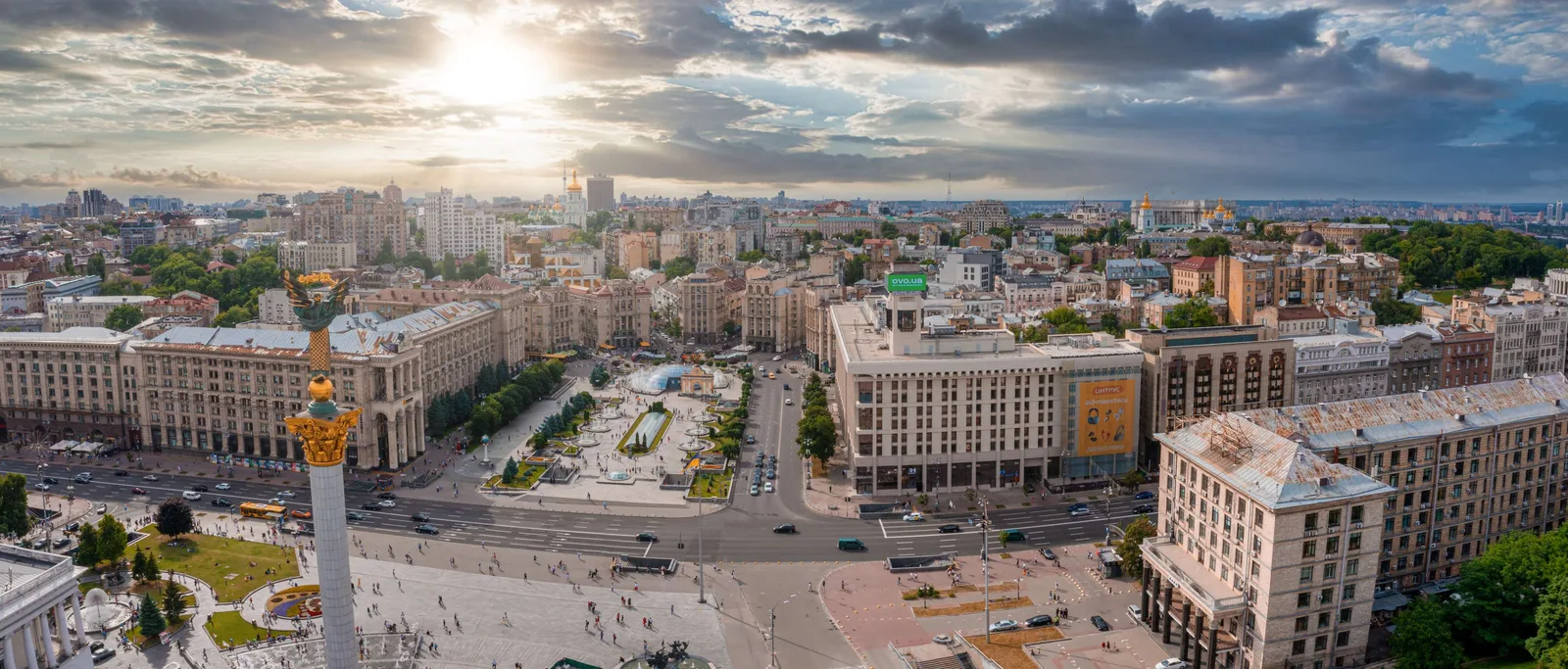
The Maidan is a square cut through by Khreshchatyk, with a very large field of small flags on the slope above it, each one planted for somebody named. Uphill, the wall along St Michael's Golden-Domed monastery carries photographs of the dead and has been growing since 2014. On the square in front of it, burnt-out Russian armour has been parked as an open-air exhibit since May 2022. None of this is presented for visitors and all of it is public. Give it the morning, then the National Museum of the History of Ukraine in the Second World War in the afternoon - where the Motherland Monument had the Soviet coat of arms cut off her shield and the trident welded on in August 2023.
Podil, the metro and the night train out
Arsenalna station is 105.5 m (346 ft) below the street, opened in 1960 and driven that deep because of the high right bank above it; it is usually called the deepest metro station in the world, although a Chongqing station opened in 2022 is measured deeper and the title is now argued over. Since 2022 the network has doubled as the city's largest shelter and people sleep on the platforms during long alerts. Podil, the old river quarter, is where Kyiv goes out - bars, small galleries and Andriyivskyy Descent running up the hill. Be at the station well before curfew: the sleeper leaves in the evening and being on the street after midnight is an offence, not an inconvenience.
Kamianets-Podilskyi
The old town sits on a rock island inside a loop of the Smotrych, with the gorge doing the work a moat would do and a castle guarding the one neck of land. The Ottomans held the town from 1672 to 1699 and added a minaret to the Cathedral of Saints Peter and Paul; when the Poles came back they left the minaret standing and put a gilded statue of the Virgin on top of it in 1756, which is still there and is the single strangest object in western Ukraine. Walk the gorge path under the bridge for the view the postcards use. Khmelnytskyi oblast is a long way from the front and it is not out of range of it - the air base at Starokostiantyniv, about 130 km (80 mi) north-east, is struck repeatedly - so the alert app stays on here exactly as it did in Kyiv.
Khotyn, then Chernivtsi
Twenty-five kilometres (15 mi) south, Khotyn fortress stands on the bank of the Dniester with walls that went up in stages from the thirteenth century to the eighteenth and a siege history involving almost everyone who ever ruled this ground. It is an hour well spent and the bus onward to Chernivtsi passes the door. Chernivtsi was Austrian Czernowitz until 1918, Romanian from then until the Soviet annexation of 1940, Romanian again under the occupation from 1941, and Soviet and then Ukrainian from 1944 - changing hands five times inside a single lifetime, and the street plan still reads as a small Habsburg capital that lost its empire.
Chernivtsi
Day 10–11 · 2 daysThe Residence
The Residence of the Bukovinian and Dalmatian Metropolitans was built between 1864 and 1882 to a design by Josef Hlávka, in brick patterned like textile, and UNESCO listed it in 2011. It has been the university since 1955, so term time means students crossing the courtyards on their way to lectures, which is the correct condition for a building of this kind. Afterwards walk Olha Kobylianska street and the old Jewish quarter; Paul Celan was born here in 1920 and wrote in the language of the people who later murdered his parents, which is a fact this city carries without a plaque doing it for you. Chernivtsi has had fewer alerts than anywhere else on this route and it took in enough people from the east that the housing market has not looked the same since; the students in those courtyards are not all from here.
Out to Romania
South to the Porubne–Siret crossing and on to Suceava, which has trains and an airport. Road borders are slower than the rail crossing you came in on and the wait is unpredictable, so treat the day as a full one and do not book an onward connection tight against it. If Romania does not suit, the same principle applies at the Slovak, Hungarian, Polish and Moldovan borders - leave a day of slack at whichever one you use.
Good to know
Start with the advisory, because it governs everything below it. Ukraine is at war. Foreign ministries advise against all travel to the country, and against all travel to the eastern and southern oblasts and to any area near the front line or the Russian and Belarusian borders. Missile and drone strikes reach cities far from the front, Kyiv and Lviv included, and air-raid alerts are a daily feature of life in both. This route deliberately stays out of the named regions, and staying out of them does not make the rest safe. Check your own ministry the week you travel - this page is not a substitute for it.
Insurance is the item that decides whether a private trip is realistic at all. No mainstream policy covers travel against an all-travel advisory, and that includes the medical cover, not just the cancellation cover. Specialist war-risk policies exist through a small number of brokers, are written per trip against a named itinerary, and run in the region of four hundred euros a week, more if you want a medical evacuation limit worth having. Read the exclusions before you pay: many will not cover you within a set distance of the front, some exclude drone and missile events outright, which is a remarkable thing to sell. Separately, Ukrainian law requires foreign nationals to hold valid medical insurance for the stay and the border check is real, so the paperwork has to satisfy two different tests.
Entry itself is simple and the airspace is not. EU, UK, US, Canadian, Australian and many other passports enter visa-free for 90 days in any 180, counted separately from the Schengen allowance. There are no commercial flights and there have been none since 24 February 2022, so every arrival is overland: rail from Przemyśl in Poland is the busiest and easiest route, with international sleepers also running from Warsaw, Chełm, Budapest, Vienna, Bucharest and Chișinău, and road crossings from Poland, Slovakia at Vyšné Nemecké–Uzhhorod, Hungary at Záhony–Chop, Romania at Siret–Porubne and Moldova. Trains beat buses at the border by hours. Book through the Ukrainian Railways app or site; seats open a fixed number of days ahead and the Przemyśl services go quickly.
Martial law has been in force since 24 February 2022 and is extended by parliament in rolling periods. The provision that catches visitors is the exit restriction on Ukrainian men of military age. It covered 18 to 60 for most of the war and was relaxed in August 2025 to let men aged 18 to 22 cross; the band is set by government resolution, it has moved more than once, and it is not something to assume is the same this month as last. Ukraine has traditionally treated anyone holding a Ukrainian passport as Ukrainian and nothing else, and legislation on multiple citizenship has been working through parliament in stages, so someone who holds a Ukrainian passport as well as another one can still be stopped as a Ukrainian on the way out regardless of which document they entered on. If that could describe you, or your father registered your birth here decades ago, take specific legal advice before you go rather than at the barrier.
A nationwide curfew applies, with the hours set by each regional military administration - roughly midnight to five in Kyiv and Lviv, and longer nearer the front. Nothing moves during it and being outside without a pass is an offence, so evening plans end early and night transfers do not exist. Install the state air-alert app and, in the capital, Kyiv Digital. When an alert sounds, go to a shelter: a metro station, an underground car park, a marked basement, or failing all of that a corridor with two walls between you and the outside. Alerts are frequent and some run for hours. Locals will often ignore a drone alert and take a ballistic one seriously; that judgement is theirs to make and copying it is not the same as understanding it.
Do not photograph checkpoints, air defence positions, military vehicles or personnel, railway or energy infrastructure, or the site of a strike before the authorities release it. This is enforced, it is the single most common way a foreign visitor ends up in a long conversation with the SBU, and the reason is straightforward: strike photographs are used for correction of fire.
Power and money are linked. Strikes on the grid produce scheduled and unscheduled blackouts, worst between November and March; hotels and cafés run generators and Starlink, and a power bank, a head torch and a downloaded offline map are not gadgets here. The currency is the hryvnia, no sanctions complicate anything, and card acceptance is genuinely excellent - contactless works in places that would take cash only in western Europe. But terminals die with the power, so carry notes.
Finally, register with your embassy on arrival, keep the itinerary loose enough that you can lose a day to a closed border or a cancelled train, and do not extend it east or south. The route above is written to stay inside the part of the country where ordinary civilian life is running. That line is where the honesty of this page sits.
Shorter or longer?
From Chernivtsi north-west to Kolomyia for the Hutsul museums, then Yaremche and the valleys under Chornohora, and out through Uzhhorod to Slovakia at Vyšné Nemecké. Adds four days. The far west is the region furthest from the fighting and the one domestic tourism has concentrated in, which means it is busy in summer and at New Year. Mountain weather closes ridge walks from November, and mine and ordnance contamination is not a Carpathian problem - but the general rule still applies everywhere in the country: stay on made paths.
In and out through Przemyśl, three nights in Lviv and two in Kyiv, with the day train between them. Cuts Podillia, Bukovina and the night train, halves the insurance bill, and keeps the two cities that people actually do visit.
Practical guide
Visa check for this route
Budget
Mid-range · per person · sharing a double room. Excludes international flights - they depend on where you fly from.
Editorial estimates · checked August 2026
Country guides
Trip essentials
The connectivity placement is our own eSIM store. No affiliate link on this list. How we choose these →