Itinerary · Europe · 14 days · Moderate
Edale to the Cuillin
Edale→Kinder Scout→Settle→Ingleborough→Once Brewed→Housesteads+8 stops
The spine of Britain on foot and by train - Kinder Scout, the Settle–Carlisle line, Hadrian's Wall on the crags, a railway Beeching closed and Scotland reopened, Rannoch Moor and Skye. No car anywhere on it.
Edale
Into the Peak District on the Hope Valley line from Manchester. Walk the Mam Tor ridge in the afternoon for the shape of the place: gritstone moor above, limestone dale below, and Sheffield and Manchester an hour away on either side. About twenty million people live within an hour's drive of the park, which is why the car parks fill and the plateau above them frequently does not.
Kinder Scout from Hayfield
The trespass route: up William Clough from Bowden Bridge quarry, onto the plateau, along the edge and down Jacob's Ladder into Edale. Six hours. The plateau is peat hags and groughs with no path worth the name in the middle, and in cloud it is genuinely disorientating - keep to the edge unless you can navigate.
North to Settle
A transfer day across the Pennines. Settle is a small market town that exists on this itinerary for one reason: it is the southern gate of the best railway in England. Afternoon circuit up to Attermire Scar and Victoria Cave, three hours from the town square, for the first limestone of the trip - the scars are a fault line, and the cave gave up hyena and hippopotamus bone from the last interglacial, when this was a warm valley. Malham Cove is the famous one, a 70-metre limestone amphitheatre with a pavement of clints and grikes on top, but it is 10 km each way over the moor from Settle and wants its own day.
Ribblehead and Ingleborough
Fifteen minutes up the line to Ribblehead, where the viaduct carries the track on twenty-four arches across a bog that swallowed the money and the men who built it. Then up Ingleborough, 723 m, five hours return, with the whole Dales limestone shelf below and no shelter anywhere on it.
The line to Carlisle, and on to the Wall
The full Settle–Carlisle run - Blea Moor tunnel, Dent, the highest mainline station in England at 350 m, and Ais Gill summit. Change at Carlisle onto the Tyne Valley line for Haltwhistle. Base at Once Brewed, which is a car park, a hostel and a pub in the middle of the best-preserved miles of Hadrian's Wall.
Steel Rigg to Housesteads
The Wall walked properly: west to east along the Whin Sill escarpment, past Sycamore Gap where the tree was felled overnight in 2023, to the fort at Housesteads with its barracks, hospital and the best-surviving Roman latrine in Britain. Vindolanda below, where the writing tablets came out of the anaerobic mud, is the better museum of the two.
Across the border to Edinburgh
East along the Tyne and north up the coast. The train crosses the Tweed at Berwick and is still in England - the border comes a few miles further on, near Lamberton - and at that line the law about where you may walk changes completely. Nothing on the train will tell you. Arrive in the afternoon and climb Arthur's Seat, an extinct volcano inside the city boundary, for the Forth and the Pentlands.
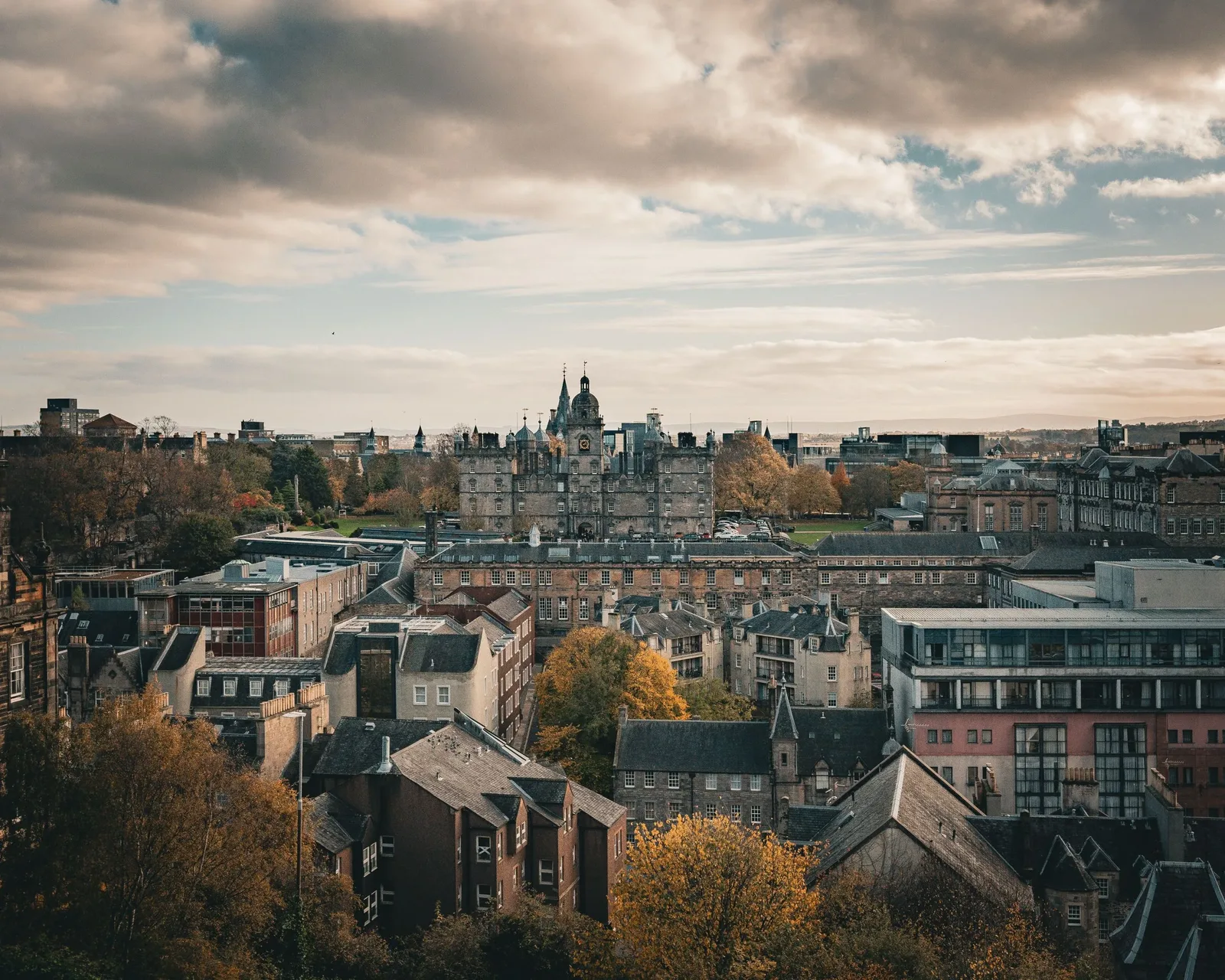
Edinburgh
A full day in the city. The Old Town closes are what the place actually was before the New Town drained the money out of it. National Museum of Scotland is free and very good. Avoid August unless the Festival is the point, when accommodation roughly triples and every bed within twenty miles is taken.
The Borders Railway to Melrose
Waverley to Tweedbank in under an hour on 48 km of track that Beeching closed in 1969 and Scotland rebuilt in 2015 - the longest new domestic railway in Britain in over a century. Walk into Melrose for the abbey, then the Eildon Hills above it, three hours up and back.
To Corrour
The West Highland Line, which is the reason to be doing this by train at all. Out of Glasgow along the Clyde, up Loch Long, over the Horseshoe Curve at Tyndrum and onto Rannoch Moor, where the track floats on a raft of brushwood, turf and ash laid down in the early 1890s. Get off at Corrour: 408 m, no public road, one hostel a mile away along the loch. Three or four trains a day stop here, so the connections out of Tweedbank and Glasgow are not optional.
Corrour to Fort William
Walk the circuit of Loch Ossian first thing - nine miles (14 km) of flat track with nothing on them, three and a half hours if you do not stop - then the train down through Tulloch and Roy Bridge. Afternoon in Glen Nevis: the gorge path to Steall Falls, 120 m of water and a three-wire bridge across the river that most people look at and decline.
Glenfinnan and Mallaig
The Mallaig extension, built by Robert McAlpine out of mass concrete because there was no workable stone within reach - the Glenfinnan viaduct is twenty-one arches of it, topped out in 1898, carrying trains since the line opened in 1901 and still standing. The scheduled ScotRail service runs the same track as the steam charter for a fraction of the fare and stops where you want.
Ferry to Skye
CalMac across the Sound of Sleat to Armadale, then buses north through Broadford to Sligachan, which is a hotel, a bridge and a campsite at the junction of the Red and Black Cuillin and nothing else. The Red hills are granite and round; the Black are gabbro and are not walking country.
Elgol, and out
Down the single-track road to Elgol for the view across Loch Scavaig into the corries - the one place you see the whole Black Cuillin ridge from sea level. Boats run to Loch Coruisk in season. Then back through Broadford and over the bridge to Kyle of Lochalsh for the train to Inverness.
Good to know
Book rail advance fares the day they are released, roughly twelve weeks out - a walk-up ticket on the West Highland Line costs three or four times the advance, and split-ticketing across a journey is entirely legal and often cheaper again. Reserve seats on the Fort William–Mallaig train in summer; it is a short unit and it fills. The AD122 Hadrian's Wall bus is seasonal, running roughly Easter to late September, and outside those months Housesteads means a taxi from Haltwhistle or a long road walk. Corrour has no shop, no phone signal and no road: carry food in and out, and if the Loch Ossian hostel is full there is nothing else. Midges are a real constraint in the West Highlands from late May to September, worst at dawn and dusk in still air - carry repellent and a head net, and camp on a breeze. Access law differs sharply either side of the border: in Scotland the Land Reform Act gives you a right of responsible access to almost all open land, wild camping included, while in England you have a right to walk on mapped access land and on public rights of way, and on neither of them may you camp. Two safety points that matter here. The Kinder plateau and Ingleborough are low, exposed and featureless in cloud, and mountain rescue is called out to both most weeks of the year. The Black Cuillin is a scrambling range, not a hillwalking one, and its gabbro is magnetic enough to make a compass unreliable on the ridge - take a guide or stay off it.
Shorter or longer?
From Uig on Skye, CalMac runs to Tarbert on Harris and Lochmaddy on North Uist. Five or six more days down the island chain by causeway and ferry to Barra, where the plane lands on the beach and the timetable is written around the tide.
Start at Edinburgh and take eight days: the Borders Railway, the West Highland Line, Corrour, Glen Nevis and Skye. You lose the English half and with it the point about access law, but the walking is better and the trains are the same.
Practical guide
Visa check for this route
Budget
Mid-range · per person · sharing a double room. Excludes international flights - they depend on where you fly from.
Editorial estimates · checked August 2026
Country guides
Trip essentials
The connectivity placement is our own eSIM store. No affiliate link on this list. How we choose these →