Itinerary · Middle East · 12 days · Expedition
Sana'a to Hadhramaut
Old City of Sana'a→Dar al-Hajar, Wadi Dhahr→Kawkaban→Manakhah→Zabid→Taiz+6 stops
Advisory - travel not recommended · checked 26 Sept 2026
Yemen
Foreign ministries advise against all travel to Yemen. The country is in an ongoing armed conflict and one of the world's largest humanitarian crises, with kidnapping risk, landmine contamination and no meaningful consular assistance. Standard scores are suspended while this alert is active.
Official advisory →Every advisory in force →Read the advisory first, and read it as settled: every foreign ministry advises against all travel to Yemen, no part of the mainland is honestly visitable today, and this route is published for the day that changes rather than as an invitation for now. It is the circuit that was genuinely travelled - freely until the late 2000s, and under escort by a thinning handful of visitors until about 2014 - from the tower houses of Sana'a down through the Haraz mountains and the Tihama to Aden, then east to the mudbrick high-rises of Hadhramaut. It stays out of Marib and al-Jawf, out of Sa'dah and the Saudi border strip, and out of the Abyan and Shabwa belt where al-Qaeda in the Arabian Peninsula has been strongest - and one leg of it, the crossing into Taiz, has had no honest version since 2015.
Sana'a
One of the oldest continuously inhabited cities anywhere, and the only skyline of its kind: tower houses of stone footings and fired brick, six and seven storeys, with gypsum tracery around alabaster and coloured-glass fanlights that make the top rooms glow after dark. The Great Mosque is among the earliest surviving in Islam, and in 1972 repairs to its roof opened a cache of parchment that included the palimpsest now argued over by every scholar of the early Quranic text. UNESCO listed the old city in 1986 and moved it to the danger list in July 2015 after air strikes brought down houses in the al-Qasimi quarter.
Wadi Dhahr
Half an hour north-west of the city the plateau drops into a green wadi of vines and qat terraces, and on a sandstone spire in the middle of it stands Dar al-Hajar, the Rock Palace - five storeys built out of the rock itself as a summer residence for Imam Yahya in the 1930s, on a site with much older use beneath it. It is the single most photographed building in the country and it earns it from the wadi floor rather than from the car park.
Thula and Kawkaban
North-west into the stone country. Thula is a walled town of dressed limestone under a fortified mountain, built almost entirely without mortar and hardly altered since the Ottomans left. Kawkaban sits on a cliff above the town of Shibam - not the Hadhramaut one - and the old stepped path down between them takes about an hour and a half on foot, which is how everything moved between the two before the road.
The Haraz mountains
West along the escarpment to Manakhah, at around 2,200 m, where the mountainside is terraced to the ridgeline. Coffee has been grown on these terraces for centuries and shipped from the Red Sea port of al-Mukha, which is where the word mocha comes from and which lost the trade in the nineteenth century to plantations the Dutch and the French had started with Yemeni stock. Al-Hajjarah, a short walk from Manakhah, is a village built into the cliff so tightly that the houses and the rock face are the same wall.
Down to the Tihama
The descent from the highlands to the Red Sea plain drops more than two kilometres and changes the country completely - from cold stone terraces to a humid coastal strip of round thatched huts, African-influenced music and brick towns. Zabid was the Rasulid capital from the thirteenth century and one of the great teaching cities of the Islamic world, with a mosque quarter and a maze of whitewashed brick houses carved in relief. UNESCO listed it in 1993 and moved it to the danger list in 2000, where it has stayed, because the historic houses were being replaced with concrete faster than anyone could record them.
Taiz
Back up into the mountains to the country's third city, under Jabal Sabir at 3,000 m, with the Cairo Castle on a spur above it and the Ashrafiya mosque and its two white minarets below. This is the day the route depends on most: Taiz has been divided by a front line since 2015 and parts of it have been under siege for most of that time, and there is no version of this stop that exists before that ends.
Aden
South to the coast and into a volcano. The old town of Crater sits inside the caldera of an extinct one, with the Tawila cisterns cut into the rock at the head of the valley to catch flash floods off the crater walls - of disputed date, cleared and rebuilt by the British administration in the 1850s, and still the best piece of engineering in the city. Aden was a British possession from 1839, one of the busiest bunkering ports in the world when coal ruled, and the capital of a separate country between 1967 and 1990. None of that is why Aden sits under the advisory: the city has had bombings, assassinations and open fighting between forces that nominally share the same government, and control of it has changed by force more than once since 2015.
East to Hadhramaut
A flight rather than a drive: the coast road east runs a very long way past very little, and the interior route is worse. Seiyun sits in the main wadi at around 700 m, and its sultan's palace - a whitewashed mudbrick block of the 1920s, seven storeys of mud standing on nothing but mud - is one of the largest mudbrick buildings anywhere and has been on the edge of structural failure for years.
Shibam
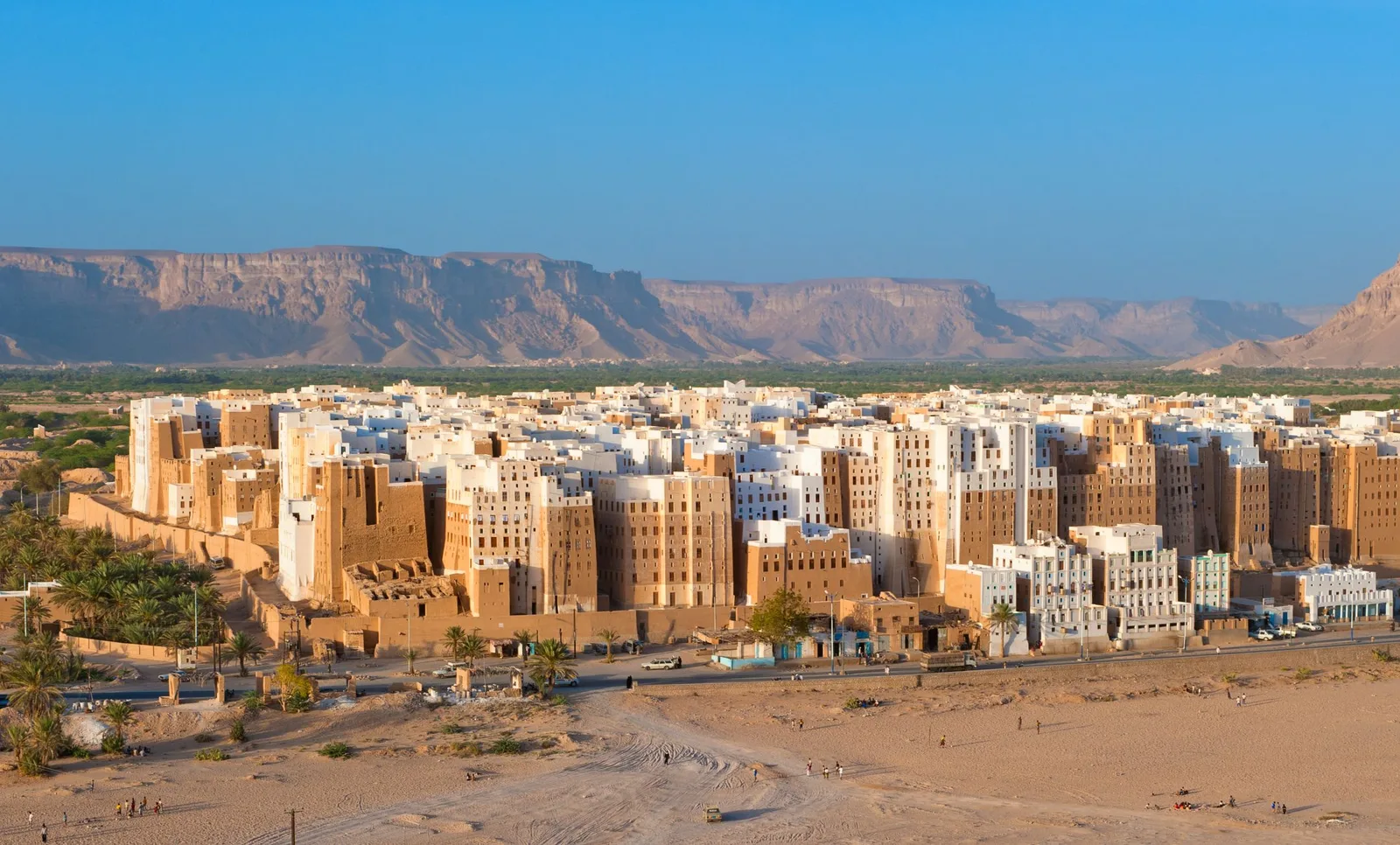
Around five hundred tower houses of unfired mud brick, most of them rebuilt in the sixteenth century after a flood, packed inside a wall on a low mound in the middle of the wadi floor - five to eight storeys, with the walls tapering as they rise because mud cannot carry itself straight. It was the first site in Yemen on the World Heritage list, in 1982, and it went to the danger list in July 2015. The view is from the escarpment on the far side of the wadi at the end of the day, when the whitewashed roof caps go orange and everything below them stays the colour of the ground.
Tarim
Half an hour up the wadi to a town of scholars and merchants, with several hundred mosques and a fortune made in Singapore and Java brought back and built into palaces that mix Hadhrami mudbrick with south-east Asian colonial detail. The al-Muhdhar minaret, finished around 1914 and rising about 50 m, is unfired mud brick the whole way up. The Ahqaf library holds thousands of manuscripts, some of them the only surviving copies.
Wadi Do'an
South-west into a side wadi with sheer walls and villages stuck to them at the point where the cliff meets the scree, painted white and blue, reached by a single ramp each. The wadi is known for sidr honey, made from bees working ziziphus trees on the valley floor, which sells for more per kilogram than almost any honey in the world and is the reason a hive here is guarded. The Buqshan palace at Khaila was built by a family who made their money in the Hadhrami diaspora and came home to spend it.
Out from Seiyun
The last morning goes on paperwork and the drive out to the airport, which has been designated international since it reopened in 2018 and has carried a Yemenia service to Aden, Cairo and Jeddah that runs and stops with the fuel supply and the politics. Everything about this last day, like everything about the eleven before it, is arranged by the sponsor rather than booked by you, and the departure date is the part of the plan nobody can guarantee.
Good to know
Start with what this page is and is not. Every foreign ministry with a view advises against all travel to Yemen. Most embassies in Sana'a closed in February 2015 and have not reopened, so there is no consular help of any kind. The country has been at war since 2015, has landmine and unexploded-ordnance contamination among the worst in the world, and has a kidnapping record against foreigners running back to the 1990s - much of it tribal and resolved by negotiation, some of it not, and the difference is not something you can assess in advance. The route above is a description of a circuit that was actually travelled, not a plan you should act on now.
Entry is not one system, because there is not one government. The Sana'a authorities hold the capital and most of the north-west; the internationally recognised government holds Aden and much of the south and east. Each issues its own visa, neither recognises the other's, and both work only through a sponsor - a local company that vouches for you in writing and is answerable for what you do. There is no visa on arrival and no online application. Moving between the two zones, which this route does once, on the leg into Taiz, means crossing a front line with permits issued per governorate, obtained locally and in person, and refusable on the morning. It also means entering on one authority's visa and leaving on the other's, which is a thing you arrange before you fly, not after you land.
Air access is thin and unreliable. Sana'a closed to commercial traffic in August 2016 and has since handled only a limited Yemenia service to Amman, restarted in May 2022 and suspended repeatedly since - Israeli strikes destroyed aircraft on the ground there in December 2024 and May 2025 and stopped it outright each time. Aden and Seiyun carry a restricted Yemenia network: Aden to Cairo, Amman and Gulf points, Seiyun to Aden, Cairo and Jeddah, all of it running and stopping without notice. Socotra is reached from Abu Dhabi; the on-and-off Yemenia link to Aden and Seiyun is not dependable enough to plan a mainland connection around. Nothing here appears on a booking site; every leg goes through the sponsor.
Money is cash, in two currencies with the same name. After the central bank split, the Sana'a authorities banned banknotes printed from 2016 onward in the areas they hold, so the north runs on old notes and the south on new ones and the two trade at very different rates against the dollar - a price quoted in rials means nothing until you know which rial. No foreign card functions anywhere: not in a hotel, not at an ATM, not for a flight. Bring clean small-denomination US dollars and change locally. Sanctions are the second layer: the Houthi authorities have been under United States terrorist designations that were imposed, revoked and reimposed between 2021 and 2025, and money moving anywhere near them is a legal exposure for you and for your bank before it is a practical one.
Insurance is the line most people get wrong. An ordinary travel policy voids the moment your government advises against all travel to a country, which means it is void here on the day you land. What covers you is specialist hostile-environment cover with medical evacuation, written by a small number of underwriters, and it runs to hundreds of euros for a fortnight rather than the tens an ordinary policy costs - the budget below carries €900 for twelve days, and you should treat that as an indicative quote that moves with the security picture. Read the exclusions: kidnap and ransom is almost always a separate product, and medical evacuation from an interior wadi is a different clause from evacuation from a capital city.
The reason evacuation cover is the load-bearing clause is that the health system it would be evacuating you from has been running on emergency funding for a decade. A large share of facilities are partly or wholly out of service, the cholera outbreak that began in 2016 is among the largest ever recorded anywhere, and the war's death toll is genuinely disputed - estimates differ by an order of magnitude depending on whether indirect deaths from hunger, untreated illness and collapsed water supply are counted, and no figure is settled enough to quote here. The practical consequence for a visitor is narrow and worth stating plainly: a foreigner on this route consumes fuel, water, bottled supply, vehicle capacity and armed attention in a place short of all five, and does it in front of people who cannot leave.
On the ground, an escort and checkpoint paperwork are the sponsor's job, not yours, and on several of these roads an armed escort for foreigners was standard practice long before 2015. Stay on hard surfaces - the mine contamination is the reason. Photograph nothing military, no checkpoint and no airport. Qat is chewed from early afternoon across most of the country and very little official business happens after about two o'clock, which is a scheduling fact rather than a curiosity. Heat is the other constraint: the Tihama and Aden are brutal from May to September, while Sana'a at 2,250 m and Manakhah a little below it are cold at night year-round.
Check your own foreign ministry the week you would travel, not the month you read this. This page does not replace it and is not trying to.
Shorter or longer?
The archipelago has been its own governorate since December 2013, sits about 380 km south of the Yemeni mainland and roughly 240 km east of the Horn of Africa, and is the one part of Yemen with a functioning visitor operation - a weekly charter from Abu Dhabi, permits handled by the operator, and camping rather than hotels. Firmihin and Diksam for the dragon's blood forest, Homhil for the bottle trees, Detwah lagoon and Arher for the dunes. Yemenia has flown it to Aden and Seiyun on and off, but nothing about that link is dependable enough to plan a mainland connection around, and none of it lowers the advisory over the country the island belongs to.
Fly into Seiyun, and work the wadi: Shibam, Tarim, Wadi Do'an and the Seiyun palace, then out the way you came. Cuts the entire north, the Tihama and Aden, and with them the front-line crossing - which is the single hardest and least predictable part of the full route.
Practical guide
Visa check for this route
Budget
Mid-range · per person · sharing a double room. Excludes international flights - they depend on where you fly from.
Editorial estimates · checked August 2026
Country guides
Trip essentials
The connectivity placement is our own eSIM store. No affiliate link on this list. How we choose these →