Journal
Reports, analyses and features from all 194 countries - the journalism behind the journeys.
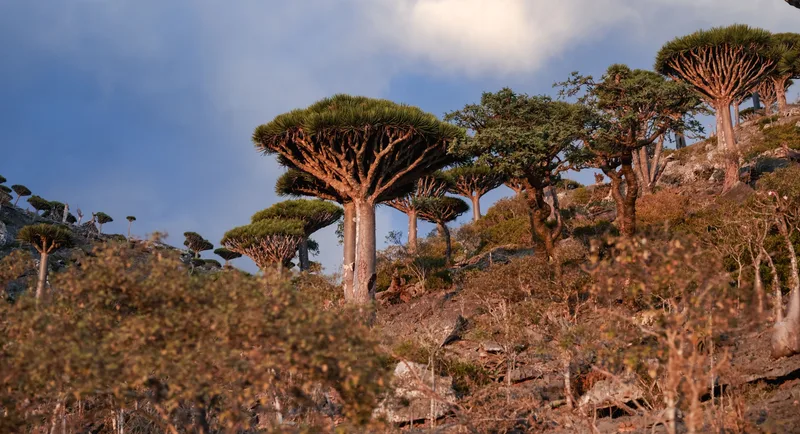
The Forest With No Children
The dragon's blood trees on Socotra's Firmihin plateau are the densest stand left of a species that grows nowhere else, and almost every one of them is an adult. The reason there are no young ones is not the climate, or not yet - it is a goat, and that makes it a question about the island's economy rather than its weather.
Two Hundred and Eighty a Year
In June 2025 Australia opened a ballot for 280 permanent residence visas a year for Tuvaluans, and within four days more than three thousand people had registered - close to a third of the country. The treaty behind it also contained a clause that took Tuvalu six months to argue back out of.
The Patent on the Pan
On 10 April 2001 the United States Patent Office granted patent 6,212,772 - "Production of a Caribbean steel pan" - to two men from the University of Delaware. Trinidad has spent the quarter-century since working out what a country can and cannot own about an instrument that nobody in particular invented.
The Decree and the Factory Ships
In 1978 the King of Tonga banned whaling by decree, and Tongan harpoons went into sheds. The whales they had been taking in ones and twos had already been destroyed on a different scale entirely, by fleets that reported one set of numbers and killed another.
The Three Per Cent Rule
Timor-Leste copied Norway's sovereign wealth fund almost line for line, wrote a spending limit into the law, and then spent above that limit in nearly every year since 2009. The gas field that filled the fund stopped producing in 2023, and the field meant to replace it has been sitting undeveloped since 1974.
The Intervention Parliament Voted For
On 24 July 2003 a force that would build to about two thousand two hundred foreign police and soldiers began landing at Honiara, and the first thing that had happened was a unanimous vote in the Solomon Islands parliament. Fourteen years later the mission left on a date agreed years in advance, which almost no armed intervention anywhere has managed.
The Law for the Oil That Never Came
In 2004 the National Assembly of São Tomé and Príncipe unanimously passed one of the strictest natural-resource revenue laws written anywhere - a sealed account, a fund for future generations, every payment published. The country has never produced a commercial barrel of oil, and it still imports every litre of fuel it burns.
The Airport Built Without a Bank
Until 2017 nobody could fly to Saint Vincent from outside the Caribbean, because the runway was 1,400 metres of tarmac wedged between a hillside and the sea. The replacement took twelve years and was financed without a loan from the IMF, the World Bank or the Caribbean Development Bank.
A Contract With a Reef
In 1994 the fishers, dive operators and hotels of Soufrière stopped fighting over the same reef and drew a map instead, closing roughly a third of the fishing ground. Five years later the boats working the water next to it were landing between 46 and 90 per cent more fish.
The Heat Under the Bath House
Water comes out of the ground at the foot of Nevis Peak at around 42°C, and a hotel was built over it in 1778. Turning that heat into electricity has been declared policy on Nevis since 2008, and the island still runs on imported diesel.
Closing Eighty Per Cent of the Sea
In October 2015 Palau passed a law shutting four-fifths of its ocean to all extractive activity, giving up the licence fees that distant-water fleets had been paying to fish it. The plan was that visitors would make up the difference, and the law took full effect in January 2020.
The Clause That Started the Clock
On 25 June 2021 Nauru sent a letter to the International Seabed Authority and triggered a treaty clause nobody had ever used. It gave the regulator of the entire deep ocean floor two years to finish its rulebook, and the country that started the clock is the one that has already been mined flat.
The Districts That Voted Themselves Out
On 12 July 1978 the districts of the American-administered Trust Territory voted on a single constitution for a single Micronesian nation, and two of them - the Marshall Islands and Palau - voted it down. The four that voted yes are 2,700 kilometres apart, share no common first language, and have spent the years since engineering a federation designed to survive its own arithmetic.
Full and Final Settlement
The United States tested 67 nuclear weapons in the Marshall Islands and then, in 1986, settled the consequences for US$150 million described in the document as full and final. The tribunal the Marshallese built to distribute that money went on to award more than two billion dollars it did not have.
The Endowment That Never Filled
In 2008 Kiribati gazetted a marine reserve slightly smaller than California, and from 2015 it closed the whole of it to commercial fishing. On 1 January 2022 it opened the area again, and the argument it made was not about fish but about who was supposed to pay.
Seven and a Half Per Cent
In 1974 Jamaica taxed its bauxite on the price of the aluminium made from it rather than on the price of the ore, and revenue from the industry rose several times over inside a year. Three American companies took the government to international arbitration, lost the argument about jurisdiction, settled - and then moved their mining to Guinea, Australia and Brazil.
A Cartel of Two
In 1987 Grenada sat down with Indonesia and the two of them agreed to set the world price of nutmeg between them. It held for about three years, and the only reason a country of a hundred thousand people could attempt it at all was a piece of 1940s legislation that had turned every grower on the island into a single seller.
A Decree, a Road and a Daily Count
Since 1997 somebody has walked the bushmeat stalls in Malabo market every day and written down what is lying on them. The record is now long enough to show what a presidential decree did to the trade in monkeys, and what a road did to it afterwards.
The Ban and the Gas Bottle
In 1967 the Dominican Republic banned commercial logging outright, closed the sawmills and handed enforcement to the armed forces. The forest has come back since - but the decision that did most of the work was a subsidy on bottled cooking gas, and a subsidy has to be paid for every month for ever.
The Acres Nobody Can Buy
On the east coast of Dominica there are 3,700 acres that cannot be sold, mortgaged or inherited as private property, because they are held in common by the Kalinago and have been since 1903. It is the reason the coast has not been developed and the reason a family there cannot borrow against the ground under their house, and both halves are the same rule.
What the Oxen Were For
When Soviet trade collapsed in 1991 Cuba lost most of its fuel, nearly all of its fertiliser and about a third of its economy, and the food system that replaced it was written up abroad as the world's largest experiment in organic farming. It was not an experiment and nobody chose it.
The Nationality That Opened No Doors
In 2008 the Comoros passed a law allowing it to sell citizenship, and Gulf states bought it in bulk for stateless residents they did not want to naturalise themselves. On 21 November 2022 a former Comorian president was sentenced to life imprisonment for what happened to the money.
Fifty-Five Cents on the Dollar
In November 2021 Belize retired its entire stock of commercial foreign debt - US$553 million, close to a third of national output - by buying it back at fifty-five cents on the dollar. The money came from a loan whose contract turns marine conservation into debt service: miss the payments into the conservation fund and it counts as a default.
The Clause in the Bond
In 2018 Barbados owed close to 160 per cent of its economic output and had a few weeks of foreign reserves left. What it did next put a clause into its sovereign bonds allowing the country to stop paying its creditors when a disaster arrives - and that clause is now written into World Bank lending.
Twenty-Eight Years to Close It
In 1958 the Bahamas drew a boundary round thirty-five kilometres of empty cays and called it the first land-and-sea park anywhere in the world. It took another twenty-eight years to do the thing that made it work, which was to forbid taking anything out of it at all.
One Fat Sheep a Year
Barbuda was too dry and too thin-soiled to be worth planting, so nobody ever divided it into estates, and after emancipation its people simply carried on using the whole island in common. An act of parliament wrote that arrangement into law in 2007; three months after Hurricane Irma emptied the island, another act took it back out.
The Passport With a Price List
For a decade Malta sold citizenship of the European Union at a published price, and the residence requirement had a price of its own. On 29 April 2025 the Court of Justice ruled that it had never been Malta's to sell that way.
A Hundred Kilometres of Maintenance
The Curonian Spit is a sandbar ninety-eight kilometres long that had already swallowed fourteen villages before anyone worked out how to hold it still. What holds it is a piece of nineteenth-century engineering shaped like a landscape, and it only holds because people keep rebuilding it.
The Layers Were Read in the Wrong Order
A metre-tall hominin came out of a cave in western Flores in 2003, and for a decade the most startling thing about it was the date - eighteen thousand years, recent enough to overlap with people like us. In 2016 the same team dug the same trench again and found that the sediment had been read in the wrong order.
A Majority of Goats
In April 2021 the European Commission registered halloumi as a protected designation of origin, which turned a recipe into a legal document with a milk ratio written into it. Cyprus now exports more of the cheese than its sheep and goats can supply.
Where the Second Sea Went
Bahrain means the two seas, and the second one was fresh - artesian springs along the northern strip and vents of sweet water rising through the seabed offshore. They stopped inside a single lifetime, and what replaced them is a line of desalination plants returning hot brine to one of the saltiest and slowest-flushing seas on earth.
Adopted Without a Vote
A campaign begun in 2019 by law students on a campus in Port Vila ended six years later with the International Court of Justice ruling unanimously on what states owe one another over climate change. Vanuatu - fewer than 350,000 people, and reliably near the top of every list of the world's most disaster-exposed countries - is the government that put the question there.
Thirty Per Cent of an Ocean
Seychelles has 455 square kilometres of land and an exclusive economic zone of about 1.4 million. In 2016 it restructured US$21.6 million of sovereign debt owed to Paris Club creditors on the condition that it protect thirty per cent of that ocean, and in March 2020 it finished the job - ten years ahead of the deadline the rest of the world would later set itself.
The Day That Did Not Happen
On the night of 29 December 2011 Samoa crossed the international date line and deleted Friday the thirtieth from its calendar. It was the second time the country had changed which half of the Pacific it kept time with, and it came two years after it changed which side of the road it drives on.
The Stand-In Tortoises
Mauritius lost its giant tortoises around 1800, and with them the only animal on the island large enough to swallow an ebony fruit and carry the seed anywhere at all. In 2000 a Mauritian conservation charity did the thing nature reserves exist to prevent - released a foreign species inside one, on purpose - and the experiment has since become a recognised category of restoration.
A Three-Year Lease on a Forest
In 1996 Madagascar passed a law that lets a village take over the management of the forest on its doorstep - for three years first, then ten more if the state decides it has gone well. Something over a thousand of those contracts have been signed since, almost all of them out of sight, and the one everybody drives past sits thirteen kilometres south of Ambalavao.
The Land That Cannot Be Sold
Around 87 per cent of Fiji is customary land that cannot be sold to anyone by anyone, ever - a rule written by the colony's first substantive governor in the 1870s and carried unbroken into the 2013 constitution. It is why indentured labourers were shipped from India, why the sugar belt emptied after 1997, and why every resort you can book is standing on a lease.
The Terraces Were a Wage
Drought in Cabo Verde has never stopped, and famine has - the last one ended in 1948, and there has not been another since. What changed was not the rainfall but a labour scheme that paid rural people, in wages funded by selling donated food, to rebuild the hillsides they were standing on.
One Island, One Resort
For thirty-seven years a visitor to the Maldives could not legally sleep on an island where Maldivians lived: the state leased whole uninhabited islands to single operators and kept tourism physically separate from the country it was happening in. A regulation issued in 2009 permitted guesthouses on inhabited islands, and the two systems have been running side by side, on very different terms, ever since.
The Year the Fertiliser Stopped
On 27 April 2021 Sri Lanka banned the import of chemical fertiliser with immediate effect and announced that it would become the world's first fully organic farming nation. Seven months later the policy was in retreat, the main rice harvest had failed, and a country that had fed itself was buying rice.
What the Iron Gates Cost
A dam agreed in 1963 made the most dangerous stretch of the Danube navigable and produced about 2,100 megawatts, and it drowned an inhabited Turkish island to do it. The engineers cut a Roman inscription out of the cliff and raised it above the new water line; they did not save the island.
The Road That Floats
In 2003 the Philippines stopped treating the sea as the place its road network ended, and rebuilt the national highway out of ferry ramps. It was the cheapest transport infrastructure an archipelago of 7,641 islands could put up, and cheapness turned out to be the achievement and the risk in the same object.
The Seal That Needs a Shovel
The Saimaa ringed seal has lived in one Finnish lake since the land rose and cut that lake off from the sea, and by the early 1980s there were fewer than two hundred left. It is recovering now under a fishing closure that costs local households real money, and in warm winters its pups are born in snowbanks that volunteers build by hand.
Our Like Will Not Be Seen Again
A community of never more than 150 people on an island off Kerry produced three books still in print seventy years later - and was evacuated by the state in 1953 because there was no way to reach a doctor.
The Barren Line
Greek ferries are not a tourist product that also carries locals. They are a public transport network serving a hundred inhabited islands - and the August crowd is what pays for the February sailing.
A Thousand Years of Dried Cod
Cod split and hung on timber racks in Lofoten, dried in cold Atlantic air without salt, and shipped to Venice and Vicenza - a trade documented since the twelfth century and still running on the same islands, the same fish and the same wind.
The Country That Made a Copy of Itself
Tuvalu is building a digital replica of its territory, records and culture - not as a stunt but as a legal instrument, designed to keep a 900,000-square-kilometre maritime boundary alive after the land inside it has gone.
A Volcano and Thirty Islands
La Soufrière erupted explosively in 2021, in 1979 and in 1902 - and in 2021 nobody died, because the evacuation came before the explosion. South of it runs a chain of thirty islands, and from this one the Garifuna were deported in 1797 to a coast where their descendants still speak the language.