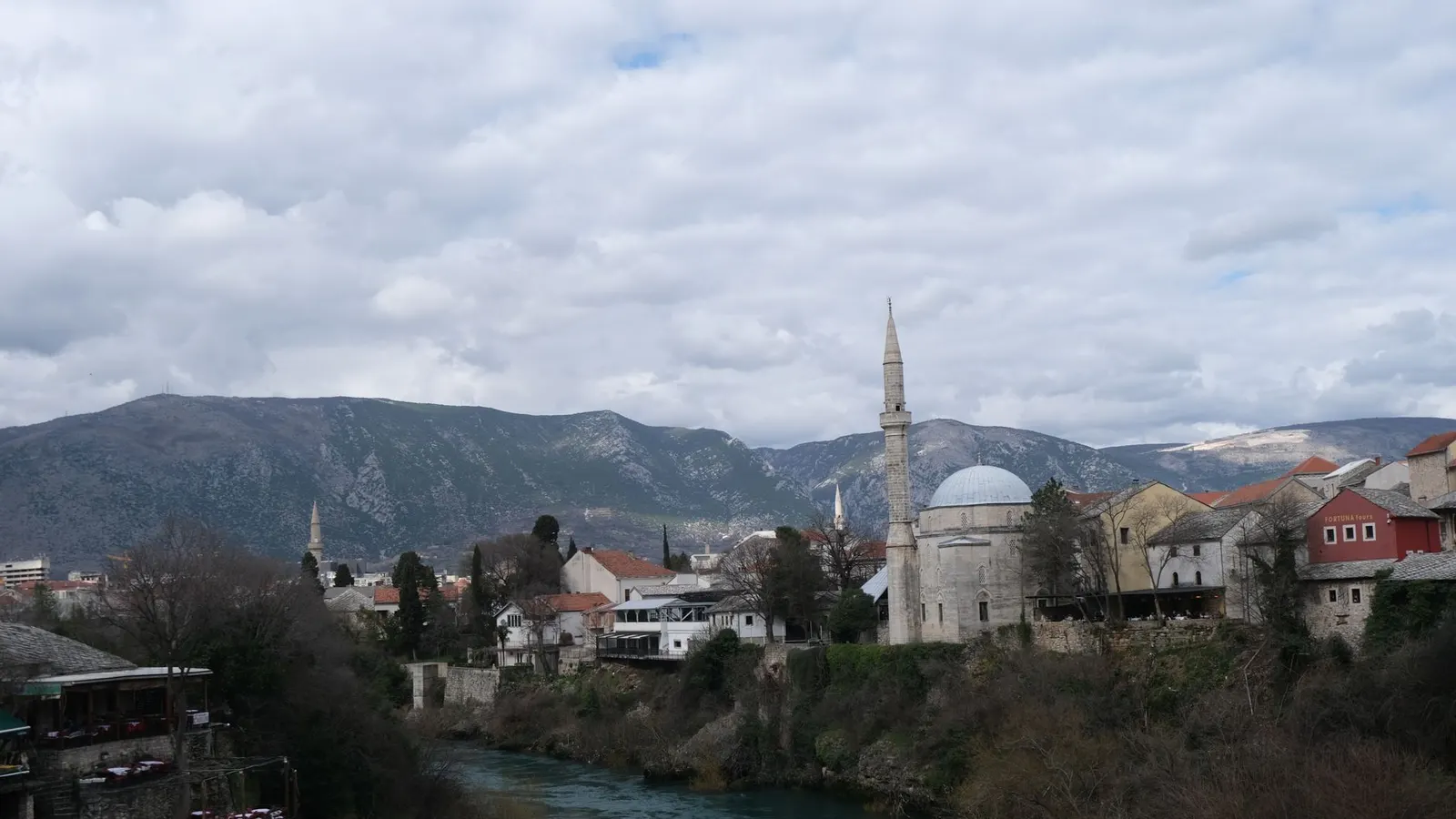
 Muhammed Fatih Beki · Pexels License
Country Guide № 022 / 194 · Europe
Bosnia and Herzegovina
Ottoman bridges, Austro-Hungarian streets and a war that ended in 1995.
“Ottoman bridges, Austro-Hungarian streets and a war that ended in 1995.”
Sarajevo is the reason most people come and it earns it: within two hundred metres you cross from an Ottoman bazaar to an Austro-Hungarian boulevard, with a line in the pavement marking where one empire's architecture stops and the next begins. The 1992–95 siege is present everywhere - in the Sarajevo Roses, the tunnel museum, the pockmarked facades - and the city talks about it directly rather than around it.
Beyond it the country is mountainous, forested and very lightly visited. Mostar's bridge was destroyed in 1993 and rebuilt with the original technique; the Neretva and Una rivers are startlingly clear; and the Sutjeska and Una national parks hold some of Europe's last primeval forest. It is cheap, the coffee culture is Ottoman and unhurried, and the hospitality is genuine.
Chapter 01
Highlights
Sarajevo
Baščaršija's Ottoman bazaar, the Latin Bridge where Franz Ferdinand was shot, the Tunnel of Hope museum and the 1984 Olympic bobsleigh track on the hill above.
Mostar
The Stari Most, destroyed in 1993 and rebuilt in 2004 using sixteenth-century methods and stone from the original quarry. Divers jump from it in summer. Stay overnight - the day-trip crowds are heavy.
The Una and Neretva rivers
Water of an implausible green, with rafting on both and waterfalls at Štrbački Buk in Una national park. The Kravice falls near Mostar are the swimmable ones.
Sutjeska and Perućica
The country's oldest national park, holding Perućica - one of the last two primeval forests in Europe - and Maglić, the highest peak, on the Montenegrin border.
Chapter 02
Entry requirements for Bosnia and Herzegovina
Checking your passport…
up to 90 days · free entry
90 days on arrival
Before you fly
The detail
- Maximum stay
- up to 90 days
- Fee
- free entry
- Passport validity
- Most destinations want validity beyond your stay, and some want six months. Check yours against the return date.
- Onward travel
- Airlines may ask for a return or onward ticket at check-in.
- Health
- No vaccinations required. Healthcare is adequate in Sarajevo and limited elsewhere; EHIC does not apply, so insurance is necessary. Tap water in Sarajevo is good. Tick-borne encephalitis is present in forests. Winter air quality in Sarajevo is among the worst in the world - the city sits in a bowl and traps coal smoke for weeks.
- Money
- Convertible mark, pegged to the euro. Cards are accepted in Sarajevo and Mostar and less so elsewhere; carry cash. ATMs are widespread in towns. Euros are sometimes accepted at poor rates. Tipping is rounding up or around 10 %.
A United States passport enters Bosnia and Herzegovina without a visa for 90 days in any 180. Bosnia and Herzegovina is not in the Schengen area and keeps its own count. Days spent here do not come out of the Schengen allowance of 90 days in any rolling 180, and days already spent in the Schengen area do not come out of what you are allowed here. The Schengen window rolls, so time spent outside the area restores it day for day. It is why the western Balkans are where a long European itinerary buys itself room: a visitor who has nearly exhausted a rolling Schengen window can cross into Bosnia and Herzegovina and let it recover while they travel. One formality is genuinely enforced here and catches independent travellers: every foreign visitor must be registered with the authorities within 24 hours of arrival. A hotel or registered guest house does it automatically when it takes your passport at check-in and gives you a white slip; staying with friends, in an unregistered flat or while camping, you must go to the local police or the Service for Foreigners’ Affairs and do it yourself. Keep every slip - they are occasionally asked for on departure, and the fine for a gap in the chain is levied at the airport when it is far too late to fix. The frontier with Croatia is an external border of the Schengen area in both directions, so each crossing is a fresh entry against your Schengen allowance rather than a reset of anything. The Neum corridor, the short stretch of Bosnian coast that the old Split-to-Dubrovnik road runs through, is now avoidable: the Pelješac bridge has bypassed it since 2022, which removes two border crossings from that drive. A hire car crossing in needs a green card from the rental company, arranged when you book rather than at the border. Your passport should be valid three months beyond the day you intend to leave.
Check another destination with this passport →
Entry details: Editorial synthesis - Bosnian Service for Foreigners’ Affairs registration rules, Border Police entry guidance (2025–2026) · compiled 18 Sept 2026
Who needs a visa for Bosnia and Herzegovina
12 common passports| Passport | Requirement | Stay | Process |
|---|---|---|---|
| United States | Visa-free | up to 90 days | No process · €0 / $0 |
| United Kingdom | Visa-free | up to 90 days | No process · €0 / $0 |
| Germany | Visa-free | up to 90 days | No process · €0 / $0 |
| India | Visa required | - | No Other passports record yet |
| China | Visa-free | up to 90 days | No Other passports record yet |
| Brazil | Visa-free | up to 90 days | No Other passports record yet |
| Nigeria | Visa required | - | No Other passports record yet |
| Indonesia | Visa required | - | No Other passports record yet |
| Philippines | Visa required | - | No Other passports record yet |
| Vietnam | Visa required | - | No Other passports record yet |
| Egypt | Visa required | - | No Other passports record yet |
| Nepal | Visa required | - | No Other passports record yet |
Holding a passport that is not listed? The picker above answers for any of them. See where your passport takes you. Source: Passport Index, updated 14 Aug 2026.
Chapter 03
When to go
BestMay–Jun, September. AvoidNov–Feb.
The best month - warm, green and rafting season starting.
The band above each month is our editorial verdict - it weighs crowds, prices and access as well as weather. The line is average daily temperature, the bars are monthly rainfall. Select a month for the figures. Climate figures: ERA5 reanalysis via Open-Meteo, 2005–2024 normals.
Chapter 04
What it costs
A day in Bosnia and Herzegovina
Comfortable · sample day
≈ $59
Line items are real prices we track. The daily budget is an editorial estimate for this level, not their sum.
Where this sits among 244 countries we have costed
Mostar and Sarajevo rise modestly from May to September and around the Sarajevo Film Festival in August; the ski resorts at Jahorina and Bjelašnica peak from January to March. There is no coastal season to distort things, so prices are among the steadiest in the region and consistently low.
Updated Aug 2026 · Editorial synthesis - operator and accommodation sampling, museum tariffs (2025–2026) · confidence medium
Excludes international flights - they depend on where you fly from.
Chapter 05
Regions to know
5Sarajevo
The capital where Ottoman and Austro-Hungarian architecture meet, with the siege history and the Olympic mountains above.
Herzegovina
Mostar and its bridge, Blagaj's dervish house at a spring, Počitelj and the Kravice waterfalls.
Central Bosnia
Travnik and Jajce with its waterfall in the town centre, and the Vlašić highlands.
The Krajina & the west
Bihać, the Una river and its national park, and the waterfalls at Štrbački Buk.
The east & Sutjeska
Višegrad's Ottoman bridge, Sutjeska national park, Perućica primeval forest and the peak of Maglić.
Chapter 06
Practical guide
Getting there
Sarajevo (SJJ) and Tuzla (TZL) take European flights, with Dubrovnik, Split and Zagreb often cheaper and within a few hours by bus. Buses connect to every neighbouring country. The rail network is very limited, though the Sarajevo to Mostar line through the Neretva canyon is one of the most scenic short journeys in Europe.
Getting around
Buses are the backbone and reach everywhere, though schedules between entities can be awkward. The Sarajevo–Mostar train runs twice daily and is worth taking for the canyon. A car gives much more freedom in the mountains and the west. Sarajevo has trams and is walkable. Roads are winding and journeys take longer than the map suggests.
Money & costs
Convertible mark, pegged to the euro. Cards are accepted in Sarajevo and Mostar and less so elsewhere; carry cash. ATMs are widespread in towns. Euros are sometimes accepted at poor rates. Tipping is rounding up or around 10 %.
Safety
Safe from ordinary crime, with petty theft in Sarajevo's tourist areas the main risk. Landmine contamination is the specific hazard and is why off-trail walking needs local knowledge. Driving is the practical risk - mountain roads, and a poor road-safety record. Political tension between the entities is real and occasionally raises temperatures but does not affect visitors.
Health
No vaccinations required. Healthcare is adequate in Sarajevo and limited elsewhere; EHIC does not apply, so insurance is necessary. Tap water in Sarajevo is good. Tick-borne encephalitis is present in forests. Winter air quality in Sarajevo is among the worst in the world - the city sits in a bowl and traps coal smoke for weeks.
SIM & internet
Not in the EU; the Western Balkans roaming zone and some EU plans cover it. Local SIMs are cheap. Coverage is good in towns and along main roads, patchy in the mountains. Wifi is standard in accommodation.
Chapter 07
Driving
Winter equipment is mandatory from November to April and mountain passes can close in snow. Rental agreements from Croatia frequently exclude Bosnia entirely or require an extra green-card fee - check before driving down the Neretva.
Rules change - verify with an official source before you rent.
ExplWorld VerifiedNo verified partners here yet - all 6 country seats are open.
Become ExplWorld Verified →Chapter 08
Itineraries through this country
Chapter 09
From the Journal
Chapter 10
Before you go
Bosnia and HerzegovinaChapter 11
Frequently asked questions
How do I talk about the war?
Directly, if the other person raises it, and with care if they do not. Many people you meet lived through the siege or were displaced, and most are willing to talk about it - the museums and tours are largely run by survivors. Avoid assuming who did what to whom; the country has three official narratives and a visitor is not going to arbitrate between them.
Are landmines still a problem?
Yes, in specific and mapped places. Bosnia remains one of the most mine-affected countries in Europe, with contamination concentrated along the former front lines. Marked areas are fenced and signed with red-and-white tape or skull signs. The rule is simple and sufficient: stay on hard surfaces and marked paths, never enter fenced or overgrown land, and take local advice before walking anywhere off-trail.
What currency and how does the country work administratively?
The convertible mark, pegged to the euro at about 1.96. The country is two entities - the Federation and Republika Srpska - plus Brčko district, with different flags, police and administration in each. For a visitor this is mostly invisible apart from signage and script changing between Latin and Cyrillic.