 Muhammed Fatih Beki · Pexels License
Itinerary · Europe · 14 days · Moderate
The Neretva and the Drina
Sarajevo→Tunnel of Hope, Butmir→Lukomir→Konjic→Jablanica→Mostar+8 stops
Down one river and along another: Sarajevo's siege ground and its Olympic mountain, a nuclear command bunker built in secret for twenty-six years, the Neretva canyon by train to Mostar, the karst and the stećci of Herzegovina, one of the last primeval forests in Europe at Sutjeska, the bridge Ivo Andrić wrote a Nobel Prize about, and the memorial at Potočari before the road back over the mountains.
Sarajevo
Arrive and walk one street. Ferhadija leaves the Ottoman bazaar at Baščaršija and changes, at a marked line in the pavement, into an Austro-Hungarian boulevard - the empire took the city in 1878 and rebuilt half of it inside thirty years. Mosque, Orthodox cathedral, Catholic cathedral and the Ashkenazi synagogue of 1902 stand within about ten minutes of each other, and that arrangement is why people write books about this town rather than about its buildings.
The siege, and the Olympics
The Tunnel of Hope at Butmir was dug by hand from both ends at once, begun on 1 March 1993 and meeting in the middle on 30 June - 800 metres, about a metre and a half high, running under the airport runway, and for most of the war the only way in or out of the city. Some twenty metres are preserved at the house it surfaced in. Afterwards take the cable car up Trebević, which reopened on 6 April 2018 after twenty-six years out of service, to the bobsleigh and luge track built for the 1984 Winter Olympics, used as a firing position during the siege and now under several layers of graffiti.
Bjelašnica and Lukomir
Up onto the other Olympic mountain and out along the ridge road to Lukomir, at about 1,470 metres the highest permanently inhabited village in the country: dry-stone walls, shingled roofs, and a winter population you can count on two hands. The road is under snow roughly from November to May and the summer walking is better below it anyway - Umoljani, the shepherds' huts, and the rim of the Rakitnica canyon, which drops 800 metres and has no road in it at all.
Konjic and the bunker
The train leaves the city and drops into the Neretva canyon, which is the reason to take it rather than the bus. Konjic has a six-arch Ottoman bridge, rebuilt in 2009 after the original was blown up in 1945, and inside the hill at Zlatar it has ARK D-0: the atomic war command built for Tito between 1953 and 1979, designed to hold about 350 people for six months, and so completely secret that the public learned of it only in 1992. It has hosted a contemporary art biennial since 2011, which is the oddest reuse of a nuclear shelter in Europe.
Jablanica, and down to Mostar
Twenty minutes further down the line. The Battle of the Neretva museum stands over a wrecked steel bridge lying in the river, and the wreck is not the original: Partisans destroyed the railway bridge here in early 1943 and crossed the ruin of it to get some four thousand wounded out of an encirclement, and what is in the water now is a replica blown up for Veljko Bulajić's 1969 film of the battle - Academy Award nominee, Yul Brynner and Orson Welles in the cast, poster by Picasso. Carry on to Mostar in the afternoon.
Mostar
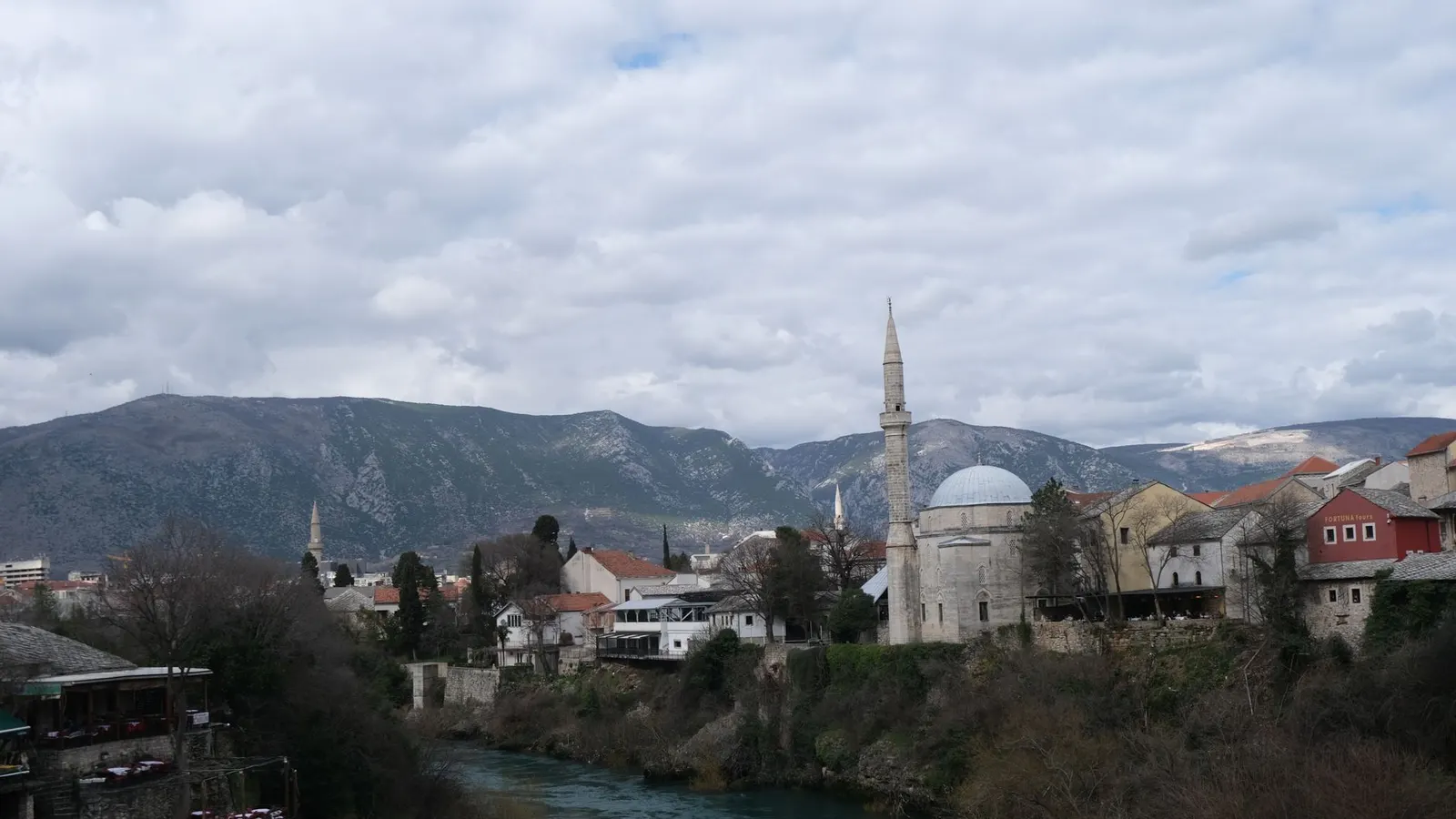
The Stari Most was finished in 1566 for Suleiman the Magnificent and stood for 427 years until a Croat tank on Mount Hum brought it down on 9 November 1993 - the Hague tribunal accepted that by then the bridge was carrying military traffic, and still held that destroying it was out of all proportion to what that was worth. What crosses the Neretva now was rebuilt between 2001 and 2004 with World Bank money, cut from the same Mukoša quarry by the original methods, with some of the fallen blocks lifted out of the river; it reopened on 23 July 2004 and UNESCO listed it the year after. Then walk the Bulevar, which was the front line of the Croat–Bosniak war in 1993 and 1994 and still shows it, and out to Bogdan Bogdanović's Partisan Memorial Cemetery of 1965, wrecked by vandals in 2022 and being pieced back together.
The Buna, Počitelj and Kravice
Pick up the car. Blagaj tekke sits under a cliff at the mouth of the Buna, which comes out of the rock as one of the strongest karst springs in Europe; a dervish lodge has stood there since the fifteenth or early sixteenth century. Počitelj is a fortified Ottoman hill town on the old road to Dubrovnik, shelled and emptied in 1993 and restored slowly since. Kravice, on the Trebižat, is a 25-metre curtain of falls and is genuinely crowded in July - go early or go last.
Radimlja, then over to Trebinje
Radimlja, just west of Stolac, holds about 130 stećci - the medieval tombstones carved across Bosnia, Herzegovina and the neighbouring borderlands between roughly the twelfth and sixteenth centuries, with raised arms, hunts and a circle dance nobody has definitively explained. Twenty-eight of the graveyards were inscribed by UNESCO in 2016 as a single site spread over four countries. Stolac lost most of its Ottoman quarter in 1993. Then south-east over the karst into Republika Srpska and down to Trebinje, which has plane trees, a working market and vineyards on the hills behind it.
Vjetrenica
West to Zavala, where the Vjetrenica cave runs kilometres into the hill and holds more recorded animal species than any other cave on earth - over two hundred, more than ninety of them found nowhere else, the olm among them. Visits are guided and numbers are limited. Back in Trebinje, the Arslanagić bridge was built in 1574 and then moved: when the Trebišnjica was dammed for hydropower in 1965 the bridge was taken apart stone by stone, lay in a field for four years, and was reassembled between 1970 and 1972 about ten kilometres downstream, in the middle of Trebinje - which is why a sixteenth-century Ottoman bridge here stands on foundations poured in the decade before the Sarajevo Olympics.
North-east to the Sutjeska
A long mountain day through Bileća, Gacko and Foča, on empty road with almost nothing to buy on it. Tjentište is a wide green valley with a monument standing at the head of it: two split concrete wings by Miodrag Živković, unveiled in 1971, to the battle fought here in May and June 1943 in which the Partisans broke out of an encirclement and lost close to a third of their force. The memorial house behind it has frescoes by Krsto Hegedušić and is usually locked - ask at the park office.
Perućica and Maglić
Sutjeska is the oldest national park in the country, declared in 1962, and Perućica inside it is one of the last primeval forests in Europe: roughly 1,400 hectares never logged, silver firs over fifty metres, and the Skakavac waterfall dropping about 75 metres into the middle of it. You go in with a park guide and not otherwise. Maglić, on the Montenegrin border, is the highest mountain in Bosnia and Herzegovina at 2,386 metres and is a long day from the meadow at Prijevor.
Down the Drina to Višegrad
Through Foča and along the river. The bridge at Višegrad was commissioned by Mehmed Paša Sokolović - born in a village near here, taken as a boy in the devşirme levy, made grand vizier - and finished by Sinan's office in 1577: eleven arches, still carrying traffic, UNESCO-listed in 2007. Ivo Andrić grew up in the town and made the bridge the main character of the novel that won him the Nobel Prize in 1961. The town also lost nearly its entire Bosniak population in the spring and summer of 1992, to Serb police and paramilitaries - Milan Lukić is serving life for his part in it - and in January 2014 the municipality sent a workman with an angle grinder into the Bosniak cemetery at Stražište, under police escort, to cut the word genocide off the memorial stone, on the ground that no court had used it of Višegrad. Across the water, Emir Kusturica's Andrićgrad, a stone town built from scratch and opened in 2014, is admired and detested in roughly equal measure.
Potočari
North through Rogatica and Vlasenica. The memorial centre at Potočari faces the battery factory that was the Dutch battalion's compound when Srebrenica fell on 11 July 1995, and the cemetery across the road holds more than 6,700 of the men and boys killed in the days that followed - over eight thousand in all, identified by DNA over three decades and buried in a new group each 11 July as they are named. The ICTY convicted Radovan Karadžić and Ratko Mladić of genocide for it, and the International Court of Justice found the same on 26 February 2007. Go in the morning, read the exhibition in the factory, and plan nothing for the afternoon.
Back over the mountains
West through Vlasenica and Sokolac, which is the ordinary interior of the country - forest, sawmills, roadside honey and rakija - and down into Sarajevo from the east. Drop the car and spend the last evening on Ferhadija, which reads differently after two weeks. If there is time, the Historical Museum on Zmaja od Bosne holds the permanent siege exhibition, and the building itself, a 1963 modernist box that has never been properly repaired because no level of government will admit to owning it, is half the point.
Good to know
Landmines are the one non-negotiable rule here. Something under two per cent of the country is still recorded as suspected hazardous area, the national clearance deadline has been pushed back more than once, and the contamination follows the 1992–95 front lines rather than anything you could guess from the landscape - parts of the Igman and Bjelašnica slopes and the hills around Mostar included. Stay on marked paths and made tracks, treat the red skull signs as literal, and do not read a well-worn trail as proof that the ground beside it has been cleared. The convertible mark is fixed to the euro at 1.95583 by a currency board set up in 1997 and the rate has never moved, so a café that takes euros at 1.90 marks to the euro is rounding in its own favour: draw marks from an ATM and decline the machine's own conversion at the last screen. The bunker at Konjic is still a Ministry of Defence facility - visits are booked in advance through the town, never turned up for - and Perućica may only be entered with a Sutjeska National Park guide arranged at the office in Tjentište. Trains are the best way down the Neretva and there are only a few a day; the two entities run separate railways, services have been suspended for months at a time in the past, so check the timetable in the week you travel and keep the bus as a fallback. Hire cars cross between the Federation and Republika Srpska with no formality at all, because it is one country and there is no internal border, but one-way hire carries a fee and taking the car into Croatia or Montenegro needs a green card and the rental company's written permission. Winter equipment is compulsory on the roads from 1 November to 15 April, the Lukomir road is shut by snow for roughly the same window, and Sarajevo sits in a bowl that traps its own smoke - in December and January the city regularly registers some of the worst air in Europe, which matters if you have a chest. Finally: 11 July at Potočari is a burial attended by tens of thousands, not a visitor event. Every bed within an hour is taken, and anyone there that week should be there as a guest.
Shorter or longer?
Add four or five days out of Sarajevo - Travnik under its fortress, Jajce, where the Pliva falls into the middle of the town and the second AVNOJ session sketched postwar Yugoslavia in November 1943, then Banja Luka and the Una at Bihać and Martin Brod, which is the best river swimming in the country.
Sarajevo, Bjelašnica, Konjic, Jablanica, Mostar and the Herzegovina day trips, finishing at Stolac and Trebinje. Keeps the train, the bridge and the stećci, cuts Sutjeska, the Drina and Potočari, and needs a car for two days rather than eight.
Practical guide
Visa check for this route
Budget
Mid-range · per person · sharing a double room. Excludes international flights - they depend on where you fly from.
Editorial estimates · checked August 2026
Country guides
Trip essentials
The connectivity placement is our own eSIM store. No affiliate link on this list. How we choose these →