 Cristina / stock.adobe.com
Country Guide № 047 / 194 · Africa
Djibouti
Whale sharks, a lake saltier than the Dead Sea and the lowest point in Africa.
“Whale sharks, a lake saltier than the Dead Sea and the lowest point in Africa.”
Djibouti is small, extremely hot and geologically extraordinary. It sits on the Afar triple junction where the Arabian, Nubian and Somali plates are pulling apart, which produces Lac Assal - a salt lake 155 metres below sea level, the lowest point in Africa and one of the saltiest bodies of water on earth - and the Ardoukoba volcano that erupted in 1978 along a fissure that opened overnight.
The other draw is whale sharks. From roughly October to February, juveniles gather in the Ghoubbet el-Kharab bay in numbers that make snorkelling with them nearly certain, in one of the more reliable aggregations anywhere. The country hosts French, American, Japanese and Chinese military bases and lives largely off the port that handles most of landlocked Ethiopia's trade, which makes it expensive. It is also easy to enter, safe and reachable.
Chapter 01
Highlights
Lac Assal
A salt lake 155 metres below sea level - the lowest point in Africa - ringed by white salt crust and black lava, with water dense enough to float in effortlessly. An hour and a half from the capital.
Whale sharks at Ghoubbet
Juvenile whale sharks aggregate in the Ghoubbet el-Kharab from roughly October to February in one of the world's most reliable concentrations, snorkelled from day boats out of Djibouti City or Arta.
Lac Abbé
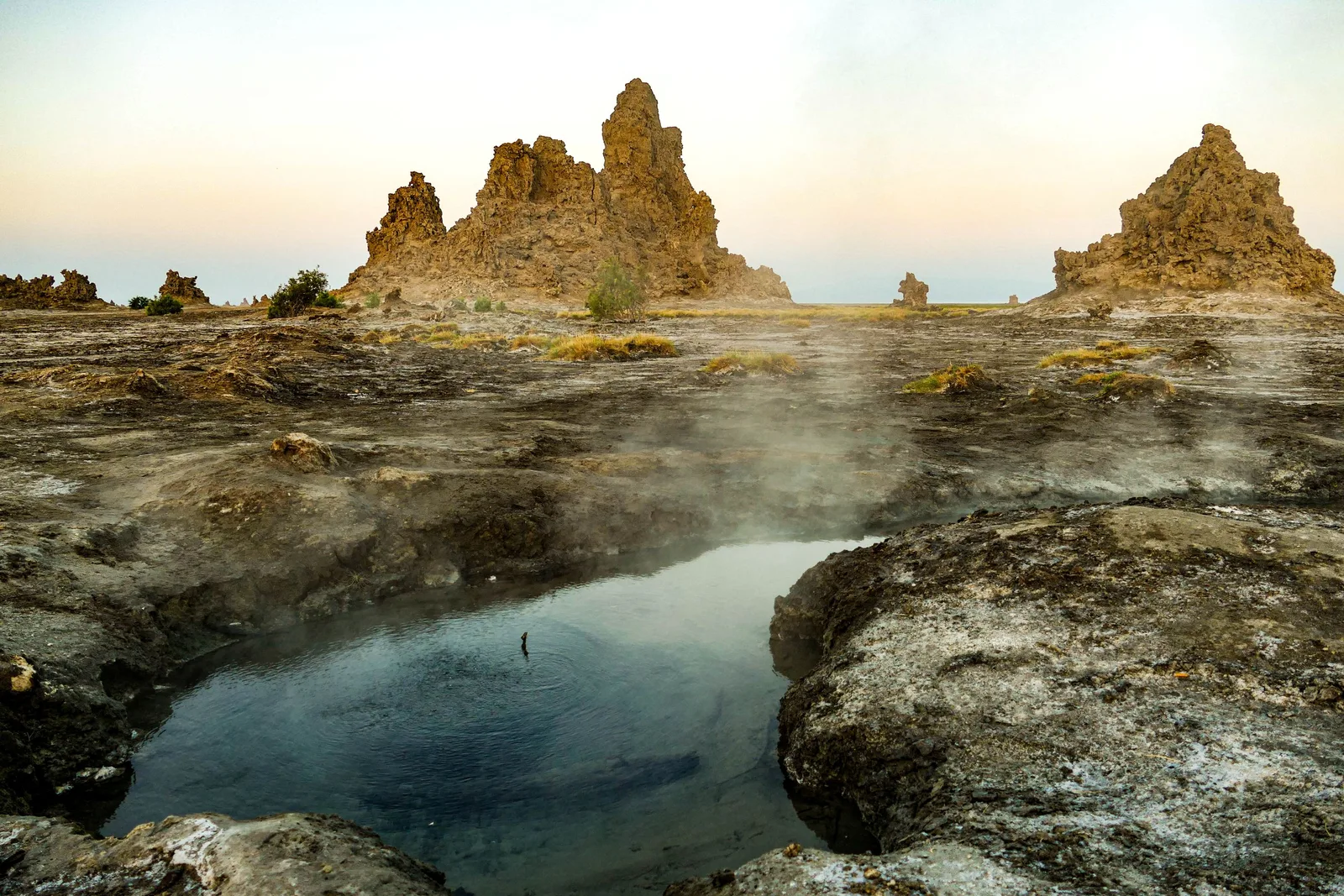
Limestone chimneys up to fifty metres tall steaming on a desert flat at the Ethiopian border - used as an alien landscape in Planet of the Apes, and best at dawn with flamingos on the shallows.
The Day Forest and Goda mountains
A relict juniper forest at 1,500 metres in the north, cool and green in a country that is otherwise lava and salt, with the Bankoualé palm found nowhere else.
Chapter 02
Entry requirements for Djibouti
Checking your passport…
up to 90 days · €55 / $59 · e-visa
90 days on arrival
Official portal only
Paid look-alike sites charge for a process that is free or cheap on the government portal. Use the link below and nothing else.
www.evisa.gouv.dj →Before you fly
The detail
- Maximum stay
- up to 90 days
- Process
- e-visa
- Fee
- €55 / $59
- Processing time
- Processing takes 2–7 days - apply with room to spare.
- Passport validity
- Most destinations want validity beyond your stay, and some want six months. Check yours against the return date.
- Onward travel
- Airlines may ask for a return or onward ticket at check-in.
- Health
- Malaria risk is low but present. Yellow fever certificate required from endemic countries. Medical facilities are limited; the French military hospital has historically been a fallback. Evacuation insurance is advisable.
- Money
- The franc is pegged to the US dollar at a fixed rate. Cash dominates; ATMs in the capital. Cards work at international hotels. Bring dollars or euros.
Djibouti expects a United States passport to arrive with an electronic visa already issued, applied for on the government's own portal before travelling. It costs in the region of fifty-five euros, the system works better than most in the region, and approvals have generally come back within a few days - apply a week ahead and print the approval rather than trusting a phone at a desk in a country where roaming is expensive and patchy. A counter issuing short-stay and transit visas has operated at Ambouli airport at various times, and you will find accounts of travellers using it. Do not plan on it. Its availability has moved more than once, an airline check-in agent working from a database that says otherwise will not board you, and the e-visa costs the same and takes days rather than nerve. There is one arrival where the distinction is not a matter of judgement at all: the Addis Ababa–Djibouti railway, which is a genuinely good way into the country, has no visa issuance at the border, and nor do the road crossings from Ethiopia at Galafi. Overland, the e-visa is the only way in. A yellow fever vaccination certificate is required to enter Djibouti only if you are arriving from a country where the disease circulates, or have spent more than twelve hours in an airport of one - a threshold worth knowing precisely, because the usual connections through Nairobi, Addis Ababa and Kampala are normally shorter than that and a long layover is not. If any leg of your journey touches such a country, carry the card; it becomes valid ten days after the injection. Six months of passport validity, a return or onward ticket and an address for the form. Two local notes worth carrying: Djibouti hosts several foreign military bases and photographing installations, ports or personnel is a serious matter rather than an awkward one; and the heat, not the paperwork, is the real hazard here - arrivals between June and August land into temperatures that make an unplanned afternoon outdoors genuinely dangerous.
Check another destination with this passport →
Entry details: Editorial synthesis - Djiboutian government e-visa portal terms and Ambouli border practice (2025–2026) · compiled 18 Sept 2026
Who needs a visa for Djibouti
12 common passports| Passport | Requirement | Stay | Process |
|---|---|---|---|
| United States | Visa on arrival | - | e-Visa · €55 / $59 · 2–7 d |
| United Kingdom | Visa on arrival | - | e-Visa · €55 / $59 · 2–7 d |
| Germany | Visa on arrival | - | e-Visa · €55 / $59 · 2–7 d |
| India | Visa on arrival | - | e-Visa · €55 / $59 · 2–7 d |
| China | Visa on arrival | - | e-Visa · €55 / $59 · 2–7 d |
| Brazil | Visa on arrival | - | e-Visa · €55 / $59 · 2–7 d |
| Nigeria | Visa on arrival | - | e-Visa · €55 / $59 · 2–7 d |
| Indonesia | Visa on arrival | - | e-Visa · €55 / $59 · 2–7 d |
| Philippines | Visa on arrival | - | e-Visa · €55 / $59 · 2–7 d |
| Vietnam | Visa on arrival | - | e-Visa · €55 / $59 · 2–7 d |
| Egypt | Visa on arrival | - | e-Visa · €55 / $59 · 2–7 d |
| Nepal | Visa on arrival | - | e-Visa · €55 / $59 · 2–7 d |
Holding a passport that is not listed? The picker above answers for any of them. See where your passport takes you. Source: Passport Index, updated 14 Aug 2026.
Chapter 03
When to go
BestNov–Feb. AvoidApr–Sep.
Coolest month; whale sharks in the Ghoubbet.
The band above each month is our editorial verdict - it weighs crowds, prices and access as well as weather. The line is average daily temperature, the bars are monthly rainfall. Select a month for the figures. Climate figures: ERA5 reanalysis via Open-Meteo, 2005–2024 normals.
Chapter 04
What it costs
A day in Djibouti
Comfortable · sample day
≈ $173
Line items are real prices we track. The daily budget is an editorial estimate for this level, not their sum.
Where this sits among 244 countries we have costed
Whale shark season from November to February is the one period with real tourist demand, and operator prices reflect it. Hotel rates are institutional and steady.
Updated Aug 2026 · Editorial synthesis - operator tariffs and market sampling (2025–2026) · confidence medium
Excludes international flights - they depend on where you fly from.
Chapter 05
Regions to know
5Djibouti City
The port capital, the European quarter, the Mahamoud Harbi mosque and the fish market at dawn.
The Gulf of Tadjoura
Tadjoura and Obock on the north shore, the Ghoubbet bay and its whale sharks, and the Sept Frères islands offshore.
Lac Assal and the rift
The lowest point in Africa, the Ardoukoba volcano and the lava fields of the Afar triple junction.
Lac Abbé and the southwest
The limestone chimneys, flamingos and Afar salt caravans on the Ethiopian border.
The Goda mountains
The Day Forest, Bankoualé and the cool relict woodland above the coastal plain.
Chapter 06
Practical guide
Getting there
Djibouti–Ambouli International is served by Ethiopian, Air France, Turkish, Flydubai, Kenya Airways and Air Djibouti. The Addis Ababa–Djibouti railway carries passengers and is a genuinely good way in from Ethiopia; the ferry to Yemen has been suspended.
Getting around
Desert excursions are operator-run with 4x4s. Minibuses cover the main roads. The railway runs to the Ethiopian border. Distances are short - the whole country is smaller than Wales.
Money & costs
The franc is pegged to the US dollar at a fixed rate. Cash dominates; ATMs in the capital. Cards work at international hotels. Bring dollars or euros.
Safety
Djibouti is calm and among the safer countries in the Horn. Petty theft in the capital. The Eritrean border area carries advisories. The heat is the genuine hazard - dehydration and heatstroke on desert excursions are the realistic risk.
Health
Malaria risk is low but present. Yellow fever certificate required from endemic countries. Medical facilities are limited; the French military hospital has historically been a fallback. Evacuation insurance is advisable.
SIM & internet
Djibouti Telecom is the sole operator; SIMs require passport registration. Coverage in the capital and along the main roads. Data is expensive by regional standards.
Chapter 07
Driving
The road to Lac Assal is paved; Lac Abbé needs a 4x4 and a guide. Never travel into the desert without water reserves and a second vehicle or a satellite phone. Checkpoints near the Eritrean border are strict.
Rules change - verify with an official source before you rent.
ExplWorld VerifiedNo verified partners here yet - all 6 country seats are open.
Become ExplWorld Verified →Chapter 08
Itineraries through this country
Chapter 09
From the Journal
Chapter 10
Before you go
DjiboutiChapter 11
Frequently asked questions
When exactly are the whale sharks there?
Roughly October to February, with November to January the most reliable. They are juveniles feeding on plankton in the enclosed Ghoubbet bay, and encounters are snorkel-only - diving with them is not permitted. Operators run day trips and liveaboards from the capital.
Why is it so expensive?
Foreign military bases and the Ethiopian transit trade set the price level in a country of about a million people that imports nearly everything. Hotel rooms in the capital cost what they would in western Europe. The desert excursions are operator-run and priced accordingly. There is very little budget infrastructure.
How hot does it get?
Extreme. Summer temperatures routinely exceed 45°C with high humidity on the coast, and the khamsin wind makes June to August genuinely dangerous for exertion. The season is November to February and that is not a preference, it is a constraint.