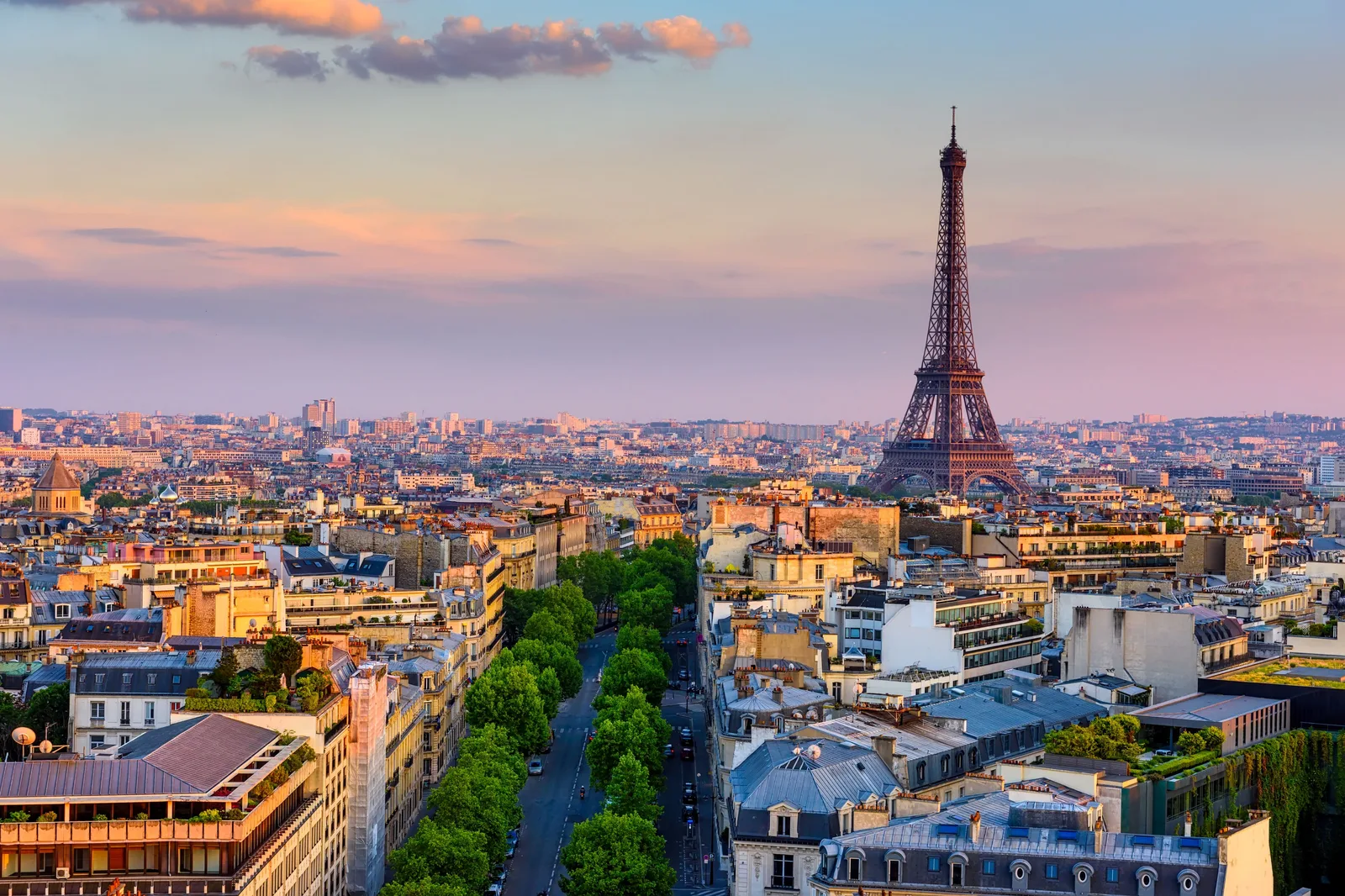
 Ekaterina Belova / stock.adobe.com
Country Guide № 060 / 194 · Europe
France
The most visited country on earth, and most of it is not Paris.
“The most visited country on earth, and most of it is not Paris.”
France takes around a hundred million visitors a year, more than any other country, and a striking share of them never leave the Île-de-France. That is the opportunity. The country packs Alps, Pyrenees, two coastlines, volcanic uplands and the largest surviving Roman monuments outside Italy into an area smaller than Texas, and the TGV network puts most of it within three hours of Paris.
It is also a country organised around eating, and regional in a way that has survived centralisation - cassoulet in Toulouse, galettes in Brittany, choucroute in Alsace, and a cheese counter that changes every hundred kilometres. Give Paris four days if it is your first visit, then take the train somewhere with a market square.
Chapter 01
Highlights
Paris beyond the checklist
The Marais and Canal Saint-Martin, the covered passages, Père Lachaise, and a museum pass that gets you past the queues. Book the Louvre and Sainte-Chapelle in advance or don't bother.
The Dordogne and the painted caves
Prehistoric art at Lascaux IV and Font-de-Gaume, cliff villages above the river, and the densest concentration of good markets in the country.
The Calanques and Provence
Limestone inlets between Marseille and Cassis, the Roman arena at Arles, Avignon's papal palace and lavender on the Valensole plateau in early July.
The Alps in summer
Chamonix's Aiguille du Midi cable car, the Vanoise and Écrins national parks, and the Tour du Mont Blanc - eleven days on marked trails through three countries.
Chapter 02
Entry requirements for France
Checking your passport…
up to 90 days · free entry
90 days on arrival
Before you fly
The detail
- Maximum stay
- up to 90 days
- Fee
- free entry
- Passport validity
- Most destinations want validity beyond your stay, and some want six months. Check yours against the return date.
- Onward travel
- Airlines may ask for a return or onward ticket at check-in.
- Health
- No vaccinations required. Healthcare is excellent; EHIC or GHIC covers EU and UK visitors for state care, others need insurance. Pharmacies are competent first stops for minor problems and are marked by a green cross. Tap water is safe everywhere. Summer heatwaves have become severe and cities are poorly adapted - take them seriously.
- Money
- Contactless everywhere, including buses and bakeries. Cash is rarely needed but useful at small markets. Service is included in restaurant prices by law - the addition on the bill is optional and small, and nobody expects fifteen per cent. ATMs are free at banks; avoid the standalone Euronet machines, which charge heavily.
France counts nothing of its own. A United States passport is admitted without a visa for 90 days in any rolling 180, and that allowance belongs to the whole twenty-nine-country Schengen area rather than to France - a fortnight in Paris, a week in Barcelona and ten days in Rome are one budget of ninety days, not three. The window rolls: count backwards 180 days from any date and add up every day you were anywhere in the area, arrival and departure days included. This is the single thing American visitors most often get wrong, because there is no fresh clock at each frontier and usually no frontier to notice. Since 10 April 2026 the Entry/Exit System has been fully operational, after a phased start in October 2025: your first crossing records a facial image and fingerprints, the passport is no longer stamped, and the count is now kept by a machine rather than by an officer finding the right inky page. Overstaying is a fine and, increasingly, a re-entry ban. ETIAS - the online authorisation that will one day sit in front of these same 90 days - was not required at the time of writing, however confidently the paid lookalike sites imply otherwise; check when you book; watch the EU’s own travel-europe.europa.eu. Your passport must be valid three months beyond the date you intend to leave the Schengen area, and France’s overseas territories - Guadeloupe, Martinique, Réunion, French Guiana, French Polynesia - sit outside Schengen, so days spent there do not touch the ninety.
Check another destination with this passport →
Entry details: Editorial synthesis - Schengen Borders Code (Regulation 2016/399), EU Entry/Exit System rollout, French Ministry of the Interior entry guidance (2025–2026) · compiled 16 Sept 2026
Who needs a visa for France
12 common passports| Passport | Requirement | Stay | Process |
|---|---|---|---|
| United States | Visa-free | up to 90 days | No process · €0 / $0 |
| United Kingdom | Visa-free | up to 90 days | No process · €0 / $0 |
| Germany | Visa-free | - | No process · €0 / $0 |
| India | Visa required | - | No Other passports record yet |
| China | Visa required | - | No Other passports record yet |
| Brazil | Visa-free | up to 90 days | No Other passports record yet |
| Nigeria | Visa required | - | No Other passports record yet |
| Indonesia | Visa required | - | No Other passports record yet |
| Philippines | Visa required | - | No Other passports record yet |
| Vietnam | Visa required | - | No Other passports record yet |
| Egypt | Visa required | - | No Other passports record yet |
| Nepal | Visa required | - | No Other passports record yet |
Holding a passport that is not listed? The picker above answers for any of them. See where your passport takes you. Source: Passport Index, updated 14 Aug 2026.
Chapter 03
When to go
BestMay–Jun, Sep–Oct. AvoidAugust.
Warm, green and pre-season - one of the two best months.
The band above each month is our editorial verdict - it weighs crowds, prices and access as well as weather. The line is average daily temperature, the bars are monthly rainfall. Select a month for the figures. Climate figures: ERA5 reanalysis via Open-Meteo, 2005–2024 normals.
Chapter 04
What it costs
A day in France
Comfortable · sample day
≈ $130
Line items are real prices we track. The daily budget is an editorial estimate for this level, not their sum.
Where this sits among 244 countries we have costed
The Mediterranean coast and the Alps both roughly double in their peaks - July and August on the coast, February and the Christmas fortnight in the ski resorts. Paris is expensive year-round with spikes around fashion weeks and major events. TGV fares rise steeply as departure approaches, which is the single biggest controllable cost in a French trip.
Updated Aug 2026 · Editorial synthesis - SNCF published fares, RATP tariffs, INSEE price data, hotel rate sampling (2025–2026) · confidence high
Excludes international flights - they depend on where you fly from.
Chapter 05
Regions to know
5Paris & Île-de-France
The capital plus Versailles, Fontainebleau and Chartres - all within an hour by regional train.
The southwest
Bordeaux and its vineyards, the Dordogne's painted caves and cliff villages, and the Basque coast at Biarritz.
Provence & the Riviera
Roman Arles and Nîmes, the Calanques, lavender plateaus and the coast from Marseille to Menton.
The Alps & the east
Chamonix and Mont Blanc, the Vanoise, plus Alsace's wine road and half-timbered villages.
The west & north
Brittany's coast and megaliths, the Loire châteaux, Normandy's D-Day beaches and Mont-Saint-Michel.
Chapter 06
Practical guide
Getting there
Paris Charles de Gaulle (CDG) and Orly (ORY) are the main gateways, with Lyon, Marseille, Nice, Bordeaux and Toulouse well served from across Europe. Eurostar links London to Paris and Lille in a little over two hours, and the TGV network reaches Brussels, Amsterdam, Cologne, Barcelona, Turin and Geneva without flying.
Getting around
TGV for long distances, booked well ahead; TER regional trains for everything else, with no reservation needed. Renting a car makes sense for the Dordogne, Provence, Brittany and the Alps, where public transport thins out. City transport is good everywhere - a Navigo Easy card in Paris, tap-to-pay in most other cities. Long-distance coaches (Flixbus, BlaBlaCar Bus) undercut the trains substantially.
Money & costs
Contactless everywhere, including buses and bakeries. Cash is rarely needed but useful at small markets. Service is included in restaurant prices by law - the addition on the bill is optional and small, and nobody expects fifteen per cent. ATMs are free at banks; avoid the standalone Euronet machines, which charge heavily.
Safety
Safe by any reasonable measure, with pickpocketing the dominant risk - Paris metro line 1, Gare du Nord, Barbès, and the approaches to major monuments. Phone snatching from café tables and on scooters is common in Paris, Lyon and Marseille. Demonstrations and strikes are frequent and can shut transport with a day's notice; check SNCF and RATP before travelling. Rural France is safe and quiet.
Health
No vaccinations required. Healthcare is excellent; EHIC or GHIC covers EU and UK visitors for state care, others need insurance. Pharmacies are competent first stops for minor problems and are marked by a green cross. Tap water is safe everywhere. Summer heatwaves have become severe and cities are poorly adapted - take them seriously.
SIM & internet
EU roaming means most European SIMs work without extra charge; others should buy an eSIM. 4G and 5G coverage is comprehensive apart from some Alpine and Massif Central valleys. Free wifi is widespread in cafés and on trains.
Chapter 07
Driving
The rural speed limit dropped to 80 km/h on undivided roads in 2018, though some departments reverted to 90 - the signs are what count. Low-emission zones (ZFE) now restrict older vehicles in Paris, Lyon, Grenoble and others; a Crit'Air sticker is required and must be ordered in advance.
Rules change - verify with an official source before you rent.
ExplWorld VerifiedNo verified partners here yet - all 6 country seats are open.
Become ExplWorld Verified →Chapter 08
Itineraries through this country
Chapter 09
From the Journal
Chapter 10
Before you go
FranceChapter 11
Frequently asked questions
Is the TGV worth it over flying or driving?
Almost always. Paris to Marseille takes three hours door to door against four or five by air with transfers, and to Bordeaux is two. Book on SNCF Connect two to three months ahead for the cheap fares - prices rise steeply toward departure. Regional TER trains cover the rest and do not need advance booking.
When should I avoid the coast?
August. The whole country takes its holiday at once, the Mediterranean coast and Atlantic resorts are full, and prices peak. June and September are warm, open and far more pleasant. Note that many restaurants and small businesses in Paris close for two or three weeks in August.
Do I need to speak French?
It helps more here than the stereotype suggests, and less than it used to. English is common in Paris, tourist areas and among younger people; in rural France it is genuinely limited. Opening with bonjour before anything else is not politeness theatre - it materially changes how the exchange goes.