 tawatchai1990 / stock.adobe.com
Country Guide № 063 / 194 · Asia
Georgia
Eight thousand years of wine, and mountains that justify the drinking.
“Eight thousand years of wine, and mountains that justify the drinking.”
Georgia has spent the last fifteen years becoming the Caucasus destination, and the reasons are easy to list: the Greater Caucasus range with genuinely alpine trekking at Kazbegi and Svaneti, a wine culture running back eight thousand years and still fermenting in buried clay qvevri, a capital with sulphur baths and Soviet modernism and better food than anywhere nearby, and a visa policy that lets most nationalities stay a year without paperwork.
It is small enough to see properly in two weeks and varied enough to fill a month. Tbilisi and the Kakheti wine region make the easy half; Svaneti's tower villages under 5,000-metre peaks and the Tusheti road - one of the most dangerous and beautiful in the world - make the other. The Russian-occupied territories of Abkhazia and South Ossetia are not accessible from the Georgian side and should be left out of any plan.
Chapter 01
Highlights
Svaneti
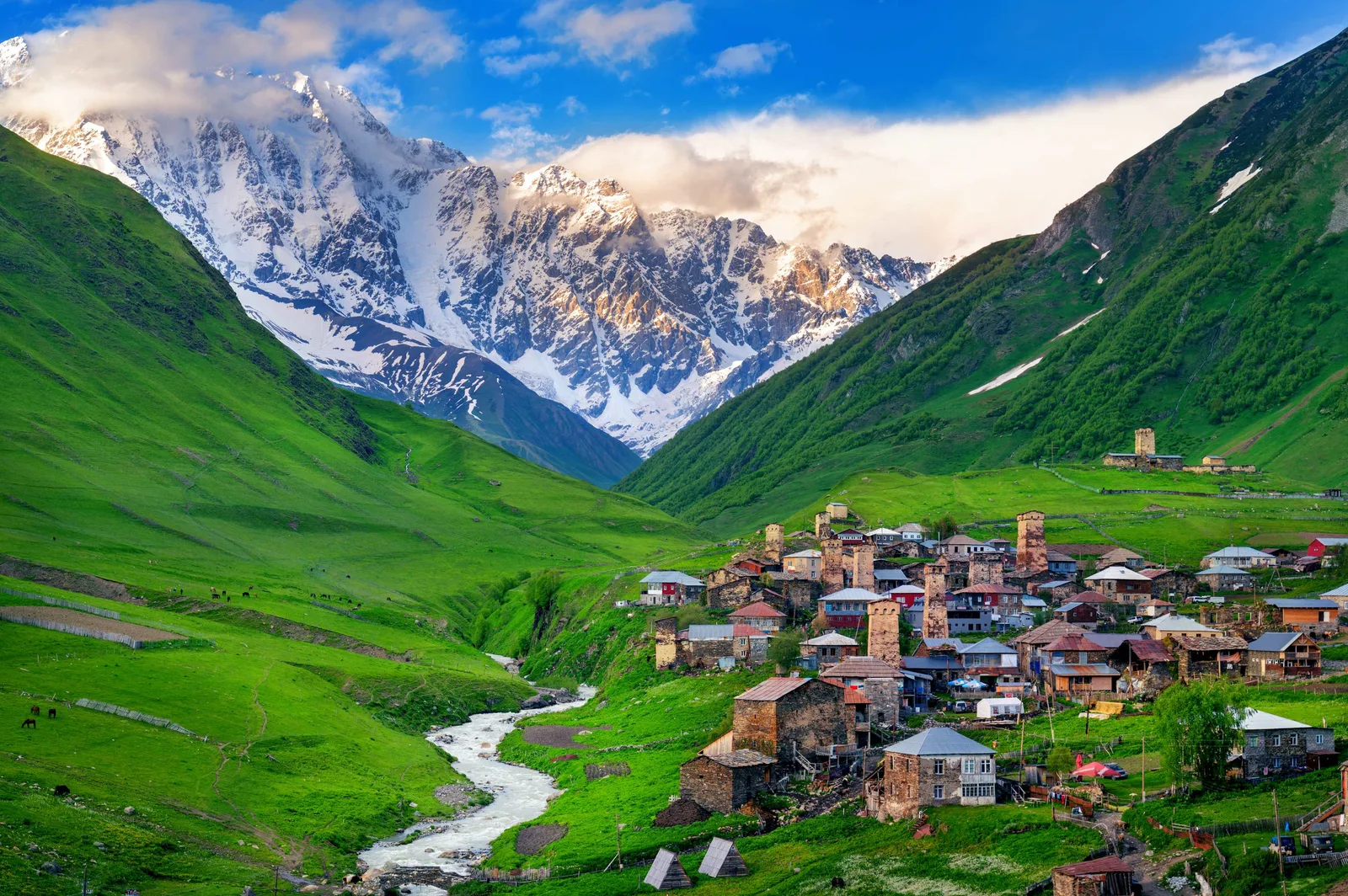
Medieval defensive tower houses at Mestia and Ushguli under Shkhara, at 5,193 metres. The four-day Mestia–Ushguli trek is the best-known walk in the country.
Kazbegi
The Gergeti Trinity church on a ridge below Mount Kazbek, three hours from Tbilisi up the Georgian Military Highway. The most photographed view in the Caucasus.
Kakheti wine country
Qvevri winemaking in buried amphorae, a UNESCO-listed technique still in everyday use. Sighnaghi as a base, and family cellars that will pour you eight wines before lunch.
Tbilisi old town
Sulphur bathhouses under brick domes, wooden balconies, Soviet-era funicular and a food scene that alone justifies four days in the city.
Chapter 02
Entry requirements for Georgia
Checking your passport…
up to 365 days · free entry
365 days on arrival
Before you fly
The detail
- Maximum stay
- up to 365 days
- Fee
- free entry
- Passport validity
- Most destinations want validity beyond your stay, and some want six months. Check yours against the return date.
- Onward travel
- Airlines may ask for a return or onward ticket at check-in.
- Health
- No vaccinations required; hepatitis A and typhoid are standard advice, rabies worth considering given the dog population, tick-borne encephalitis for forest and mountain travel. Tap water in Tbilisi is drinkable and mountain spring water is a national point of pride. Medical care is reasonable in Tbilisi and thin in the mountains; insurance covering trekking and evacuation matters for Svaneti and Tusheti.
- Money
- Cards are widely accepted in Tbilisi, Batumi and tourist towns; villages and marshrutkas are cash. ATMs are everywhere and many are fee-free for foreign cards. The lari is stable. Tipping around 10 % is normal in restaurants; a service charge often appears on the bill in the capital.
Georgia admits US passports with no visa for a full year, which is the longest ordinary tourist stay anywhere in this dataset and is granted at the border with a stamp and no paperwork. It is a year per entry rather than a year in total, so leaving and returning starts a fresh one; what it is not is permission to work, and staying 183 days in any twelve months makes you tax resident, which is the reason a good many remote workers here file Georgian returns. The one way to turn a simple border into a criminal matter is to enter Abkhazia or South Ossetia from Russia: Georgian law treats both as occupied territory, entry from the Russian side is an offence prosecuted on the way out, and the ban that follows is not negotiable. The passport needs only to be valid for the stay, there is no arrival form and no fee, and the land crossings from Türkiye and Armenia are straightforward. If you are not on the exemption list - it runs to roughly 98 countries - the alternative is the government e-visa, and the exemption also extends to holders of valid EU, US, UK and Gulf visas or residence permits.
Check another destination with this passport →
Entry details: Editorial synthesis - Georgian Ministry of Foreign Affairs visa regulations (Order N255), Georgian Border Police (2025–2026) · compiled 15 Sept 2026
Who needs a visa for Georgia
12 common passports| Passport | Requirement | Stay | Process |
|---|---|---|---|
| United States | Visa-free | up to 360 days | No process · €0 / $0 |
| United Kingdom | Visa-free | up to 360 days | No process · €0 / $0 |
| Germany | Visa-free | up to 360 days | No process · €0 / $0 |
| India | Visa required | - | No Other passports record yet |
| China | Visa-free | up to 30 days | No Other passports record yet |
| Brazil | Visa-free | up to 360 days | No Other passports record yet |
| Nigeria | Visa required | - | No Other passports record yet |
| Indonesia | e-Visa | - | No Other passports record yet |
| Philippines | e-Visa | - | No Other passports record yet |
| Vietnam | e-Visa | - | No Other passports record yet |
| Egypt | e-Visa | - | No Other passports record yet |
| Nepal | Visa required | - | No Other passports record yet |
Holding a passport that is not listed? The picker above answers for any of them. See where your passport takes you. Source: Passport Index, updated 14 Aug 2026.
Chapter 03
When to go
BestMay–Jun, Sep–Oct.
Green, mild and beautiful at low and middle altitude.
The band above each month is our editorial verdict - it weighs crowds, prices and access as well as weather. The line is average daily temperature, the bars are monthly rainfall. Select a month for the figures. Climate figures: ERA5 reanalysis via Open-Meteo, 2005–2024 normals.
Chapter 04
What it costs
A day in Georgia
Comfortable · sample day
≈ $54
Line items are real prices we track. The daily budget is an editorial estimate for this level, not their sum.
Where this sits among 244 countries we have costed
Batumi and the Black Sea coast double in July and August and are cheap the rest of the year. Svaneti and Kazbegi guesthouses rise in the July–September trekking window. Tbilisi is comparatively flat, though the growing remote-worker population has pushed long-stay rents up considerably since 2022. Ski resorts have their own January–March peak.
Updated Aug 2026 · Editorial synthesis - Georgian National Tourism Administration, guesthouse and operator rate sampling (2025–2026) · confidence high
Excludes international flights - they depend on where you fly from.
Chapter 05
Regions to know
5Tbilisi & the centre
The capital with its sulphur baths and old town, plus Mtskheta's ancient churches half an hour away.
Kakheti
Wine country - qvevri cellars, the hill town of Sighnaghi and the David Gareja cave monasteries on the Azerbaijani border.
Svaneti & the high Caucasus
Tower villages at Mestia and Ushguli under 5,000-metre peaks, and the country's best trekking.
Kazbegi & the Military Highway
The road north through the Caucasus to Stepantsminda, the Gergeti church and the Russian border.
The west & Black Sea
Kutaisi's cathedrals and canyons, the cave city of Vardzia to the south, and Batumi's summer coast.
Chapter 06
Practical guide
Getting there
Tbilisi (TBS) and Kutaisi (KUT) take direct flights from many European cities, with Wizz Air using Kutaisi as a low-cost hub - often the cheapest way in from Central Europe. Batumi serves the summer coastal market. Overland from Armenia, Azerbaijan and Turkey is routine; the Russian border at Verkhny Lars is open but comes with obvious complications.
Getting around
Marshrutka minibuses connect everything cheaply and depart when full. Trains link Tbilisi with Batumi, Kutaisi and Zugdidi comfortably and are worth booking online. Bolt is the ride-hailing app everywhere and is very cheap. For the mountains, shared or hired 4×4s - Mestia and Tusheti are not saloon-car country. Renting a car is easy and popular, and the main roads are decent.
Money & costs
Cards are widely accepted in Tbilisi, Batumi and tourist towns; villages and marshrutkas are cash. ATMs are everywhere and many are fee-free for foreign cards. The lari is stable. Tipping around 10 % is normal in restaurants; a service charge often appears on the bill in the capital.
Safety
Georgia is very safe - low crime, and solo travel including for women is straightforward by regional standards. The real risks are mountain roads, weather at altitude, and stray dogs, which are numerous though usually vaccinated and tagged. Political demonstrations in Tbilisi have been frequent and occasionally met with force; avoid them. Do not attempt to enter the occupied territories, and note that the administrative boundary lines have shifted and are not always marked.
Health
No vaccinations required; hepatitis A and typhoid are standard advice, rabies worth considering given the dog population, tick-borne encephalitis for forest and mountain travel. Tap water in Tbilisi is drinkable and mountain spring water is a national point of pride. Medical care is reasonable in Tbilisi and thin in the mountains; insurance covering trekking and evacuation matters for Svaneti and Tusheti.
SIM & internet
Magti, Silknet and Beeline SIMs cost a few euros with generous data. 4G coverage is excellent, including in most mountain valleys. Wifi is universal in guesthouses and cafés and genuinely fast - part of why the country attracts remote workers.
Chapter 07
Driving
Georgian driving is assertive and overtaking habits are optimistic. The Abano pass to Tusheti is 4×4-only, single-track with unprotected drops, and closed most of the year - do not take a rental car on it, and check whether your insurance excludes it, because many do.
Rules change - verify with an official source before you rent.
ExplWorld VerifiedNo verified partners here yet - all 6 country seats are open.
Become ExplWorld Verified →Chapter 08
Itineraries through this country
Chapter 09
From the Journal
Chapter 10
Before you go
GeorgiaChapter 11
Frequently asked questions
Can I really stay a year?
Yes. Georgia grants visa-free stays of 365 days to citizens of around 95 countries, including the EU, UK, US, Canada and Australia - one of the most liberal regimes anywhere, and the reason the country has a substantial remote-worker population. No registration, no paperwork. Confirm your own passport is on the list, since it is a national policy that could in principle change.
When can I trek in Svaneti and Tusheti?
Roughly late June to early October. The Zagari pass into Ushguli and the Abano pass into Tusheti are snowbound outside that window - the Tusheti road in particular opens around late May and closes in October, and it is a 4×4-only track with a reputation as one of the world's most dangerous roads. Do not plan mountain trekking here in May.
What about Abkhazia and South Ossetia?
Both are Russian-occupied and cannot be entered legally from Georgia proper. Entering from the Russian side is a criminal offence under Georgian law and will bar you from re-entering Georgia. Foreign ministries advise against travel to both. Treat them as off the map for any Georgia trip.