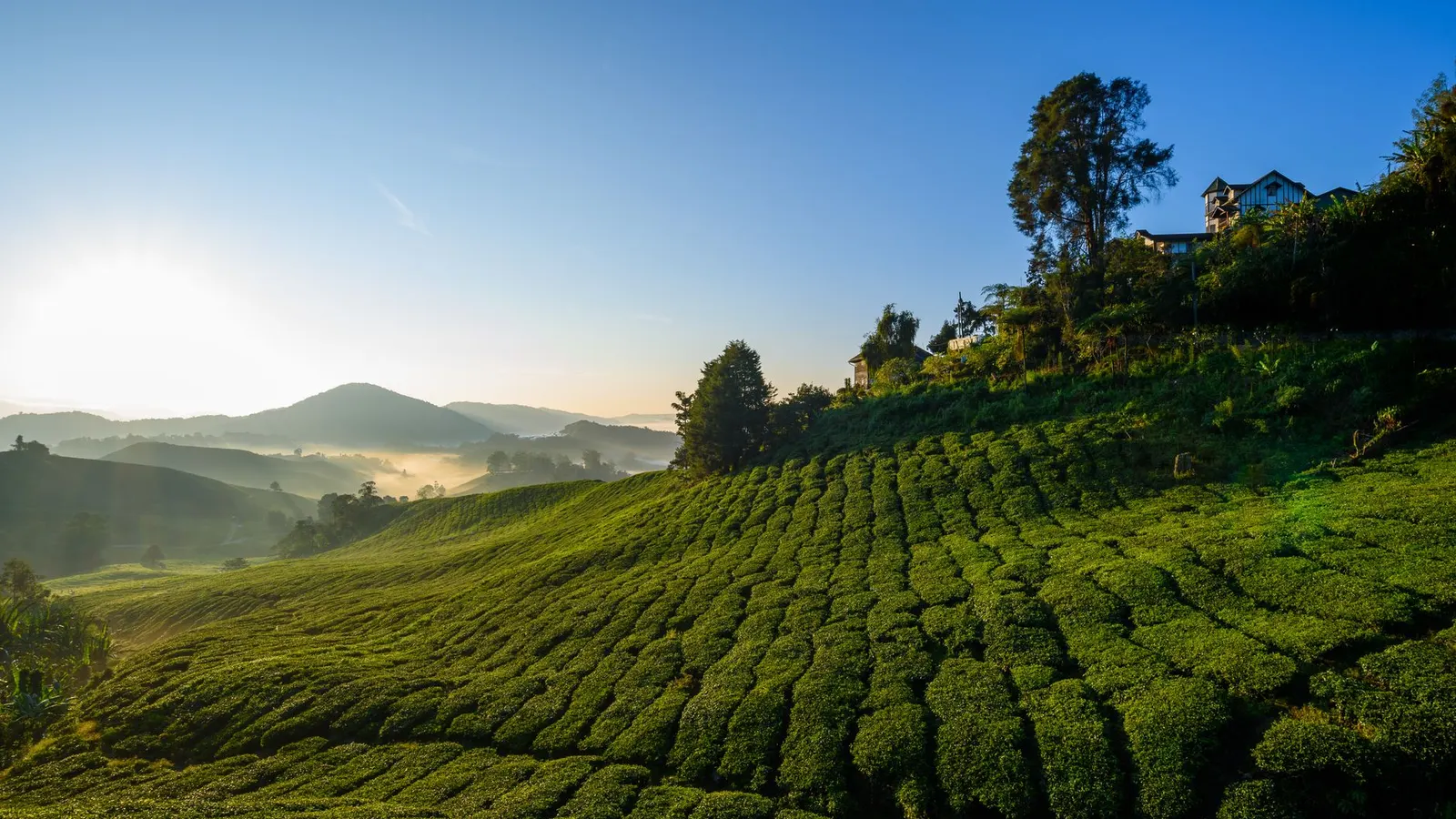
 Munzir · Pexels License
Country Guide № 102 / 194 · Asia
Malaysia
Three cuisines, two landmasses and the oldest rainforest on earth.
“Three cuisines, two landmasses and the oldest rainforest on earth.”
Malaysia is the region's easy country and its most consistently underestimated. The infrastructure works, English is widely spoken, the food is arguably the best in Southeast Asia, and almost every nationality walks in visa-free. What it lacks is a single postcard image - which is why people transit through Kuala Lumpur without stopping.
The country comes in two halves. The peninsula holds Penang's street food, the tea plantations of the Cameron Highlands, Melaka's trading-port architecture and the Perhentian islands. Across the South China Sea, Malaysian Borneo - Sabah and Sarawak - has orangutans, Mount Kinabalu, longhouse communities and rainforest that predates the Amazon by tens of millions of years. Give the second half at least a week of its own.
Chapter 01
Highlights
George Town, Penang
A UNESCO shophouse city where the hawker food is a national argument settled nightly - char kway teow at Lorong Selamat, assam laksa at Air Itam, and a clan jetty at sunrise.
Mount Kinabalu
Southeast Asia's most climbed 4,000-metre peak, done overnight from Kota Kinabalu with a permit and a mandatory guide. Book months ahead - daily numbers are capped.
The Kinabatangan River
Dawn and dusk boat safaris in Sabah with proboscis monkeys, pygmy elephants and hornbills along a corridor squeezed between oil-palm estates - spectacular and sobering at once.
Taman Negara
A 130-million-year-old rainforest on the peninsula, with a canopy walkway, night jungle walks and river trips upstream to Orang Asli settlements.
Chapter 02
Entry requirements for Malaysia
Checking your passport…
up to 90 days · free entry
90 days on arrival
Official portal only
Paid look-alike sites charge for a process that is free or cheap on the government portal. Use the link below and nothing else.
imigresen-online.imi.gov.my/mdac/main →Before you fly
The detail
- Maximum stay
- up to 90 days
- Fee
- free entry
- Passport validity
- Most destinations want validity beyond your stay, and some want six months. Check yours against the return date.
- Onward travel
- Airlines may ask for a return or onward ticket at check-in.
- Health
- No vaccinations required. Hepatitis A, typhoid and tetanus are standard; rabies and Japanese encephalitis for rural stays. Dengue is common nationwide, with periodic large outbreaks. Malaria risk is limited to inland Borneo. Tap water is chlorinated and generally safe in cities but most people drink bottled or filtered. Healthcare is genuinely good and Malaysia is a medical-tourism destination - private hospitals in KL and Penang are excellent value.
- Money
- Cards are widely accepted in cities, malls and mid-range restaurants; hawker stalls, small towns and rural Borneo are cash. ATMs are everywhere and many charge no local fee. Touch 'n Go is the local e-wallet and now takes some foreign cards for tolls and transit. Tipping is not customary; a 6 % service tax and 10 % service charge appear on formal restaurant bills.
What changed
United States passports enter Malaysia visa-free for 90 days, one of the longest such allowances in the region and stable for many years. Everyone must lodge the free Malaysia Digital Arrival Card online in the three days before arrival - compulsory since January 2024, not a visa, and the imitators charging for it are selling nothing. The 90 days is a single continuous entry rather than a rolling allowance and is not extendable for tourism; leaving for Singapore and coming straight back is tolerated once or twice and then it is not. Sabah and Sarawak run their own immigration control, so flying from Kuala Lumpur to Kota Kinabalu or Kuching means clearing immigration again and being given a fresh, often shorter, permitted period - read the new stamp before planning the rest of the trip. Malaysia carries a mandatory death sentence for drug trafficking and the quantities that trigger it are small, which is the single most important sentence on this page.
Check another destination with this passport →
Entry details: Editorial synthesis - Immigration Department of Malaysia entry requirements and Malaysia Digital Arrival Card, Sabah and Sarawak immigration rules (2025–2026) · compiled 15 Sept 2026
Who needs a visa for Malaysia
12 common passports| Passport | Requirement | Stay | Process |
|---|---|---|---|
| United States | Visa-free | up to 90 days | No process · €0 / $0 |
| United Kingdom | Visa-free | up to 90 days | No process · €0 / $0 |
| Germany | Visa-free | up to 90 days | No process · €0 / $0 |
| India | Visa-free | up to 90 days | No Other passports record yet |
| China | Visa-free | up to 30 days | No Other passports record yet |
| Brazil | Visa-free | up to 90 days | No Other passports record yet |
| Nigeria | e-Visa | - | No Other passports record yet |
| Indonesia | Visa-free | up to 30 days | No Other passports record yet |
| Philippines | Visa-free | up to 30 days | No Other passports record yet |
| Vietnam | Visa-free | up to 30 days | No Other passports record yet |
| Egypt | Visa-free | up to 90 days | No Other passports record yet |
| Nepal | e-Visa | - | No Other passports record yet |
Holding a passport that is not listed? The picker above answers for any of them. See where your passport takes you. Source: Passport Index, updated 14 Aug 2026.
Chapter 03
When to go
BestMarch, May–Aug. AvoidNov–Dec.
East-coast islands reopen; good weather almost nationwide.
The band above each month is our editorial verdict - it weighs crowds, prices and access as well as weather. The line is average daily temperature, the bars are monthly rainfall. Select a month for the figures. Climate figures: ERA5 reanalysis via Open-Meteo, 2005–2024 normals.
Chapter 04
What it costs
A day in Malaysia
Comfortable · sample day
≈ $52
Line items are real prices we track. The daily budget is an editorial estimate for this level, not their sum.
Where this sits among 244 countries we have costed
Island accommodation on the east coast simply stops for the monsoon - most Perhentian resorts close November to February rather than discounting. School holidays and Chinese New Year lift domestic flight prices sharply. Borneo runs 20–30 % above the peninsula once park fees, permits and guides are counted, and those are effectively fixed costs rather than optional extras.
Updated Aug 2026 · Editorial synthesis - KTMB and airline published fares, Sabah Parks tariffs, Budget Your Trip (2025–2026) · confidence high
Excludes international flights - they depend on where you fly from.
Chapter 05
Regions to know
5Kuala Lumpur & the west coast
The capital, the Batu Caves, Melaka's trading-port streets and Penang's hawker food - the country's dense, easy core.
The Cameron Highlands & interior
Tea plantations, cool air and mossy forest, plus the 130-million-year-old rainforest of Taman Negara.
The east coast & islands
Perhentian and Redang's clear water, Tioman's jungle and reefs, and traditional Malay states - March to October only.
Sabah
Mount Kinabalu, the Kinabatangan wildlife corridor, Sepilok's orangutans and the diving off Semporna.
Sarawak
Kuching's riverfront, Bako's proboscis monkeys, Mulu's vast caves and longhouse communities up the Rejang.
Chapter 06
Practical guide
Getting there
Kuala Lumpur (KUL) is a major hub with direct flights from London, Paris, Frankfurt, Istanbul and the Gulf, and AirAsia's regional network from KLIA Terminal 2. Penang, Langkawi, Kota Kinabalu and Kuching take regional flights. Overland from Singapore (causeway or the KTM shuttle) and Thailand (Padang Besar train) is simple and frequently used.
Getting around
Domestic flights are cheap and fast, which matters given the sea in the middle. The peninsula's ETS trains between Kuala Lumpur, Ipoh and Penang are excellent and cheap; long-distance coaches cover everywhere else comfortably. Grab operates nationwide and is the default in every city. In Borneo, distances are long and roads are slow - fly between Kota Kinabalu, Sandakan and Kuching rather than driving.
Money & costs
Cards are widely accepted in cities, malls and mid-range restaurants; hawker stalls, small towns and rural Borneo are cash. ATMs are everywhere and many charge no local fee. Touch 'n Go is the local e-wallet and now takes some foreign cards for tolls and transit. Tipping is not customary; a 6 % service tax and 10 % service charge appear on formal restaurant bills.
Safety
Malaysia is safe by regional standards. Petty theft and motorbike bag-snatching happen in Kuala Lumpur and Penang; keep bags on the inside pavement. The one region with a standing advisory is the east coast of Sabah near the Sulu Sea - the Semporna area including some dive resorts sits inside a designated security zone with curfews, following historical kidnappings. Check current advice before booking Sipadan-area diving. Drug offences carry the death penalty and this is not theoretical.
Health
No vaccinations required. Hepatitis A, typhoid and tetanus are standard; rabies and Japanese encephalitis for rural stays. Dengue is common nationwide, with periodic large outbreaks. Malaria risk is limited to inland Borneo. Tap water is chlorinated and generally safe in cities but most people drink bottled or filtered. Healthcare is genuinely good and Malaysia is a medical-tourism destination - private hospitals in KL and Penang are excellent value.
SIM & internet
Maxis, Celcom-Digi and U Mobile sell tourist SIMs for €7–12; eSIM works. Coverage is excellent on the peninsula, good around Borneo towns, absent in rainforest interiors. Wifi is universal in accommodation and cafés. WhatsApp is the standard business channel.
Chapter 07
Driving
Malaysia is the easiest country in Southeast Asia to self-drive - good roads, clear signage in Malay and English, disciplined motorway traffic. Borneo's interior roads are a different proposition and need a 4×4 in the wet.
Rules change - verify with an official source before you rent.
ExplWorld VerifiedNo verified partners here yet - all 6 country seats are open.
Become ExplWorld Verified →Chapter 08
Itineraries through this country
Chapter 09
From the Journal
Chapter 10
Before you go
MalaysiaChapter 11
Frequently asked questions
Peninsula or Borneo?
Both, if you have three weeks; Borneo alone if you have ten days and want wildlife. The peninsula is about cities, food and beaches and is very easy to travel; Sabah and Sarawak are about rainforest, diving and indigenous cultures, cost more and need more planning. Internal flights between them run about €50–80.
When should I go, given the two monsoons?
The east coast of the peninsula, including the Perhentians and Tioman, is closed or washed out from November to February; the west coast (Penang, Langkawi) is fine then and wettest around April and October. Borneo is broadly drier March to October. There is no month when the entire country is at its best.
Is it expensive?
Mid-range: more than Vietnam, less than Thailand's islands. Budget €48 a day comfortably, €28 as a backpacker. Hawker food is the great bargain at €2–3 a meal; what costs is Borneo - park fees, permits, guides and internal flights add up quickly and are not optional there.