 Phat Nguy · Pexels License
Country Guide № 117 / 194 · Asia
Myanmar
A guide written for people who will go anyway - and an advisory that says most should not.
Advisory - travel not recommended · checked 26 Sept 2026
Foreign ministries advise against all or all-but-essential travel to Myanmar. Armed conflict affects large parts of the country, conscription applies to some residents, and overland borders open and close without notice. Standard scores are suspended while this alert is active.
Official advisory →Every advisory in force →“A guide written for people who will go anyway - and an advisory that says most should not.”
Myanmar is on this site because leaving it off would not stop anyone going, and because the people who do go - journalists, aid workers, those with family here, and travellers who have weighed it - deserve accurate information rather than silence. It is not a recommendation. Since the 2021 coup the country has been in an armed conflict that now touches most of its states and regions, and foreign ministries advise against all or all-but-essential travel.
What that means practically: no meaningful consular assistance, commercial flights that suspend without notice, banking cut off from the international system, and a conscription law that has driven hundreds of thousands of young people out of the country. Whole regions - Rakhine, Chin, Kachin, much of Shan and Sagaing - are effectively closed. Yangon, Bagan and Inle Lake continue to receive visitors, and the ethical question of whose economy your money enters has no comfortable answer.
Chapter 01
Highlights
The Bagan plain
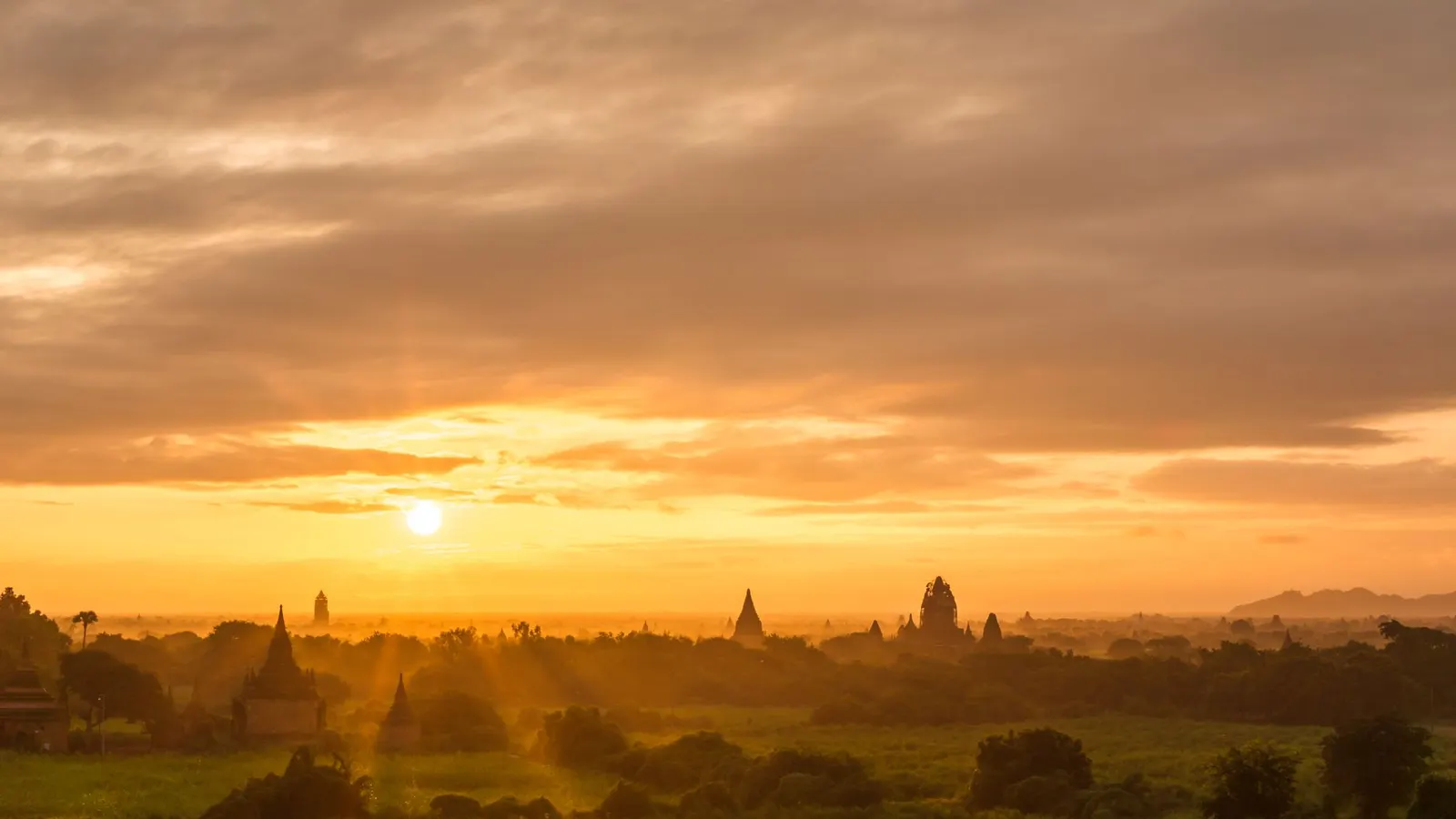
Over two thousand surviving temples across forty square kilometres of the Irrawaddy bend - one of the great archaeological landscapes on earth. Climbing the temples has been banned since 2018; viewing mounds and balloons replaced it.
Inle Lake
Leg-rowing fishermen, floating tomato gardens and stilt villages in the Shan hills. The classic image of the country, and still functioning.
Shwedagon Pagoda
Yangon's gilded stupa, ninety-nine metres of it, best at dusk when the city comes to sit on the marble. The single most important religious site in the country.
Mrauk U
Arakanese temple city in Rakhine State, often compared to Bagan and far emptier. It sits in one of the most conflict-affected states and has been effectively inaccessible since 2023 - listed here for what the country holds, not as a suggestion.
Chapter 02
Entry requirements for Myanmar
Advisory - travel not recommended · checked 26 Sept 2026
Foreign ministries advise against all or all-but-essential travel to Myanmar. Armed conflict affects large parts of the country, conscription applies to some residents, and overland borders open and close without notice. Standard scores are suspended while this alert is active.
Official advisory →Every advisory in force →Checking your passport…
up to 28 days · €46 / $50 · e-visa
28 days on arrival
Official portal only
Paid look-alike sites charge for a process that is free or cheap on the government portal. Use the link below and nothing else.
evisa.moip.gov.mm →Before you fly
The detail
- Maximum stay
- up to 28 days
- Process
- e-visa
- Fee
- €46 / $50
- Processing time
- Processing takes 3–5 days - apply with room to spare.
- Passport validity
- Most destinations want validity beyond your stay, and some want six months. Check yours against the return date.
- Onward travel
- Airlines may ask for a return or onward ticket at check-in.
- Arrival form
- Myanmar e-visa approval letter, printed, plus any health declaration in force at the time of travel.
- Health
- Hepatitis A, typhoid, tetanus and rabies are the standard recommendations; Japanese encephalitis for rural stays. Malaria and dengue are both present, malaria in rural areas year-round. Medical infrastructure has deteriorated badly since 2021 - many doctors joined the civil disobedience movement or left, and drug supply is unreliable. Serious illness or injury means evacuation to Bangkok, if it can be arranged at all.
- Money
- Cash economy, US dollars in, kyat out. Bring pristine, unfolded, post-2013 US notes - anything marked is refused - and enough for the whole trip. Foreign cards generally do not work at ATMs and international transfers are severely constrained. Multiple exchange rates operate; the official rate and the market rate differ substantially. Changing money outside licensed counters carries legal risk.
A tourist e-visa is required: US$50 at the time of writing, 28 days single entry, valid for 90 days from issue, applied for on the Ministry of Immigration and Population’s own portal and normally returned in three to five working days. Treat the scheme as something to confirm rather than assume - it has been suspended and restored more than once since 2020, and the list of ports where it is accepted is narrower than the list of borders on a map: Yangon, Mandalay and Nay Pyi Taw international airports and a small number of land crossings, several of which have been closed or contested since 2021. Check the portal and the crossing in the same week you book, not the same month. Entry is also not the same thing as access. Internal travel permits are needed for many areas, several states are closed outright, and the practical questions - whether the flight exists, whether the road is open, whether a card will work anywhere - change faster than any stored row. Bring clean US dollar notes; the banking system will not help you. Anyone holding Myanmar citizenship, dual nationals included, should take legal advice about the 2024 conscription law before entering, and every traveller should read the current travel advisory first: most governments advise against travel to parts or all of the country, which normally voids an ordinary travel insurance policy.
Check another destination with this passport →
Entry details: Editorial synthesis - Myanmar Ministry of Immigration and Population e-visa portal, foreign-ministry travel advisories (2025–2026) · compiled 17 Sept 2026
Who needs a visa for Myanmar
12 common passports| Passport | Requirement | Stay | Process |
|---|---|---|---|
| United States | e-Visa | - | e-Visa · €46 / $50 · 3–5 d |
| United Kingdom | e-Visa | - | e-Visa · €46 / $50 · 3–5 d |
| Germany | e-Visa | - | e-Visa · €46 / $50 · 3–5 d |
| India | Visa on arrival | - | No Other passports record yet |
| China | Visa on arrival | - | No Other passports record yet |
| Brazil | e-Visa | - | No Other passports record yet |
| Nigeria | Visa required | - | No Other passports record yet |
| Indonesia | Visa-free | up to 14 days | No Other passports record yet |
| Philippines | Visa-free | up to 14 days | No Other passports record yet |
| Vietnam | Visa-free | up to 14 days | No Other passports record yet |
| Egypt | e-Visa | - | No Other passports record yet |
| Nepal | e-Visa | - | No Other passports record yet |
Holding a passport that is not listed? The picker above answers for any of them. See where your passport takes you. Source: Passport Index, updated 14 Aug 2026.
Chapter 03
When to go
BestNov–Feb. AvoidApr–Sep.
Cool dry season - the only comfortable window, security permitting.
The band above each month is our editorial verdict - it weighs crowds, prices and access as well as weather. The line is average daily temperature, the bars are monthly rainfall. Select a month for the figures. Climate figures: ERA5 reanalysis via Open-Meteo, 2005–2024 normals.
Chapter 04
What it costs
A day in Myanmar
Comfortable · sample day
≈ $43
Line items are real prices we track. The daily budget is an editorial estimate for this level, not their sum.
Where this sits among 244 countries we have costed
Ordinary seasonality is not the variable that matters here. Prices are distorted by multiple exchange rates, cash-only operation and a collapsed visitor economy - some hotels are far below pre-2021 rates, while imported goods and domestic flights are relatively expensive. Treat every figure as indicative and verify on the ground.
Updated Aug 2026 · Editorial synthesis - operator rate sampling, archaeological-zone tariffs, traveller reports (2025–2026) · confidence low
Excludes international flights - they depend on where you fly from.
Chapter 05
Regions to know
5Yangon & the delta
The former capital - Shwedagon, colonial-era downtown and the country's densest street life. The most accessible part of the country.
Bagan & the dry zone
The temple plain on the Irrawaddy, plus Mandalay and the former royal capitals around it. Very hot from March to May.
Shan State & Inle Lake
Cool plateau country, the lake's stilt villages and hill trekking around Kalaw - with large parts of the state conflict-affected.
Rakhine
Mrauk U's temple city and the Ngapali coast. Conflict-affected and effectively closed to visitors since 2023.
Kachin & the far north
Himalayan foothills rising to Hkakabo Razi, Myitkyina and the jade country. Long restricted, currently inaccessible.
Chapter 06
Practical guide
Getting there
Yangon (RGN) is served by a reduced network of regional carriers from Bangkok, Singapore, Kuala Lumpur and Kunming; schedules change at short notice and airlines have withdrawn abruptly. There are no direct flights from Europe. Land borders with Thailand have opened and closed repeatedly and several are in contested territory; do not plan around one.
Entry formalities
Myanmar e-visa approval letter, printed, plus any health declaration in force at the time of travel.
Getting around
Domestic flights connect Yangon, Mandalay, Bagan and Heho (for Inle), and are the only routine way to move between them - long-distance roads pass through areas with checkpoints run by different armed actors. Overland travel outside the Yangon–Mandalay–Bagan–Inle circuit ranges from restricted to impossible, and permits are required for many areas. Curfews apply in parts of the country and change without notice.
Money & costs
Cash economy, US dollars in, kyat out. Bring pristine, unfolded, post-2013 US notes - anything marked is refused - and enough for the whole trip. Foreign cards generally do not work at ATMs and international transfers are severely constrained. Multiple exchange rates operate; the official rate and the market rate differ substantially. Changing money outside licensed counters carries legal risk.
Safety
This is the central issue, not a footnote. Armed conflict affects most states and regions, airstrikes have hit civilian areas, landmine contamination is spreading, and arbitrary detention of foreigners has occurred. Communications are cut in conflict areas and the internet is filtered and periodically shut down. Consular assistance is minimal to nonexistent for most nationalities. A conscription law introduced in 2024 affects Myanmar nationals including dual citizens - anyone with Myanmar citizenship should take specific legal advice before entering.
Health
Hepatitis A, typhoid, tetanus and rabies are the standard recommendations; Japanese encephalitis for rural stays. Malaria and dengue are both present, malaria in rural areas year-round. Medical infrastructure has deteriorated badly since 2021 - many doctors joined the civil disobedience movement or left, and drug supply is unreliable. Serious illness or injury means evacuation to Bangkok, if it can be arranged at all.
SIM & internet
SIM cards are available but registration is tied to identity, surveillance of communications is assumed, and internet shutdowns are used as a tool in conflict areas. VPNs are widely used and have themselves been targeted by regulation. Do not assume any digital communication is private.
Chapter 07
Driving
Myanmar switched from left to right-hand traffic in 1970 but most vehicles are still right-hand drive imports, so overtaking on two-lane roads is genuinely dangerous. Road travel between cities also means checkpoints - this is not a country to drive yourself around.
Rules change - verify with an official source before you rent.
ExplWorld VerifiedNo verified partners here yet - all 6 country seats are open.
Become ExplWorld Verified →Chapter 08
Itineraries through this country
Chapter 09
From the Journal
Chapter 10
Before you go
MyanmarChapter 11
Frequently asked questions
Should I travel to Myanmar at all?
Most foreign ministries say no. Beyond the security question there is an ethical one: a share of tourism revenue reaches the military administration through licences, entry fees and state-owned enterprises, and the National Unity Government and many exiled civil-society groups have asked visitors to stay away. Travellers who go anyway generally do so to support specific people or organisations, and structure the trip around locally owned guesthouses and guides. There is no version of this trip that is neutral.
Can I use cards or ATMs?
Assume not. International banking links have been severed or heavily restricted since the coup, foreign cards mostly fail, and the kyat has multiple exchange rates. Visitors bring clean, new US dollars in cash for the entire trip and change them locally. This alone makes the country logistically unlike anywhere else in the region.
Is my travel insurance valid?
Almost certainly not. Standard policies void cover for travel against a government advisory, which is exactly what is in force. Specialist high-risk insurers exist and cost accordingly. Without cover, medical evacuation from Myanmar is a six-figure problem.