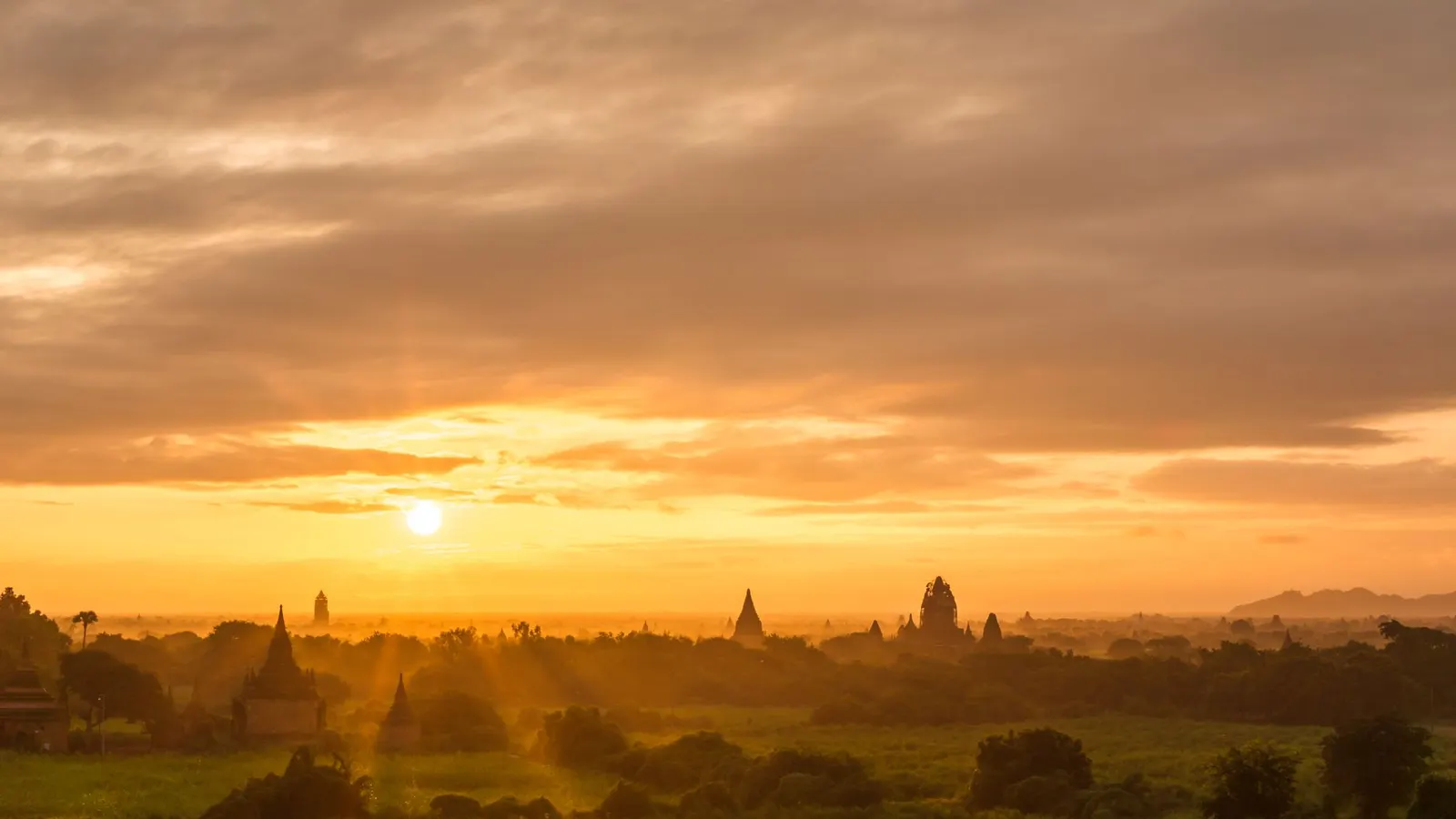
 Phat Nguy · Pexels License
Itinerary · Asia · 12 days · Challenging
The Corridor That Still Runs
Shwedagon Pagoda, Yangon→Downtown Yangon→Bago→Kyaiktiyo Pagoda→Nyaung U, Bagan→Old Bagan+6 stops
Advisory - travel not recommended · checked 26 Sept 2026
Myanmar
Foreign ministries advise against all or all-but-essential travel to Myanmar. Armed conflict affects large parts of the country, conscription applies to some residents, and overland borders open and close without notice. Standard scores are suspended while this alert is active.
Official advisory →Every advisory in force →Read the advisory first: foreign ministries advise against all or all-but-essential travel to Myanmar, the country has been at war with itself since the military seized power on 1 February 2021, air strikes have hit populated places a long way from any front line, consular assistance is limited and nobody can extract you - this route is published for the day that changes rather than as an invitation for now. It works only the central corridor that is genuinely still travelled - Yangon, Bago and the Golden Rock, Bagan, Mandalay and Inle Lake - and it stays out of Rakhine, Chin, Kachin, Kayah, Kayin and northern Shan, out of the Sagaing resistance districts, and away from every land border, because those are the places the warnings are actually about. The earthquake of 28 March 2025 is the other half of the picture: it broke Mandalay and Sagaing, and the repairs are nowhere near finished.
Yangon and Shwedagon
The only sensible way in is a flight to Yangon, and the only sensible first afternoon is the hill north of the lakes. Shwedagon stands about 99 m (325 ft) and is not one building but a platform of several hundred, added to for centuries by anyone with the means. The 1768 earthquake brought the top down and King Hsinbyushin rebuilt it to the height it has now; the hti, the crown umbrella above the bell, was replaced again in the 1870s and is hung with several thousand donated diamonds. Go barefoot, go at dusk, and walk the platform clockwise once before you look at anything in particular.
Downtown and the Circular Line
Yangon has the largest surviving stock of colonial-era commercial building in South-East Asia, most of it on the grid Lieutenant Alexander Fraser laid out from 1852, and most of it in the condition that follows sixty years of no maintenance. The Secretariat, where Aung San and six colleagues were shot on 19 July 1947, has been partially restored and opens on a limited schedule. The Circular Line loops the city in about three hours for a fare of a few hundred kyat when the full circuit is running - services have been cut back and partially restored several times since 2021, so ask at Yangon Central rather than trusting a timetable found online - and it remains the cheapest sustained look at how the place actually works. Bogyoke market for lacquer and cloth; do not photograph soldiers, police or checkpoints anywhere in the country.
Bago, then east to Kinpun
Two hours north-east on the road to the old Mon capital. Shwemawdaw is the tallest stupa in the country at roughly 114 m (374 ft), which it reached because the 1930 earthquake flattened it and the rebuild finished in 1954 went higher than the original. Ten minutes away the Shwethalyaung reclining Buddha runs 55 m (180 ft) and spent several centuries under jungle before a railway contractor uncovered it in 1880. Then four hours further east to Kinpun, the base village under the mountain, and an early night.
Kyaiktiyo
The last stretch up is a shared open truck on a road steep enough that the benches are fitted with a bar to hold. At the top, a granite boulder about 7.6 m (25 ft) high sits on the lip of a cliff under a small stupa, gilded leaf by leaf; only men may cross the barrier and apply the gold, which is a rule of the site rather than of the state. Pilgrims sleep on the terrace overnight and the hours before dawn are the reason to be there rather than the view. Down in the afternoon.
West and north to Bagan
A long transfer day and the one place the route depends on aviation. Back to Yangon by road in about five hours, then a domestic flight north to Nyaung U. Domestic schedules here are published optimistically and consolidated at short notice, so hold the whole afternoon and confirm the flight the evening before rather than the week before. Arrive in the dry zone, which gets a third of Yangon's rain and looks it, and spend what is left of the light on the Shwezigon, the gilded prototype for most of what follows.
The plain
Something over three and a half thousand stupas, temples and monasteries stand across roughly 50 square kilometres (19 sq mi) of the Irrawaddy bend, nearly all of them built between the middle of the eleventh century and the end of the thirteenth. Ananda, finished around 1105 under Kyansittha, is the one to see first and the best preserved. Thatbyinnyu is the tallest at about 66 m (217 ft); Dhammayangyi is the largest mass of brick on the plain and was never finished. Climbing the monuments has been prohibited since March 2018, so sunrise is watched from purpose-built earth mounds, which is less romantic and is the correct decision.
Mount Popa
Fifty kilometres (31 mi) south-east, a volcanic plug rises 737 m (2,417 ft) out of flat ground with a monastery on top of it and 777 steps up, shared with macaques who will take anything held loosely. Taungkalat is the principal shrine of the nats, the pre-Buddhist spirits that Anawrahta failed to abolish in the eleventh century and instead absorbed, licensing thirty-seven of them and installing their images at Shwezigon. That compromise is why nat shrines still sit beside Buddhist ones everywhere on this route.
North-east to Mandalay
Roughly 180 km (112 mi) by road through Kyaukpadaung and the palm-sugar villages, four to five hours depending on checkpoints, of which there will be several. Travel this leg in daylight and with a driver who has done it inside the last fortnight. Mandalay was founded in 1857 as a deliberate act - Mindon moved the capital here to fulfil a prophecy about the 2,400th year of the Buddhist era - and it has been the country's cultural centre ever since, which is part of why the war and then the earthquake have hit it as hard as they have.
The hill and the largest book
Kuthodaw holds 729 marble slabs, each under its own small white stupa in ruled rows, carved with the Pali Tipitaka between 1860 and 1868 so that the canon would survive whatever happened to the manuscripts - which, given what happened to Mandalay in 1945 and again in 2025, was a well-judged instinct. Mahamuni houses a bronze Buddha brought from Rakhine in 1784 and so thickly leafed by donors that its shape has gone. Mandalay Palace is a 1990s reconstruction on the footprint of the one burned out in March 1945; part of the walled square is a military compound and closed. Expect closures without notice: the 28 March 2025 earthquake damaged monasteries, pagodas and ordinary housing across the city and much of it is still shored up rather than repaired.
Amarapura, Inwa and the river
U Bein bridge crosses Taungthaman lake on about 1.2 km (0.75 mi) of teak posts, cut from the palace at Inwa after the court moved back to Amarapura in 1841 and reused rather than wasted; the bridge itself went up around 1850. Inwa was capital on and off for four centuries and was abandoned after the earthquake of 23 March 1839, which is worth standing in the ruins and thinking about. Sagaing hill and its several hundred monasteries are visible across the Irrawaddy, and on this route they stay across it: the hill sat directly over the March 2025 rupture and the old Ava bridge of 1934 came down in that quake, but the reason not to cross is the advisory rather than the damage - Sagaing Region beyond the west bank is among the districts the warnings name specifically, and army operations and air strikes there are continuous. Look at it from this side. What you are looking at is a landscape that has been knocked down and rebuilt repeatedly and is currently being knocked down faster than anyone can repair it.
South to Inle
A short flight east and up onto the Shan plateau to Heho, then forty minutes down to Nyaung Shwe at the head of the lake. The route stops here and goes no further east or north: the Shan hills beyond Taunggyi, the road to Lashio and everything towards the Chinese border are conflict ground and are not part of this itinerary. Southern Shan is not a quiet exception to that either - fighting has reached townships a couple of hours from the lake and the picture has turned over several times since 2023, so this is the leg to re-check the week you travel rather than the month you book. The Mandalay–Heho sector is thin rather than daily; hold the whole day for it. Nyaung Shwe is canals, bicycles and a market that rotates around five towns on a five-day cycle, so ask which day it is before making plans.
Inle Lake
A long-boat day. Intha fishermen row standing with one leg wrapped round the oar, which frees both hands for the conical net and lets them see over the reeds; the ones posing on a stump near the jetty are paid models, and the ones actually working are further out. The floating gardens are mats of cut weed anchored with bamboo poles and planted with tomatoes, and they are the reason the lake is silting. Take the creek up to Indein for a hillside of small stupas in various stages of collapse and re-gilding, then out to Nga Phe Kyaung and back. Fly to Yangon from Heho the following morning.
Good to know
Start with the advisory, because it is not decorative. Foreign ministries advise against all or all-but-essential travel to Myanmar. The country has been at war with itself since the military seized power on 1 February 2021: armed conflict affects large parts of it, air strikes have hit populated areas well away from any front, and UN agencies count more than three million people displaced inside the country - a figure that is an estimate and is contested at the edges, because the districts where the fighting is worst are the ones nobody can survey. Consular assistance is limited, several embassies work at reduced capacity, and no government can extract you. The People's Military Service Law, activated on 10 February 2024, conscripts Myanmar citizens - which does not apply to you but does mean the guide or driver you hire may be at risk of being taken, and is why staff turnover is what it is. Going now means travelling against your government's advice.
Insurance is the concrete consequence. An ordinary annual or single-trip policy is void in a country under an against-all-travel warning, including the medical cover, and Myanmar has no commercial medical evacuation to speak of - an evacuation means a chartered air ambulance to Bangkok. Specialist high-risk cover from a war-and-terrorism underwriter is the only real answer, it is bought through a broker rather than a website, and it costs on the order of €50 to €70 a day for a trip of this length. Budget it as a headline item, not a footnote.
Enter by air. The tourist e-visa gives 28 days, is applied for online and is normally issued in a few days; it is valid for arrival at Yangon, Mandalay and Nay Pyi Taw international airports only. Land borders with Thailand, China and India open and close at no notice and several sit in contested territory - do not build a plan around one. There are no direct flights from Europe or North America; connections run through Bangkok, Singapore, Kuala Lumpur and Chinese cities.
Money is the practical trap. Foreign Visa and Mastercard have not worked reliably since 2021 and ATMs should be assumed dead. Bring the entire trip in United States dollars, in cash: notes must be post-2006 series, crisp, unfolded and unmarked, and a pen mark or a soft crease is enough for a hotel to refuse them. There are two exchange rates - the Central Bank reference rate and the rate the market actually uses - and the gap between them has been wide for years, so changing at a bank rather than through your hotel or a licensed shop can cost you half your money. Carry small denominations for zone fees.
Those zone fees go to the state, and so does a share of the domestic airfares and the entry tickets. The national carrier is state-owned and the other domestic airlines are not, which is one of the few choices you actually get. There is no way to travel here without money reaching the administration; what you can do is keep as much as possible in private hands - locally owned guesthouses, independent guides, drivers paid directly, restaurants - and be clear with yourself about the trade rather than pretending it away.
A cybersecurity law in force since the start of 2025 penalises unauthorised use of VPNs, and phone checks at checkpoints happen. Mobile data is throttled and cut regionally without warning, so download offline maps and carry printed copies of your bookings. Township-level curfews are common and change; ask locally each evening rather than trusting a page you read a month ago. Hotels must be licensed to take foreigners and report your stay to immigration, so a private room booked informally is not the neutral choice it looks like.
Season: November to February is dry and comfortable and is the only sensible window. March to May pushes past 40 °C (104 °F) in the dry zone with Bagan at its worst, and the south-west monsoon from late May to October floods roads in the delta and around Bago. The 2025 earthquake left closures and shoring across Mandalay, Sagaing and parts of Bagan that are still being worked through, so treat any specific monument as provisional and confirm on the day.
Check your own foreign ministry the week you travel rather than the month you book. This page does not replace it.
Shorter or longer?
Take the slow boat between Bagan and Mandalay instead of the road when it is running - this route's direction is upstream, so budget a long day and a half rather than the ten hours the downstream sailing takes - and add Mingun across the river from Mandalay, where an unfinished stupa begun in 1790 was split by the 1839 earthquake and shaken again in 2025, plus two nights up at Pyin Oo Lwin on the hill. Confirm the sailing locally; the service has been intermittent since 2021.
Yangon, Bagan and Mandalay with their surroundings, flying between the three. Cuts Bago, Kyaiktiyo and Inle Lake, removes both long road transfers and every night outside a city with a functioning hospital, which is the version most people travelling under this advisory should be looking at.
Practical guide
Visa check for this route
Budget
Mid-range · per person · sharing a double room. Excludes international flights - they depend on where you fly from.
Editorial estimates · checked August 2026
Country guides
Trip essentials
The connectivity placement is our own eSIM store. No affiliate link on this list. How we choose these →