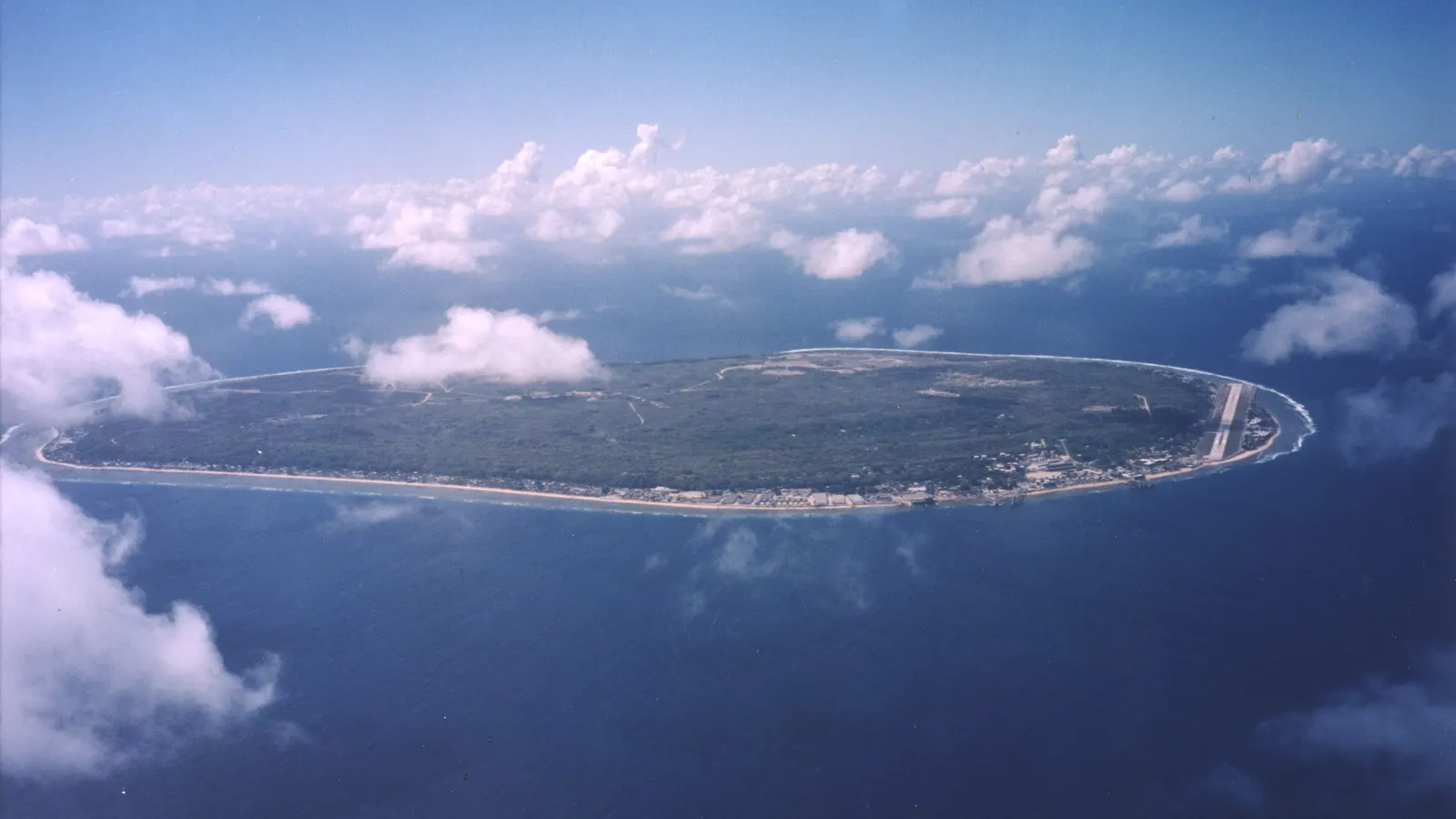
 U.S. Department of Energy's Atmospheric Radiation Measurement Program · Public domain
Country Guide № 119 / 194 · Oceania
Nauru
Twenty-one square kilometres, once the richest country per head on earth, now mined out.
“Twenty-one square kilometres, once the richest country per head on earth, now mined out.”
Nauru is 21 square kilometres, the third-smallest country in the world and the smallest republic, and in the 1970s it had among the highest GDP per capita on earth. That wealth came from phosphate - fossilised seabird guano - strip-mined for a century until roughly 80% of the island was reduced to a plateau of jagged limestone pinnacles that cannot be farmed or built on. The money was largely lost to bad investments, and the country has since depended on aid and on hosting an Australian offshore immigration processing centre.
There is no tourism industry to speak of - a handful of hotel rooms, one road around the coast, and perhaps a couple of hundred leisure visitors a year. What is there: Command Ridge with Japanese guns from the Second World War, Buada Lagoon inland, the Anibare Bay coast, and one of the more unvarnished demonstrations anywhere of what resource extraction does to a place. It is a serious and sobering visit rather than a holiday.
Chapter 01
Highlights
The Topside
The mined-out interior plateau - a landscape of coral limestone pinnacles left standing after the phosphate between them was removed. Rehabilitation efforts have made little impact on the scale of it.
Command Ridge
The island's highest point at 65 metres, with Japanese anti-aircraft guns and a communications bunker left from the wartime occupation, and a view over the whole country.
Anibare Bay
The best beach on the island on the eastern shore, with white sand and coral outcrops - though the currents and reef make swimming limited to the harbour and a few sheltered spots.
Buada Lagoon
A brackish inland lake in the only fertile depression on the island, surrounded by palms and the closest thing Nauru has to a green interior.
Chapter 02
Entry requirements for Nauru
Checking your passport…
up to 30 days · €30 / $32 · embassy application
30 days on arrival
Before you fly
The detail
- Maximum stay
- up to 30 days
- Process
- embassy application
- Fee
- €30 / $32
- Processing time
- Processing takes 14–60 days - apply with room to spare.
- Passport validity
- Most destinations want validity beyond your stay, and some want six months. Check yours against the return date.
- Onward travel
- Airlines may ask for a return or onward ticket at check-in.
- Health
- No malaria. Medical facilities are very limited and the country has among the world's highest rates of diabetes and obesity, which strains them further. Evacuation to Australia for anything serious, and insurance must cover it.
- Money
- Australian dollar. Cash only in practice - card acceptance is minimal and ATMs unreliable for foreign cards. Bring Australian dollars in cash for the whole visit.
Nauru is the one country in this part of the Pacific that a United States passport cannot simply turn up at. A visitor visa is arranged before travel, through the government rather than through a portal: the forms are obtained from and returned to the Nauruan authorities by email, so confirm the current address with the Department of Foreign Affairs and Trade before sending anything, and use nobody who offers to do it for you - an intermediary here is a fee, not a service. The application wants a confirmed booking, a return ticket and a stated purpose, and it is decided slowly; a fortnight is optimistic, two months is not unusual, and refusals are issued without explanation. Treat the fee as an approximation rather than a schedule. Book the room first and apply afterwards, which is the reverse of the usual order and is the right way round here, because the island has very few beds and an approved visa is worth nothing without one. Carry the onward ticket and the first accommodation booking in a form you can show on a phone. Across the Pacific these are asked for far more consistently than in most of the world, and they are asked for by the AIRLINE at check-in rather than by Nauru at the door - a carrier that lands somebody in a country they have no way out of owns the cost of taking them home, so the refusal comes from a check-in agent hours before anyone official has looked at your passport. There is one airline. Nauru Airlines reaches the island from Brisbane and Nadi and, on some rotations, from Tarawa, Honiara and Majuro, and a cancellation is measured in days rather than hours, so build the slack in and do not put a connecting long-haul flight the day after you are due out. Journalism has been treated as a separate and expensive category for years and the arrangements have moved more than once; anyone travelling to report on the island should establish the current position with the government directly rather than arriving on a visitor visa.
Check another destination with this passport →
Entry details: Editorial synthesis - Nauru Department of Foreign Affairs and Trade visa practice, Nauru Airlines schedule (2025–2026) · compiled 18 Sept 2026
Who needs a visa for Nauru
12 common passports| Passport | Requirement | Stay | Process |
|---|---|---|---|
| United States | Visa required | - | Embassy visit · €30 / $32 · 14–60 d |
| United Kingdom | Visa required | - | Embassy visit · €30 / $32 · 14–60 d |
| Germany | Visa required | - | Embassy visit · €30 / $32 · 14–60 d |
| India | Visa required | - | Embassy visit · €30 / $32 · 14–60 d |
| China | Visa required | - | Embassy visit · €30 / $32 · 14–60 d |
| Brazil | Visa required | - | Embassy visit · €30 / $32 · 14–60 d |
| Nigeria | Visa required | - | Embassy visit · €30 / $32 · 14–60 d |
| Indonesia | Visa required | - | Embassy visit · €30 / $32 · 14–60 d |
| Philippines | Visa required | - | Embassy visit · €30 / $32 · 14–60 d |
| Vietnam | Visa required | - | Embassy visit · €30 / $32 · 14–60 d |
| Egypt | Visa required | - | Embassy visit · €30 / $32 · 14–60 d |
| Nepal | Visa required | - | Embassy visit · €30 / $32 · 14–60 d |
Holding a passport that is not listed? The picker above answers for any of them. See where your passport takes you. Source: Passport Index, updated 14 Aug 2026.
Chapter 03
When to go
BestMay–Oct.
Dry season opens - steady trades and less humidity.
The band above each month is our editorial verdict - it weighs crowds, prices and access as well as weather. The line is average daily temperature, the bars are monthly rainfall. Select a month for the figures. Climate figures: ERA5 reanalysis via Open-Meteo, 2005–2024 normals.
Chapter 04
What it costs
A day in Nauru
Comfortable · sample day
≈ $194
Line items are real prices we track. The daily budget is an editorial estimate for this level, not their sum.
Where this sits among 244 countries we have costed
No tourist season exists. Hotel demand comes from the processing centre contractors, aid workers and officials, and pricing does not move.
Updated Aug 2026 · Editorial synthesis - reported prices and operator quotes (2025–2026) · confidence low
Excludes international flights - they depend on where you fly from.
Chapter 05
Regions to know
5Yaren and the south
The de facto capital district, the parliament, the airport and the wartime relics along the coast.
Anibare
The eastern bay, the harbour, the best beach and most of the visitor accommodation.
The Topside
The mined interior plateau of limestone pinnacles, Command Ridge and the phosphate workings.
Buada
The inland lagoon and the only fertile part of the island, ringed by palms and gardens.
The north coast
Anabar and Ewa districts, coral pinnacles at the shoreline and the quietest part of the ring road.
Chapter 06
Practical guide
Getting there
Nauru International is served by Nauru Airlines from Brisbane, Nadi and, on some rotations, Tarawa, Honiara and Majuro. There is no other way in. Schedules are thin and a cancellation means several days.
Getting around
One road circles the island in about half an hour. A few hire cars exist; hotels arrange transport. Everything is within walking or short driving distance of everything else.
Money & costs
Australian dollar. Cash only in practice - card acceptance is minimal and ATMs unreliable for foreign cards. Bring Australian dollars in cash for the whole visit.
Safety
Low crime. The hazards are the mined interior, where the pinnacle field is genuinely dangerous to walk across, and the reef and currents on most of the coast. Do not photograph government buildings or anything connected with the processing centre.
Health
No malaria. Medical facilities are very limited and the country has among the world's highest rates of diabetes and obesity, which strains them further. Evacuation to Australia for anything serious, and insurance must cover it.
SIM & internet
Digicel Nauru; a submarine cable landed in 2023 and improved things considerably. Coverage across the island, which is small enough that it is not difficult.
Chapter 07
Driving
Nineteen kilometres of coastal road and a few tracks up to the Topside. Traffic is minimal. The airport runway crosses the island beside the road and traffic stops for the twice-weekly landings.
Rules change - verify with an official source before you rent.
ExplWorld VerifiedNo verified partners here yet - all 6 country seats are open.
Become ExplWorld Verified →Chapter 08
Itineraries through this country
Chapter 09
From the Journal
Chapter 10
Before you go
NauruChapter 11
Frequently asked questions
Can I actually visit?
Yes, but you need a visa arranged in advance - there is no visa on arrival for most nationalities - and accommodation confirmed, because there are very few rooms. Nauru Airlines flies from Brisbane and Nadi a few times a week. Applications ask why you are coming, and journalists have historically had difficulty.
What about the processing centre?
Australia has operated an offshore immigration processing arrangement on Nauru since 2001, on and off, and it has been a major source of national revenue and of international criticism. It is a sensitive subject, access is restricted, and photographing anything associated with it is unwise.
How long do I need?
Two or three days covers everything - the island road is 19 kilometres and takes half an hour to drive. The flight schedule usually dictates a stay of three or four days, which is more than enough time to see the island and think about what it shows.