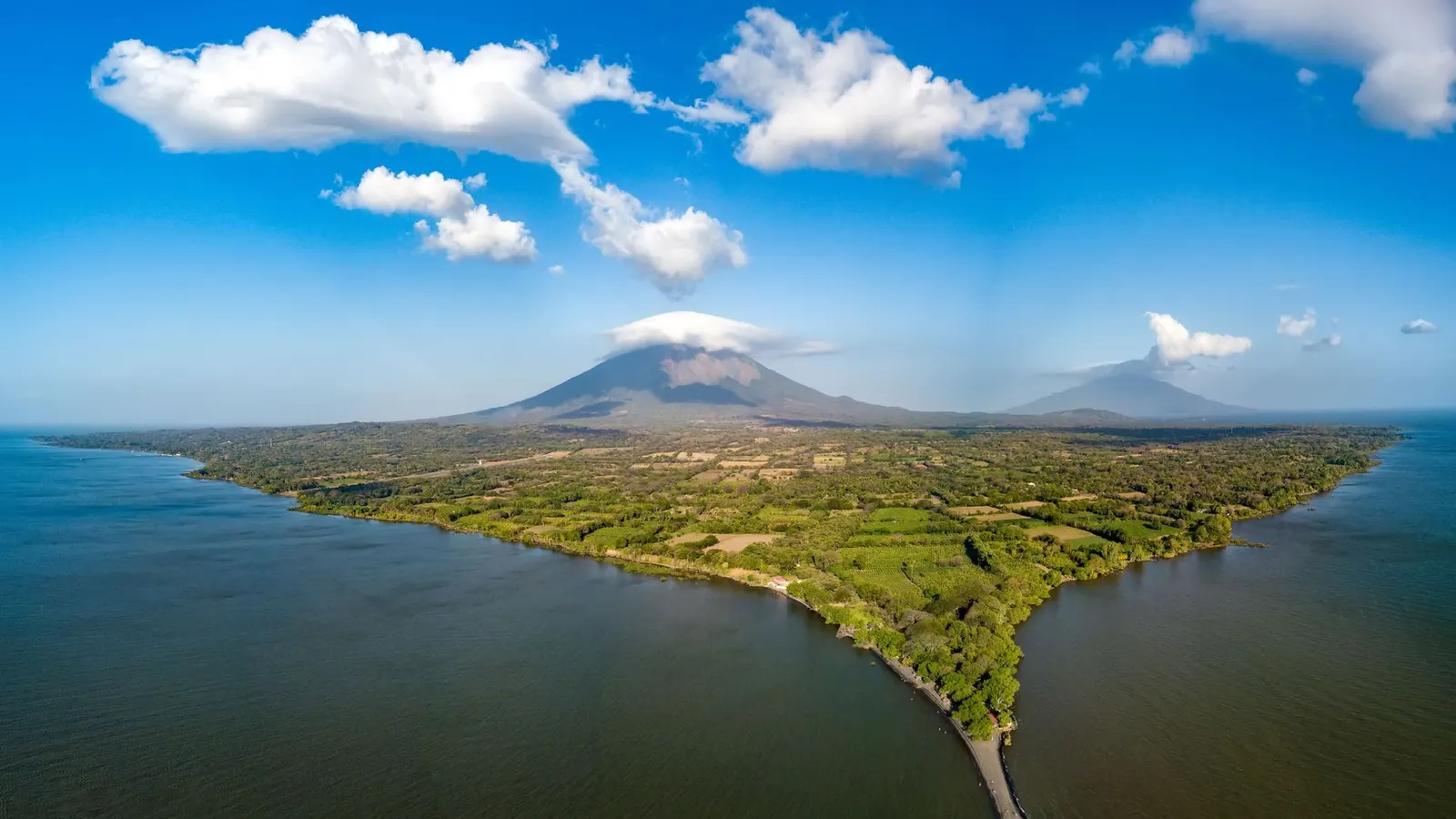
 ROBERTO ZUNIGA · Pexels License
Country Guide № 123 / 194 · Central America
Nicaragua
Volcano boarding, twin-peaked islands and the region’s lowest prices - the backpacker classic that never gentrified.
“Volcano boarding, twin-peaked islands and the region’s lowest prices - the backpacker classic that never gentrified.”
Nicaragua is the land of lakes and volcanoes taken literally: a chain of smoking cones runs the Pacific side, Ometepe’s twin peaks rise straight from Lake Nicaragua, and at Cerro Negro you can hike up an active volcano and slide down its black gravel face on a plywood board. Colonial Granada and studenty León bookend the circuit with churches, heat and rooftop sunsets.
It is the cheapest country in Central America to travel well - dorms under €10, lunches under €4 - and its tourism never recovered its pre-2018 volume, which for travellers means empty beaches at San Juan del Sur’s edges and Caribbean-clear water at the Corn Islands without a single resort chain. The political situation is authoritarian and visitors should stay clear of anything that looks like protest or reporting; tourism itself runs smoothly and locals are glad to see you.
Chapter 01
Highlights
Volcano boarding Cerro Negro
Hike 45 minutes up a bare black cone that first erupted in 1850, then slide down 500 vertical metres at up to 50 km/h. León’s signature adrenaline hit.
Isla de Ometepe
Two volcanoes joined by an isthmus in the middle of Lake Nicaragua - climb Concepción or Maderas, cycle between petroglyphs, swim at the Ojo de Agua spring.
Granada & the isletas
One of the oldest colonial cities on the American mainland, painted in ochre and coral, with 365 volcanic islets scattered in the lake behind it.
The Corn Islands
Two specks of Caribbean 70 km offshore: Little Corn has no cars at all, coral reef off the beach, and lobster dinners at backpacker prices.
Chapter 02
Entry requirements for Nicaragua
Checking your passport…
up to 90 days · €9 / $10 · visa on arrival
90 days on arrival
Before you fly
The detail
- Maximum stay
- up to 90 days
- Process
- visa on arrival
- Fee
- €9 / $10
- Passport validity
- Most destinations want validity beyond your stay, and some want six months. Check yours against the return date.
- Onward travel
- Airlines may ask for a return or onward ticket at check-in.
- Health
- No mandatory vaccinations; hepatitis A and typhoid are the standard advice, with malaria prophylaxis discussed only for extended Caribbean-coast travel. Dengue peaks in the wet season - repellent from May. Drink bottled or filtered water. The April–May heat on the Pacific plain is brutal (38 °C+) - schedule volcano hikes for dawn. Hospitals are basic; insurance with evacuation cover recommended.
- Money
- The córdoba trades around 40 to the euro and slides gently by design; US dollars are accepted almost everywhere at fair rates (change comes in córdobas). Cash dominates - cards work in better hotels and Granada restaurants, often with surcharges. ATMs (BAC is the reliable network) dispense both currencies in cities; the Corn Islands and Ometepe have few and fickle machines - carry your budget in cash there.
A US passport needs no visa, but Nicaragua is not a free border: everybody buys a tourist card on arrival for US$10, paid in cash at the desk, and the officer would much rather have a ten-dollar note than a fifty. Land crossings add a couple of dollars of municipal charges on top of it. The stay is 90 days and it is a CA-4 stay - Guatemala, El Salvador, Honduras and Nicaragua share ONE allowance, so the days you spent in Antigua or on the Honduran coast come off the same ninety, and an overstay is calculated across all four rather than against the stamp in front of you. Stepping over the Honduran border and back resets nothing; only leaving the bloc does, Costa Rica is the usual way out, and officers generally expect about 72 hours outside the four before a fresh allowance. Extensions are applied for at the Dirección General de Migración y Extranjería in Managua, not at a border post. Have an onward ticket and an address for the first night ready, keep six months of passport validity, and understand that admission is discretionary: screening has been markedly heavier since 2018 for journalists, NGO staff and travellers whose paperwork suggests either.
Check another destination with this passport →
Entry details: Editorial synthesis - Dirección General de Migración y Extranjería de Nicaragua, CA-4 Central America Border Control Agreement (2025–2026) · compiled 18 Sept 2026
Who needs a visa for Nicaragua
12 common passports| Passport | Requirement | Stay | Process |
|---|---|---|---|
| United States | Visa-free | up to 90 days | Visa on arrival · €9 / $10 |
| United Kingdom | Visa-free | up to 90 days | Visa on arrival · €9 / $10 |
| Germany | Visa-free | up to 90 days | Visa on arrival · €9 / $10 |
| India | Visa required | - | No Other passports record yet |
| China | Visa required | - | No Other passports record yet |
| Brazil | Visa-free | up to 90 days | No Other passports record yet |
| Nigeria | Visa required | - | No Other passports record yet |
| Indonesia | Visa on arrival | - | No Other passports record yet |
| Philippines | Visa on arrival | - | No Other passports record yet |
| Vietnam | Visa required | - | No Other passports record yet |
| Egypt | Visa on arrival | - | No Other passports record yet |
| Nepal | Visa required | - | No Other passports record yet |
Holding a passport that is not listed? The picker above answers for any of them. See where your passport takes you. Source: Passport Index, updated 14 Aug 2026.
Chapter 03
When to go
BestDec–Apr.
Dry, breezy and still green - the best all-round month.
The band above each month is our editorial verdict - it weighs crowds, prices and access as well as weather. The line is average daily temperature, the bars are monthly rainfall. Select a month for the figures. Climate figures: ERA5 reanalysis via Open-Meteo, 2005–2024 normals.
Chapter 04
What it costs
A day in Nicaragua
Comfortable · sample day
≈ $49
Line items are real prices we track. The daily budget is an editorial estimate for this level, not their sum.
Where this sits among 244 countries we have costed
The cheapest baseline in Central America moves least of all: dry-season (Dec–Mar) coastal rooms rise perhaps 10–20 %, with Semana Santa and the Christmas fortnight the only true spikes. Green-season (May–Oct) hostels discount readily and tours run half-empty - the best-value months anywhere in the region. Corn Islands prices sit ~30 % above the mainland year-round due to freight.
Updated Aug 2026 · Editorial synthesis - Budget Your Trip, hostel and tour operator price lists, regional backpacker cost guides (2025–2026) · confidence medium
Excludes international flights - they depend on where you fly from.
Chapter 05
Regions to know
5León & the volcano chain
The liberal, studenty rival to Granada: rooftop cathedral views, revolutionary murals and Cerro Negro volcano boarding an hour away.
Granada & Masaya
Ochre colonial streets, lake isletas, the artisan market at Masaya and a night visit to the glowing lava lake of Masaya volcano.
Isla de Ometepe
Two volcanoes in a lake - farm stays, waterfall hikes, kayaking the Istián river and the slowest travel rhythm in the country.
San Juan del Sur & the Pacific coast
The party-and-surf hub, with quieter world-class breaks (Maderas, Popoyo) strung along the coast north and south.
The Corn Islands
Caribbean Nicaragua: Creole English, coral reefs, lobster boats and Little Corn’s total absence of motor vehicles.
Chapter 06
Practical guide
Getting there
Managua (MGA) connects via Miami, Houston, Panama City (Copa) and San Salvador (Avianca) - from Europe count on two hops or one US-hub stop, 16–20 hours. Many travellers arrive overland: Ticabus and shuttles from León to El Salvador and Honduras, and the busy Peñas Blancas crossing from Costa Rica in the south. Border formalities are slow but routine - carry USD cash for the fees.
Getting around
Chicken buses fan out from every city’s market for pennies; express minivans (microbuses) halve the time for double the pennies. Shuttles link León, Granada and San Juan del Sur for €15–25. Ometepe is an hour’s ferry from San Jorge; the Corn Islands are a 90-minute La Costeña flight from Managua or a long boat-and-bus slog via Bluefields. Taxis are shared and unmetered - agree the fare before getting in.
Money & costs
The córdoba trades around 40 to the euro and slides gently by design; US dollars are accepted almost everywhere at fair rates (change comes in córdobas). Cash dominates - cards work in better hotels and Granada restaurants, often with surcharges. ATMs (BAC is the reliable network) dispense both currencies in cities; the Corn Islands and Ometepe have few and fickle machines - carry your budget in cash there.
Safety
Day-to-day, Nicaragua is calm: walk Granada or León in the evening and the atmosphere is unmistakably easy. Keep the standard rules - nothing valuable on beaches, agreed taxi fares, daylight buses - and add the political ones: no demonstrations, no drone flying, no photographing uniforms or state buildings. Pacific riptides are strong and unguarded; ask surf camps where swimming is sane.
Health
No mandatory vaccinations; hepatitis A and typhoid are the standard advice, with malaria prophylaxis discussed only for extended Caribbean-coast travel. Dengue peaks in the wet season - repellent from May. Drink bottled or filtered water. The April–May heat on the Pacific plain is brutal (38 °C+) - schedule volcano hikes for dawn. Hospitals are basic; insurance with evacuation cover recommended.
SIM & internet
Claro and Tigo cover the Pacific corridor well; a prepaid SIM with ~10 GB costs €7–9 (passport to register). Coverage thins fast toward the Caribbean - Little Corn runs on island wifi and patience. Power cuts happen; hostels with generators advertise the fact. Download offline maps before Ometepe’s far side and any boat travel.
Chapter 07
Driving
Police checkpoints are frequent and usually uneventful - documents ready, patience on. Any fine must come with an official receipt (boleta); a request for cash without one is not a fine. The Pan-American is decent; secondary roads on Ometepe and toward the Caribbean deteriorate fast - a high-clearance vehicle earns its keep.
Rules change - verify with an official source before you rent.
ExplWorld VerifiedNo verified partners here yet - all 6 country seats are open.
Become ExplWorld Verified →Chapter 08
Itineraries through this country
Chapter 09
From the Journal
Chapter 10
Before you go
NicaraguaChapter 11
Frequently asked questions
Is Nicaragua safe for travellers?
Street crime is low by regional standards - Nicaragua consistently polls among Central America’s safest for visitors, and the tourist circuit feels notably relaxed. The risks are specific: petty theft in markets and on beaches, riptides on the Pacific coast, and politics - avoid demonstrations entirely, don’t photograph police or government buildings, and keep political opinions out of public conversation. Journalists and NGO workers face scrutiny that ordinary tourists do not.
When is the best time to visit Nicaragua?
December to March: dry, breezy and green from the finished rains, before the April heat peaks near 38 °C on the Pacific plain. May to October is the green season - afternoon storms, empty hostels and the best surf swell at San Juan del Sur. The Corn Islands run a wetter Caribbean calendar; March–April is their most reliable window.
How much does a day in Nicaragua cost?
The region’s floor: about €45 ($49) per day mid-range - €18–22 for your half of a double, €10–12 for food, the rest for transport and one activity. Backpackers genuinely manage on €25 ($27). Volcano boarding (€30) and the flight or ferry to the Corn Islands are the only budget-breakers on the standard route.