 Alex Blokstra · Pexels License
Country Guide № 137 / 194 · Europe
Poland
Rebuilt cities, primeval forest and the best value in the EU.
“Rebuilt cities, primeval forest and the best value in the EU.”
Poland lost a fifth of its population and most of its urban fabric in the Second World War, and what visitors see today in Warsaw's old town and Gdańsk's waterfront is meticulous reconstruction - a decision that says as much about the country as any surviving monument would. Kraków escaped largely intact and holds the largest medieval market square in Europe.
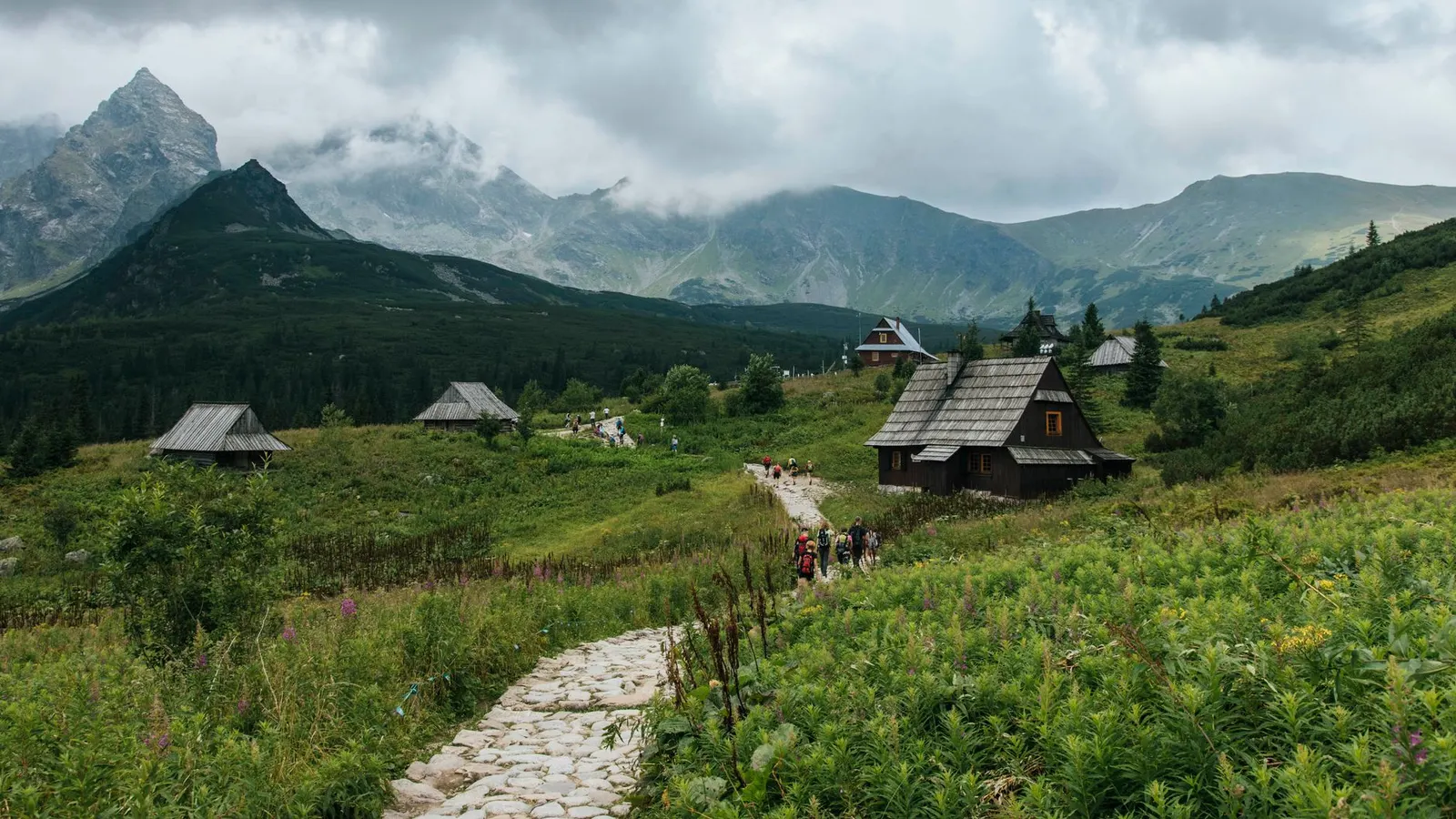
It is also, quietly, one of the more varied countries on the continent: the Tatra mountains on the Slovak border, the Masurian lakes in the northeast, a Baltic coast of dunes and amber, and Białowieża, the last substantial old-growth lowland forest in Europe with wild bison in it. Prices remain well below Western Europe despite two decades of growth, and the rail network has improved sharply.
Chapter 01
Highlights
Kraków
The largest medieval square in Europe, Wawel castle, the Kazimierz Jewish quarter and the Wieliczka salt mine outside town. Auschwitz-Birkenau is 70 km west and requires advance booking.
The Tatra mountains
Alpine terrain on the Slovak border, with Zakopane as the base, Morskie Oko lake and the Orla Perć - one of the more serious via ferrata routes in Europe.
Gdańsk and the Baltic coast
A reconstructed Hanseatic waterfront, the Solidarity museum, the Second World War museum, and the Hel peninsula's dunes and beaches beyond.
Białowieża Forest
The last large fragment of the primeval lowland forest that once covered the European plain, straddling the Belarusian border, with a free-ranging European bison population.
Chapter 02
Entry requirements for Poland
Checking your passport…
up to 90 days · free entry
90 days on arrival
Before you fly
The detail
- Maximum stay
- up to 90 days
- Fee
- free entry
- Passport validity
- Most destinations want validity beyond your stay, and some want six months. Check yours against the return date.
- Onward travel
- Airlines may ask for a return or onward ticket at check-in.
- Health
- No vaccinations required. Healthcare is good; EHIC/GHIC covers EU and UK visitors for state care, and private clinics are inexpensive and fast. Tick-borne encephalitis is present in forested areas, particularly the northeast, and vaccination is worth considering for extended outdoor stays. Tap water is safe in cities. Winter air quality in Kraków and southern Poland is genuinely poor due to coal heating.
- Money
- Złoty, not euros - Poland is in the EU but not the eurozone, and paying in euros where accepted gets a poor rate. Cards are accepted almost everywhere including small shops. ATMs are widespread; decline the machine's offer to convert to your home currency. Tipping is around 10 % in restaurants.
A United States passport enters Poland without a visa for 90 days in any rolling 180, and the allowance is the Schengen area’s rather than Poland’s - days in Berlin, Prague or Vilnius are already spent from it. Poland’s own border complications are eastern. A restricted zone has been maintained along parts of the frontier with Belarus in connection with the migration situation there, and access to some areas near it - including stretches of the Białowieża forest, which is the reason many visitors come - has been limited at times, so check before planning the eastern edge of that trip rather than at the trailhead. The land crossings into Ukraine are open and heavily used, with queues measured in hours rather than minutes; leaving Poland for Ukraine leaves the Schengen area, and coming back is a new entry counted against the same ninety days. Since 10 April 2026 the Entry/Exit System has been fully operational, so those exits and re-entries are biometric records: a facial image and fingerprints at the first crossing, no stamps afterwards, and an automatic count. ETIAS has been announced for visa-exempt visitors and was not required at the time of writing - nothing was being applied for and nothing could be paid; check when you book. Passport valid three months beyond your intended departure from the Schengen area.
Check another destination with this passport →
Entry details: Editorial synthesis - Schengen Borders Code, Polish Border Guard restricted-zone notices, EU Entry/Exit System rollout (2025–2026) · compiled 16 Sept 2026
Who needs a visa for Poland
12 common passports| Passport | Requirement | Stay | Process |
|---|---|---|---|
| United States | Visa-free | up to 90 days | No process · €0 / $0 |
| United Kingdom | Visa-free | up to 90 days | No process · €0 / $0 |
| Germany | Visa-free | - | No process · €0 / $0 |
| India | Visa required | - | No Other passports record yet |
| China | Visa required | - | No Other passports record yet |
| Brazil | Visa-free | up to 90 days | No Other passports record yet |
| Nigeria | Visa required | - | No Other passports record yet |
| Indonesia | Visa required | - | No Other passports record yet |
| Philippines | Visa required | - | No Other passports record yet |
| Vietnam | Visa required | - | No Other passports record yet |
| Egypt | Visa required | - | No Other passports record yet |
| Nepal | Visa required | - | No Other passports record yet |
Holding a passport that is not listed? The picker above answers for any of them. See where your passport takes you. Source: Passport Index, updated 14 Aug 2026.
Chapter 03
When to go
BestMay–Jun, September. AvoidJan–Feb, November.
Warm, green and long-dayed - the best month.
The band above each month is our editorial verdict - it weighs crowds, prices and access as well as weather. The line is average daily temperature, the bars are monthly rainfall. Select a month for the figures. Climate figures: ERA5 reanalysis via Open-Meteo, 2005–2024 normals.
Chapter 04
What it costs
A day in Poland
Comfortable · sample day
≈ $76
Line items are real prices we track. The daily budget is an editorial estimate for this level, not their sum.
Where this sits among 244 countries we have costed
The Baltic coast and the Masurian lakes fill and roughly double in July and August with domestic holiday demand; Zakopane peaks twice, in the winter ski season and again in summer. Kraków is busy from April to October and cheap in January and February. Rail fares are fixed and low.
Updated Aug 2026 · Editorial synthesis - PKP Intercity published fares, museum tariffs, Polish statistical office price data (2025–2026) · confidence high
Excludes international flights - they depend on where you fly from.
Chapter 05
Regions to know
5Kraków & Lesser Poland
The medieval capital, the Wieliczka salt mine, Auschwitz-Birkenau and the Ojców limestone valleys.
Warsaw & Mazovia
The rebuilt capital, the Warsaw Rising and POLIN museums, and Chopin's birthplace at Żelazowa Wola.
The Tatras & the south
Zakopane and alpine walking, the Pieniny gorge, and Wrocław's island-strewn old town further west.
The Baltic coast
Gdańsk, Sopot and Gdynia, the Hel peninsula, and the shifting dunes of Słowiński national park.
The east & Masuria
The Masurian lakes for sailing, Białowieża's primeval forest and bison, and the wooden architecture of Podlasie.
Chapter 06
Practical guide
Getting there
Warsaw (WAW), Kraków (KRK) and Gdańsk (GDN) take flights from across Europe, with Wizz Air and Ryanair serving many secondary cities cheaply. Trains link to Berlin, Prague, Vienna and Budapest. The land borders with Germany, Czechia, Slovakia and Lithuania are internal Schengen crossings.
Getting around
PKP Intercity trains between the major cities are fast, comfortable and inexpensive; book online. Regional trains and buses reach the rest. FlixBus covers intercity routes cheaply. Cities have trams and buses with ticket machines and apps. A car helps in Masuria, the Bieszczady mountains and Białowieża.
Money & costs
Złoty, not euros - Poland is in the EU but not the eurozone, and paying in euros where accepted gets a poor rate. Cards are accepted almost everywhere including small shops. ATMs are widespread; decline the machine's offer to convert to your home currency. Tipping is around 10 % in restaurants.
Safety
Safe, with pickpocketing in Kraków's old town and on Warsaw public transport the main risk. Taxi overcharging at stations has been largely solved by ride-hailing apps. Football match days can bring disorder in some cities. The Belarusian and Ukrainian border regions have restricted zones related to the migration and security situation - check before travelling to the immediate frontier.
Health
No vaccinations required. Healthcare is good; EHIC/GHIC covers EU and UK visitors for state care, and private clinics are inexpensive and fast. Tick-borne encephalitis is present in forested areas, particularly the northeast, and vaccination is worth considering for extended outdoor stays. Tap water is safe in cities. Winter air quality in Kraków and southern Poland is genuinely poor due to coal heating.
SIM & internet
EU roaming applies. Coverage is comprehensive and mobile data is fast and cheap. Free wifi is widespread.
Chapter 07
Driving
The 140 km/h motorway limit is the highest in the EU, and enforcement is heavy on the lower-limit roads that make up most of the network. Winter tyres are not legally mandatory but are strongly advised from November to March. Rural roads carry a lot of slow agricultural traffic.
Rules change - verify with an official source before you rent.
ExplWorld VerifiedNo verified partners here yet - all 6 country seats are open.
Become ExplWorld Verified →Chapter 08
Itineraries through this country
Chapter 09
From the Journal
Chapter 10
Before you go
PolandChapter 11
Frequently asked questions
How cheap is it now?
Meaningfully cheaper than Western Europe though no longer the bargain of 2005. A restaurant main runs €9–14, a beer €3, a mid-range hotel €60. Budget €70 a day comfortably and €40 as a backpacker. Kraków and Warsaw are the expensive ends; the east and the small towns are considerably less.
How should I visit Auschwitz-Birkenau?
Book a timed entry online well in advance - it is free without a guide in the early morning and late afternoon, and guided tours are compulsory in between and sell out weeks ahead. Allow at least four hours for both sites. It is a memorial and a burial ground, not a sight, and the museum publishes conduct guidance worth reading before you go.
Is the train network good?
Much better than its old reputation. PKP Intercity's express services link Warsaw, Kraków, Gdańsk and Wrocław quickly and cheaply, and the Pendolino runs Warsaw to Kraków in two and a half hours. Book online for cheaper fares. Regional services are slower and cover almost everywhere.