 Peter Engelke / stock.adobe.com
Report · Culture & Place · Poland
Younger Than the People Walking Through Them
Warsaw, Dresden and Frankfurt each rebuilt what the war removed, and each did it for a different reason with the same technique. The conservation objection, the residents’ reply, and why the newest old town is interesting about something else.
Several of Europe’s most admired historic centres are younger than the people walking through them. Warsaw’s old town was rebuilt from near-total destruction after 1945. Dresden’s Frauenkirche was reassembled from a heap of rubble in the 1990s and 2000s. Frankfurt built a new old town in the 2010s on the footprint of what the war removed. Each raises the same question, and each answered it differently.
Three different projects
Warsaw was a national reconstruction, undertaken immediately, on the argument that the destruction had been deliberate and directed at the nation itself rather than incidental to fighting - and that rebuilding was therefore an act of refusal rather than of restoration. It used surviving documentation including detailed eighteenth-century townscape paintings, and it was inscribed as World Heritage explicitly as an example of reconstruction, which is an unusual designation given that the convention generally values original fabric above all.
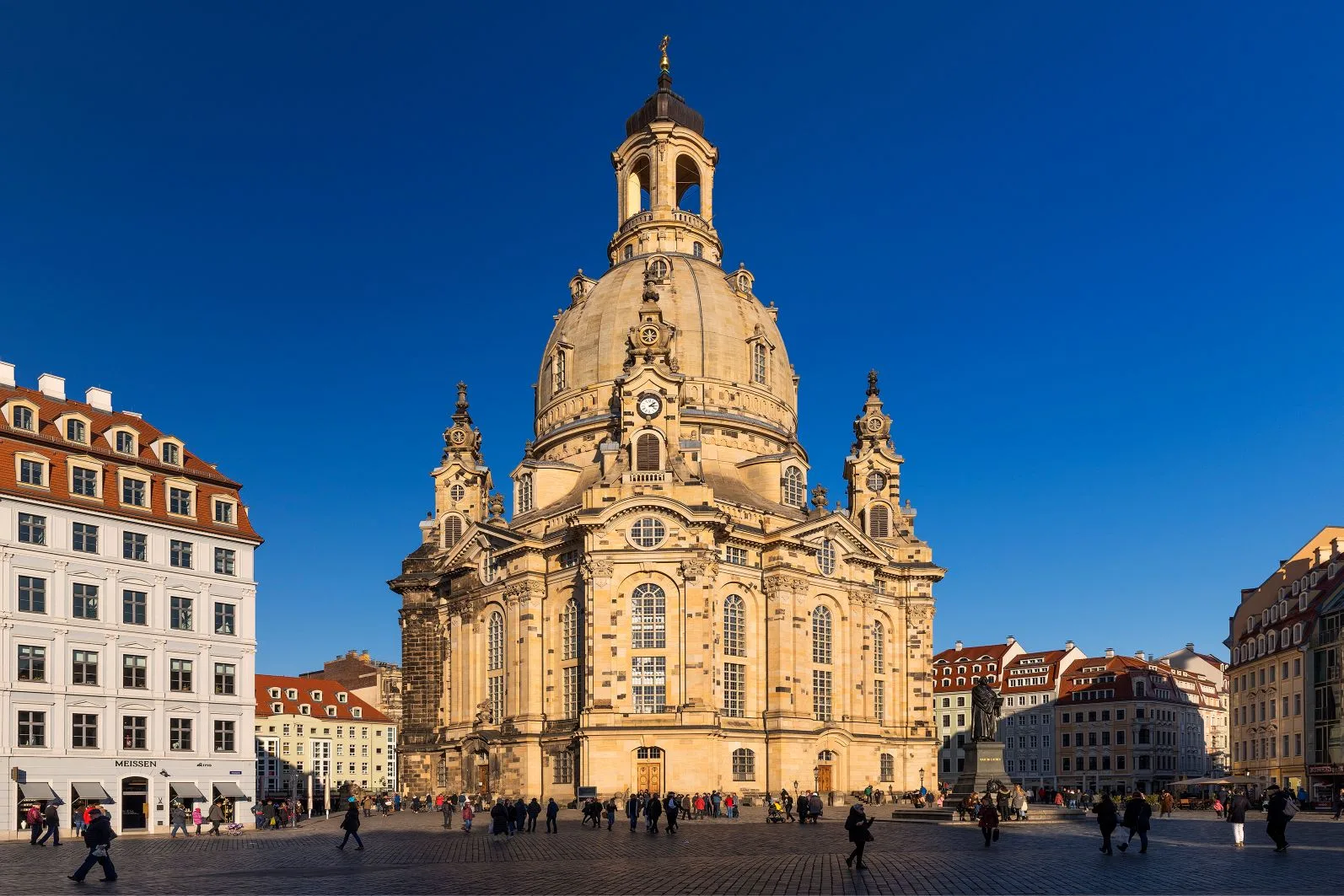
Dresden’s Frauenkirche was archaeological in method. The rubble field was surveyed and catalogued stone by stone, and thousands of original blocks were returned to their original positions, where they sit visibly darker than the new stone around them. The building is a reconstruction that shows its own history in its walls - a record of destruction and of rebuilding, legible from the square - which is why it convinces a great many people who dislike the idea in principle.
Frankfurt was different again: a small number of faithful reconstructions among a majority of new buildings in a historic idiom, built seventy years after the loss, on the site of a demolished modernist complex that the city had come to dislike. It is popular with the public and disliked by a large part of the architectural profession, and both of those facts deserve to be taken seriously rather than one being used to dismiss the other.
Warsaw rebuilt to refuse an erasure. Frankfurt rebuilt because the concrete had aged badly. The technique is the same and the arguments are not.
The objection, fairly stated
Conservation doctrine has long held that reconstruction is falsification. It creates a building that lies about its age, it removes the evidence of what happened at the site, and it substitutes a comfortable image for an uncomfortable history - a town that looks as though the twentieth century did not occur.
The strongest version of the objection is political. Reconstruction follows a mood, and choosing which period to restore a town to is choosing which history to make visible and which to leave in the ground. A rebuilt medieval core can be a way of skipping over the two centuries in between, and that skipping is sometimes precisely the point for whoever is funding it.
The reply
That a townscape is a public good rather than a document, and that a city has a right to decide what it wants to live in. Residents have generally supported these projects - Dresden’s was funded substantially by donation over the objections of those who wanted the ruin kept as a memorial, and Frankfurt’s quarter filled from the day it opened - and doctrine has real difficulty accommodating facts that inconvenient.
And the alternative to reconstruction is rarely a preserved ruin. It is whatever gets built instead, on the ordinary economics of the decade in which the decision falls, which the next generation may like considerably less. Frankfurt’s new old town replaced a building that had itself replaced the old town, and was demolished because people hated it.
How to look at one
Know which is which, which is usually easy: the mortar, the weathering, the too-regular stone, the absence of the small accumulated irregularities that four hundred years produce. Most of these places tell you themselves if you look at the ground floor.
Then look properly, because a reconstruction is a document of the moment it was rebuilt rather than of the period it depicts. It records what that city thought it had lost, what it decided was worth having back, what it could afford, and what it chose to leave out. Read that way, the newest old town in Europe is not less interesting than an untouched one. It is interesting about something else, and the something else is usually more recent and more raw.
Sources
- UNESCO World Heritage List - Historic Centre of Warsaw
The inscription documents record Warsaw’s listing explicitly as an example of reconstruction - the unusual designation the piece describes.