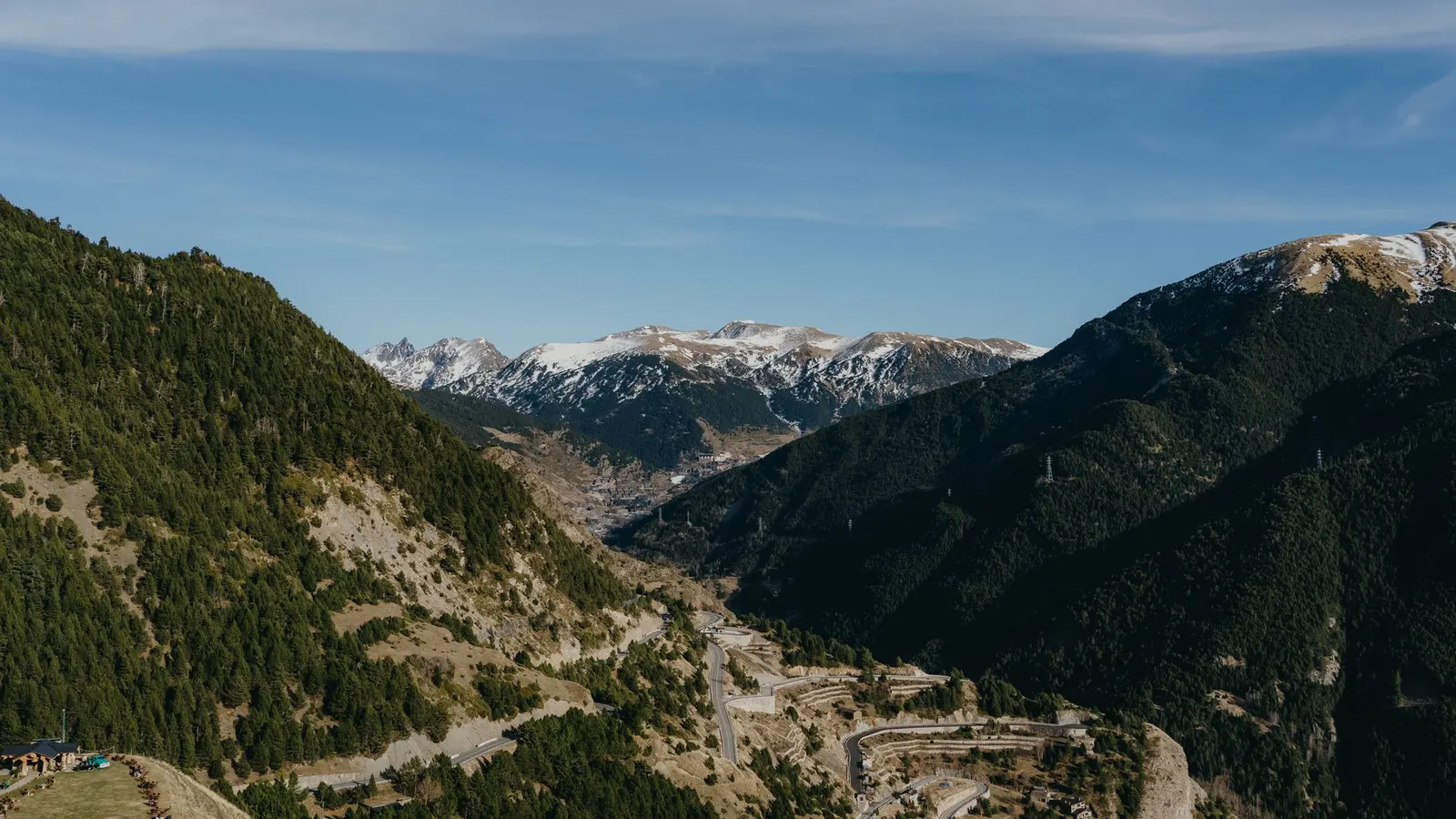
 Diogo Miranda · Pexels License
Itinerary · Europe · 6 days · Moderate
The Capital and the Roadless Valley
Andorra la Vella→Sant Julià de Lòria→Refugi de l'Illa→Estanys dels Pessons→Estanys de Tristaina, Arcalís→Estanys de Juclar
Andorra has no airport and no railway, so this route arrives on a coach from Barcelona or Toulouse and leaves the same way. Six days between 1,000 and 2,900 metres - the capital and the pre-Romanesque church below it, a two-day crossing of the UNESCO valley that covers a tenth of the country and has no road into any of it, and the northern lakes - on the national bus network and on foot, with one night in a mountain hut.
Andorra la Vella and Escaldes
The coach drops you on the valley floor at about 1,000 metres, with the country stacked up on either side. Casa de la Vall was built in 1580 as a private manor, bought by the Consell de la Terra in 1702 and used as the parliament until the Consell General moved across the road in 2011; it closed for most of 2025 for restoration and reopened that December, guided visits only. Walk the length of Meritxell avenue afterwards for the other half of the argument - three kilometres of electronics, perfume and liquor shops that exist because Andorra sits outside the EU customs union. Caldea in Escaldes is fed by a hot spring at 68°C and is where everyone in this country goes on a bad-weather day.
Santa Coloma and Sant Julià de Lòria
South down the Gran Valira on the national bus. Santa Coloma is the oldest church in the country - a pre-Romanesque nave with the only circular bell tower in Andorra - and it is mostly empty, because in 1933 the Romanesque apse paintings were cut off the wall and sold abroad. They were in Berlin until the Andorran government bought them back in 2007, and they are shown a few minutes away at Espai Columba. The Pont de la Margineda, a single medieval arch on the old Camí Ral, is the largest bridge of its kind here. Then Sant Julià and the Museu del Tabac, in the Reig factory that cured Andorran leaf from 1909 to 1957 - tobacco is still grown on terraces above the town, it is the country's main cultivated crop, and it survives on subsidy rather than on price.
Into the Madriu
The path leaves from the top of Escaldes and climbs steeply into a valley that has never had a road. Inscribed by UNESCO in 2004, the Madriu-Perafita-Claror covers 42.47 square kilometres - roughly a tenth of Andorra - and the whole of it is walked. Past Entremesaigües, where the three branches meet, then hours of glacial steps, stone shepherds' bordes and the unguarded hut at Fontverd, before the last pull to the Estany de l'Illa and the refuge beside it at 2,488 metres. About 1,400 metres of ascent from the town, and the only thing waiting at the top is the fifty places in the hut, which is why you book them.
Over the Collada dels Pessons
North out of the valley head over the Collada dels Pessons at roughly 2,810 metres, which is the highest point on the GRP - the 120-kilometre circuit of the country in seven stages, of which today is one. The descent on the far side is abrupt and drops straight into the Pessons cirque, a chain of lakes strung down towards Grau Roig with the ski infrastructure of Grandvalira sitting incongruously at the bottom of them. Out to the road, then the Pas de la Casa bus down to Encamp, where Sant Romà de les Bons stands on a rock above the town with the ruins of the fortified house beside it.
Ordino, Sorteny and the Tristaina lakes
Up the other main valley. Casa d'Areny-Plandolit in Ordino is the house of the family whose head, Guillem d'Areny-Plandolit, pushed through the Nova Reforma of 1866 that gave the vote to every head of household in Andorra - women had to wait until 1970. Beyond it the Sorteny valley is a nature park with a botanic garden of Pyrenean flora beside its refuge, and at the top of the road the Arcalís station is the trailhead for the Tristaina circuit: three lakes between 2,249 and 2,306 metres on a 4.4-kilometre loop, and the Pyrenean frontier ridge above them. This is the day the bus network stops being enough.
Meritxell and the Juclar lakes
Sant Joan de Caselles above Canillo is twelfth-century and holds a Romanesque Christ that spent centuries hidden behind a later altarpiece. Down the road at Meritxell, the sanctuary of the country's patron burned on the night of 8 September 1972, taking the Romanesque Virgin, the altarpieces and the archive with it; the replacement, designed by Ricardo Bofill, was inaugurated in 1976 and stands beside the shell of what it replaced. Then the Vall d'Incles, where private cars are turned back through the day in high season and a shuttle runs instead - about two hours on foot from the valley head to the Estanys de Juclar, the largest lake in Andorra at about 2,300 metres and twenty-one hectares.
Good to know
There is no airport and no railway, and there never has been. Coaches run from Barcelona airport in about three and a half hours, from Barcelona city and from Toulouse in about three; the nearest station is L'Hospitalet-près-l'Andorre in France, with a bus link over the pass. Andorra is not in the EU, not in Schengen and not in the customs union, though it has used the euro under a monetary agreement signed on 30 June 2011 and has minted its own euro coins since they entered circulation in January 2015. There is no immigration control on either border - but the only ways in run through France or Spain, so you have to be admissible to Schengen in your own right, and re-entering afterwards counts against the same 90-day allowance again. A trip here does not pause the clock. What does exist on the way out is customs: allowances on alcohol, tobacco, fuel and electronics are published by both neighbours, they are lower than most shoppers assume, and the Sunday-evening queues at La Farga de Moles and Pas de la Casa are customs officers rather than passport control. EU roaming rules do not apply. Andorra Telecom is the only operator, phones latch onto it from border valleys and from any ridge near the frontier, and the bills that result are the single most common complaint from visitors - turn data off at the border or buy a local SIM. EHIC and GHIC are not valid here and mountain rescue is charged, so insurance covering both, and covering walking above 2,500 metres, is not optional. The walking season runs roughly from late June to early October, and September is the best of it - stable weather, open refuges, no crowds. April, May and November are dead months in which the lifts are shut, the huts are shut and the high paths are still under snow. In the Madriu there is no road, no shop, no vehicle and no signal in the lower valley; Fontverd and Riu dels Orris are unguarded, free and first-come, while Refugi de l'Illa is guarded in summer, does half-board and has fifty places that need booking. Bivouacking high in the valley between dusk and dawn is tolerated under national rules; pitching a tent for the day is not. Livestock graze the whole valley, so treat the water. The national buses run the length of both main valleys from the station in Andorra la Vella, cheaply and often - the side valleys are the gap, and Arcalís, Sorteny and Incles are where a car or a taxi earns its cost. Parking in the capital is metered and difficult. In winter, snow tyres or chains are legally required when conditions demand and the requirement is enforced; the Port d'Envalira at 2,408 metres is the highest paved pass in the Pyrenees and closes in storms, while the toll tunnel beneath it stays open. Catalan is the only official language, and Spanish, French and Portuguese are all spoken everywhere. Fuel, drink and electronics are cheaper than in either neighbour; hotels, restaurants and lift passes are not, though summer is the low season for rooms rather than the high one.
Shorter or longer?
Two more days from Arinsal up to the Refugi de Comapedrosa and the summit at 2,942 metres, the highest ground in the country. If you have a week instead, walk the GRP itself - about 120 kilometres in seven stages, a circuit of the whole of Andorra along the frontier ridges, sleeping in the refuges. Day four of this route is already one of its stages.
The capital and Santa Coloma, a day walk into the Madriu as far as the huts at Fontverd and back down to Escaldes, and the Vall d'Incles. Keeps the World Heritage valley and the biggest lake, drops the crossing to Grau Roig, Ordino and Tristaina - and with them every night above 2,000 metres.
Practical guide
Visa check for this route
Budget
Mid-range · per person · sharing a double room. Excludes international flights - they depend on where you fly from.
Editorial estimates · checked August 2026
Country guides
Trip essentials
The connectivity placement is our own eSIM store. No affiliate link on this list. How we choose these →