 K · Pexels License
Itinerary · Asia · 14 days · Moderate
The Long Way to Angkor
Phnom Penh→Tuol Sleng, Phnom Penh→Kampong Cham→Kratie→Koh Trong→Kampong Thom+8 stops
Most people fly into Siem Reap and give Angkor two days. This goes the other way round - up the Mekong from Phnom Penh, west to the seventh-century Chenla capital, north to Preah Vihear on the Dângrêk escarpment and back down to Koh Ker, and only then into Angkor, by which point the temples read as the end of six centuries rather than the start of a holiday.
Phnom Penh
Start at the National Museum rather than the Royal Palace: it holds the pre-Angkorian sculpture from Phnom Da and Sambor Prei Kuk, which is the beginning of the story this route follows and is better than anything still standing in situ. Then the riverfront at Chaktomuk, where the Mekong meets the Tonlé Sap and the Bassac splits off - four channels, one confluence, and the reason the city is here.
S-21 and Choeung Ek
Tuol Sleng was a secondary school before the Khmer Rouge turned it into a prison in 1976; perhaps twelve to twenty thousand people passed through and a handful came out. Choeung Ek is fifteen kilometres south. Take the audio guide at both. The tribunal that tried this closed in 2022 having convicted three men in sixteen years at a cost above 300 million dollars, which is worth knowing before anyone tells you the matter is settled.
Up the Mekong to Kampong Cham
Three hours north on a good road. Wat Nokor Bachey is an eleventh-century sandstone temple with a working modern pagoda built inside it - monks, paint and plastic chairs among Angkorian lintels, which is how most Khmer temples are actually used. The bamboo bridge to Koh Paen island was rebuilt by hand every dry season and dismantled before the flood; a concrete bridge opened in 2017 and the bamboo one now goes up only in some years, so ask before crossing town for it.
Kratie and the dolphins
Another three hours upriver. The Irrawaddy dolphins live in a deep pool at Kampi, fifteen kilometres north; the last full census, in 2020, counted eighty-nine in the whole Mekong, all of them in the one stretch of river between here and the Laos border. Go at dawn or late afternoon, take a boat that cuts its engine, and cross to Koh Trong afterwards - a sand island of pomelo orchards with a Vietnamese floating village at the far end that moves with the water level.
Koh Trong and the river
A slow day on the island by bicycle - there is one loop and it takes two hours - then the dolphin pool again at dusk if the morning was poor. This is the last of the Mekong on this route; from here the trip turns west and inland and does not see a big river again.
West to Kampong Thom
The long transfer of the trip and there is no way to make it short - shared minibus back down the Mekong to Kampong Cham, west through Skun, then north. Around six hours and roughly 290 kilometres. Book a seat the day before rather than turning up; the vans leave when full in the early morning and not much after that.
Sambor Prei Kuk
Thirty kilometres north-east, and five hundred years older than Angkor Wat. This was Ishanapura, capital of Chenla under Ishanavarman I in the early seventh century, and its octagonal brick towers exist nowhere else. UNESCO listed it in 2017. The craters between the groups are from American B-52 strikes in the early 1970s and nobody has filled them in; the site is a straightforward lesson in what this country has had happen to it.
North to Preah Vihear
Four hours and about 240 kilometres up through Tbeng Meanchey to Sra Em, the base town, then the last stretch. The temple runs 800 metres along a promontory of the Dângrêk range on a north-south axis: the monumental stairway climbs from the north, on the Thai side, and the sanctuary sits at the far end above a cliff 525 metres over the Cambodian plain. So it is entered from Thailand and turns its back on the country that owns it, which is the whole of the argument. Eleventh and twelfth century, dedicated to Shiva, built by four kings.
Koh Ker
Two hours south-west, down off the escarpment on laterite and asphalt - Koh Ker is not on the Dângrêk but forty kilometres below it. Jayavarman IV moved the capital here in 928 and it lasted sixteen years, which is long enough to build a seven-tiered pyramid 36 metres high and short enough that nothing was ever added. UNESCO listed it in 2023. Much of its statuary was looted through the 1970s and 1990s and has been coming back since 2013 from American museums and private estates - the empty plinths are labelled.
Beng Mealea, then Siem Reap
Twelfth century, roughly the ground plan of Angkor Wat, and never restored - the galleries are down and you walk over them on a boardwalk. It is what every temple at Angkor looked like in 1860. Then an hour and a half into Siem Reap. Buy the Angkor pass that afternoon: after five o'clock it is dated for the next day and you are let in for the evening anyway.
Angkor Wat and Angkor Thom
Angkor Wat faces west, which is unusual and probably funerary; Suryavarman II began it around 1113 and it was never finished. Then Angkor Thom - the Bayon's face towers, the Terrace of the Elephants - built by Jayavarman VII around 1200, in sandstone cut faster and worse than Suryavarman II's masons managed two generations earlier. Ta Prohm at the end of the day, when the coach parties have gone.
Banteay Srei and the waterworks
Banteay Srei, consecrated in 967, is small, pink and carved at a level nothing else here reaches. Kbal Spean is twenty minutes further and a 1,500-metre climb to a riverbed carved with lingas so that the water ran over them before it reached the city. Come back past the West Baray - eight kilometres by two, dug by hand in the eleventh century. Angkor was a hydraulic city of perhaps three quarters of a million people, and the current reading is that the network silted, was patched, and failed.
Across the lake to Battambang
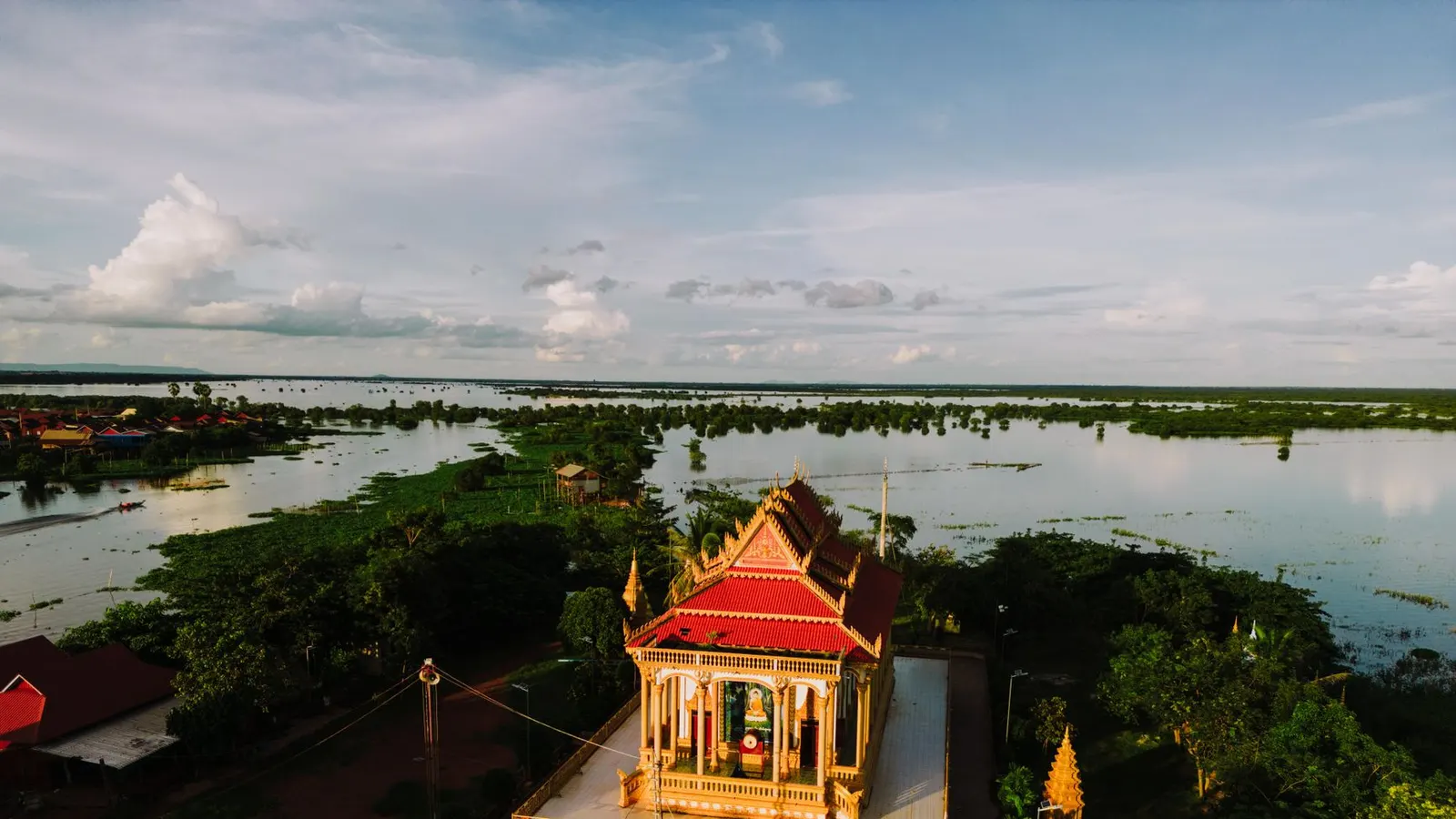
From roughly August to January there is enough water to take the boat: out across the Tonlé Sap past Chong Kneas and Kampong Phluk, then hours up the Sangkae river through villages where the bank is at eye level. It is slow, hot and uncomfortable and it is the best day on this route. When the water drops the service stops and the bus does it in three and a half hours.
Battambang, and out
The best colonial shophouse streets in the country, a morning at Phare Ponleu Selpak - a school and arts NGO founded in 1994 by young people who came out of the border refugee camps, with the circus attached to it rather than the other way round - and Phnom Sampeau at dusk for the killing caves and then the bat exodus, which takes about forty minutes to come out of the cliff. The original bamboo railway closed in 2017 when the line was rebuilt; what runs now is a purpose-built tourist track near Banan. Exit to Siem Reap in three hours, or north-west to Banteay Chhmar and the Thai border at Poipet.
Good to know
Angkor passes are sold only by Angkor Enterprise at the ticket centre on Road 60, four kilometres out of Siem Reap - not at the temples, not by your driver. One day is 37 dollars, three days 62, seven days 72; your photograph is taken on the spot, the pass is non-transferable and it is checked at every gate including Banteay Srei. The three-day pass is used on any three days within ten, and the seven-day within a month, so a rest day costs nothing; there is no two-day pass, so the three-day is what you buy even though this route spends only two days inside the park. Preah Vihear, Koh Ker and Sambor Prei Kuk are outside that pass and charge about ten dollars each at the gate; Beng Mealea and Banteay Chhmar have their own five-dollar tickets, and the barrier on the Beng Mealea road catches people who assumed the Angkor pass covered it. At Preah Vihear you cannot drive your own car up the last steep kilometres either - everyone changes at Kor Muy into a local 4x4 or moto at a fixed posted price, and that is on top of the temple ticket. No public transport links Sra Em, Koh Ker and Beng Mealea - hire a car and driver for those three days as a package, in Kampong Thom or from Siem Reap, and agree the route in writing. Preah Vihear itself is the one date-sensitive decision on this trip: the frontier there produced armed clashes from 2008 to 2011 after the temple was inscribed, and again in 2025, and the site closes at short notice, so check the day before rather than the week before. Cambodia is among the most mine-contaminated countries on earth and the worst of it is exactly where this route ends - the K5 barrier minefield laid along the Thai border in the mid-1980s runs through Banteay Meanchey and Oddar Meanchey. Temple grounds are cleared; the scrub beside them is not always, so stay on paths and take red-and-white marker signs literally. Dollars and riel both circulate, ATMs dispense dollars, and change below a dollar comes back in riel at 4,000 to the dollar. Since 2020 the National Bank has been pushing small dollar notes out of circulation in favour of riel, so ones, twos and fives are scarcer than they were and a torn or scribbled note will be refused. Roads to Koh Ker and along the Dângrêk are part laterite and slow badly after heavy rain in September and October.
Shorter or longer?
Add four or five days from Kratie: south-east through Snuol to Sen Monorom for the Bunong villages and the elephant projects that let you walk with the animals rather than ride them. Roughly five hours each way and a genuinely different landscape - red earth and pine, not rice.
Fly into Siem Reap, take three days on the pass, add Beng Mealea and two nights in Battambang. Keeps the temples and the boat, cuts the Mekong, the northern run and every long road day on this route.
Practical guide
Visa check for this route
Budget
Mid-range · per person · sharing a double room. Excludes international flights - they depend on where you fly from.
Editorial estimates · checked August 2026
Country guides
Trip essentials
The connectivity placement is our own eSIM store. No affiliate link on this list. How we choose these →