Itinerary · Europe · 13 days · Easy
Both Sides of the Line
Larnaca→Pano Lefkara→Nicosia→Selimiye Mosque, North Nicosia→St Hilarion Castle→Bellapais Abbey+7 stops
One island, two administrations, thirteen days and one hire car. Nicosia crossed on foot at Ledra Street and again by road at Metehan, the Kyrenia range, Salamis and Famagusta, the emptied Karpas, then back south for Kourion, the painted churches of the Troodos and the turtle beaches of the Akamas.
Larnaca
Arrive, collect the car, and do nothing ambitious. Agios Lazaros was built in the late ninth century over the tomb of Lazarus after the emperor Leo VI took the relics to Constantinople and paid for a church in exchange. Out at the salt lake, Hala Sultan Tekke stands over the grave of Umm Haram, who died here during an Arab raid in the 640s. Flamingos are on the lake from November to March; by June it is a white pan of dry salt.
Choirokoitia and Lefkara
Choirokoitia is a Neolithic village of round stone houses occupied from roughly the seventh millennium BC, listed by UNESCO in 1998, with five reconstructions at the gate that make the plan legible. Then up into the foothills to Pano Lefkara for lefkaritika needlework, on UNESCO's intangible heritage list since 2009. The story that Leonardo bought an altar cloth here in 1481 is a local tradition with nothing behind it, and the women who still sew will tell you so themselves. Carry on to Nicosia in the evening.
Nicosia, the southern half
The Venetian walls went up between 1567 and 1570: eleven bastions on a perfect circle, thrown around a city deliberately made smaller than the one they replaced. The engineers pulled down something like 1,800 houses, eighty churches and chapels and the royal palace itself, partly for the stone and partly to clear a field of fire, and diverted the Pedieos river out of the town to fill the moat. The Ottomans arrived as the work finished and took the place in about seven weeks. The Cyprus Museum holds the island from the Neolithic to Rome and is the one indoor thing worth a full morning. Walk down Ledra Street to where it used to stop.
Nicosia, the northern half
The Ledra Street crossing opened on 3 April 2008; you show a passport at two booths thirty metres apart and the walk takes five minutes. Büyük Han is an Ottoman caravanserai of 1572 that the British used as the city prison. Selimiye Mosque is the cathedral of Saint Sophia, consecrated in 1326 and given minarets after 1570 - French Gothic with the pews taken out and the floor turned towards Mecca. The Ledra Street booths run around the clock, so there is no need to hurry back.
North by road, and St Hilarion
Take the car through the Agios Dometios–Metehan crossing, where you buy Turkish Cypriot third-party motor insurance at a booth before the barrier. Then up the Kyrenia range to St Hilarion, a Byzantine watchpost the Lusignans turned into a summer castle, stacked in three wards up to about 730 metres. The army holds ground on either side of the road; obey the signs about photography, which are not decorative.
Kyrenia and Bellapais
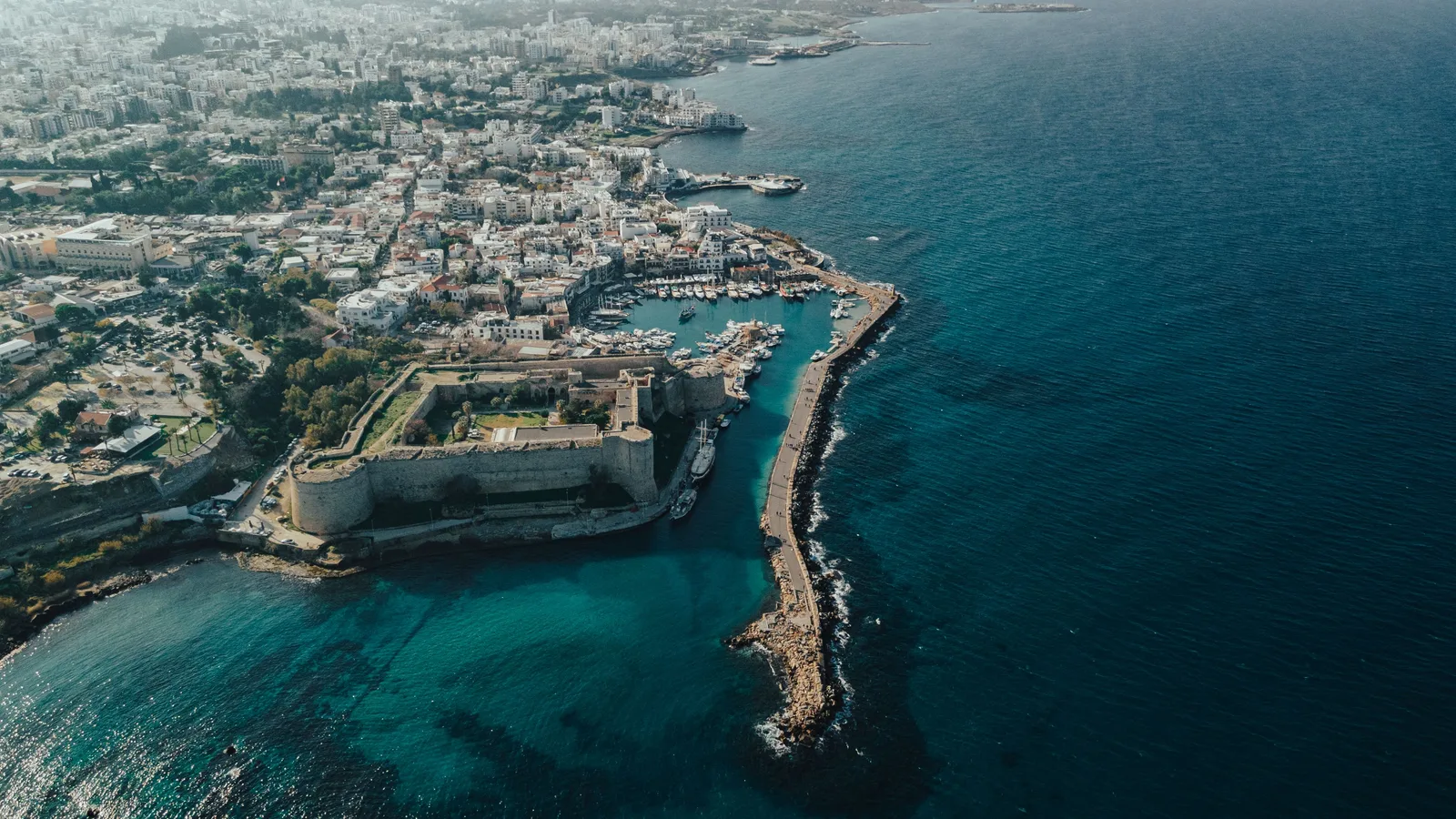
The castle is a Venetian refit of a Byzantine fort, and inside it is the Kyrenia ship: a Greek merchant hull that went down with four hundred amphorae and a cargo of millstones, found by a local diver, Andreas Cariolou, in 1965 and lifted in 1968 and 1969. It was dated to about 300 BC for half a century; a 2024 recalibration of the radiocarbon curve for those decades moved the sinking to the 280s or 270s BC, and not every caption has caught up. In the afternoon climb to Bellapais, founded by Augustinian canons out of Jerusalem and run from 1206 by the White Canons, who built the Gothic refectory over the plain under Hugh IV. Lawrence Durrell lived in the village from 1953 to 1956 and wrote Bitter Lemons there.
Salamis and Famagusta
Salamis was the island's principal city for a thousand years - a gymnasium with its colonnade re-erected, a theatre that seated something like fifteen thousand, and latrines built for forty-four people at once. Earthquakes wrecked it in the fourth century AD and the Arab raids of the 640s finished it. Twenty minutes south, inside Famagusta's walls, the Gothic cathedral of St Nicholas is now the Lala Mustafa Pasha Mosque: the Ottomans took it in 1571 after an eleven-month siege and flayed the Venetian commander in the square outside.
The Karpas
The long finger north-east, two hours each way on an empty road. Apostolos Andreas at the tip was falling down until a restoration ran from 2014 to 2016, paid for largely by the Church of Cyprus and the Evkaf and managed through the bicommunal Technical Committee on Cultural Heritage - one of the very few things both sides have started and finished together. Golden Beach is sand and nothing else. Several hundred feral donkeys live out here and will put their heads through an open car window; do not feed them from your hand.
Back south at Deryneia
The Deryneia crossing opened in November 2018 and put ten minutes between Famagusta and the south for the first time since 1974. On the southern side the cultural centre at Deryneia keeps the viewing platform from which displaced families looked at Varosha through binoculars for forty-six years; parts of that fenced quarter were opened to visitors in October 2020, a move the UN Security Council criticised, and plenty of Cypriots regard going in as taking a side. Finish at Cape Greco, a limestone headland held as national forest park, which is where the hotel strip stops dead: low sea caves cut at the waterline, juniper on the cliff top, and a path along the edge of it.
Kourion and Limassol
West along the coast. Kourion sits on a bluff with a Greco-Roman theatre still used for performances and the House of Eustolios below it, whose fifth-century mosaic floor carries an inscription in Greek. The earthquake of 21 July 365 flattened the town, and one excavated house holds the people it fell on. Kolossi, ten minutes on, is a Hospitaller keep of 1454 on the estate that gave Commandaria its name. Note the fence west of Limassol: Akrotiri is British sovereign territory, retained under the 1960 treaty along with Dhekelia.
Into the Troodos
The painted churches were listed in 1985 and extended to ten in 2001. Agios Nikolaos tis Stegis above Kakopetria has the barn roof that gives the group its look - a steep second roof thrown over a small Byzantine shell to keep the snow off the frescoes. Panagia tou Araka at Lagoudera is the other one to prioritise. Some are locked and a neighbour or the priest in the village below holds the key; ask at the coffee shop. Chionistra, the summit, is 1,952 metres and carries five lifts over four short runs, open from about January to the end of March.
Kykkos and down to Paphos
Kykkos was founded around 1100 under Alexios I Komnenos and is the richest monastery on the island; the icon it is built around has been kept covered for centuries. Makarios III was a novice here and is buried at Throni, three kilometres up. Then west through the Cedar Valley, which holds Cedrus brevifolia and nothing else like it, and down through the Paphos forest, where the last few thousand Cyprus mouflon live. The whole massif is a slab of ocean floor pushed onto land, which is why there was copper here from the third millennium BC and why the metal is named after the island rather than the other way round.
Paphos and the Akamas
The mosaics at Kato Paphos came up in 1962 under a farmer's plough; the House of Dionysos is the one everybody photographs and the House of Aion is the one worth standing in front of. The Tombs of the Kings up the road are Hellenistic rock-cut chambers with peristyle courtyards and no kings in them. In the afternoon drive the Akamas to Lara, where loggerheads and greens have nested through a conservation programme running since 1978 - the track is dirt, rough and steep in places, most hire agreements exclude it, and the beach has restrictions in nesting season that are enforced.
Good to know
Enter the island through Larnaca or Paphos airport, or through Limassol port. The Republic of Cyprus treats arrival at Ercan airport or the northern seaports as illegal entry, and although in practice that mostly bites when you then try to cross south, it is not worth testing on a first visit. Crossing the line itself is routine: show a passport at each booth, no fee, no stamp in most cases. Hours differ by crossing - Ledra Street on foot and the Agios Dometios–Metehan vehicle crossing run twenty-four hours, while Deryneia, which this route uses to come back south, opens at seven in the morning and shuts at eleven at night. Every crossing was closed outright for most of 2020 and 2021, so treat published hours as current rather than permanent. Hire cars are the real friction - some southern companies allow the north and some void the policy outright, so ask before you book, and either way you buy separate Turkish Cypriot third-party insurance at the crossing booth for a small fee covering a few days. Cars hired in the north generally may not come south at all. Driving is on the left in both parts, a British legacy, and the road signage changes language but not side. The euro is the currency in the south and the Turkish lira in the north, where euros are widely taken and cards are the sensible answer given how fast lira prices move. Regulation 866/2004 limits what goods you may carry back across the line, so buy your souvenirs where you intend to keep them. Summer inland is severe: Nicosia passes 40 °C routinely in July and August and is among the hottest capitals in Europe, which is why this route reads best in April, May, September or October. Military areas on both sides are marked and photography near them is genuinely prohibited, particularly around St Hilarion and along the buffer zone. In the Troodos, several of the listed churches are kept locked and opened by a keyholder in the village - go before four in the afternoon and expect to knock on a door. On the Akamas, the Lara track is unsurfaced and needs clearance rather than four-wheel drive in dry weather; the beach closes to vehicles and to night visitors during the turtle nesting season, roughly June to September, and the restrictions are policed by the conservation station rather than by nobody. Cyprus is in the EU but still outside the Schengen area: the Commission adopted a positive assessment of its readiness in July 2026 and the Council has not yet voted on it, so nothing has changed at the airport. That cuts two ways for now - Cyprus admits holders of a valid double or multiple-entry Schengen visa without a separate Cypriot one, and the days you spend here do not count against a Schengen 90-in-180 allowance. Both of those stop being true on the day it joins, so check the position when you book rather than assuming it from an older guide.
Shorter or longer?
Add the Marathasa and Solea valleys - Kalopanayiotis, the rest of the ten listed churches, and the Artemis and Atalante trails looping the summit ridge. It turns a driving route into a walking one and is the best use of three extra days on the island.
Larnaca, both halves of Nicosia on foot, the Troodos and Paphos. Keeps the division, the frescoes and the mosaics; cuts the northern coast, Famagusta and the Karpas, and removes the need to take a hire car over the line at all.
Practical guide
Visa check for this route
Budget
Mid-range · per person · sharing a double room. Excludes international flights - they depend on where you fly from.
Editorial estimates · checked August 2026
Country guides
Trip essentials
The connectivity placement is our own eSIM store. No affiliate link on this list. How we choose these →