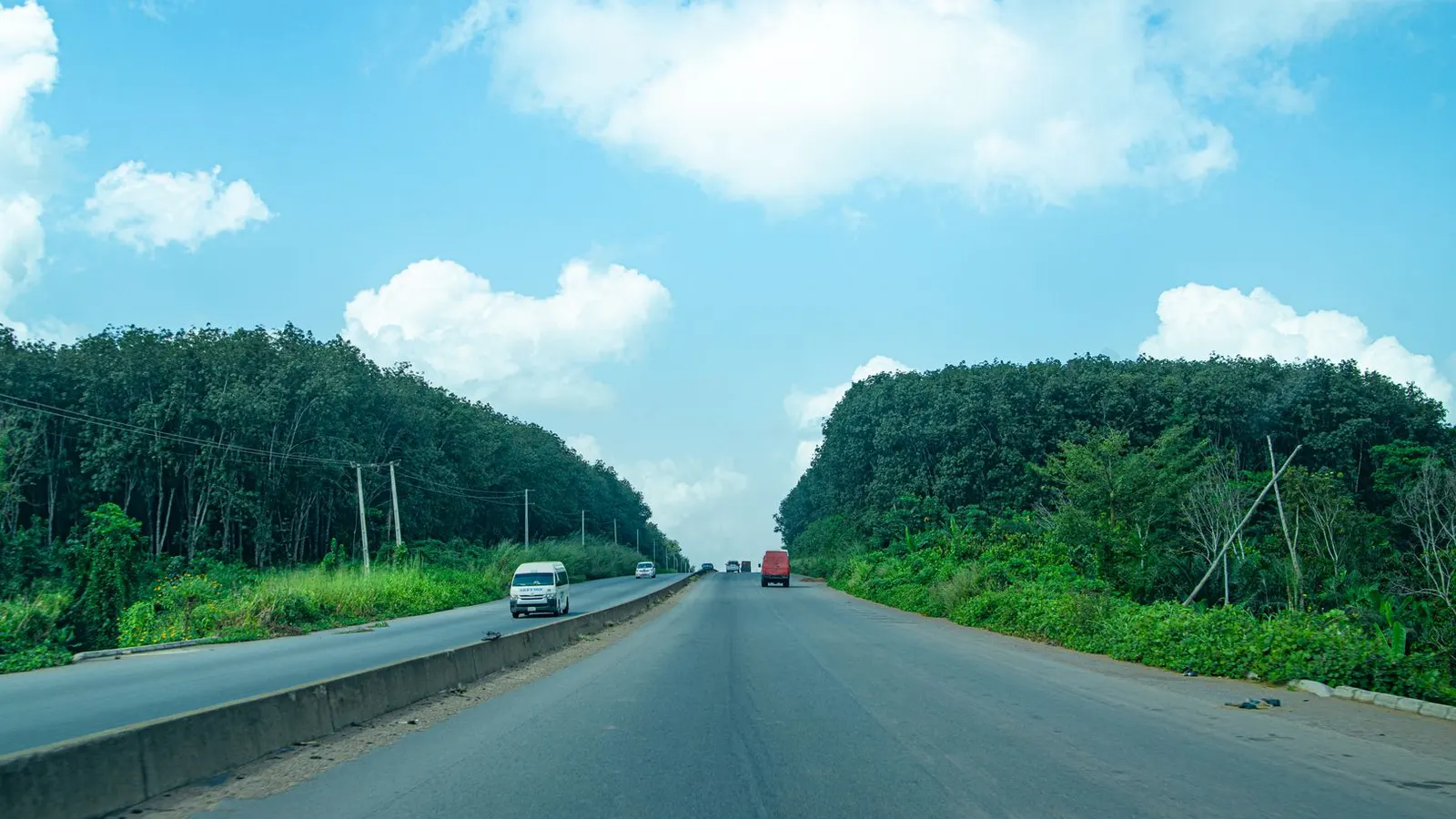
 David Iloba · Pexels License
Itinerary · Africa · 12 days · Moderate
The South-West by Road
Isale Eko, Lagos Island→Kalakuta Republic Museum, Ikeja→Badagry→Olumo Rock, Abeokuta→Cocoa House, Dugbe, Ibadan→Osun-Osogbo Sacred Grove+6 stops
Nigeria is enormous and most of it is under a travel advisory. What is left is the Yoruba south-west - Lagos, Ogun, Oyo, Osun, Ondo and Ekiti, plus Kwara, which speaks Yoruba but is counted north - and twelve days is enough to drive it properly: the Lagos Island markets, the slave port at Badagry, the last sacred grove of its kind, the town where the Ife heads were cast, a hill settlement abandoned in 1923, and the emirate city where the Sokoto Caliphate stopped moving south.
Lagos Island
Arrive at Murtala Muhammed, buy a SIM at an official branded shop before you leave the terminal, and give the day to Isale Eko - the original town, on the island, before any of the rest of this existed. Freedom Park on Broad Street was the colonial Broad Street Prison; it was cleared and reopened as a public park and arts venue in 2010 for the fiftieth anniversary of independence, and the cell blocks are still legible in the layout. Round the corner at Onikan, the National Museum Lagos holds a good share of the Ife brasses and terracottas, a Nok head, and the bullet-holed Mercedes in which Murtala Muhammed was assassinated in 1976. See the Ife work here as well as at Ife: the heads dug up in 1938 were divided, and no single building has them all. Then Tinubu Square, the water-front, and Jankara market for cloth and beads. The fixed constraint on Lagos is not distance. Nothing on the island is far and everything takes an hour.
Ikeja, Kalakuta and the markets
Over to the mainland. The Kalakuta Republic Museum on Gbemisola Street in Ikeja is Fela Kuti's last house, opened as a museum in 2012 with his rooms left largely as they were. The first Kalakuta, in Mushin, was burned down by soldiers in February 1977; his mother, Funmilayo Ransome-Kuti - who had organised the Abeokuta women's tax revolt thirty years earlier - was thrown from an upstairs window during the raid and died of her injuries the following year. The New Afrika Shrine ten minutes away is run by his children and has live music most nights. In the afternoon, Idumota or Alaba International Market, which is where the video film trade was financed and where a good deal of it still is.
Badagry
Sixty kilometres west along the lagoon, and two to three hours of it, because the expressway is the expressway. Badagry was one of the main embarkation ports on this coast; Britain bombarded Lagos in 1851, annexed it in 1861 and took Badagry in 1863. The Heritage Museum occupies the old District Officer's building. The Mobee family keeps a room of iron shackles that its own ancestors used as dealers, which is not an arrangement most countries would permit and is the more honest for it. The house on the Marina, dated 1845, is claimed as the first two-storey building in the country and is where Samuel Ajayi Crowther - himself taken off a slave ship as a boy, later the first African Anglican bishop - worked on the Yoruba Bible. A boat crosses to Gberefu and a walk over the sand reaches the Point of No Return.
Abeokuta
North through Ilaro. Abeokuta means under the rock, and the rock is Olumo - a granite outcrop the Egba sheltered in and behind during the Yoruba wars of the 1830s, with a stairway, a lift and a priestess at the shrine partway up. Below it Itoku market sells adire: indigo resist-dyed cloth, patterned with cassava-paste stencils or raffia tying, with the dye pits behind the stalls and the women who work them willing to show you the process for a fee. This is also Funmilayo Ransome-Kuti's town. The Abeokuta Women's Union she led against a flat tax on market traders forced the Alake to abdicate in January 1949. He was back on the throne inside two years, which is the part usually left out; but the tax on women went and did not come back, and women took seats on the council that had levied it, which is more than most colonial-era protest movements in Africa came away with.
Ibadan
Eighty kilometres and about two hours. Ibadan was a war camp before it was a city - settled in the 1820s and 1830s by fighters and refugees from the collapse of the Oyo empire, and it grew into one of the largest cities in West Africa without ever acquiring a king in the ordinary Yoruba sense; its rulers rose by military rank instead, and still do. Mapo Hall, opened in 1929, sits on the hill above the whole rust-coloured roofscape. Cocoa House at Dugbe was completed in 1965 at twenty-six storeys, paid for out of the Western Region's cocoa earnings and the first tower of its kind in tropical Africa; it burned in 1985 and was rebuilt. The University of Ibadan opened in 1948 as the country's first, and its campus is worth an hour.
Osogbo and the grove
A hundred kilometres north-east through Gbongan. The sacred grove runs along the Osun river below the town - some seventy-five hectares of high forest, and the last one left intact, because every Yoruba town once had one outside it and almost all were cleared for farmland or for churches. UNESCO inscribed it in 2005. Much of what stands in it now is the work of Susanne Wenger, an Austrian artist who arrived in the 1950s, became an Osun priestess and spent fifty years rebuilding the shrines in cement and mud with Nigerian sculptors - the New Sacred Art movement, and the reason the grove survived at all. Take a guide from the gate. The shrines are in use, not on display. Osogbo is also where Ibadan's army stopped Ilorin's advance around 1840, which is why the country you have been driving through is not part of the Sokoto Caliphate.
Erin-Ijesha, and back for the looms
Fifty-five kilometres east through Ilesa to the Olumirin waterfall at Erin-Ijesha, which comes down in seven distinct steps. The first is five minutes from the car park and the top is an hour or more of wet scrambling on rock, with a village at the summit and no handrail anywhere. Do not attempt the upper steps after rain. Back in Osogbo for the afternoon at the Nike Centre for Art and Culture, where Nike Davies-Okundaye has taught adire, weaving and painting free of charge to anyone who turns up and stays long enough to learn.
Ile-Ife
Sixty kilometres south. Yoruba tradition holds that creation began here and that every Yoruba crown descends from the one at Ife; the Ooni still reigns and the palace is in the middle of the town. The National Museum on Enuwa square holds terracottas and brasses of its own, though not the whole famous set - the heads turned up at Wunmonije Compound in 1938 were split, and the best known of them are now in Lagos and London. What is here still makes the point: modelled from life, cast by the lost-wax method, and the technical equal of anything being cast in Europe at the same date. When Leo Frobenius excavated here in 1910 he announced that they must be the work of a lost Greek colony, because the alternative was not available to him, and it took European scholarship most of the following century to withdraw the idea. Opa Oranmiyan, a granite shaft five and a half metres high studded with iron nails, stands where it has always stood.
East to Idanre
Through Akure, the Ondo state capital, then twenty-five kilometres south-west into a bowl of granite domes. Idanre is a new town by local standards - barely a century in its present position - and the point of arriving in the afternoon is to look at it from below before you climb above it. Sort the guide out this evening rather than at the foot of the steps in the morning, and drink more water than you think you need; the humidity here is the thing that catches people, not the gradient.
Oke Idanre, then the springs
Six hundred and sixty steps with five rest points built into them, and an unhurried hour to the top. Old Idanre was lived in for something like eight centuries and was abandoned in 1923, when the community moved down to the plain for water and road access; what is left is the Owa's palace, the court where cases were heard, a colonial-era schoolhouse, a burial ground and a very long view. It has been on Nigeria's UNESCO tentative list since 2007. Down by midday and north-west into Ekiti, to Ikogosi, where a warm spring and a cold spring run down opposite sides of a wooded valley and meet in one stream - you can put a hand in each within a single step, which is the whole attraction. The resort built around it belongs to Ekiti State, has changed operator and closed for refurbishment more than once, so telephone ahead and confirm it is open before you commit the night to it.
Esie, and north into Kwara
The long day, and the only one on this route that feels like a drive: west through Efon-Alaaye and Ilesa, past Osogbo, then north through Ikirun and Offa into Kwara - roughly two hundred and forty-five kilometres in total. Esie is a village off the Offa road with the oldest museum in Nigeria, opened in 1945 and built to hold the largest collection of soapstone figures in Africa, about a thousand of them, found sitting in the bush by the people who founded the village. They did not make them, they have never claimed to, and nobody has since established who did. Then Ilorin, which is a Yoruba-speaking city ruled by an emir: Afonja's revolt against Oyo brought Fulani clerics into the city in the 1810s, and by about 1830 Ilorin was the southernmost emirate of the Sokoto Caliphate. Old Oyo was abandoned within the decade.
Ilorin, and the flight back
The morning in Ilorin: the Emir's palace gate, the central mosque, and Dada Pottery at Okelele, where the women build pots by hand without a wheel and fire them in an open pit, as their households have done for generations. Then the flight. Air Peace and Overland both run Ilorin–Lagos in about an hour; the road is three hundred kilometres through Ogbomoso and Ibadan and takes six, which is a poor way to spend a departure day. Domestic flights here are delayed more often than not, so if the international connection is tight, fly the day before and sleep near the Lagos airport rather than gambling on it.
Good to know
Start with the map, because this route is drawn around it. Large parts of Nigeria are under standing foreign-office warnings: the north-east - Borno, Yobe, Adamawa - for the insurgency; a broad northern belt including Zamfara, Katsina, Kaduna, Sokoto and Niger for kidnapping for ransom, which is an organised commercial industry there rather than an occasional risk; Plateau, Benue and Taraba for communal violence; and Rivers, Bayelsa and the riverine delta for armed robbery and kidnapping. This itinerary stays inside Lagos, Ogun, Oyo, Osun, Ondo, Ekiti and Kwara, which are generally outside both the "all travel" and "all but essential travel" bands, and it is built that way on purpose. Three live caveats even so. Banditry has been reported in northern Kwara, in Baruten and Kaiama towards the Benin border, so keep to the Offa–Ilorin side of the state. Nothing here drives to Abuja, because the roads between the south-west and the capital cross Kogi and Niger states and both carry warnings - if you want Abuja, fly. And a state sitting outside the warning bands does not mean its highways are quiet: kidnapping for ransom off interstate roads has reached the south-west, the forested stretches of Ondo and Ekiti and the Ilesa–Akure and Ekiti–Kwara roads most of all, which is days nine to eleven of this route. That is not a reason to cancel them. It is a reason to run those legs in the middle of the day rather than at either end of it, and to ask the driver on the morning rather than assume last week's answer still holds. Read your own government's advice the week you travel rather than the month you book. Visas changed recently and comprehensively: Nigeria discontinued visa on arrival and moved to an electronic visa applied for through the Nigeria Immigration Service portal, with decisions quoted in around forty-eight hours, and separately introduced a mandatory electronic arrival and departure card that you complete online before you fly. The tourist category asks for a return ticket, confirmed accommodation and, depending on nationality, a letter of invitation from a Nigerian host or hotel. Because the rules moved twice inside two years, confirm the current position with a Nigerian mission rather than with a forum thread. A yellow fever certificate is required of every arrival from nine months old, must have been issued at least ten days before you land, and is genuinely inspected at Lagos before you reach immigration; since 2016 it is valid for life and no country may demand a booster. Malaria is the medical question that actually matters. Transmission is year-round and countrywide, falciparum, and nowhere in the south-west is high enough to give you an altitude break from it, so take prophylaxis for the whole trip and keep taking it after you leave. Self-drive is not realistic and you should not try it. Hire a car with a driver - somewhere around €70 to €100 a day all in, which is the largest single line in the budget and the best-spent one. A driver knows the potholes, the diversions, which checkpoints want paperwork and which want conversation, and how long the Lagos–Badagry expressway is going to take today, which is not a question a map can answer. Do not drive at night anywhere on this route: unlit vehicles, no hard shoulder, livestock and no street lighting make it the single largest risk on the trip. Police, army and road safety checkpoints are frequent and routine; keep passport, visa and vehicle papers where you can reach them, stay polite, and let the driver do the talking. Do not photograph airports, bridges, military installations, government buildings or police officers - this is enforced, and being right about the law is not much help at the roadside. Ask before photographing people; Badagry and the Osogbo grove both charge a camera fee, and it is small. Money is naira, and the rate has moved a very long way since the currency was floated in June 2023 and devalued again in early 2024, so treat every euro figure here as an estimate rather than a price. Card acceptance is decent in Lagos hotels and thin upcountry; ATM limits per withdrawal are low; carry cash for markets, guides, gates and the grove, and expect everything else to run on bank transfers and POS agents. A local SIM needs NIN registration, which for a visitor means a passport at an official MTN, Airtel or Glo shop rather than a table on the street. The south-west has two rain peaks and a real gap between them: main rains from about April to July, the August break - a short dry spell that the whole region plans around - and a second peak in September and October, with the dry season from November to March and the harmattan blowing Saharan dust south from December to February, giving cool nights and flat hazy light. Both climbs on this route, Erin-Ijesha and the Idanre steps, are dangerous on wet rock. The Osun-Osogbo festival falls in August and is the largest event on this route by a distance; if you want it, book Osogbo months ahead and expect the town to be full and the prices to double for that week. Site fees are small - the two Lagos museums, Badagry, the grove, Olumo, Esie and Idanre together cost a fraction of a single day in an East African national park - but bring the notes in small denominations. Power is intermittent everywhere and hotels run generators, sometimes not all night, so carry a power bank. English is official and universal here; Yoruba is what you will hear.
Shorter or longer?
Fly Lagos–Abuja and back rather than driving, because the roads between cross Kogi and Niger states. Abuja was created by decree in 1976 and formally replaced Lagos as capital on 12 December 1991; the central area was laid out by Kenzo Tange's office, and the National Mosque and the National Christian Centre face each other across the main axis by design rather than by accident. Add three days, and treat it as a separate trip that happens to be in the same country.
Lagos, Badagry, Abeokuta, Ibadan, Osogbo and Ile-Ife, then back to Lagos. Keeps the markets, the slave coast, the grove and the Ife heads; cuts Ondo, Ekiti and Kwara, which is also most of the driving and the only long transfer day.
Practical guide
Visa check for this route
Budget
Mid-range · per person · sharing a double room. Excludes international flights - they depend on where you fly from.
Editorial estimates · checked August 2026
Country guides
Trip essentials
The connectivity placement is our own eSIM store. No affiliate link on this list. How we choose these →