 João Saplak · Pexels License
Itinerary · South America · 12 days · Moderate
The Chaco and the Paraná
Asunción→Museo del Barro, Asunción→Filadelfia→Loma Plata→Fortín Boquerón→Areguá+6 stops
The thorn country first, while you can still stand the heat, then the whole length of the south - Asunción, the Mennonite colonies and the battlefield that started the Chaco War, a Franciscan church built by Guaraní carvers, the iron foundry the Triple Alliance came to destroy, both binational dams, and the Jesuit reductions at the far end.
Asunción
One of the oldest cities in South America and one of the least visited, low-rise and slow and hot. The Panteón de los Héroes, the Casa de la Independencia, and the Estación Central - a railway station kept as a museum with the locomotives still standing on the rails, because the line stopped running and nobody removed them. Walk down to the Costanera in the evening. The shanty district of the Chacarita drops from the government quarter to the river bank below it, floods when the Paraguay river rises, and is not a place to wander into; the corniche above it is ordinary and busy.
The Museo del Barro, and the market
The Museo del Barro is the best museum in the country by a wide margin and almost nobody outside Paraguay has heard of it: Guaraní ceramics, mission-era santos, and a contemporary collection hung deliberately alongside them rather than in a separate wing. Then Mercado 4, which is where Asunción actually shops - herbs sold by the bundle for tereré, the cold yerba mate infusion that the entire country carries around in a thermos and a guampa. Buy the kit here; you will use it every day of this trip.
North-west on the Transchaco
Ruta 9 leaves Asunción, crosses the river and does not bend for four hundred and fifty kilometres. The Chaco is flat thorn scrub, cattle and palm savanna at the eastern end drying to hard brush further out, with almost nothing between the fuel stop at Pozo Colorado and the colonies. Six to seven hours on tarmac. Leave at first light: the heat here is the reason this leg goes at the start of the trip and not the end.
Filadelfia and Loma Plata
Menno colony was settled in 1927 by Mennonites arriving from Canada, Fernheim in 1930 by refugees from the Soviet Union, and Neuland in 1947 by more of the same. They were given land in a place the Paraguayan state could not otherwise occupy, and they built the co-operatives that now supply a large share of the country's dairy. Plautdietsch is still the language of the shop counter; Spanish and Guaraní are what the Enlhet and Nivaclé workers who do most of the labour speak, and the relationship between the two is the local argument. The Jakob Unger natural history museum in Filadelfia and the Loma Plata colony museum both explain the settlement from the settlers' side, honestly enough to be worth an hour each.
Fortín Boquerón and the salt lagoons
South-west to the fort. Bolivian troops took the outpost at the end of July 1932; the Paraguayan army under Estigarribia besieged it from 9 to 29 September, and the surviving garrison - something over four hundred men - surrendered on the day the water ran out. The trenches are still cut into the ground and there is a small museum. Water, not ammunition, decided this battle, and over the three years that followed thirst and disease killed as many men in the Chaco as the fighting did. In the afternoon the lagoons east of Loma Plata - Laguna Capitán and Campo María - hold flamingo on the salt in the right season, and the birding is genuinely good. Doing both halves in one day is three hundred kilometres of ripio, the fort one way and the lagoons the other, so start at first light or drop one of them. Take a local guide and a lot of water; tracks off the main roads turn to grease after rain and there is no phone signal to speak of.
Back down the road, and Areguá
The same four hundred and fifty kilometres in reverse, which is the honest price of the Chaco. Arrive in the early afternoon and carry on thirty kilometres east to Areguá on Lake Ypacaraí - a cobbled hill town of ceramic workshops that has been the capital's summer escape for a century. The lake itself has had serious cyanobacteria blooms and swimming in it is a bad idea most years; the town is the point, not the water.
Yaguarón, and the foundry at Ybycuí
South on Ruta 1 to Yaguarón, where the Franciscans and their Guaraní carvers built the Templo San Buenaventura between 1755 and 1772. It is one of very few mission churches in the country still standing as built: a plain shell, and inside it a gilded polychrome interior with pigments ground from local plants and Guaraní faces worked into the capitals. Then south-east to Ybycuí National Park, where Carlos Antonio López began Paraguay's first ironworks in 1850; La Rosada was in production from 1854 and made much of the artillery the country fought the Triple Alliance with. Brazilian troops destroyed it in 1869 and the ruins are still in the trees beside a stream, with a museum next to them. The park has waterfalls and one of the last patches of Atlantic forest left in Paraguay.
Misiones: San Ignacio, Santa María, Ayolas
Back to Ruta 1 and south into Misiones. San Ignacio Guasú was the first Jesuit reduction in what is now Paraguay, founded in 1609, and its museum holds Guaraní baroque woodcarving - saints cut by mission craftsmen, with faces that are not European. Santa María de Fe, fifteen kilometres off the road, has a better collection in a quieter room around a grass plaza. Then back onto Ruta 1 as far as Santa Rosa, where the Ayolas road turns off south for Ayolas on the Paraná - a company town built for a dam.
Yacyretá, then east to Encarnación
The other binational dam, shared with Argentina under a treaty signed in December 1973 - the same year as Itaipú, and the opposite experience. Civil works began in 1983, the first turbine turned in 1994 and the twentieth in 1998 - but the reservoir sat seven metres below its design level for another thirteen years while the resettlement was fought out, so the plant produced a fraction of what had been promised until it finally filled to 83 metres in February 2011. The visitor centre runs tours and the scale of the thing is easier to grasp here than at Itaipú because you can see both ends of it. Then east: San Cosme y Damián, the reduction where the Jesuits built an astronomical observatory, reconstructed instruments and all, and on to Encarnación on the Paraná.
Trinidad and Jesús de Tavarangue
Twenty-eight kilometres north of Encarnación and the reason most people who come to Paraguay come at all. Trinidad has a carved stone pulpit, a frieze of angels playing instruments, and a church shell you can walk the whole length of. Jesús de Tavarangue, twelve kilometres further, was still being built when the Jesuits were expelled from the Spanish empire in 1767 and was never finished - which is why its trefoil Moorish doorways stand in a roofless nave with nothing around them. One ticket covers both plus San Cosme and is valid for three days. Stay for the sound-and-light show at Trinidad after dark.
North on Ruta 6
Two hundred and ninety kilometres up the eastern edge of the country through the soy country - first Hohenau and Obligado, German-speaking colonies founded in 1900 and 1912, then Bella Vista and its yerba mate plantations, then hours of soybean to the horizon. This is the frontier of Brazilian-owned agribusiness in Paraguay and the land conflict that goes with it, and you drive through the middle of it. Arrive at Ciudad del Este in the afternoon.
Itaipú and Saltos del Monday
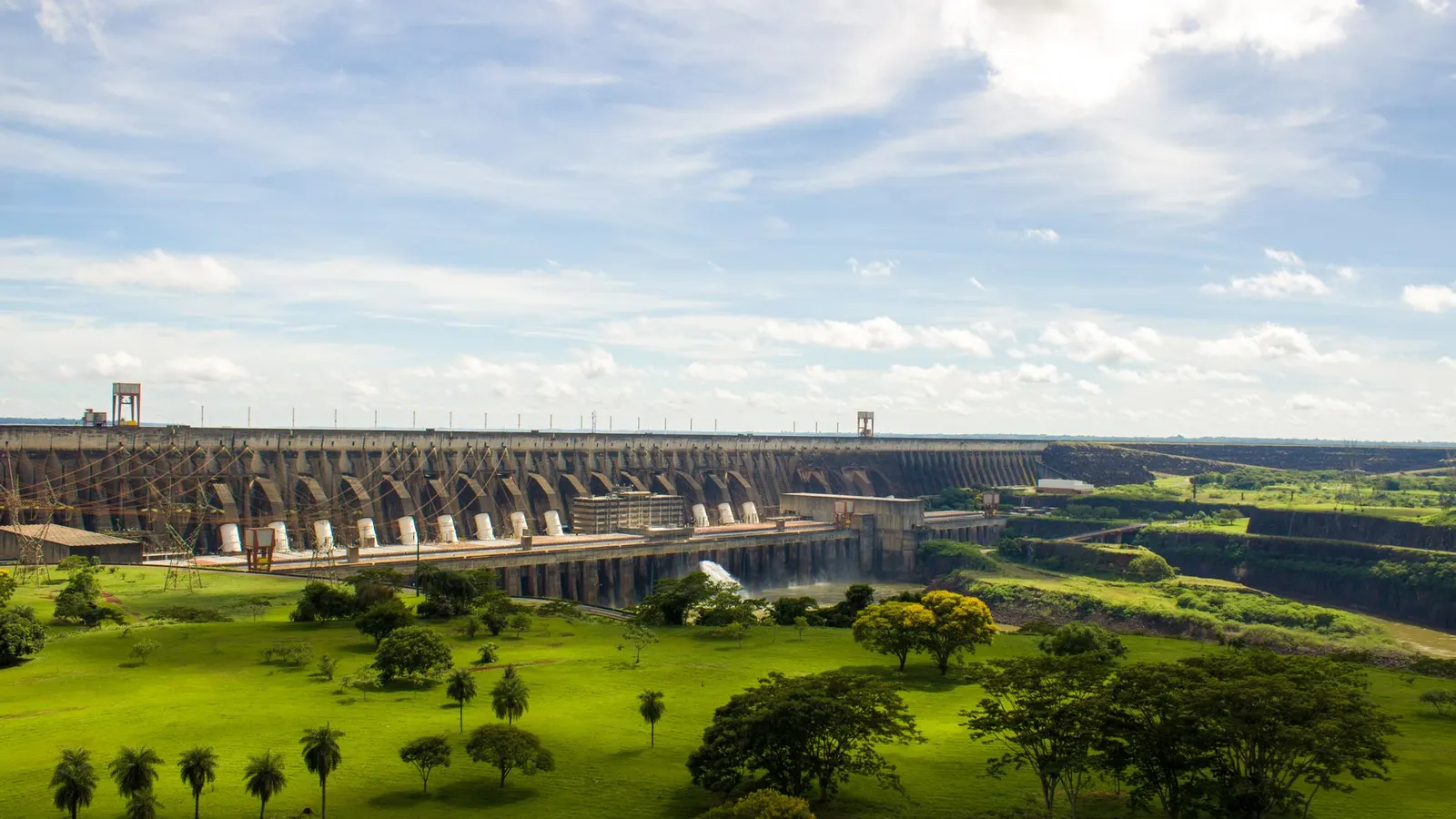
The visitor centre on the Paraguayan side is at Hernandarias, twelve kilometres north of Ciudad del Este, and the panoramic tour has traditionally been free - book it, because the slots go. Fourteen thousand megawatts, twenty turbines, half of them turning at 50 Hz for Paraguay and half at 60 Hz for Brazil because the two countries never agreed on a frequency. Afterwards, Saltos del Monday south of the city: forty metres over a horseshoe, a fraction of the size of Iguazú half an hour away and almost empty because of it. Ciudad del Este's commercial centre around the Friendship Bridge is one of the largest informal trading hubs anywhere, chaotic by day and not a place to be on foot after dark.
Good to know
Entry is easy: European, British, Australian and most Latin American passports need no visa, and United States citizens travel under a visa waiver that Paraguay has renewed by decree in fixed blocks since 2019 rather than made permanent - check the current expiry before booking, because it is the one that keeps changing. Ninety days on arrival, extendable once at the immigration directorate in Asunción, and six months' passport validity. Yellow fever is the requirement people miss: anyone aged one or over arriving from a country with risk of transmission - Bolivia, Brazil, Peru and Colombia among them - must show the certificate, which catches anyone reaching Paraguay overland from Bolivia or across the bridge from Foz do Iguaçu. Parts of Paraguay itself count as risk areas, so expect to be asked for it again on the way out. The vaccine needs ten days to take effect and since 2016 the certificate is valid for life. Dengue is endemic and has recurring outbreaks in the hot months; chikungunya circulates too, and repellent in the evenings matters more here than a mosquito net. Heat is the real planning constraint. October to March regularly passes 40°C and the Chaco goes higher; May to September is the sensible window, and even then the Chaco leg is written into this route at the start so you meet it before the trip has worn you down. Water: Asunción's supply is treated but the distribution network is old and intermittent, and almost nobody drinks it unfiltered - bottled or filtered everywhere, and carry far more of it than you think into the Chaco. Money is the guaraní, cash still matters outside the cities, and cards are fine in Asunción, Encarnación and Ciudad del Este and unreliable in Ybycuí or a colony shop; there are ATMs in Filadelfia but plan not to depend on one. Guaraní is spoken by most of the country alongside Spanish and is not a heritage language here - it is what the conversation switches into. English is thin outside hotel desks. On driving: self-drive is genuinely realistic, the Transchaco and Rutas 1, 2, 6 and 7 are paved, and a high-clearance vehicle matters for the ripio tracks off them, which turn to grease within minutes of rain. Do not drive at night anywhere on this route - unlit lorries, loose cattle and unmarked roadworks are the standing risk. The northern departments of Concepción, San Pedro and Amambay carry warnings in most foreign-office advice over the EPP insurgency and cross-border crime, which is one reason this route stays south and west of them. Ciudad del Este is fine in daylight in the commercial grid and worth leaving before dark. Book the Itaipú tour ahead through the Paraguayan visitor centre at Hernandarias; the missions ticket is bought at Trinidad, covers three sites and runs three days; Trinidad's evening show does not run every night, so ring first. Finally the tereré: iced yerba mate, shared from one guampa passed round a circle, drunk from mid-morning onwards by everyone. Accepting it is how conversations start.
Shorter or longer?
Two or three more days from Ciudad del Este: cross the Friendship Bridge to Foz do Iguaçu for the Brazilian side of the falls, then over the Tancredo Neves bridge to Puerto Iguazú for the Argentine trails, which need a full day on their own. Check the yellow fever certificate rule before you go - it applies in both directions.
Asunción, Yaguarón and Ybycuí, the Misiones museums, the reductions at Trinidad and Jesús, and out via Ciudad del Este. Cuts the Chaco entirely, which removes the two longest driving days, the heat problem and most of the vehicle cost - and it is the right call if you are travelling between November and March.
Practical guide
Visa check for this route
Budget
Mid-range · per person · sharing a double room. Excludes international flights - they depend on where you fly from.
Editorial estimates · checked August 2026
Country guides
Trip essentials
The connectivity placement is our own eSIM store. No affiliate link on this list. How we choose these →