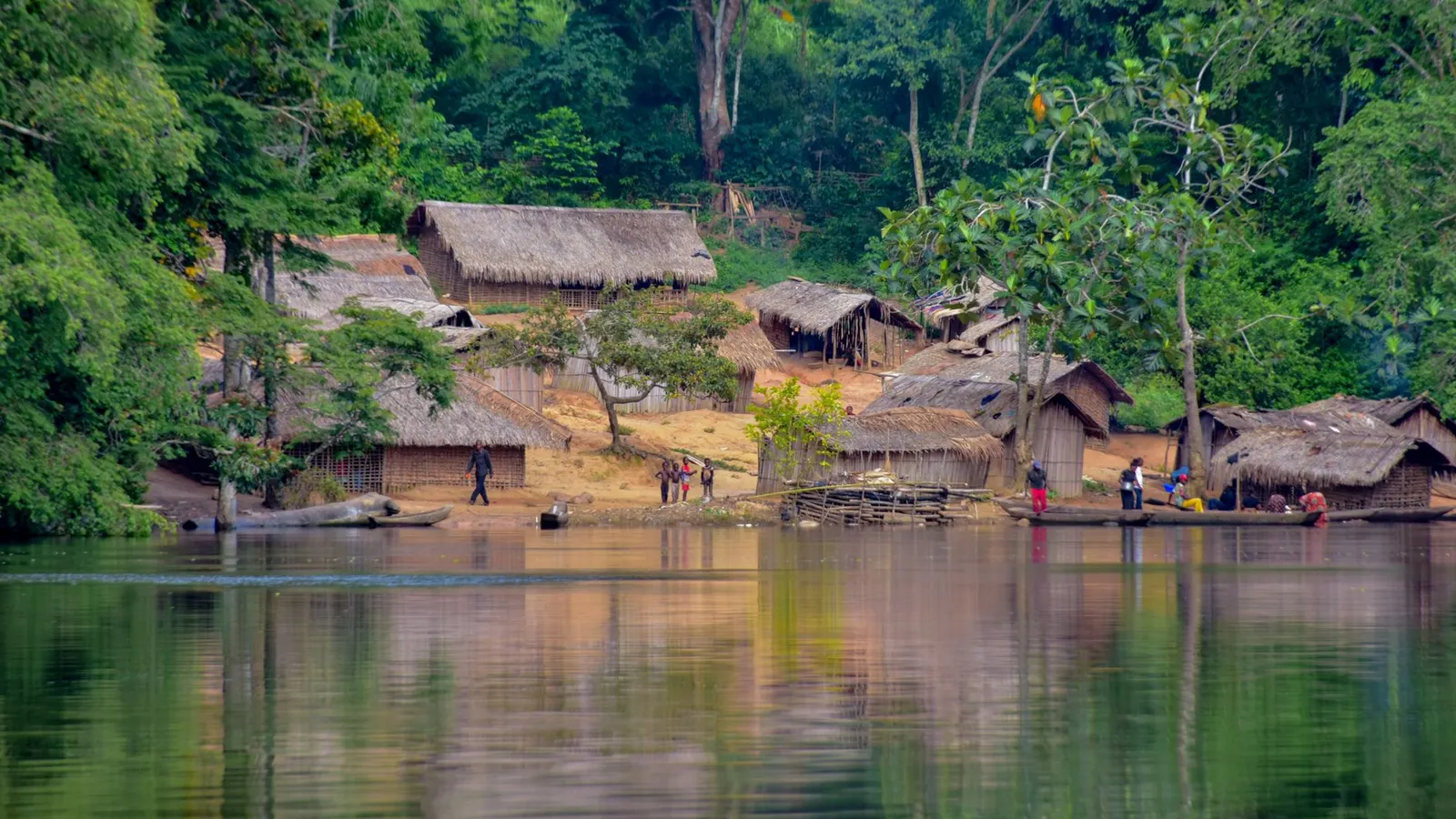
 Hervé Kashama · Pexels License
Itinerary · Africa · 14 days · Challenging
The River, the Rail and the Bais
Brazzaville→Les Rapides, Brazzaville→Lésio-Louna Gorilla Reserve→Brazzaville→Dolisie→Diosso+8 stops
Two capitals staring at each other across the Congo, then the railway built because the river stops being navigable a few kilometres downstream - 510 km through the Mayombe to the Atlantic. Chimpanzees released onto lagoon islands at Conkouati, and finally the charter north to Odzala-Kokoua, where you wade into a swamp clearing to stand among forest elephants and track lowland gorillas through forest you cannot see ten metres into.
Brazzaville
Land at Maya-Maya and give the first afternoon to the two things within walking distance of each other. The Basilique Sainte-Anne du Congo is a parabolic concrete frame under green ceramic tiles, designed by Roger Erell and finished in 1949 - its spire was wrecked in the fighting of 1997 and rebuilt afterwards, and the interior is the single best room in the country. Ten minutes away, Poto-Poto holds the painting school Pierre Lods founded in 1951, whose graduates defined what most people outside Africa think Congolese painting looks like. Then the corniche, and Kinshasa on the far bank. Read the photography note before you lift a camera anywhere near the water.
The rapids, and why the railway exists
Drive downstream to Les Rapides, where the Congo - navigable for 1,700 km upstream of here - falls off the edge of the Batéké plateau into the first of the cataracts of Livingstone Falls. Thirty-two of them run the next 350 km to Matadi, and no boat has ever got past them. That single fact built Brazzaville, built Kinshasa, and built the railway you will ride tomorrow. Afterwards the Mausolée Pierre Savorgnan de Brazza, white marble, opened in 2006 to hold the remains of the explorer the city is named after and still argued about here on grounds of both cost and subject. Bacongo on a Sunday for the sapeurs, who dress in Yamamoto and Cerruti on Congolese wages and treat it as a discipline rather than a joke.
North to Lésio-Louna
Out on the RN2 across the Batéké plateau - grassland and gallery forest, not what people expect of Congo - then off the tarmac on a track to Iboubikro on the Louna river. The reserve exists for a gorilla reintroduction project run with the Aspinall Foundation, which has been taking in orphaned western lowland gorillas since the late 1980s, raising them and releasing them here. Some live on forested islands in the river, which is how you see them: from a pirogue, at distance, with no possibility of contact. It is a rehabilitation site rather than a wild population and it says so.
Back down to the river
A second morning on the water and in the gallery forest - a different stretch of the Louna, the other islands, and the birds along the bank, which are the reason a good number of people come here at all - then the track and the RN2 back to Brazzaville by mid-afternoon. Use the rest of the day for the practical things: cash out of an ATM while you are still somewhere with ATMs, and confirm tomorrow at the station in person rather than by telephone.
The Congo-Ocean railway to the sea
La Gazelle leaves Brazzaville station in the morning and reaches Pointe-Noire when it reaches it. The scheduled run is around fourteen hours over 510 km; the real one is often longer and the service is suspended more often than any timetable admits. West through the Pool to Mindouli and Loutété, down to Dolisie, then the section that took the longest to build and is still the reason to be aboard - tunnels and cuttings through the Mayombe massif, forest closing over the track on both sides. It was also the section that killed the most people. The line was built largely with conscripted labour and at least 17,000 African workers died on it, the majority of them in the Mayombe cuttings you are riding through. It is what André Gide described in Voyage au Congo in 1927, and the scandal that book caused in Paris is most of the reason the numbers are known at all. The first part of the day crosses the Pool department, where the Ninja insurgency of 2016–17 was fought and where several governments still advise against all but essential travel, or against travel to parts of it. The transport corridor itself has been calm since the ceasefire and is used daily; read your own government's current advice before you commit, and cross the Pool in daylight. Take all your own food and water. If the train is not running, the RN1 covers roughly 600 km of the same ground by road in nine or ten hours, checkpoints included.
Pointe-Noire and Diosso
The town did not exist before 1922, when it was laid out as the ocean end of the railway, and it is now where the country's money arrives - offshore oil, a container port, and a foreign workforce that gives the place a different register from Brazzaville. Do not photograph any of that. Drive out to Diosso instead, about 35 km north: the Musée Ma Loango occupies the residence of the last kings of Loango, whose port shipped captives across the Atlantic for two centuries, and the gorge behind it is a red sandstone amphitheatre cut into the escarpment. Back for the Côte Sauvage in the evening, where the Atlantic arrives hard and nobody swims far.
North to Conkouati-Douli
The RN5 towards Gabon, then west off it - about 150 km and four hours, and the surface decides how much of that is the four. Conkouati-Douli was gazetted as a national park in 1999 and runs from the Mayombe hills down through savanna and lagoon to a coast where leatherback and olive ridley turtles nest between roughly October and March. It is around 5,000 square kilometres with people living inside it, which makes it a fisheries and land-use negotiation as much as a park.
The lagoon and the chimpanzee islands
Out by pirogue across the lagoon. HELP Congo, started in 1989 by Aliette Jamart around a handful of confiscated infants, moved its first chimpanzees onto the forested islands here in 1991 and began putting them back into the park itself in 1996 - animals taken as infants from the bushmeat trade, raised, and given a forest back - and the project has run long enough that some of the released females have raised their own young in the forest. You watch from the water and do not land, because the whole point is that the islands are theirs. The rest of the day is the beach and, in season, the turtle patrol that walks it before dawn.
Back to the coast, and the flight east
Early out of Conkouati so the road is done before the afternoon rain, then the flight from Pointe-Noire to Brazzaville - an hour, several a day, and the one leg of this route with genuine competition on it. An evening in the capital, packing for the north: the Odzala camps have a hard weight limit on the charter and it is enforced with a scale, not a glance.
Charter north to Odzala-Kokoua
A light aircraft from Maya-Maya to the airstrip at Mboko, about an hour and three quarters over the Cuvette - savanna, then forest, then nothing but forest. Odzala-Kokoua is around 13,500 square kilometres, was first protected in 1935, and has been managed since 2010 under an agreement between the Congolese government and African Parks. The afternoon is the Lékoli river by boat: monkeys along the bank, and the transition where the last of the savanna gives up and the closed canopy takes over.
Lango bai
A bai is a swamp clearing in an otherwise unbroken canopy, kept open by the animals that come to it for the minerals in the mud, and Lango is the one you walk into rather than watch from a tower. Thigh-deep, slowly, with a guide reading the wind. Forest elephant, forest buffalo and sometimes bongo will already be standing in it, and the rule is that they choose the distance. Forest elephants are a separate species from the savanna animal, confirmed genetically and formally assessed as Critically Endangered in 2021, and this is one of the few places left where you meet them on foot.
West to Ngaga
Two to three hours by road through Mbomo to Ngaga, in the Ndzehe forest west of the park, and the vegetation changes completely: Marantaceae, a dense herb layer two to three metres high under the trees that you push through rather than walk in, and which happens to be exactly what a lowland gorilla eats. Two groups here have been habituated over years of research. The afternoon is the briefing and the first walk, which may or may not find them.
Gorillas
Out at first light with trackers who will have found the night nests before you arrive. Western lowland gorillas are smaller, more scattered and far harder to see than the mountain animals in Rwanda and Uganda - you often hear the group for twenty minutes before a single black shape resolves in the green, and the hour with them is measured from the moment of contact. Masks are compulsory and the seven-metre rule is not a suggestion: these animals have no immunity to anything you brought with you. Afternoon on the forest trails, or with the researchers, who will tell you more in an hour than any panel.
Out
Back east to the Mboko airstrip and the charter to Brazzaville, arriving early afternoon. That leaves the rest of the day in the capital, which most international departures need anyway - the long-haul flights out of Maya-Maya leave at night. Marché Total for the last of the CFA francs, which are worth nothing to you the moment you clear the airport.
Good to know
Independent travel works in Brazzaville and Pointe-Noire and nowhere else on this route. Odzala cannot be reached on your own at all - the airstrip, the camps and the gorilla permits are one package sold by the concessionaire, and there is no road arrival and no walk-up rate. Conkouati and Lésio-Louna need a hired vehicle with a driver who knows the tracks. Price the trip accordingly: Congo is one of the most expensive countries in Africa to travel in and almost none of that money is going on comfort. Visas must be arranged before you fly - there is no tourist visa on arrival. Applications go to a Congolese embassy or through the online portal the government has operated in recent years, and both want a letter of invitation or a confirmed booking from a host in the country; if you are booking Odzala through an operator they will issue it, and that letter is usually the fastest route to a visa. Start six weeks out. A yellow fever certificate is required of every arrival, not merely of arrivals from risk countries, and it is checked at Maya-Maya - without it you are vaccinated at the airport or refused. Since 2016 the certificate is valid for life. Malaria is year-round and countrywide, chloroquine-resistant falciparum, and there is no altitude anywhere on this route that gets you out of it: take prophylaxis for all fourteen days and use a net and repellent regardless. The currency is the Central African CFA franc, pegged to the euro at a fixed 655.957, which makes euros - not dollars - the useful cash here, the opposite of the rule across the river in Kinshasa. Bring more of them than you think. ATMs work in Brazzaville and Pointe-Noire and essentially nowhere else; cards are accepted at a handful of hotels and nothing else; there is no cash of any kind at Odzala or Conkouati. Photography is the single most likely way to have a bad day. The Congo river frontage in Brazzaville, the port and the oil installations at Pointe-Noire, bridges, both airports, military and police, and anything with a government sign in front of it are all off limits, and the consequence is not a polite word but being taken to a post and negotiated with for an hour or several. Ask before photographing people, and put the camera away at checkpoints, of which there are many on the RN1 and around the Pool - carry a colour copy of the passport and visa page and hand that over rather than the passport. The seasons run in two halves. In the south the dry season is roughly June to September with a shorter dry spell in January, and the wet months make the RN5 north of Pointe-Noire slow and the Conkouati tracks worse. The north is equatorial and rains in most months; the Odzala camps close for parts of the year, historically the wettest stretches around April to May and October to November, so the trip is built around their operating season rather than yours - book that first and fit everything else to it. The railway is its own gamble: CFCO passenger service between Brazzaville and Pointe-Noire has been suspended for long stretches, including through the Pool unrest that ended with the ceasefire of December 2017, and it has never returned to a dependable rhythm since. Both the railway and the RN1 cross the Pool department, and several governments still advise against all but essential travel there or to parts of it; the corridor has been calm since the ceasefire and carries daily traffic, but check the current advice for your own nationality before you build the trip around either, and do the crossing in daylight. Ask at the station in Brazzaville in person, buy the ticket in person, and have the RN1 by road or the hour-long flight as a live alternative rather than a theoretical one. For the great apes there are rules with a medical basis: no tracking if you have any respiratory symptom, masks worn throughout, a minimum age normally of fifteen, and a seven-metre distance that the trackers will enforce on your behalf. French is the working language everywhere, with Lingala in the north and Kituba in the south; English gets you very little outside the camps.
Shorter or longer?
Five or six more days at the top of the country: north to Ouésso, then by boat up the Sangha to the park headquarters at Bomassa. Nouabalé-Ndoki is part of the Sangha Trinational World Heritage site inscribed in 2012, and it holds Mbeli Bai and the Goualougo Triangle, where chimpanzees use tool sets that were only described because researchers went in after them. Visitor capacity is tiny and everything is arranged in advance with the park; this is not a leg you can add on arrival.
Brazzaville for two, Lésio-Louna for one, and the rest at Odzala - Mboko, Lango bai and Ngaga. Loses the railway, the coast and Conkouati, and with them almost all of the driving. It is also the version most operators will quote you first.
Practical guide
Visa check for this route
Budget
Mid-range · per person · sharing a double room. Excludes international flights - they depend on where you fly from.
Editorial estimates · checked August 2026
Country guides
Trip essentials
The connectivity placement is our own eSIM store. No affiliate link on this list. How we choose these →