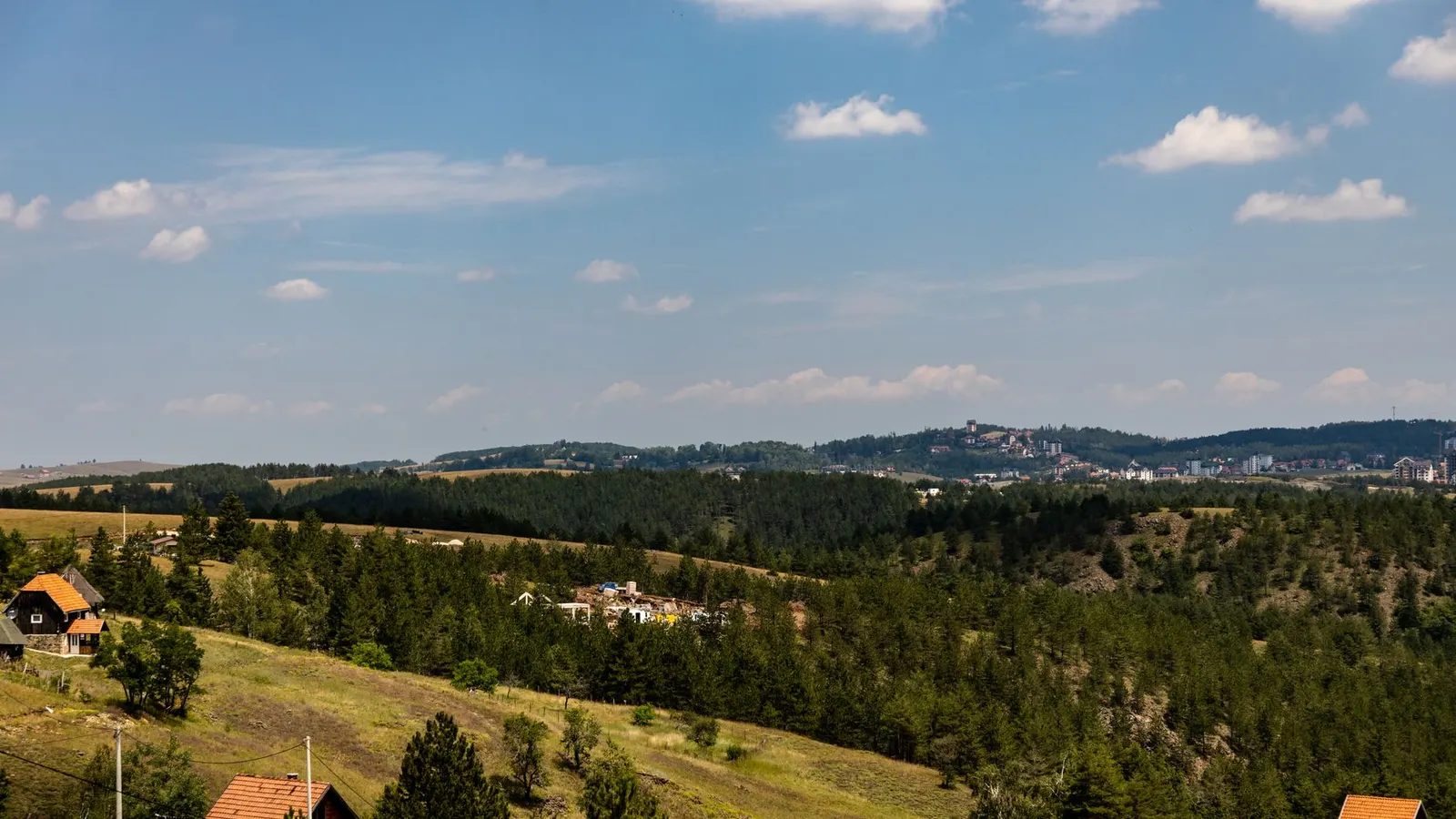
 Boris Hamer · Pexels License
Itinerary · Europe · 15 days · Moderate
The Danube and the Raška
Belgrade→Museum of Yugoslavia, Belgrade→Novi Sad→Sremski Karlovci→Subotica→Smederevo+9 stops
Serbia has no coast, so the Danube does the work. Two hundred-kilometre-an-hour trains north to the Hungarian border, then a hire car east down the river into the Iron Gates, past a Mesolithic village that was lifted up the bank ahead of a reservoir, then inland to Niš, the Raška monasteries and a narrow-gauge railway that climbs by tying itself in a knot.
Belgrade
Kalemegdan first, because the fortress explains the city: Roman foundations, Ottoman gates, Austrian bastions, all of it pointed at the confluence where the Sava runs into the Danube. Then downhill into Savamala, where the Belgrade Waterfront towers went up over a district that was partly cleared in one night in April 2016 by masked men with bulldozers - an episode the state ombudsman criticised the police for and which nobody has been convicted over.
Belgrade, the twentieth century
Walk down Kneza Miloša past the two burnt blocks of the old General Staff, hit in the NATO campaign of 1999 and standing ever since, then the RTS building on Takovska where sixteen employees were killed on 23 April 1999 and there is a small memorial. Afterwards the Museum of Yugoslavia at Dedinje, which holds Tito's grave and the relay batons, and is the least defensive museum in the country. Evening in Zemun, Austro-Hungarian until 1918 and still a separate town in its own mind.
Novi Sad
Thirty-six minutes on the Soko, which runs at 200 km/h and is the only line in the western Balkans that does. You arrive under the station whose concrete canopy collapsed on 1 November 2024 and killed sixteen people, less than four months after the rebuilt station reopened on 5 July; the protest movement that followed was the largest in Serbia since 2000 and it is still running. Cross the Danube afterwards to Petrovaradin, the Habsburg fortress with sixteen kilometres of galleries cut under it.
Sremski Karlovci and Fruška Gora
Twelve kilometres downriver to the small town where the Treaty of Karlowitz was signed in 1699, ending sixteen years of war and putting the Habsburg gains from it - most of Ottoman Hungary - down on paper. It ratified an advance that had already happened rather than starting one. The first Serbian grammar school opened here in 1791. Then up into Fruška Gora, a low wooded ridge with sixteen surviving Orthodox monasteries on it - Krušedol and Novo Hopovo are the two to pick if you only want two.
Subotica
Forty minutes further north and the architecture changes language. The city hall of 1908 and the synagogue of 1902 are both by Marcell Komor and Dezső Jakab, working in the Hungarian Secession idiom, and the synagogue reopened in 2018 after a restoration that took the better part of thirty years. Palić lake is eight kilometres out and has the rest of it - a water tower, a bandstand and a summer that lasts about six weeks.
South to Smederevo
Back down the line to Belgrade, collect a hire car, and drive fifty kilometres down the Danube. Smederevo fortress was raised between 1427 and 1430 by Despot Đurađ Branković as the last capital of medieval Serbia, and it fell to the Ottomans in 1459. On 5 June 1941 a German ammunition dump stacked inside the walls went up and took much of the town with it; the death toll has never been settled, with estimates running from several hundred to about 2,500.
Viminacium and Golubac
Viminacium was the capital of Moesia Superior and the base of the Seventh Legion, and only a fraction of it is dug - the rest lies under and beside the Kostolac lignite mine, which is why the site has a mammoth skeleton and a coal-fired power station in the same field of view. Ninety minutes on, Golubac fortress stands at the mouth of the gorge, where the Danube is as wide as it gets anywhere on its course - about six kilometres from bank to bank, immediately before it is squeezed into the Carpathians. It was restored with EU money and reopened in 2019; the main road used to run straight through the gate and now goes round in a tunnel.
Into the gorge
The Đerdap road runs along the water for a hundred kilometres with the Carpathians on both banks and Romania close enough to read the road signs; the Kazan narrows come tomorrow, further downstream. Today it is the Gospođin Vir stretch, and Lepenski Vir sits on a terrace above the river a little short of Donji Milanovac: a settlement of trapezoidal houses and sandstone heads with fish faces, excavated between 1965 and 1970 and then lifted about thirty metres up the slope before the reservoir filled. The shelter over it is modern and the point of the museum is the floor plans, not the objects.
Kladovo and the dam
The road tightens into the Kazan first, where the river is under 200 metres wide between vertical limestone and Romania is a stone's throw off the left bank. Đerdap I was built jointly by Yugoslavia and Romania between 1964 and 1972 and raised the river by around 35 metres, which drowned the Turkish-speaking island of Ada Kaleh and moved some 23,000 people off both banks. The Tabula Traiana, cut into the cliff in AD 100 to mark the completion of Trajan's road, was cut out and raised too - it stands in the Kazan and is only visible from a boat, and the trips run from Tekija and Donji Milanovac in season.
Felix Romuliana
South-west out of the river country. Galerius, emperor from 305 to 311, was born somewhere near here and built himself a fortified palace at what is now Gamzigrad, naming it after his mother Romula; UNESCO listed it in 2007 and it is usually almost empty. Break the drive at the Rajac and Rogljevo cellar hamlets near Negotin - streets of stone winemakers' cellars with nobody living in them.
Niš
A hundred kilometres over the hills to the third city, which has been the road junction of the Balkans since the Romans put Naissus on the route to Constantinople. Constantine the Great was born here around 272; his villa complex at Mediana is four kilometres out on the Sofia road, with the mosaics under cover. The Ottoman fortress in the centre is a park now and the whole city eats in Kazandžijsko sokače behind it.
Ćele Kula and Crveni Krst
After the Serbian defeat at Čegar in 1809, where the commander Stevan Sinđelić blew his own powder magazine rather than be taken, the Ottoman governor had a tower built and 952 skulls set into it in fourteen rows. Fifty-eight are left; a chapel was put over it in 1892. Then the Crveni Krst camp on the north edge of town, run by the Germans from 1941, where prisoners staged a mass escape in February 1942 - one of the few camps anywhere that they got out of by force.
West to Novi Pazar
A long day across the middle of the country to the main town of the Sandžak, which is majority Bosniak and looks and sounds different from everywhere else on this route. Sopoćani, sixteen kilometres out, was founded by King Stefan Uroš I in the 1260s and its Dormition fresco is the one Byzantine painting in Serbia that people travel for. Đurđevi Stupovi of 1171 stands on the hill above the town, and the ruins of Ras, the medieval capital, are in the valley between them.
Studenica, then the mountains
North to Studenica, founded by Stefan Nemanja around 1190 and still a working monastery with monks who will tell you when to come back if you arrive during a service. The Church of the Virgin is white marble and its Crucifixion is dated by inscription to 1209. Then west over the hills on small roads through Ivanjica and Arilje to Zlatibor, which is a plateau of pine and second homes and the place Serbs go when they want air.
The Šargan Eight
Forty kilometres to Mokra Gora, where a stretch of the old 760 mm narrow-gauge line to Sarajevo has been rebuilt as a heritage railway. It closed in 1974 and reopened from 1999 onwards, and it climbs about 300 metres in fifteen kilometres of track by crossing over itself in a figure of eight, through twenty-two tunnels. Drvengrad on the ridge above is the wooden village Emir Kusturica built as a film set in 2004 and then kept. Out afterwards through Užice and the A2.
Good to know
EU, UK, US, Canadian, Australian and most other Western passports enter visa-free for 90 days in any 180, and because Serbia is outside Schengen that time does not eat into a Schengen allowance - useful if this route is bolted onto EU travel. Foreigners are required by law to register with the police within 24 hours of arrival - the bela karta, or white card. Hotels do it automatically and hand you the slip; private apartments and short-let flats often do not, and it remains the guest's obligation rather than the host's. Enforcement is inconsistent and the usual place it surfaces is a border post on the way out, so keep whatever slips you are given. On hire cars, ask specifically about the green card insurance extension and about which borders the contract allows: most Serbian firms will not permit their vehicles into Kosovo at all. If your own itinerary involves Kosovo, note that Serbia does not treat that boundary as an international frontier, so travellers who enter Kosovo from Albania, North Macedonia or Montenegro and then try to cross directly into Serbia have been turned back for having no Serbian entry stamp; going in and out the same way avoids the problem entirely. The Đerdap gorge road is two lanes, unlit, tunnelled and short of fuel between Golubac and Kladovo - fill up at Veliko Gradište. The currency is the dinar and euros are not accepted in shops; exchange offices marked menjačnica give better rates than banks and are everywhere. Studenica and Sopoćani are working monasteries: covered shoulders and knees, no photography of frescoes without asking, and services take precedence over visitors. The Šargan Eight runs a full timetable from roughly April to the end of October and a thin one outside it, so check departures before building a day around it, and book ahead in July and August when it sells out.
Shorter or longer?
The Đerdap I dam carries a road and a border crossing. Cross to Drobeta-Turnu Severin and run the Romanian bank of the gorge back upstream - three or four extra days, and the far side of every view from days eight and nine.
Belgrade, Novi Sad, then straight down the Danube to Kladovo and back. Keeps the fortresses, the gorge and Lepenski Vir; cuts Niš, the Raška monasteries and the whole of the west.
Practical guide
Visa check for this route
Budget
Mid-range · per person · sharing a double room. Excludes international flights - they depend on where you fly from.
Editorial estimates · checked August 2026
Country guides
Trip essentials
The connectivity placement is our own eSIM store. No affiliate link on this list. How we choose these →