 Damir K . · Pexels License
Itinerary · Europe · 12 days · Moderate
The Inland Line to Lapland
Stockholm→Grinda→Uppsala→Falun→Rättvik→Östersund+6 stops
Stockholm to the Arctic by train, with the Inlandsbanan as the spine - a summer-only single track from Dalarna to Gällivare that survives because the municipalities along it bought it. Copper, iron, reindeer country, and two mining towns being demolished and rebuilt because the ore runs underneath them.
Stockholm
Arrive and give the day to Djurgården. The Vasa sank about 1,300 metres into her maiden voyage on 10 August 1628, was raised in 1961 and is still around 98 per cent original timber - she survived because the Baltic is too brackish for the shipworm that eats wrecks in salt water. Gamla Stan afterwards, once the day boats have gone.
Into the archipelago
Waxholmsbolaget out of Strömkajen. The archipelago runs to something like thirty thousand islands and skerries, of which only a few hundred are lived on all year. Grinda is a nature reserve with an inn, a jetty and no cars. It is also where allemansrätten stops being an abstraction: you may land, walk and pitch a tent for a night on almost any of it, provided you stay clear of houses and take everything out again.
Uppsala
Forty minutes north on the commuter train. Gamla Uppsala first - three royal mounds on a plain that was the cult centre of the Svear, and which Adam of Bremen described in the 1070s as the site of a temple and a sacrificial grove. Then the cathedral, at 118.7 metres the tallest church in the Nordic countries, and Carolina Rediviva, which holds the Codex Argenteus: a sixth-century Gothic gospel book written in silver on purple vellum, carried out of Prague as war booty in 1648.
Falun and the copper mountain
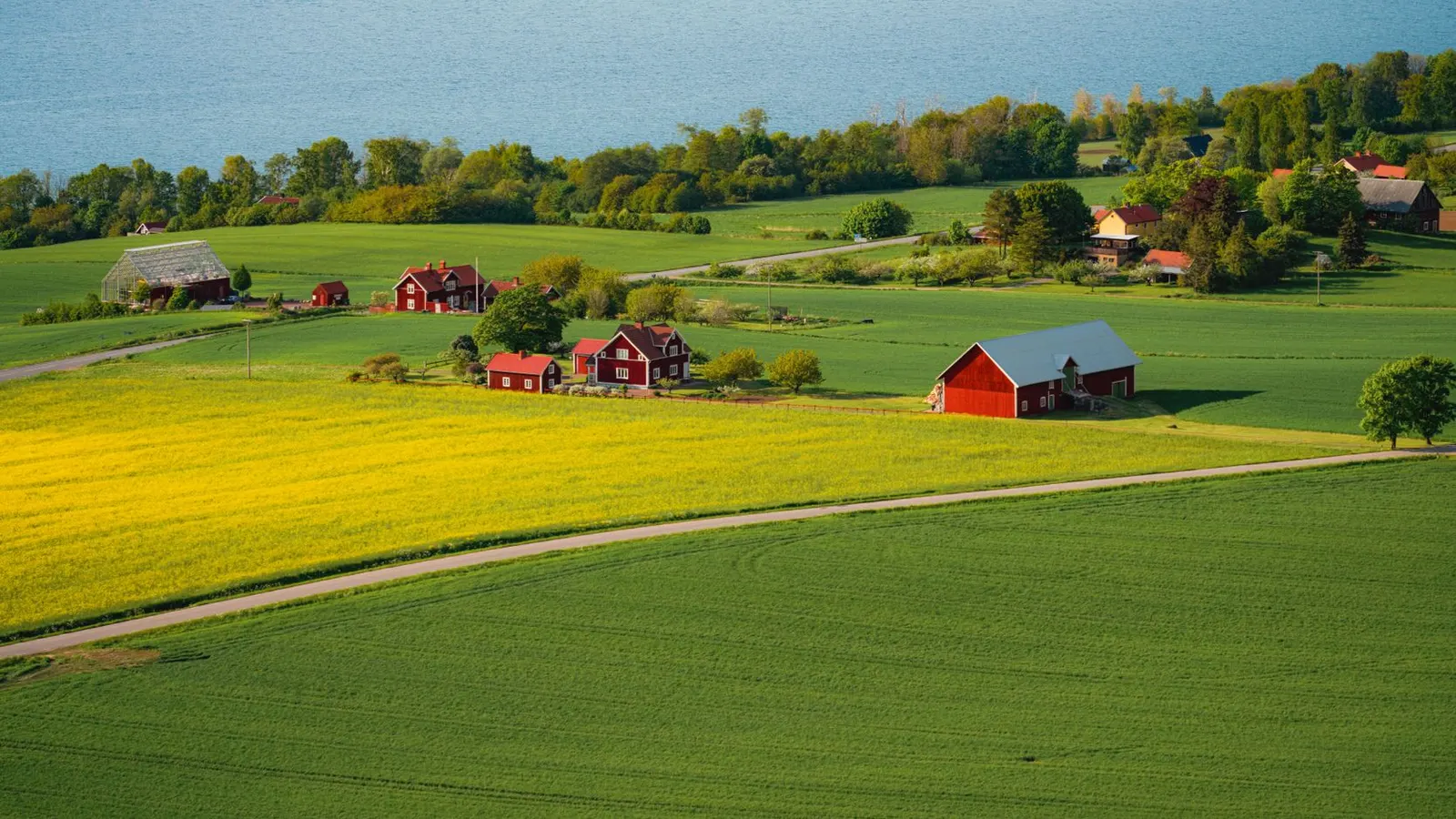
West into Dalarna. Stora Kopparberget worked copper for roughly a thousand years and in the seventeenth century supplied something in the order of two-thirds of what Europe used; the company that ran it holds a share deed from 1288, the usual claim for the oldest surviving corporation anywhere. On Midsummer Day 1687 the middle of the mine collapsed into a pit about ninety-five metres deep, and nobody died because it was a holiday. Mining stopped in 1992. The red on every Swedish cottage is a by-product of the same hole - falu rödfärg is made from the roasted tailings.
Lake Siljan
Siljan sits in a meteorite crater about 377 million years old and some fifty kilometres across - the largest impact structure in western Europe, and completely invisible from ground level. Rättvik's pier runs 628 metres out into the lake because the steamers could not get closer to the shore. Dalhalla, seven kilometres north, is a limestone quarry sixty metres deep that was turned into a concert amphitheatre in 1995 and has the acoustics to justify it.
Onto the Inlandsbanan
Ordinary train to Mora, then the inland line proper. It was built in stages between 1908 and 1937 to open the interior and to move troops without going near a coast an enemy could reach; it lost its scheduled passenger service in the 1990s and exists today because the municipalities along it bought the operation rather than watch the track lifted. The train stops for coffee, for a lake, and - this is not a marketing line - for moose.
Östersund and Frösön
Storsjön is Sweden's fifth-largest lake and its monster was a legally protected species from 1986 until the county board lifted the protection in 2005, which is an administrative fact rather than a joke. Cross the bridge to Frösön for the northernmost runestone in the world, cut around 1050, recording that a man called Östman had Jämtland christened. Jämtland was Norwegian until 1645 and parts of it have never entirely accepted the paperwork.
North to Arvidsjaur
The long day: ten hours on single track with passing loops, out of Jämtland and into Lappland. Almost every stand of trees you pass is production forest on a rotation of seventy to a hundred years, clear-felled and replanted, which is why so much of it is exactly the same age and the same height. Arvidsjaur at the end of it has Lappstaden, a Sámi church town of about eighty timber huts and cottages from the eighteenth and nineteenth centuries, still used for one weekend every August.
Across the Arctic Circle to Jokkmokk
The train halts at the circle so that everyone can get out and stand on a line painted across the ballast, which is silly and which nobody skips. Jokkmokk has held a winter market since 1605, when the crown ordered one so that it could tax and christen the Sámi in a single visit; it still runs from the first Thursday in February. Ájtte, the mountain and Sámi museum, is the clearest explanation of Sápmi anywhere in the country and worth the stop on its own.
End of the line at Gällivare
Two and a half hours to the northern terminus. On the hill above the town is Malmberget, which has spent the last fifteen years being emptied: LKAB's iron ore mine undermined it, a pit called Kaptensgropen opened in the middle of the community in the 1970s and cut it in two, and the residents have been bought out and moved down into Gällivare. Walk up and look at what is left of it - the subsidence zone itself is fenced and signed, so what you get is the edge - because Kiruna tomorrow is the same argument at several times the size.
Kiruna
An hour and a half up the Malmbanan, the ore railway that has run from Luleå through Kiruna to Narvik since 1902 because the Norwegian side of the mountains does not freeze and the Gulf of Bothnia does. LKAB runs tours down to a visitor level at 540 metres. Above ground the new centre is finished, most of the old one has gone, and the church - driven five kilometres east over two days in August 2025 - now stands near a town hall that opened in 2018. This is the subject of the feature that goes with this route.
Abisko
West into the Abisko valley. The park was one of nine created in 1909, the first national parks in Europe. Abisko lies in the rain shadow of the Norwegian mountains and is the driest place in Sweden, which is why the sky is clear here more often than anywhere further north and why the aurora station sits on Nuolja rather than somewhere colder. Lapporten, the U-shaped glacial valley across the lake, is the shape everything in Lapland gets photographed against. The Kungsleden starts at the station, and so does the night train home - about eighteen hours to Stockholm.
Good to know
The Inlandsbanan runs roughly from late June to mid or late August and not one day outside it. Exact dates are published each spring, and the northern half from Östersund to Gällivare runs on fewer days of the week than the southern half, so build the itinerary around that timetable rather than the other way round. The Inlandsbanan Card gives unlimited travel on the line for a fixed number of days and pays for itself on any version of this route; ordinary SJ tickets are not valid on it and SJ's app will not sell it to you. SJ's night train from Stockholm to Kiruna, Abisko and Narvik runs all year and is the fallback if the season does not fit - berths and couchettes sell out months ahead for summer and for the February market. Inland Norrland in July has mosquitoes in numbers that are difficult to overstate: carry repellent and a head net, and do not plan on eating outdoors in the evening anywhere between Östersund and Jokkmokk. Anything above 3.5 per cent alcohol comes only from Systembolaget, which shuts at three on Saturday afternoons and does not open on Sundays. Sweden is close to cashless - buses, museums and small cafés routinely take cards only, and some refuse notes outright.
Shorter or longer?
From Abisko the trail runs about 105 km south to Nikkaluokta past Kebnekaise - five or six days, with STF mountain huts at roughly one day's walk apart. They can be booked ahead now and the popular ones should be, but they still turn nobody away; what a late arrival is guaranteed is floor space, not a bunk. Add a week and finish on foot instead of on a train.
Night train from Stockholm straight to Gällivare, then Malmberget, Kiruna and Abisko. It loses the Inlandsbanan and the whole middle of the country, but it works in any month and it is the version to take in winter.
Practical guide
Visa check for this route
Budget
Mid-range · per person · sharing a double room. Excludes international flights - they depend on where you fly from.
Editorial estimates · checked August 2026
Country guides
Trip essentials
The connectivity placement is our own eSIM store. No affiliate link on this list. How we choose these →